The official data lists 133 versions of the Mercedes-Benz GLA (2013 - 2026), in the European Union, the United Kingdom, France, the United States, and Canada. Each market publishes its own figures, measured on its own test procedure.
At a glance
Years in the data
2013 - 2026
Markets
European Union, United Kingdom, France, United States, Canada
The GLA is a compact SUV in Mercedes-Benz’s compact-car family. Its taller body brings an elevated seating position and SUV-style practicality to a relatively compact footprint, making it suited to everyday urban and family use.
EU registration figures span 2013-2025 and include 1,167,847 GLA registrations. UK figures span 2014-2026; US and Canadian figures span 2015-2026.
Generations and design
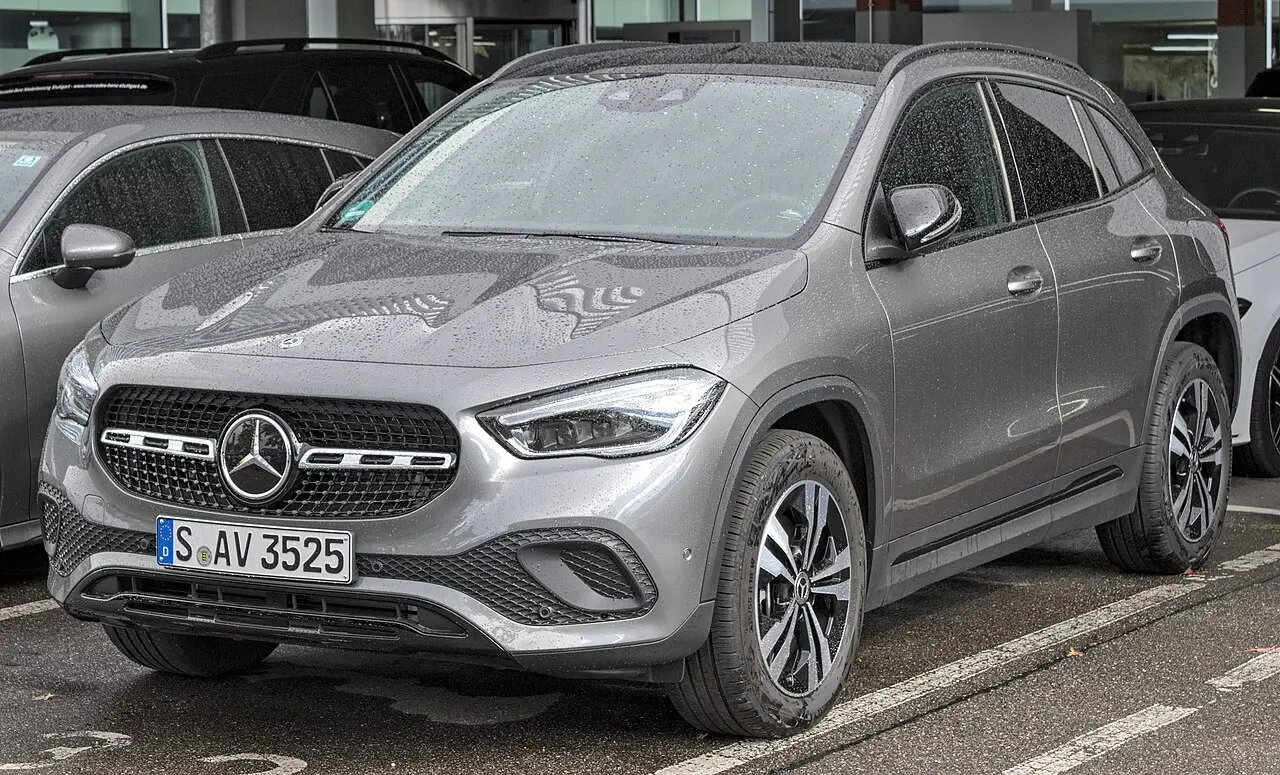
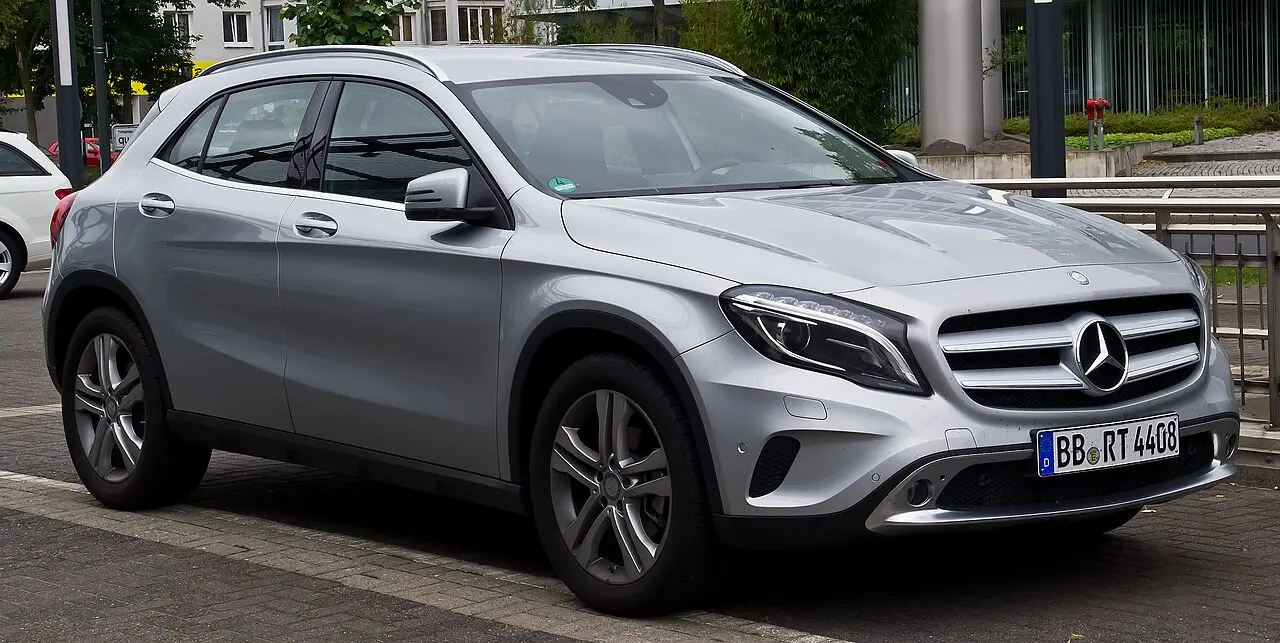
The first generation, X156, ran from 2013 to 2019. The second generation, H247, began in 2020. The GLA remains part of Mercedes-Benz’s compact-car family, with a taller shape and a more upright driving position than a conventional compact car.
Engines, power and official consumption
In EU figures, engine sizes range from 1.3 to 2.1 litres and power from 80 kW (109 PS) to 310 kW (421 PS). UK versions reach 310 kW (421 PS). Petrol and diesel models are joined by hybrids and plug-in hybrids in some markets; US figures also include flex-fuel E85 versions.
The lowest listed EU consumption for petrol, diesel and hybrid versions is 5.1 L/100 km on WLTP. The plug-in hybrid weighted WLTP figure starts at 1.1 L/100 km and assumes some driving is electric. UK results start at 4.2 L/100 km on NEDC, and France’s at 3.9 L/100 km on NEDC. In the USA, the lowest listed consumption is 8.1 L/100 km on EPA, with a best combined rating of 29 MPG. Canada’s lowest listed figure is 8.2 L/100 km on the NRCan 5-cycle test. The results use different procedures: WLTP and NEDC in Europe, EPA in the USA and the 5-cycle test in Canada.
Where was the GLA sold?
The GLA appears in figures for the EU, UK, France, the USA and Canada, with available fuel types varying by market. EU and UK figures include plug-in hybrids, while US and Canadian figures include flex-fuel E85 versions. EU registration leaders include a 1.6-litre petrol version rated at 90 kW (122 PS), alongside 2.1-litre diesels rated at 100 kW (136 PS).
Questions and answers
What generations of Mercedes-Benz GLA are there?
The first generation is the X156 (2013-2019); the second is the H247 (2020-today).
What is the GLA’s lowest listed EU consumption?
For petrol, diesel and hybrid versions, it is 5.1 L/100 km on WLTP. The plug-in hybrid weighted figure starts at 1.1 L/100 km and assumes some electric driving.
What is the GLA’s best combined US fuel-economy rating?
The best combined EPA rating listed is 29 MPG.
Which markets have GLA figures?
The GLA appears in EU, UK, France, US and Canadian figures, with available powertrains differing by market.
At a glance: Length 4,430 - 4,470 mm · Kerb weight 1,295 - 1,485 kg · Top speed 200 - 235 km/h · MOT first-time pass at 6 - 8 years: 88.9% (UK average 86.4%) Specifications, reliability and all versions
At a glance: Length 4,440 mm · Kerb weight 1,380 - 1,710 kg · Top speed 200 - 220 km/h · MOT first-time pass at 3 years: 94.4% (UK average 92.2%) Specifications, reliability and all versions
Show all 71 versions
European Union 47 versions
New cars registered in the EU (plus Norway and Iceland), from the European Environment Agency. Figures on the NEDC procedure until 2020 and on WLTP from 2021; versions are grouped by engine and power, with their number of registrations.
Years and version
Engine
Power
Fuel
Consumption (combined)
CO₂
Electric range
EU registrations
2022 - 2025
2.0 L
110 kW (150 PS)
Diesel
5.4 - 5.5 L/100 km WLTP
143 - 145 g/km
-
67,356
2023 - 2025
1.3 L
120 kW (163 PS) (engine only)
Plug-in hybrid
1.1 - 1.4 L/100 km WLTP18.7 - 19.9 kWh/100 km WLTP
26 - 33 g/km
68 - 72 km
35,756
2021 - 2025
1.3 L
120 kW (163 PS)
Petrol
6.6 - 6.9 L/100 km WLTP
150 - 156 g/km
-
30,605
2023 - 2025
1.3 L
120 kW (163 PS)
Hybrid
6.7 - 6.8 L/100 km WLTP
152 - 154 g/km
-
24,267
2022 - 2025
1.3 L
118 kW (160 PS) (engine only)
Plug-in hybrid
1.4 L/100 km WLTP18.6 - 19.9 kWh/100 km WLTP
31 - 32 g/km
61 - 62 km
23,665
2021 - 2025
2.0 L
85 kW (116 PS)
Diesel
5.1 - 5.4 L/100 km WLTP
141 - 142 g/km
-
20,480
2023 - 2025
1.3 L
100 kW (136 PS)
Hybrid
6.7 - 6.8 L/100 km WLTP
151 - 153 g/km
-
15,159
2021 - 2025
2.0 L
140 kW (190 PS)
Diesel
5.7 - 5.9 L/100 km WLTP
149 - 154 g/km
-
13,706
2023 - 2025
2.0 L
140 kW (190 PS)
Hybrid
7.5 - 7.6 L/100 km WLTP
170 - 173 g/km
-
3,875
2023 - 2025
2.0 L
165 kW (224 PS)
Hybrid
7.5 - 7.7 L/100 km WLTP
172 - 174 g/km
-
2,355
2023 - 2025
2.0 L
225 kW (306 PS)
Hybrid
9.0 L/100 km WLTP
204 - 205 g/km
-
1,767
2021 - 2025
2.0 L
310 kW (421 PS)
Petrol
9.6 - 9.9 L/100 km WLTP
221 - 224 g/km
-
1,582
2025
2.0 L
140 kW (190 PS)
Hybrid
7.5 L/100 km WLTP
171 g/km
-
144
2025
1.3 L
100 kW (136 PS)
Hybrid
6.7 L/100 km WLTP
151 g/km
-
19
2025
Electric motor
180 kW (245 PS)
Electric
-
0 g/km
-
14
2025
Electric motor
210 kW (286 PS)
Electric
16.5 kWh/100 km WLTP
0 g/km
-
11
2021 - 2024
1.3 L
100 kW (136 PS)
Petrol
6.6 - 6.8 L/100 km WLTP
152 - 154 g/km
-
11,177
2021 - 2024
2.0 L
225 kW (306 PS)
Petrol
8.4 - 8.9 L/100 km WLTP
196 - 202 g/km
-
2,533
2021 - 2023
2.0 L
165 kW (224 PS)
Petrol
7.8 - 7.9 L/100 km WLTP
177 - 179 g/km
-
8,733
2021 - 2023
2.0 L
285 kW (387 PS)
Petrol
9.6 L/100 km WLTP
218 - 219 g/km
-
194
2021 - 2022
1.3 L
118 kW (160 PS)
Petrol
20.9 - 22.4 kWh/100 km WLTP
150 - 164 g/km
-
75
2021 - 2022
1.3 L
120 kW (163 PS)
Hybrid
-
41 g/km
-
44
2021
2.0 L
110 kW (150 PS)
Diesel
5.3 L/100 km WLTP0.5 kWh/100 km WLTP
143 g/km
-
26,066
2021
1.3 L
118 kW (160 PS) (engine only)
Plug-in hybrid
1.4 L/100 km WLTP21.6 kWh/100 km NEDC
38 g/km
62 km
21,812
2021
1.3 L
118 kW (160 PS)
Hybrid
1.4 L/100 km WLTP22.1 kWh/100 km WLTP
33 g/km
61 km
829
2021
1.6 L
90 kW (122 PS)
Petrol
6.5 L/100 km WLTP
169 g/km
-
80
2021
1.6 L
115 kW (156 PS)
Petrol
6.7 L/100 km WLTP
171 g/km
-
24
2021
2.0 L
135 kW (184 PS)
Petrol
7.9 L/100 km WLTP
188 g/km
-
12
2020
1.3 L
120 kW (163 PS)
Petrol
-
131 g/km
-
28,326
2020
2.0 L
110 kW (150 PS)
Diesel
-
124 g/km
-
26,946
2020
1.6 L
90 kW (122 PS)
Petrol
-
146 g/km
-
15,116
2020
1.3 L
118 kW (160 PS) (engine only)
Plug-in hybrid
22.1 kWh/100 km NEDC
39 g/km
64 km
11,930
2020
1.6 L
115 kW (156 PS)
Petrol
-
148 g/km
-
6,137
2020
2.0 L
140 kW (190 PS)
Diesel
-
133 g/km
-
5,905
2020
2.0 L
165 kW (224 PS)
Petrol
-
157 g/km
-
5,445
2020
2.0 L
85 kW (116 PS)
Diesel
-
121 g/km
-
2,134
2020
1.3 L
118 kW (160 PS)
Petrol
-
115 g/km
-
756
2020
1.3 L
100 kW (136 PS)
Petrol
-
133 g/km
-
717
2020
2.0 L
135 kW (184 PS)
Petrol
-
168 g/km
-
642
2020
2.0 L
225 kW (306 PS)
Petrol
-
174 g/km
-
604
2020
2.0 L
155 kW (211 PS)
Petrol
-
165 g/km
-
397
2020
2.0 L
310 kW (421 PS)
Petrol
-
213 g/km
-
369
2020
2.1 L
125 kW (170 PS)
Diesel
-
148 g/km
-
264
2020
1.3 L
Not listed
Plug-in hybrid
15.5 kWh/100 km NEDC
38 g/km
60 km
100
2020
2.0 L
285 kW (387 PS)
Petrol
-
222 g/km
-
38
2020
2.0 L
280 kW (381 PS)
Petrol
-
193 g/km
-
30
2020
2.0 L
85 kW (116 PS)
Diesel
-
148 g/km
-
12
United Kingdom 14 versions
New cars on sale in the UK, from the Vehicle Certification Agency. NEDC figures until 2018 and WLTP figures after; years are the editions a version appeared in.
2024 - 2026Mercedes-AMG GLA 45 S 4MATIC+ · AMG GLA 45 S 4MATIC+
2.0 L
310 kW (421 PS)
Petrol
8-speed automatic
9.5 - 10.0 L/100 km WLTP
215 - 227 g/km
-
2021 - 2026AMG GLA 45 S 4MATIC+
2.0 L
310 kW (421 PS)
Petrol
8-speed automatic
9.0 - 10.2 L/100 km WLTP
214 - 231 g/km
-
2021 - 2023GLA 180
1.3 L
100 kW (136 PS)
Petrol
7-speed automatic
6.3 - 7.4 L/100 km WLTP
148 - 167 g/km
-
2020 - 2023GLA 200
1.3 L
120 kW (163 PS)
Petrol
7-speed automatic
6.3 - 7.4 L/100 km WLTP
148 - 168 g/km
-
2021 - 2023AMG GLA 35 4MATIC
2.0 L
225 kW (306 PS)
Petrol
8-speed automatic
8.2 - 9.2 L/100 km WLTP
189 - 207 g/km
-
2021GLA 250 e
1.3 L
Not listed
Plug-in hybrid
8-speed automatic
17.0 - 19.0 kWh/100 km WLTP
-
53 - 61 km
2021GLA 200 d 4MATIC
2.0 L
110 kW (150 PS)
Diesel
8-speed automatic
5.5 - 6.2 L/100 km WLTP
144 - 160 g/km
-
2021GLA 250
2.0 L
165 kW (224 PS)
Petrol
8-speed automatic
7.2 - 8.1 L/100 km WLTP
167 - 184 g/km
-
United States 7 versions
Model years sold in the USA, from the EPA and the Department of Energy (fueleconomy.gov). MPG on the EPA test; litres per 100 km = 235.215 ÷ MPG.
Years and version
Engine
Fuel
Gearbox
Drive
Consumption (combined)
CO₂
2024 - 2026SIDI; Mild Hybrid
2.0 L
Hybrid
8-speed automated manual
Front-wheel drive
28 - 29 MPG (8.1 - 8.4 L/100 km) EPA
190 - 194 g/km
2024 - 2026SIDI; Mild Hybrid
2.0 L
Hybrid
8-speed automated manual
All-wheel drive
24 - 28 MPG (8.4 - 9.8 L/100 km) EPA
196 - 230 g/km
2021 - 2023SIDI
2.0 L
Petrol
8-speed automated manual
Front-wheel drive
28 MPG (8.4 L/100 km) EPA
195 - 199 g/km
2022 - 2023SIDI
2.0 L
Petrol
8-speed automated manual
All-wheel drive
22 - 26 MPG (9.0 - 10.7 L/100 km) EPA
209 - 254 g/km
2021SIDI
2.0 L
Petrol
8-speed automated manual
Four-wheel drive
23 - 27 MPG (8.7 - 10.2 L/100 km) EPA
203 - 244 g/km
2020SIDI
2.0 L
Petrol
7-speed automated manual
Front-wheel drive
28 MPG (8.4 L/100 km) EPA
196 g/km
2020SIDI
2.0 L
Petrol
7-speed automated manual
Four-wheel drive
25 MPG (9.4 L/100 km) EPA
217 g/km
Canada 3 versions
Model years sold in Canada, from Natural Resources Canada fuel consumption ratings (5-cycle test).
Years and version
Engine
Fuel
Gearbox
Consumption (combined)
CO₂
2021 - 2026Sport utility vehicle: Small
2.0 L
Petrol
8-speed automated manual
8.4 - 10.4 L/100 km 5-cycle
196 - 243 g/km
2022 - 2026Station wagon: Small
2.0 L
Petrol
8-speed automated manual
8.2 - 11.1 L/100 km 5-cycle
190 - 260 g/km
2020Sport utility vehicle: Small
2.0 L
Petrol
7-speed automated manual
9.0 L/100 km 5-cycle
211 g/km
Mercedes-Benz GLA recalls
72 official safety recalls for the Mercedes-Benz GLA from NHTSA (United States), DVSA (United Kingdom) and the EU Safety Gate, newest first. Recall repairs are normally free at the maker’s dealers.
Door lock may fail to engage automatic parking brake2021 - 2025
Door may not open from inside2026
Front short-range sensor circuit board may be out of specification2025
Official figures are measured on standard test procedures and differ between markets. Your consumption depends on how, where and in what conditions you drive.