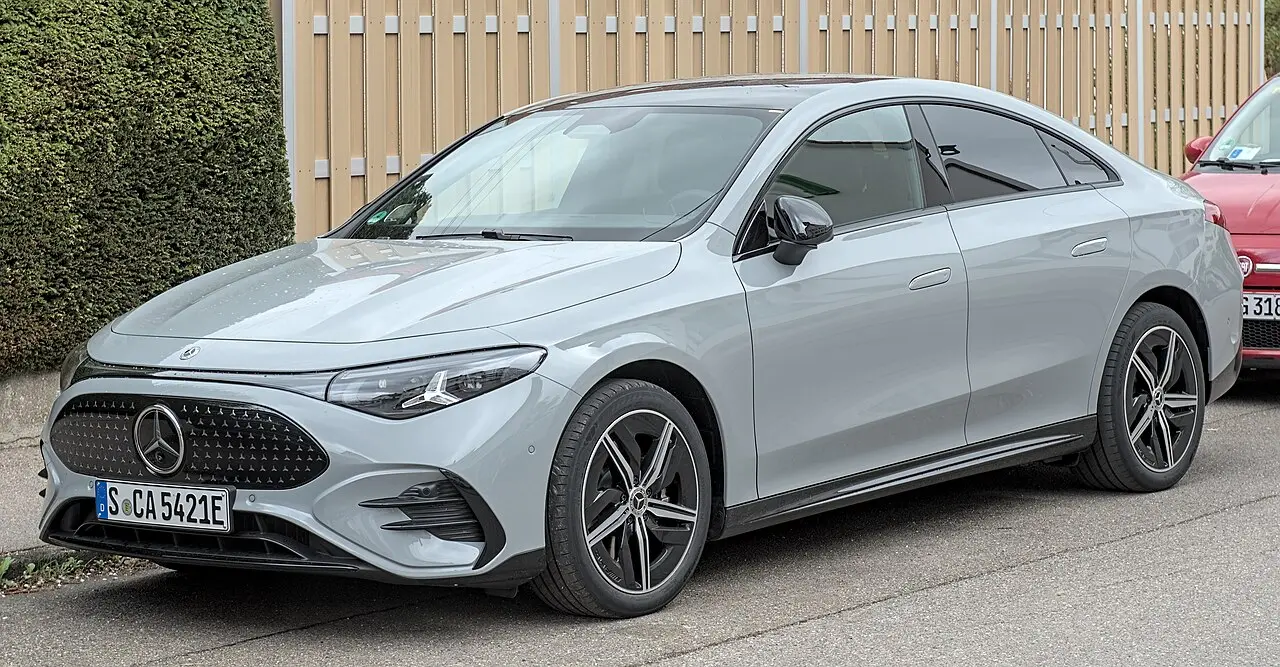
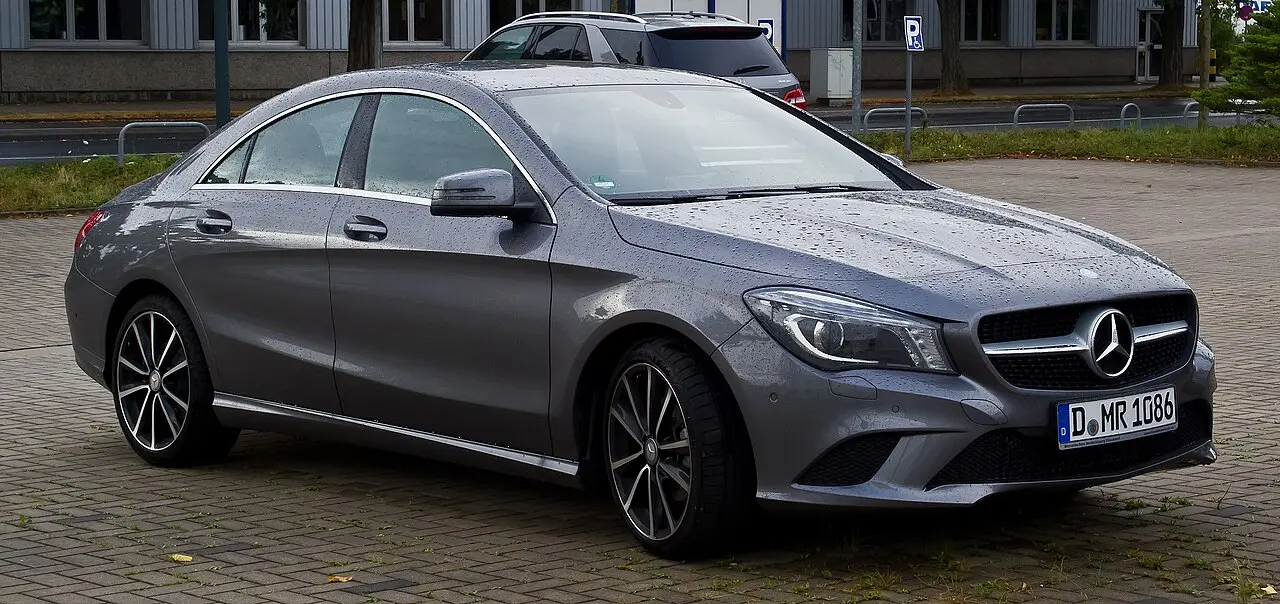
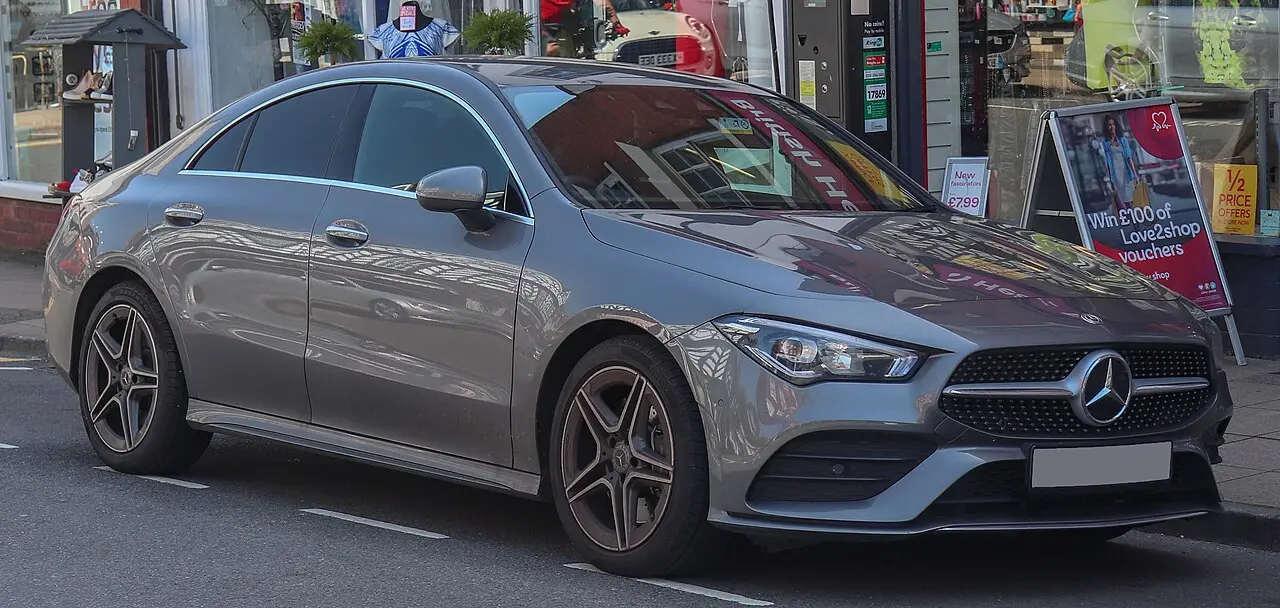
The official data lists 696 versions of the Mercedes-Benz CLA (2013–2027), in the European Union, the United Kingdom, France, the United States, and Canada. Each market publishes its own figures, measured on its own test procedure.
At a glance
Years in the data
2013–2027
Markets
European Union, United Kingdom, France, United States, Canada
The CLA is a compact car with the low roofline and sweeping profile of a four-door coupé. Mercedes-Benz introduced it as a more style-led member of its compact range. A Shooting Brake estate version has also been part of the CLA line-up.
The CLA arrived in 2013 and became Mercedes-Benz’s first compact car in the US market. Its sleek shape gave buyers a different take on the brand’s compact cars.
CLA generations
The first generation, C117/X117, ran from 2013 to 2019. It established the four-door coupé shape and added the Shooting Brake body style.
The second generation, C118/X118, followed from 2019 to 2025. It kept both body styles and brought a more digital cabin with Mercedes-Benz’s MBUX system. The C174/C178 generation began in 2025.
Engines, power and fuel consumption
The CLA has been offered with petrol, diesel, hybrid and plug-in hybrid power, as well as electric versions. In EU figures from 2013 to 2025, engines range from 1.3 to 2.1 litres and power from 80 kW (109 PS) to 310 kW (421 PS). UK versions reach 421 kW (572 PS).
The lowest EU figure for petrol, diesel and hybrid versions is 1.2 L/100 km on WLTP. The EU plug-in hybrid low is 0.9 L/100 km, a weighted figure that assumes some driving is electric. In the US, the EPA low is 7.1 L/100 km, or 33 MPG combined. Canada’s low is 7.8 L/100 km on the 5-cycle test. These figures reflect different procedures: Europe uses WLTP or NEDC, the US uses EPA, and Canada uses the 5-cycle test.
Where was the CLA sold?
The CLA appears in EU registration figures from 2013 to 2025, UK figures from 2013 to 2026, US figures from 2014 to 2027, and Canadian figures from 2014 to 2026. French figures cover 2013 to 2015. EU registrations total 1,110,425. Among the leading EU versions were 2.1-litre diesels rated at 100 kW (136 PS).
Questions and answers
What kind of car is the Mercedes-Benz CLA?
It is a compact four-door coupé, also offered as a Shooting Brake estate.
What are the CLA generation years?
The C117/X117 ran from 2013 to 2019, the C118/X118 from 2019 to 2025, and the C174/C178 began in 2025.
What is the lowest official CLA fuel-consumption figure?
The EU WLTP low is 1.2 L/100 km for petrol, diesel and hybrid versions; the plug-in hybrid weighted figure is 0.9 L/100 km.
Where was the CLA sold?
Its official figures cover the EU, UK, France, US and Canada, with market years varying by region.
New cars registered in the EU (plus Norway and Iceland), from the European Environment Agency. Figures on the NEDC procedure until 2020 and on WLTP from 2021; versions are grouped by engine and power, with their number of registrations.
Years and version
Engine
Power
Fuel
Consumption (combined)
CO₂
Electric range
EU registrations
2025
Electric motor
200 kW (272 PS)
Electric
13.0 kWh/100 km WLTP
0 g/km
753 km
11,642
2025
1.3 L
120 kW (163 PS)
Hybrid
6.1 L/100 km WLTP
139 g/km
–
7,486
2025
1.3 L
120 kW (163 PS)
Plug-in hybrid
1.1 L/100 km WLTP17.8 kWh/100 km WLTP
26 g/km
80 km
6,355
2025
2.0 L
110 kW (150 PS)
Diesel
5.2 L/100 km WLTP
136 g/km
–
3,910
2025
Electric motor
260 kW (354 PS)
Electric
13.7 kWh/100 km WLTP
0 g/km
720 km
2,443
2025
2.0 L
140 kW (190 PS)
Diesel
5.2 L/100 km WLTP
137 g/km
–
1,854
2025
2.0 L
85 kW (116 PS)
Diesel
5.2 L/100 km WLTP
136 g/km
–
1,578
2025
2.0 L
225 kW (306 PS)
Hybrid
8.4 L/100 km WLTP
192 g/km
–
1,026
2025
2.0 L
310 kW (421 PS)
Petrol
9.1 L/100 km WLTP
207 g/km
–
886
2025
Electric motor
145 kW (197 PS)
Electric
13.0 kWh/100 km WLTP
0 g/km
751 km
749
2025
1.3 L
120 kW (163 PS)
Petrol
6.1 L/100 km WLTP
139 g/km
–
592
2025
2.0 L
165 kW (224 PS)
Hybrid
7.1 L/100 km WLTP
161 g/km
–
422
2025
2.0 L
140 kW (190 PS)
Hybrid
7.0 L/100 km WLTP
159 g/km
–
258
2025
Electric motor
100 kW (136 PS)
Electric
–
0 g/km
–
116
2025
1.5 L
140 kW (190 PS)
Hybrid
–
140 g/km
–
106
2025
Electric motor
80 kW (109 PS)
Electric
–
0 g/km
–
93
2025
2.0 L
140 kW (190 PS)
Plug-in hybrid
6.8 L/100 km WLTP
154 g/km
–
59
2025
Electric motor
180 kW (245 PS)
Electric
–
0 g/km
595 km
54
2025
1.5 L
120 kW (163 PS)
Hybrid
–
138 g/km
–
52
2025
Electric motor
125 kW (170 PS)
Electric
–
0 g/km
625 km
50
2025
1.5 L
100 kW (136 PS)
Hybrid
–
134 g/km
–
35
2025
1.5 L
140 kW (190 PS)
Hybrid
5.4 L/100 km WLTP
136 g/km
–
34
2025
1.3 L
100 kW (136 PS)
Plug-in hybrid
6.0 L/100 km WLTP
135 g/km
–
31
2025
Electric motor
210 kW (286 PS)
Electric
14.8 kWh/100 km WLTP
0 g/km
–
30
2025
1.5 L
120 kW (163 PS)
Hybrid
5.3 L/100 km WLTP
131 g/km
–
29
2025
1.3 L
118 kW (160 PS)
Plug-in hybrid
1.1 L/100 km WLTP17.6 kWh/100 km WLTP
32 g/km
67 km
18
2025
1.5 L
170 kW (231 PS)
Hybrid
–
146 g/km
–
16
2025
2.0 L
225 kW (306 PS)
Petrol
8.4 L/100 km WLTP
191 g/km
–
16
United Kingdom 40 versions
New cars on sale in the UK, from the Vehicle Certification Agency. NEDC figures until 2018 and WLTP figures after; years are the editions a version appeared in.
Years and version
Engine
Power
Fuel
Gearbox
Consumption (combined)
CO₂
Electric range
2026CLA 200
Electric motor
165 kW (224 PS)
Electric
–
14.6 kWh/100 km WLTP
0 g/km
462 km
2026CLA 200
Electric motor
165 kW (224 PS)
Electric
–
15.1 kWh/100 km WLTP
0 g/km
447 km
2025–2026CLA 250+
Electric motor
200 kW (272 PS)
Electric
–
12.2 kWh/100 km WLTP
0 g/km
791 km
2025–2026CLA 250+
Electric motor
200 kW (272 PS)
Electric
–
14.1 kWh/100 km WLTP
0 g/km
694 km
2026CLA 250+
Electric motor
200 kW (272 PS)
Electric
–
14.5 kWh/100 km WLTP
0 g/km
678 km
2026CLA 250+
Electric motor
200 kW (272 PS)
Electric
–
14.9 kWh/100 km WLTP
0 g/km
657 km
2025–2026CLA 350 4MATIC
Electric motor
260 kW (354 PS)
Electric
–
12.2 kWh/100 km WLTP
0 g/km
791 km
2025–2026CLA 350 4MATIC
Electric motor
260 kW (354 PS)
Electric
–
14.1 kWh/100 km WLTP
0 g/km
694 km
2026CLA 350 4MATIC
Electric motor
260 kW (354 PS)
Electric
–
15.6 kWh/100 km WLTP
0 g/km
631 km
2026CLA 350 4MATIC
Electric motor
272 kW (370 PS)
Electric
–
15.2 kWh/100 km WLTP
0 g/km
650 km
2025–2026CLA 180
1.3 L
100 kW (136 PS)
Hybrid
7-speed automatic
5.8 L/100 km WLTP
131 g/km
–
2025–2026CLA 180
1.3 L
100 kW (136 PS)
Hybrid
7-speed automatic
6.3 L/100 km WLTP
144 g/km
–
2025–2026CLA 180
1.3 L
100 kW (136 PS)
Hybrid
7-speed automatic
5.9 L/100 km WLTP
134 g/km
–
2025–2026CLA 180
1.3 L
100 kW (136 PS)
Hybrid
7-speed automatic
6.5 L/100 km WLTP
147 g/km
–
2025–2026CLA 200
1.3 L
120 kW (163 PS)
Hybrid
7-speed automatic
5.8 L/100 km WLTP
131 g/km
–
2025–2026CLA 200
1.3 L
120 kW (163 PS)
Hybrid
7-speed automatic
6.3 L/100 km WLTP
144 g/km
–
2025–2026CLA 200
1.3 L
120 kW (163 PS)
Hybrid
7-speed automatic
5.9 L/100 km WLTP
134 g/km
–
2025–2026CLA 200
1.3 L
120 kW (163 PS)
Hybrid
7-speed automatic
6.5 L/100 km WLTP
147 g/km
–
2025–2026CLA 250 e
1.3 L
160 kW (218 PS)
Plug-in hybrid
8-speed automatic
17.7 kWh/100 km WLTP
–
84 km
2025–2026CLA 250 e
1.3 L
160 kW (218 PS)
Plug-in hybrid
8-speed automatic
19.4 kWh/100 km WLTP
–
74 km
2025–2026CLA 250 e
1.3 L
160 kW (218 PS)
Plug-in hybrid
8-speed automatic
12.5 kWh/100 km WLTP
–
82 km
2025–2026CLA 250 e
1.3 L
160 kW (218 PS)
Plug-in hybrid
8-speed automatic
13.2 kWh/100 km WLTP
–
71 km
2026CLA 180
1.5 L
100 kW (136 PS)
Hybrid
8-speed automatic
5.4 L/100 km WLTP
123 g/km
–
2026CLA 180
1.5 L
100 kW (136 PS)
Hybrid
8-speed automatic
5.5 L/100 km WLTP
125 g/km
–
2026CLA 200
1.5 L
120 kW (163 PS)
Hybrid
8-speed automatic
5.4 L/100 km WLTP
123 g/km
–
2026CLA 200
1.5 L
120 kW (163 PS)
Hybrid
8-speed automatic
5.5 L/100 km WLTP
125 g/km
–
2026CLA 220 4MATIC
1.5 L
140 kW (190 PS)
Hybrid
8-speed automatic
5.8 L/100 km WLTP
132 g/km
–
2026CLA 220 4MATIC
1.5 L
140 kW (190 PS)
Hybrid
8-speed automatic
5.9 L/100 km WLTP
135 g/km
–
2025–2026CLA 220 d
2.0 L
140 kW (190 PS)
Diesel
8-speed automatic
5.0 L/100 km WLTP
130 g/km
–
2025–2026CLA 220 d
2.0 L
140 kW (190 PS)
Diesel
8-speed automatic
5.1 L/100 km WLTP
133 g/km
–
2025–2026CLA 220 d
2.0 L
140 kW (190 PS)
Diesel
8-speed automatic
5.6 L/100 km WLTP
147 g/km
–
2025–2026CLA 220 d
2.0 L
140 kW (190 PS)
Diesel
8-speed automatic
5.5 L/100 km WLTP
143 g/km
–
2025–2026AMG CLA 35 4MATIC
2.0 L
225 kW (306 PS)
Hybrid
8-speed automatic
8.1 L/100 km WLTP
185 g/km
–
2025–2026AMG CLA 35 4MATIC
2.0 L
225 kW (306 PS)
Hybrid
8-speed automatic
8.3 L/100 km WLTP
189 g/km
–
2025–2026AMG CLA 35 4MATIC
2.0 L
225 kW (306 PS)
Hybrid
8-speed automatic
8.5 L/100 km WLTP
193 g/km
–
2025–2026AMG CLA 35 4MATIC
2.0 L
225 kW (306 PS)
Hybrid
8-speed automatic
8.7 L/100 km WLTP
197 g/km
–
2025–2026AMG CLA 45 S 4MATIC+
2.0 L
310 kW (421 PS)
Petrol
8-speed automatic
9.2 L/100 km WLTP
209 g/km
–
2025–2026AMG CLA 45 S 4MATIC+
2.0 L
310 kW (421 PS)
Petrol
8-speed automatic
8.9 L/100 km WLTP
201 g/km
–
2025–2026AMG CLA 45 S 4MATIC+
2.0 L
310 kW (421 PS)
Petrol
8-speed automatic
9.0 L/100 km WLTP
205 g/km
–
2025–2026AMG CLA 45 S 4MATIC+
2.0 L
310 kW (421 PS)
Petrol
8-speed automatic
9.1 L/100 km WLTP
206 g/km
–
United States 8 versions
Model years sold in the USA, from the EPA and the Department of Energy (fueleconomy.gov). MPG on the EPA test; litres per 100 km = 235.215 ÷ MPG.
Years and version
Engine
Fuel
Gearbox
Drive
Consumption (combined)
CO₂
Electric range
2026–2027
Electric motor
Electric
Automatic
Rear-wheel drive
109 MPGe EPA
0 g/km
510 km
2026–2027
Electric motor
Electric
Automatic
Rear-wheel drive
126 MPGe EPA
0 g/km
602 km
2026–2027
Electric motor
Electric
2-speed automatic
All-wheel drive
118 MPGe EPA
0 g/km
502 km
2027SIDI; Mild Hybrid
1.5 L
Hybrid
8-speed automated manual
Front-wheel drive
33 MPG (7.1 L/100 km) EPA
170 g/km
–
2025–2026SIDI; Mild Hybrid
2.0 L
Hybrid
8-speed automated manual
All-wheel drive
29 MPG (8.1 L/100 km) EPA
193 g/km
–
2025–2026SIDI; Mild Hybrid
2.0 L
Hybrid
8-speed automated manual
Front-wheel drive
30 MPG (7.8 L/100 km) EPA
185 g/km
–
2025–2026SIDI
2.0 L
Petrol
8-speed automated manual
All-wheel drive
23 MPG (10.2 L/100 km) EPA
235 g/km
–
2026SIDI; Mild Hybrid
2.0 L
Hybrid
8-speed automated manual
All-wheel drive
25 MPG (9.4 L/100 km) EPA
224 g/km
–
Canada 5 versions
Model years sold in Canada, from Natural Resources Canada fuel consumption ratings (5-cycle test).
Years and version
Engine
Power
Fuel
Gearbox
Consumption (combined)
CO₂
Electric range
2026Compact
Electric motor
260 kW (354 PS)
Electric
Automatic
17.7 kWh/100 km 5-cycle
0 g/km
502 km
2025–2026Compact
2.0 L
–
Petrol
8-speed automated manual
10.2 L/100 km 5-cycle
236 g/km
–
2025–2026Compact
2.0 L
–
Petrol
8-speed automated manual
8.2 L/100 km 5-cycle
193 g/km
–
2026Compact
2.0 L
–
Petrol
8-speed automated manual
9.6 L/100 km 5-cycle
224 g/km
–
2026Compact
2.0 L
–
Petrol
8-speed automated manual
7.9 L/100 km 5-cycle
185 g/km
–
Official figures are measured on standard test procedures and differ between markets. Your consumption depends on how, where and in what conditions you drive.