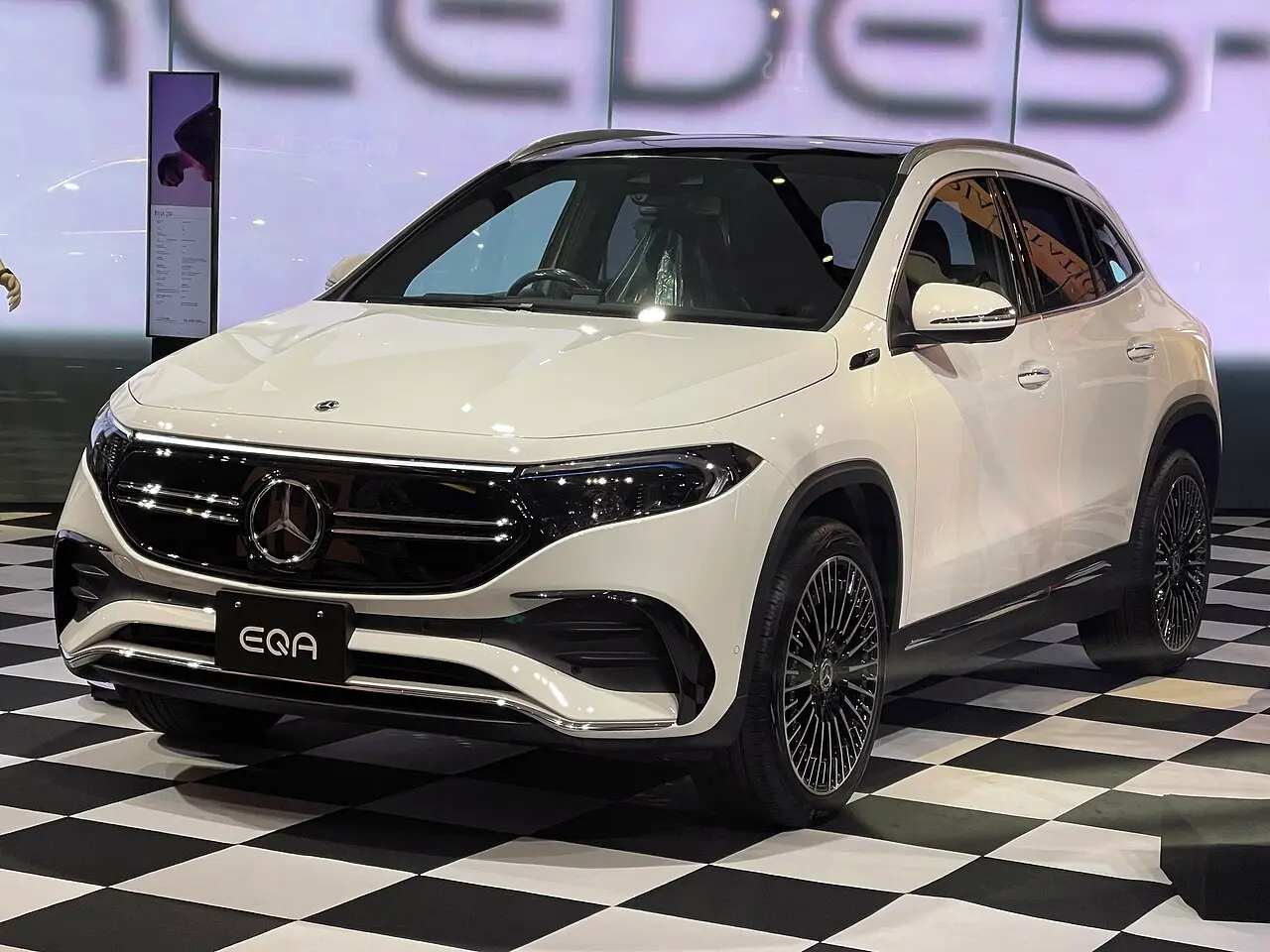
The official data lists 76 versions of the Mercedes-Benz EQA (2019–2026), in the European Union, the United Kingdom, and France. Each market publishes its own figures, measured on its own test procedure.
At a glance
Years in the data
2019–2026
Markets
European Union, United Kingdom, France
Power
80 kW (109 PS) to 430 kW (585 PS)
Fuels
Electric
Lowest consumption (European Union)
5.1 L/100 km (WLTP)
New registrations in the EU
140,057
What is the Mercedes-Benz EQA?
The EQA is a fully electric compact SUV in Mercedes-Benz’s EQ family. It brings electric drive to the compact-car range and shares its basic proportions with the GLA. Its SUV shape and electric powertrain suit drivers looking for a compact car with a higher seating position.
Generations and design
The EQA has one generation, H243, introduced in 2021. Its GLA-like proportions are paired with EQ design details, including a distinctive front end. A later update brought fresh styling and equipment while retaining the H243 generation.
Engines and power
The EQA is powered by electricity. EU registration figures list power from 80 kW (109 PS) to 430 kW (585 PS). UK figures span 140 kW (190 PS) to 292 kW (397 PS), while French listings show 95 kW (129 PS) to 139 kW (189 PS). The figures vary between markets.
How efficient is the EQA?
Because it is electric, the EQA uses electricity rather than petrol or diesel. The EU figure of 5.1 L/100 km is for petrol, diesel or hybrid versions and does not describe the EQA’s energy use. Europe uses WLTP or older NEDC procedures, while the USA uses EPA testing and Canada uses the 5-cycle procedure; results from different markets are not directly comparable.
Where was the EQA sold?
The EQA appears in EU, UK and French market listings. EU registration figures span 2019–2025, UK listings cover 2021–2026 and French listings cover 2026. As a member of Mercedes-Benz’s EQ family, the EQA brought the brand’s electric-car design to the compact SUV class.
Questions and answers
Is the Mercedes-Benz EQA fully electric?
Yes. The EQA is a fully electric compact SUV.
What generation is the EQA?
The EQA is the H243 generation, introduced in 2021.
What power does the EQA have?
EU registration figures span 80 kW (109 PS) to 430 kW (585 PS). UK figures span 140 kW (190 PS) to 292 kW (397 PS).
How is the EQA’s energy use measured?
The EQA uses electricity, so its energy use is measured in electricity rather than litres of fuel. The 5.1 L/100 km EU figure applies to petrol, diesel or hybrid versions.
Model codes: H243 · Sold in: European Union, France, and United Kingdom · References: en.wikipedia.org, klasseshop.nl
European Union 39 versions
New cars registered in the EU (plus Norway and Iceland), from the European Environment Agency. Figures on the NEDC procedure until 2020 and on WLTP from 2021; versions are grouped by engine and power, with their number of registrations.
Years and version
Engine
Power
Fuel
Consumption (combined)
CO₂
Electric range
EU registrations
2025
Electric motor
140 kW (190 PS)
Electric
15.0 kWh/100 km WLTP
0 g/km
540 km
24,172
2025
Electric motor
168 kW (228 PS)
Electric
17.4 kWh/100 km WLTP
0 g/km
459 km
4,349
2025
Electric motor
95 kW (129 PS)
Electric
15.0 kWh/100 km WLTP
0 g/km
540 km
2,752
2025
Electric motor
215 kW (292 PS)
Electric
20.6 kWh/100 km WLTP
0 g/km
428 km
885
2025
Electric motor
139 kW (189 PS)
Electric
17.4 kWh/100 km WLTP
0 g/km
441 km
130
2025
Electric motor
130 kW (177 PS)
Electric
17.4 kWh/100 km WLTP
0 g/km
463 km
94
2025
Electric motor
111 kW (151 PS)
Electric
14.8 kWh/100 km WLTP
0 g/km
515 km
17
2024
Electric motor
140 kW (190 PS)
Electric
14.9 kWh/100 km WLTP
0 g/km
536 km
18,067
2024
Electric motor
168 kW (228 PS)
Electric
17.2 kWh/100 km WLTP
0 g/km
443 km
5,659
2024
Electric motor
215 kW (292 PS)
Electric
17.3 kWh/100 km WLTP
0 g/km
449 km
2,609
2024
Electric motor
95 kW (129 PS)
Electric
15.1 kWh/100 km WLTP
0 g/km
540 km
2,073
2024
Electric motor
139 kW (189 PS)
Electric
17.3 kWh/100 km WLTP
0 g/km
441 km
947
2024
Electric motor
130 kW (177 PS)
Electric
17.3 kWh/100 km WLTP
0 g/km
465 km
555
2024
Electric motor
111 kW (151 PS)
Electric
15.5 kWh/100 km WLTP
0 g/km
496 km
78
2024
Electric motor
430 kW (585 PS)
Electric
18.1 kWh/100 km WLTP
0 g/km
423 km
67
2023
Electric motor
140 kW (190 PS)
Electric
15.9 kWh/100 km WLTP
0 g/km
496 km
21,707
2023
Electric motor
168 kW (228 PS)
Electric
17.9 kWh/100 km WLTP
0 g/km
425 km
4,412
2023
Electric motor
215 kW (292 PS)
Electric
18.1 kWh/100 km WLTP
0 g/km
423 km
1,309
2023
Electric motor
95 kW (129 PS)
Electric
15.7 kWh/100 km WLTP
0 g/km
519 km
1,091
2023
Electric motor
111 kW (151 PS)
Electric
15.8 kWh/100 km WLTP
0 g/km
485 km
550
2023
Electric motor
139 kW (189 PS)
Electric
17.9 kWh/100 km WLTP
0 g/km
427 km
505
2023
Electric motor
430 kW (585 PS)
Electric
18.2 kWh/100 km WLTP
0 g/km
421 km
101
2023
Electric motor
67 kW (91 PS)
Electric
16.7 kWh/100 km WLTP
0 g/km
459 km
26
2023
Electric motor
80 kW (109 PS)
Electric
18.0 kWh/100 km WLTP
0 g/km
423 km
14
2023
Electric motor
110 kW (150 PS)
Electric
17.2 kWh/100 km WLTP
0 g/km
454 km
12
2022
Electric motor
140 kW (190 PS)
Electric
16.8 kWh/100 km WLTP
0 g/km
465 km
10,077
2022
Electric motor
168 kW (228 PS)
Electric
17.9 kWh/100 km WLTP
0 g/km
427 km
2,991
2022
Electric motor
80 kW (109 PS)
Electric
18.3 kWh/100 km WLTP
0 g/km
415 km
1,982
2022
Electric motor
215 kW (292 PS)
Electric
18.1 kWh/100 km WLTP
0 g/km
432 km
961
2022
Electric motor
111 kW (151 PS)
Electric
15.9 kWh/100 km WLTP
0 g/km
484 km
811
2022
Electric motor
139 kW (189 PS)
Electric
18.0 kWh/100 km WLTP
0 g/km
425 km
497
2022
Electric motor
95 kW (129 PS)
Electric
15.7 kWh/100 km WLTP
0 g/km
521 km
385
2021
Electric motor
80 kW (109 PS)
Electric
18.3 kWh/100 km WLTP
0 g/km
438 km
17,267
2021
Electric motor
140 kW (190 PS)
Electric
18.7 kWh/100 km WLTP
0 g/km
421 km
9,694
2021
Electric motor
168 kW (228 PS)
Electric
17.9 kWh/100 km WLTP
0 g/km
422 km
1,439
2021
Electric motor
139 kW (189 PS)
Electric
18.0 kWh/100 km WLTP
0 g/km
444 km
742
2021
Electric motor
215 kW (292 PS)
Electric
18.1 kWh/100 km WLTP
0 g/km
419 km
430
2021
–
140 kW (190 PS)
Other fuel
5.1 L/100 km WLTP18.3 kWh/100 km WLTP
52 g/km
486 km
306
2021
Electric motor
210 kW (286 PS)
Electric
–
0 g/km
–
10
United Kingdom 32 versions
New cars on sale in the UK, from the Vehicle Certification Agency. NEDC figures until 2018 and WLTP figures after; years are the editions a version appeared in.
Years and version
Engine
Power
Fuel
Consumption (combined)
CO₂
Electric range
2025–2026EQA 250+
Electric motor
140 kW (190 PS)
Electric
14.4 kWh/100 km WLTP
0 g/km
561 km
2025–2026EQA 250+
Electric motor
140 kW (190 PS)
Electric
16.4 kWh/100 km WLTP
0 g/km
497 km
2025–2026EQA 300 4MATIC
Electric motor
168 kW (228 PS)
Electric
16.8 kWh/100 km WLTP
0 g/km
477 km
2025–2026EQA 300 4MATIC
Electric motor
168 kW (228 PS)
Electric
18.6 kWh/100 km WLTP
0 g/km
435 km
2025–2026EQA 350 4MATIC
Electric motor
215 kW (292 PS)
Electric
16.8 kWh/100 km WLTP
0 g/km
477 km
2025–2026EQA 350 4MATIC
Electric motor
215 kW (292 PS)
Electric
18.6 kWh/100 km WLTP
0 g/km
435 km
2024EQA 250+
Electric motor
190 kW (258 PS)
Electric
16.4 kWh/100 km WLTP
0 g/km
497 km
2024EQA 250+
Electric motor
190 kW (258 PS)
Electric
14.4 kWh/100 km WLTP
0 g/km
560 km
2024EQA 300 4MATIC
Electric motor
228 kW (310 PS)
Electric
18.6 kWh/100 km WLTP
0 g/km
412 km
2024EQA 300 4MATIC
Electric motor
228 kW (310 PS)
Electric
16.7 kWh/100 km WLTP
0 g/km
459 km
2024EQA 350 4MATIC
Electric motor
292 kW (397 PS)
Electric
18.6 kWh/100 km WLTP
0 g/km
412 km
2024EQA 350 4MATIC
Electric motor
292 kW (397 PS)
Electric
16.7 kWh/100 km WLTP
0 g/km
459 km
2022–2023EQA 250+
Electric motor
140 kW (190 PS)
Electric
15.3 kWh/100 km WLTP
0 g/km
531 km
2022–2023EQA 250+
Electric motor
140 kW (190 PS)
Electric
16.8 kWh/100 km WLTP
0 g/km
489 km
2023EQA 250
Electric motor
140 kW (190 PS)
Electric
15.4 kWh/100 km WLTP
0 g/km
495 km
2023EQA 250
Electric motor
140 kW (190 PS)
Electric
16.9 kWh/100 km WLTP
0 g/km
457 km
2023EQA 250+
Electric motor
140 kW (190 PS)
Electric
15.3 kWh/100 km WLTP
0 g/km
532 km
2023EQA 250+
Electric motor
140 kW (190 PS)
Electric
16.7 kWh/100 km WLTP
0 g/km
490 km
2022–2023EQA 300 4MATIC
Electric motor
168 kW (228 PS)
Electric
17.4 kWh/100 km WLTP
0 g/km
438 km
2022–2023EQA 300 4MATIC
Electric motor
168 kW (228 PS)
Electric
18.6 kWh/100 km WLTP
0 g/km
411 km
2023EQA 300 4MATIC
Electric motor
168 kW (228 PS)
Electric
18.7 kWh/100 km WLTP
0 g/km
411 km
2022–2023EQA 350 4MATIC
Electric motor
215 kW (292 PS)
Electric
17.4 kWh/100 km WLTP
0 g/km
438 km
2022–2023EQA 350 4MATIC
Electric motor
215 kW (292 PS)
Electric
18.6 kWh/100 km WLTP
0 g/km
411 km
2023EQA 350 4MATIC
Electric motor
215 kW (292 PS)
Electric
18.7 kWh/100 km WLTP
0 g/km
411 km
2021EQA 250
Electric motor
140 kW (190 PS)
Electric
17.9 kWh/100 km WLTP
0 g/km
401 km
2021EQA 250
Electric motor
140 kW (190 PS)
Electric
19.0 kWh/100 km WLTP
0 g/km
423 km
2021EQA 250
Electric motor
140 kW (190 PS)
Electric
17.7 kWh/100 km WLTP
0 g/km
400 km
2021EQA 250
Electric motor
140 kW (190 PS)
Electric
19.0 kWh/100 km WLTP
0 g/km
426 km
2021EQA 300 4MATIC
Electric motor
168 kW (228 PS)
Electric
17.5 kWh/100 km WLTP
0 g/km
409 km
2021EQA 300 4MATIC
Electric motor
168 kW (228 PS)
Electric
18.6 kWh/100 km WLTP
0 g/km
432 km
2021EQA 350 4MATIC
Electric motor
215 kW (292 PS)
Electric
17.5 kWh/100 km WLTP
0 g/km
409 km
2021EQA 350 4MATIC
Electric motor
215 kW (292 PS)
Electric
18.6 kWh/100 km WLTP
0 g/km
432 km
France 2 versions
New cars on sale in France, from ADEME Car Labelling. NEDC figures until 2015, WLTP figures in the current catalogue.
Years and version
Engine
Power
Fuel
Gearbox
Consumption (combined)
Electric range
2026EQA 250+
Electric motor
95 kW (129 PS)
Electric
Continuously variable (CVT)
14.6 kWh/100 km WLTP
551 km
2026EQA 350 4MATIC
Electric motor
139 kW (189 PS)
Electric
Continuously variable (CVT)
16.7 kWh/100 km WLTP
453 km
Versions outside these generations
European Union 3 versions
New cars registered in the EU (plus Norway and Iceland), from the European Environment Agency. Figures on the NEDC procedure until 2020 and on WLTP from 2021; versions are grouped by engine and power, with their number of registrations.
Years and version
Engine
Power
Fuel
Consumption (combined)
CO₂
Electric range
EU registrations
2019–2020
Electric motor
140 kW (190 PS)
Electric
–
0 g/km
–
184
2020
Electric motor
80 kW (109 PS)
Electric
18.7 kWh/100 km NEDC
0 g/km
486 km
86
2020
Electric motor
210 kW (286 PS)
Electric
–
0 g/km
–
14
Official figures are measured on standard test procedures and differ between markets. Your consumption depends on how, where and in what conditions you drive.