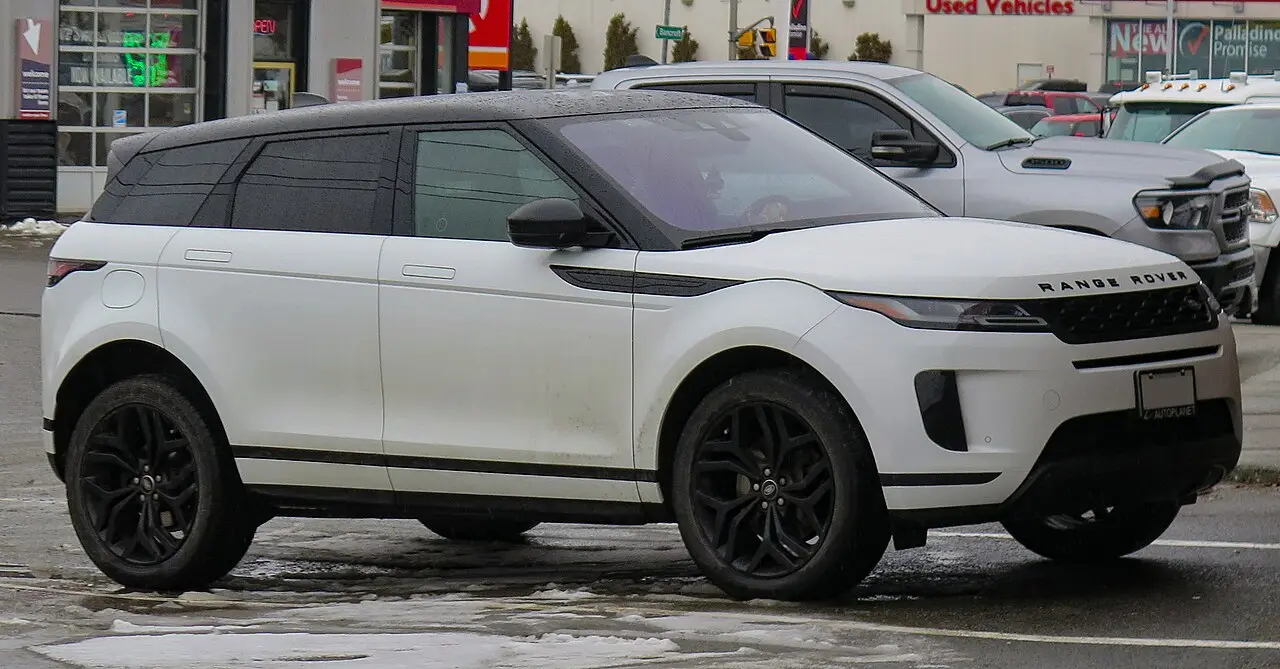
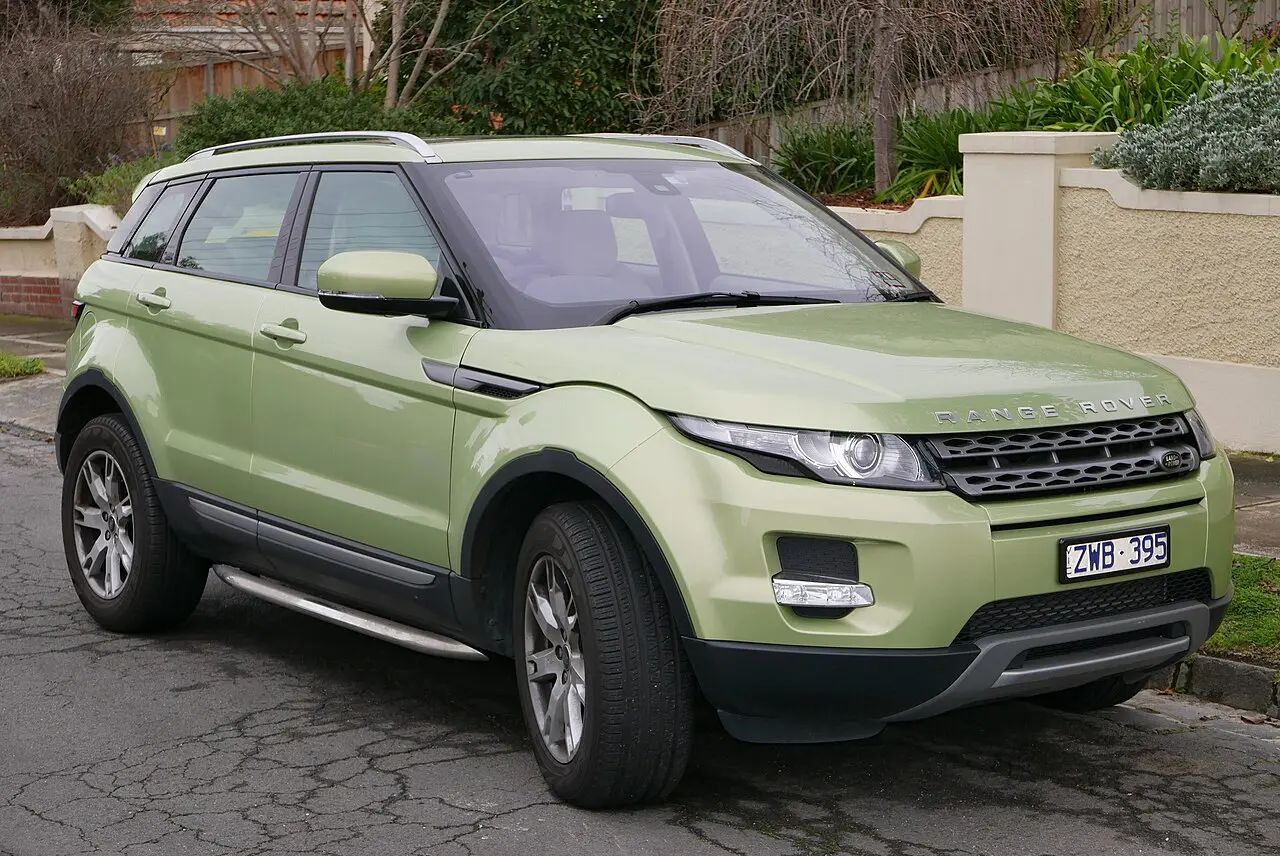
The official data lists 259 versions of the Land Rover Range Rover Evoque (2011–2026), in the European Union, the United Kingdom, France, the United States, and Canada. Each market publishes its own figures, measured on its own test procedure.
At a glance
Years in the data
2011–2026
Markets
European Union, United Kingdom, France, United States, Canada
The Range Rover Evoque is the compact SUV in the Range Rover family. Its coupé-like shape, inspired by Land Rover’s LRX concept, gives it a distinctive profile; its compact size suits everyday driving around town and beyond.
The first generation ran from 2012 to 2019, followed by the second from 2020 onward. The later model kept the original’s sloping roofline while bringing a fresh design and updated technology.
Engines and power
In EU registrations, engine sizes range from 1.5 to 2.2 litres, with power from 110 kW (150 PS) to 221 kW (300 PS). The range has included petrol, diesel and hybrid versions, as well as other fuel classifications.
US figures cover 2.0-litre engines and include petrol and hybrid versions. Canadian figures cover 2.0-litre petrol versions.
How economical is the Range Rover Evoque?
The lowest EU figure for petrol, diesel and hybrid versions is 5.4 L/100 km on WLTP. For plug-in hybrids, the lowest weighted WLTP figure is 1.5 L/100 km; it assumes some journeys are driven using electric power. In the UK, the lowest listed figure is 4.2 L/100 km on NEDC. France’s lowest listed figure is 4.9 L/100 km, also on NEDC.
The lowest US EPA figure is 9.4 L/100 km, or 25 MPG combined. Canada’s lowest figure is 9.6 L/100 km on its 5-cycle test. European WLTP and NEDC, the US EPA test and Canada’s 5-cycle test use different procedures, so results are best understood within each market.
Where was the Evoque sold?
Official figures are available for the European Union, the UK, France, the United States and Canada. EU registrations span 2011–2025 and total 853,669 cars. Among the leading versions in several years was the 2.0-litre diesel rated at 110 kW (150 PS).
Questions and answers
When did the Evoque generations run?
The first generation ran from 2012 to 2019; the second began in 2020.
What is the Evoque’s lowest listed EU consumption?
It is 5.4 L/100 km for petrol, diesel and hybrid versions on WLTP. The plug-in hybrid weighted figure is 1.5 L/100 km.
What power outputs are listed in EU registrations?
The range runs from 110 kW (150 PS) to 221 kW (300 PS).
New cars registered in the EU (plus Norway and Iceland), from the European Environment Agency. Figures on the NEDC procedure until 2020 and on WLTP from 2021; versions are grouped by engine and power, with their number of registrations.
Years and version
Engine
Power
Fuel
Consumption (combined)
CO₂
Electric range
EU registrations
2024–2025
2.0 L
120 kW (163 PS)
Hybrid
6.5 L/100 km WLTP
170 g/km
–
4,679
2025
1.5 L
118 kW (160 PS)
Plug-in hybrid
1.7 L/100 km WLTP19.6 kWh/100 km WLTP
35 g/km
63 km
3,456
2025
2.0 L
150 kW (204 PS)
Hybrid
6.5 L/100 km WLTP
171 g/km
–
1,078
2025
1.5 L
118 kW (160 PS)
Hybrid
7.8 L/100 km WLTP
180 g/km
–
483
2025
1.5 L
147 kW (200 PS)
Plug-in hybrid
1.5 L/100 km WLTP18.9 kWh/100 km WLTP
33 g/km
61 km
414
2025
2.0 L
120 kW (163 PS)
Diesel
6.3 L/100 km WLTP
166 g/km
–
110
2025
2.0 L
120 kW (163 PS)
Plug-in hybrid
6.5 L/100 km WLTP
170 g/km
–
23
2025
2.0 L
147 kW (200 PS)
Hybrid
8.8 L/100 km WLTP
199 g/km
–
19
2025
2.0 L
150 kW (204 PS)
Plug-in hybrid
–
171 g/km
–
13
2024
1.5 L
147 kW (200 PS)
Plug-in hybrid
1.5 L/100 km WLTP18.4 kWh/100 km WLTP
32 g/km
61 km
3,047
2024
1.5 L
118 kW (160 PS)
Plug-in hybrid
1.5 L/100 km WLTP19.7 kWh/100 km WLTP
33 g/km
62 km
1,791
2024
2.0 L
150 kW (204 PS)
Hybrid
6.5 L/100 km WLTP
171 g/km
–
1,560
2024
2.0 L
147 kW (200 PS)
Hybrid
8.8 L/100 km WLTP
199 g/km
–
505
2024
1.5 L
118 kW (160 PS)
Hybrid
8.0 L/100 km WLTP
180 g/km
–
448
2024
2.0 L
183 kW (249 PS)
Hybrid
8.9 L/100 km WLTP
202 g/km
–
200
2024
2.0 L
147 kW (200 PS)
Flex fuel (E85)
9.1 L/100 km WLTP
207 g/km
–
159
2024
2.0 L
120 kW (163 PS)
Diesel
6.1 L/100 km WLTP
159 g/km
–
58
2024
2.0 L
147 kW (200 PS)
Plug-in hybrid
1.0 L/100 km WLTP27.7 kWh/100 km WLTP
23 g/km
107 km
15
2023
1.5 L
147 kW (200 PS)
Plug-in hybrid
1.5 L/100 km WLTP18.7 kWh/100 km WLTP
33 g/km
60 km
4,786
2023
2.0 L
120 kW (163 PS)
Hybrid
6.5 L/100 km WLTP
172 g/km
–
2,054
2023
2.0 L
150 kW (204 PS)
Hybrid
6.6 L/100 km WLTP
173 g/km
–
1,171
2023
2.0 L
147 kW (200 PS)
Flex fuel (E85)
9.2 L/100 km WLTP
209 g/km
–
765
2023
2.0 L
147 kW (200 PS)
Hybrid
9.0 L/100 km WLTP
202 g/km
–
651
2023
1.5 L
118 kW (160 PS)
Hybrid
8.0 L/100 km WLTP
182 g/km
–
493
2023
2.0 L
183 kW (249 PS)
Hybrid
9.0 L/100 km WLTP
204 g/km
–
239
2023
2.0 L
120 kW (163 PS)
Diesel
6.2 L/100 km WLTP
162 g/km
–
78
2023
2.0 L
221 kW (300 PS)
Hybrid
9.3 L/100 km WLTP
210 g/km
–
16
2022
1.5 L
147 kW (200 PS)
Plug-in hybrid
3.4 L/100 km WLTP19.0 kWh/100 km WLTP
38 g/km
60 km
4,375
2022
2.0 L
120 kW (163 PS)
Hybrid
5.5 L/100 km WLTP
173 g/km
–
3,899
2022
2.0 L
150 kW (204 PS)
Hybrid
6.2 L/100 km WLTP
175 g/km
–
1,761
2022
2.0 L
147 kW (200 PS)
Flex fuel (E85)
9.3 L/100 km WLTP
210 g/km
–
1,222
2022
2.0 L
147 kW (200 PS)
Hybrid
8.8 L/100 km WLTP
209 g/km
–
1,218
2022
2.0 L
120 kW (163 PS)
Diesel
5.8 L/100 km WLTP
165 g/km
–
439
2022
1.5 L
118 kW (160 PS)
Hybrid
7.9 L/100 km WLTP
182 g/km
–
418
2022
2.0 L
183 kW (249 PS)
Hybrid
8.5 L/100 km WLTP
206 g/km
–
362
2022
2.0 L
221 kW (300 PS)
Hybrid
8.9 L/100 km WLTP
208 g/km
–
68
2022
1.5 L
147 kW (200 PS)
Petrol
2.1 L/100 km WLTP17.4 kWh/100 km WLTP
179 g/km
–
44
2022
2.0 L
147 kW (200 PS)
Petrol
8.1 L/100 km WLTP
204 g/km
–
25
2021
1.5 L
147 kW (200 PS)
Plug-in hybrid
3.0 L/100 km WLTP20.0 kWh/100 km WLTP
53 g/km
124 km
9,925
2021
2.0 L
120 kW (163 PS)
Diesel
6.4 L/100 km WLTP
170 g/km
–
5,809
2021
2.0 L
120 kW (163 PS)
Hybrid
5.4 L/100 km WLTP
172 g/km
–
4,657
2021
2.0 L
147 kW (200 PS)
Flex fuel (E85)
9.4 L/100 km WLTP
211 g/km
–
2,252
2021
2.0 L
150 kW (204 PS)
Diesel
6.6 L/100 km WLTP
174 g/km
–
1,844
2021
2.0 L
150 kW (204 PS)
Hybrid
5.9 L/100 km WLTP
173 g/km
–
1,704
2021
2.0 L
147 kW (200 PS)
Petrol
8.9 L/100 km WLTP
205 g/km
–
1,296
2021
1.5 L
118 kW (160 PS)
Petrol
8.0 L/100 km WLTP
181 g/km
–
1,226
2021
1.5 L
118 kW (160 PS)
Hybrid
7.0 L/100 km WLTP
181 g/km
–
1,206
2021
2.0 L
147 kW (200 PS)
Hybrid
8.2 L/100 km WLTP
205 g/km
–
908
2021
2.0 L
110 kW (150 PS)
Diesel
6.8 L/100 km WLTP
178 g/km
210 km
556
2021
2.0 L
110 kW (150 PS)
Hybrid
5.9 L/100 km WLTP21.0 kWh/100 km WLTP
180 g/km
55 km
462
2021
2.0 L
132 kW (179 PS)
Hybrid
6.7 L/100 km WLTP
183 g/km
–
352
2021
2.0 L
132 kW (179 PS)
Diesel
7.0 L/100 km WLTP
183 g/km
–
350
2021
2.0 L
183 kW (249 PS)
Petrol
9.2 L/100 km WLTP
207 g/km
–
179
2021
2.0 L
183 kW (249 PS)
Hybrid
8.5 L/100 km WLTP
207 g/km
–
171
2021
2.0 L
221 kW (300 PS)
Petrol
9.3 L/100 km WLTP
211 g/km
–
91
2021
2.0 L
221 kW (300 PS)
Hybrid
8.8 L/100 km WLTP
211 g/km
–
89
2021
2.0 L
177 kW (241 PS)
Hybrid
7.0 L/100 km WLTP
187 g/km
–
45
2021
2.0 L
177 kW (241 PS)
Diesel
7.1 L/100 km WLTP
187 g/km
–
45
2020
2.0 L
110 kW (150 PS)
Diesel
20.8 kWh/100 km NEDC
143 g/km
50 km
30,536
2020
2.0 L
110 kW (150 PS)
Hybrid
–
142 g/km
55 km
15,711
2020
2.0 L
132 kW (179 PS)
Hybrid
–
145 g/km
55 km
7,269
2020
2.0 L
147 kW (200 PS)
Petrol
–
177 g/km
–
7,068
2020
1.5 L
147 kW (200 PS)
Plug-in hybrid
20.9 kWh/100 km NEDC
43 g/km
56 km
5,597
2020
2.0 L
147 kW (200 PS)
Hybrid
–
174 g/km
–
3,830
2020
2.0 L
177 kW (241 PS)
Hybrid
–
158 g/km
–
1,075
2020
2.0 L
183 kW (249 PS)
Hybrid
–
177 g/km
–
865
2020
2.0 L
–
Diesel
–
139 g/km
–
532
2020
2.0 L
221 kW (300 PS)
Hybrid
–
187 g/km
–
283
2020
2.0 L
132 kW (179 PS)
Diesel
–
148 g/km
–
200
2020
1.5 L
40 kW (54 PS)
Plug-in hybrid
15.9 kWh/100 km NEDC
43 g/km
55 km
150
2020
2.0 L
120 kW (163 PS)
Hybrid
–
139 g/km
–
72
2020
2.0 L
183 kW (249 PS)
Petrol
–
177 g/km
–
36
2020
1.5 L
147 kW (200 PS)
Hybrid
–
43 g/km
–
31
2020
2.0 L
150 kW (204 PS)
Hybrid
–
140 g/km
–
20
2020
2.0 L
177 kW (241 PS)
Diesel
–
160 g/km
–
16
2020
2.0 L
110 kW (150 PS)
Plug-in hybrid
20.0 kWh/100 km NEDC
119 g/km
53 km
12
United Kingdom 30 versions
New cars on sale in the UK, from the Vehicle Certification Agency. NEDC figures until 2018 and WLTP figures after; years are the editions a version appeared in.
Years and version
Engine
Power
Fuel
Gearbox
Consumption (combined)
CO₂
Electric range
20241.5 i3 Petrol 300PS AWD Auto
1.5 L
200 kW (272 PS)
Plug-in hybrid
8-speed automatic
6.5 kWh/100 km WLTP
–
190 km
20241.5 i3 Petrol 300PS AWD Auto
1.5 L
200 kW (272 PS)
Plug-in hybrid
8-speed automatic
5.9 kWh/100 km WLTP
–
210 km
20242.0 i4 Diesel 150PS FWD Manual
2.0 L
150 kW (204 PS)
Diesel
6-speed manual
6.3 L/100 km WLTP
165 g/km
–
20242.0 i4 Diesel 150PS FWD Manual
2.0 L
150 kW (204 PS)
Diesel
6-speed manual
6.7 L/100 km WLTP
176 g/km
–
2020–20231.5 i3 Petrol 300PS AWD Auto
1.5 L
147 kW (200 PS)
Plug-in hybrid
8-speed automatic
5.9 kWh/100 km WLTP
–
210 km
2020–20231.5 i3 Petrol 300PS AWD Auto
1.5 L
147 kW (200 PS)
Plug-in hybrid
8-speed automatic
6.5 kWh/100 km WLTP
–
190 km
2020–20232.0 i4 Petrol 200PS AWD Auto
2.0 L
147 kW (200 PS)
Petrol
9-speed automatic
9.0 L/100 km WLTP
204 g/km
–
2020–20232.0 i4 Petrol 200PS AWD Auto
2.0 L
147 kW (200 PS)
Petrol
9-speed automatic
9.7 L/100 km WLTP
220 g/km
–
2020–20232.0 i4 Petrol 200PS AWD Auto
2.0 L
147 kW (200 PS)
Petrol
9-speed automatic
9.2 L/100 km WLTP
209 g/km
–
2020–20232.0 i4 Petrol 200PS AWD Auto
2.0 L
147 kW (200 PS)
Petrol
9-speed automatic
9.9 L/100 km WLTP
224 g/km
–
2020–20232.0 i4 Petrol 249PS AWD Auto
2.0 L
183 kW (249 PS)
Petrol
9-speed automatic
9.1 L/100 km WLTP
205 g/km
–
2020–20232.0 i4 Petrol 249PS AWD Auto
2.0 L
183 kW (249 PS)
Petrol
9-speed automatic
9.7 L/100 km WLTP
220 g/km
–
2020–20232.0 i4 Petrol 249PS AWD Auto
2.0 L
183 kW (249 PS)
Petrol
9-speed automatic
9.3 L/100 km WLTP
210 g/km
–
2020–20232.0 i4 Petrol 249PS AWD Auto
2.0 L
183 kW (249 PS)
Petrol
9-speed automatic
9.9 L/100 km WLTP
224 g/km
–
2020–20232.0 i4 Petrol 300PS AWD Auto
2.0 L
221 kW (300 PS)
Petrol
9-speed automatic
9.1 L/100 km WLTP
207 g/km
–
2020–20232.0 i4 Petrol 300PS AWD Auto
2.0 L
221 kW (300 PS)
Petrol
9-speed automatic
9.8 L/100 km WLTP
221 g/km
–
2020–20232.0 i4 Petrol 300PS AWD Auto
2.0 L
221 kW (300 PS)
Petrol
9-speed automatic
9.3 L/100 km WLTP
211 g/km
–
2020–20232.0 i4 Petrol 300PS AWD Auto
2.0 L
221 kW (300 PS)
Petrol
9-speed automatic
9.8 L/100 km WLTP
223 g/km
–
2020–20232.0 i4 Diesel 150PS AWD Auto
2.0 L
110 kW (150 PS)
Diesel
9-speed automatic
6.7 L/100 km WLTP
176 g/km
–
2020–20232.0 i4 Diesel 150PS AWD Auto
2.0 L
110 kW (150 PS)
Diesel
9-speed automatic
7.1 L/100 km WLTP
186 g/km
–
2020–20232.0 i4 Diesel 150PS AWD Auto
2.0 L
110 kW (150 PS)
Diesel
9-speed automatic
6.7 L/100 km WLTP
177 g/km
–
2020–20232.0 i4 Diesel 150PS FWD Manual
2.0 L
110 kW (150 PS)
Diesel
6-speed manual
6.3 L/100 km WLTP
165 g/km
–
2020–20232.0 i4 Diesel 150PS FWD Manual
2.0 L
110 kW (150 PS)
Diesel
6-speed manual
6.7 L/100 km WLTP
176 g/km
–
2020–20232.0 i4 Diesel 180PS AWD Auto
2.0 L
132 kW (179 PS)
Diesel
9-speed automatic
6.8 L/100 km WLTP
178 g/km
–
2020–20232.0 i4 Diesel 180PS AWD Auto
2.0 L
132 kW (179 PS)
Diesel
9-speed automatic
7.4 L/100 km WLTP
194 g/km
–
2020–20232.0 i4 Diesel 180PS AWD Auto
2.0 L
132 kW (179 PS)
Diesel
9-speed automatic
6.8 L/100 km WLTP
179 g/km
–
2020–20232.0 i4 Diesel 180PS AWD Auto
2.0 L
132 kW (179 PS)
Diesel
9-speed automatic
7.3 L/100 km WLTP
193 g/km
–
2020–20232.0 i4 Diesel 240PS AWD Auto
2.0 L
177 kW (241 PS)
Diesel
9-speed automatic
6.9 L/100 km WLTP
181 g/km
–
2020–20232.0 i4 Diesel 240PS AWD Auto
2.0 L
177 kW (241 PS)
Diesel
9-speed automatic
7.5 L/100 km WLTP
196 g/km
–
2020–20232.0 i4 Diesel 240PS AWD Auto
2.0 L
177 kW (241 PS)
Diesel
9-speed automatic
7.0 L/100 km WLTP
183 g/km
–
United States 4 versions
Model years sold in the USA, from the EPA and the Department of Energy (fueleconomy.gov). MPG on the EPA test; litres per 100 km = 235.215 ÷ MPG.
Years and version
Engine
Fuel
Gearbox
Drive
Consumption (combined)
CO₂
2021–2026SIDI
2.0 L
Petrol
9-speed automatic
All-wheel drive
22 MPG (10.7 L/100 km) EPA
247 g/km
2022–2023SIDI; Mild Hybrid
2.0 L
Hybrid
9-speed automatic
All-wheel drive
23 MPG (10.2 L/100 km) EPA
244 g/km
2020SIDI
2.0 L
Petrol
9-speed automatic
All-wheel drive
23 MPG (10.2 L/100 km) EPA
245 g/km
2020SIDI; Mild Hybrid
2.0 L
Hybrid
9-speed automatic
All-wheel drive
23 MPG (10.2 L/100 km) EPA
242 g/km
Canada 4 versions
Model years sold in Canada, from Natural Resources Canada fuel consumption ratings (5-cycle test).
Years and version
Engine
Fuel
Gearbox
Consumption (combined)
CO₂
2021–2026Sport utility vehicle: Small
2.0 L
Petrol
9-speed automatic
10.5 L/100 km 5-cycle
247 g/km
2022–2023Sport utility vehicle: Small
2.0 L
Petrol
9-speed automatic
10.3 L/100 km 5-cycle
244 g/km
2020Sport utility vehicle: Small
2.0 L
Petrol
9-speed automatic
10.4 L/100 km 5-cycle
245 g/km
2020Sport utility vehicle: Small
2.0 L
Petrol
9-speed automatic
10.3 L/100 km 5-cycle
242 g/km
Versions outside these generations
European Union 5 versions
New cars registered in the EU (plus Norway and Iceland), from the European Environment Agency. Figures on the NEDC procedure until 2020 and on WLTP from 2021; versions are grouped by engine and power, with their number of registrations.
Official figures are measured on standard test procedures and differ between markets. Your consumption depends on how, where and in what conditions you drive.