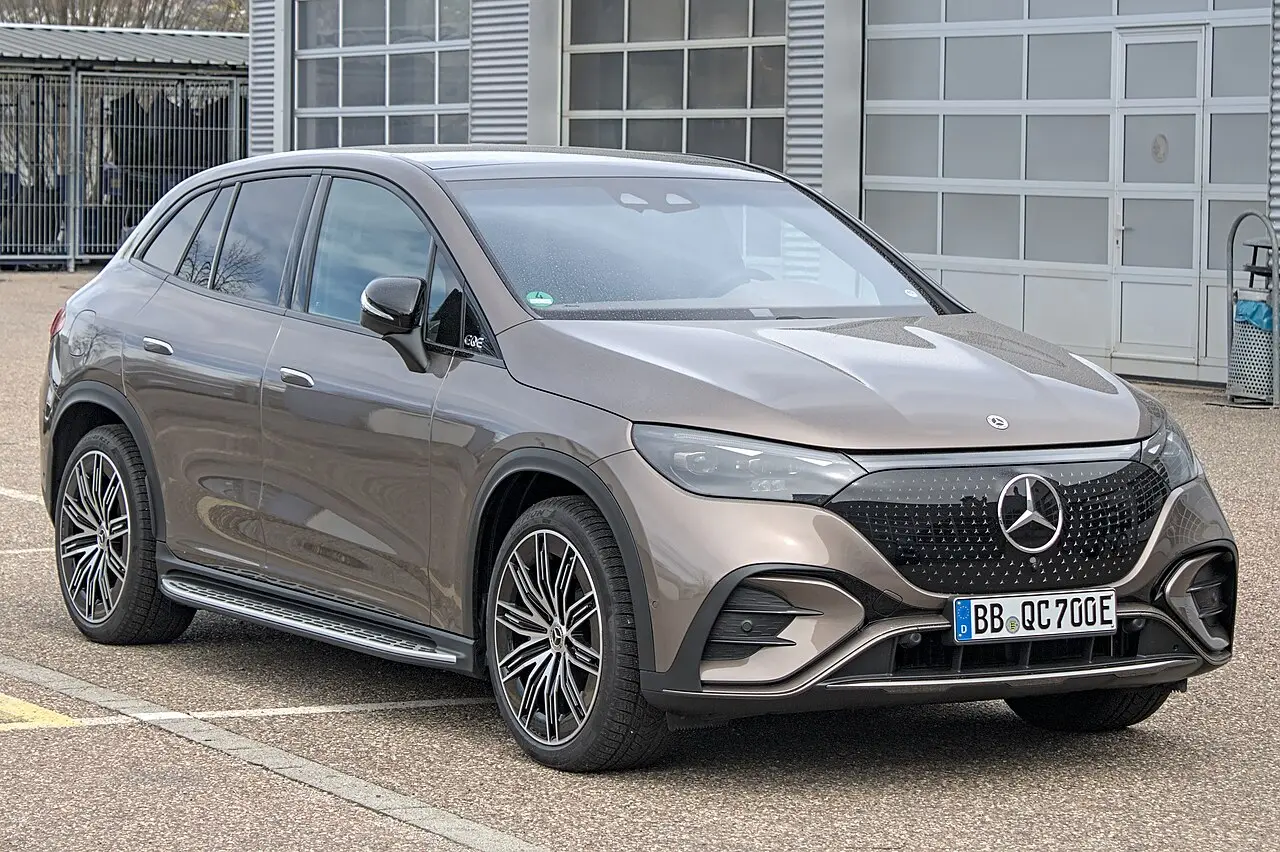
The official data lists 42 versions of the Mercedes-Benz EQE (2021 - 2027), in the European Union, the United Kingdom, the United States, and Canada. Each market publishes its own figures, measured on its own test procedure.
At a glance
Years in the data
2021 - 2027
Markets
European Union, United Kingdom, United States, Canada
Power
135 kW (184 PS) to 460 kW (625 PS)
Fuels
Electric
New registrations in the EU
65,887
What is the Mercedes-Benz EQE?
The EQE is a fully electric executive saloon in Mercedes-Benz’s EQ family. It brings the brand’s electric-car design and technology to a roomy, everyday passenger car. The EQE range also includes versions bearing the AMG performance badge.
The V295 is the EQE’s single listed generation, spanning 2022 onward. The model appears in EU, UK, US and Canadian figures.
Engines and power
All EQE versions in these markets are electric, so power comes from electric motors. The EU range is 135 kW (184 PS) to 460 kW (625 PS). In the UK it runs from 180 kW (245 PS) to 460 kW (625 PS), and in Canada from 215 kW (292 PS) to 460 kW (625 PS). US figures identify electric versions without stating a power range.
The range includes Mercedes-Benz and AMG-badged versions, with power outputs varying between markets.
Official consumption and CO₂
As an electric car, the EQE has zero tailpipe CO₂ emissions. No official electricity-consumption figure is available to quote here. Regional test results use different procedures: Europe uses WLTP or, for some older figures, NEDC; the US uses EPA testing and Canada uses its 5-cycle procedure.
Questions and answers
Is the EQE fully electric?
Yes. The listed EU, UK, US and Canadian versions are electric.
What generation is the EQE?
The listed generation is V295, spanning 2022 onward.
What is the highest listed EQE power output?
The EU range reaches 460 kW (625 PS). Market-specific ranges differ.
What are the EQE’s CO₂ emissions?
It has zero tailpipe CO₂ emissions as an electric vehicle. No official electricity-consumption figure is available to quote here.
New cars registered in the EU (plus Norway and Iceland), from the European Environment Agency. Figures on the NEDC procedure until 2020 and on WLTP from 2021; versions are grouped by engine and power, with their number of registrations.
Years and version
Engine
Power
Fuel
Consumption (combined)
CO₂
Electric range
EU registrations
2022 - 2025
Electric motor
215 kW (292 PS)
Electric
17.2 - 18.7 kWh/100 km WLTP
0 g/km
566 - 608 km
29,809
2022 - 2025
Electric motor
180 kW (245 PS)
Electric
16.8 - 17.4 kWh/100 km WLTP
0 g/km
596 - 610 km
14,434
2022 - 2025
Electric motor
300 kW (408 PS)
Electric
19.2 - 20.1 kWh/100 km WLTP
0 g/km
519 - 560 km
5,131
2022 - 2025
Electric motor
Not listed
Electric
17.1 - 23.6 kWh/100 km WLTP
0 g/km
448 - 630 km
3,873
2022 - 2025
Electric motor
135 kW (184 PS)
Electric
19.7 - 21.6 kWh/100 km WLTP
0 g/km
483 - 555 km
3,218
2022 - 2025
Electric motor
350 kW (476 PS)
Electric
21.7 - 23.5 kWh/100 km WLTP
0 g/km
460 - 484 km
3,098
2025
Electric motor
235 kW (320 PS)
Electric
17.9 kWh/100 km WLTP
0 g/km
618 km
1,804
2025
Electric motor
195 kW (265 PS)
Electric
16.7 kWh/100 km WLTP
0 g/km
636 km
1,495
2022 - 2025
Electric motor
460 kW (625 PS)
Electric
22.1 - 23.5 kWh/100 km WLTP
0 g/km
443 - 470 km
1,310
2023 - 2025
Electric motor
430 kW (585 PS)
Electric
19.8 - 20.2 kWh/100 km WLTP
0 g/km
513 - 526 km
542
2022 - 2025
Electric motor
185 kW (252 PS)
Electric
22.2 - 25.9 kWh/100 km WLTP
0 g/km
428 - 469 km
224
2025
Electric motor
330 kW (449 PS)
Electric
19.4 kWh/100 km WLTP
0 g/km
574 km
205
2022
Electric motor
210 kW (286 PS)
Electric
-
0 g/km
-
89
2022
Electric motor
260 kW (354 PS)
Electric
-
0 g/km
-
87
2022
Electric motor
445 kW (605 PS)
Electric
-
0 g/km
-
28
2022
Electric motor
330 kW (449 PS)
Electric
-
0 g/km
-
22
United Kingdom 12 versions
New cars on sale in the UK, from the Vehicle Certification Agency. NEDC figures until 2018 and WLTP figures after; years are the editions a version appeared in.
Model years sold in the USA, from the EPA and the Department of Energy (fueleconomy.gov). MPG on the EPA test; litres per 100 km = 235.215 ÷ MPG.
Years and version
Engine
Fuel
Gearbox
Drive
Consumption (combined)
CO₂
Electric range
2024 - 2027
Electric motor
Electric
Automatic
Rear-wheel drive
93 - 96 MPGe EPA
0 g/km
480 - 496 km
2024 - 2027
Electric motor
Electric
Automatic
All-wheel drive
70 - 96 MPGe EPA
0 g/km
354 - 480 km
Canada 8 versions
Model years sold in Canada, from Natural Resources Canada fuel consumption ratings (5-cycle test).
Years and version
Engine
Power
Fuel
Gearbox
Consumption (combined)
CO₂
Electric range
2026Mid-size
Electric motor
235 kW (320 PS)
Electric
Automatic
24.4 kWh/100 km 5-cycle
0 g/km
430 km
2026Station wagon: Mid-size
Electric motor
235 kW (320 PS)
Electric
Automatic
26.1 kWh/100 km 5-cycle
0 g/km
407 km
2023 - 2025Mid-size
Electric motor
215 kW (292 PS)
Electric
Automatic
23.0 - 24.4 kWh/100 km 5-cycle
0 g/km
418 - 451 km
2023 - 2025Sport utility vehicle: Standard
Electric motor
215 kW (292 PS)
Electric
Automatic
24.9 - 26.1 kWh/100 km 5-cycle
0 g/km
407 - 426 km
2023 - 2025Mid-size
Electric motor
300 kW (408 PS)
Electric
Automatic
23.6 - 25.2 kWh/100 km 5-cycle
0 g/km
418 - 446 km
2023 - 2025Sport utility vehicle: Standard
Electric motor
300 kW (408 PS)
Electric
Automatic
23.7 - 26.1 kWh/100 km 5-cycle
0 g/km
425 - 462 km
2023 - 2025Mid-size
Electric motor
460 kW (625 PS)
Electric
Automatic
28.3 - 29.9 kWh/100 km 5-cycle
0 g/km
354 - 370 km
2024 - 2025Sport utility vehicle: Standard
Electric motor
460 kW (625 PS)
Electric
Automatic
28.3 - 28.6 kWh/100 km 5-cycle
0 g/km
370 - 378 km
Versions outside these generations
European Union 8 versions
New cars registered in the EU (plus Norway and Iceland), from the European Environment Agency. Figures on the NEDC procedure until 2020 and on WLTP from 2021; versions are grouped by engine and power, with their number of registrations.
Years and version
Engine
Power
Fuel
CO₂
EU registrations
2021
Electric motor
210 kW (286 PS)
Electric
0 g/km
250
2021
Electric motor
260 kW (354 PS)
Electric
0 g/km
114
2021
Electric motor
136 kW (185 PS)
Electric
0 g/km
40
2021
Electric motor
330 kW (449 PS)
Electric
0 g/km
34
2021
Electric motor
Not listed
Electric
0 g/km
30
2021
Electric motor
445 kW (605 PS)
Electric
0 g/km
20
2021
Electric motor
215 kW (292 PS)
Electric
0 g/km
18
2021
Electric motor
180 kW (245 PS)
Electric
0 g/km
12
Mercedes-Benz EQE recalls
23 official safety recalls for the Mercedes-Benz EQE from NHTSA (United States), DVSA (United Kingdom) and the EU Safety Gate, newest first. Recall repairs are normally free at the maker’s dealers.
Pedestrian warning sound may not increase with speed2024 - 2025
Steering coupling bolts may not meet specifications2022 - 2025
Steering coupling bolt may loosen2023 - 2025
Reversing warning sound may be incorrect2023 - 2025
Incorrect fuse box may cause power loss or fire2023
Official figures are measured on standard test procedures and differ between markets. Your consumption depends on how, where and in what conditions you drive.