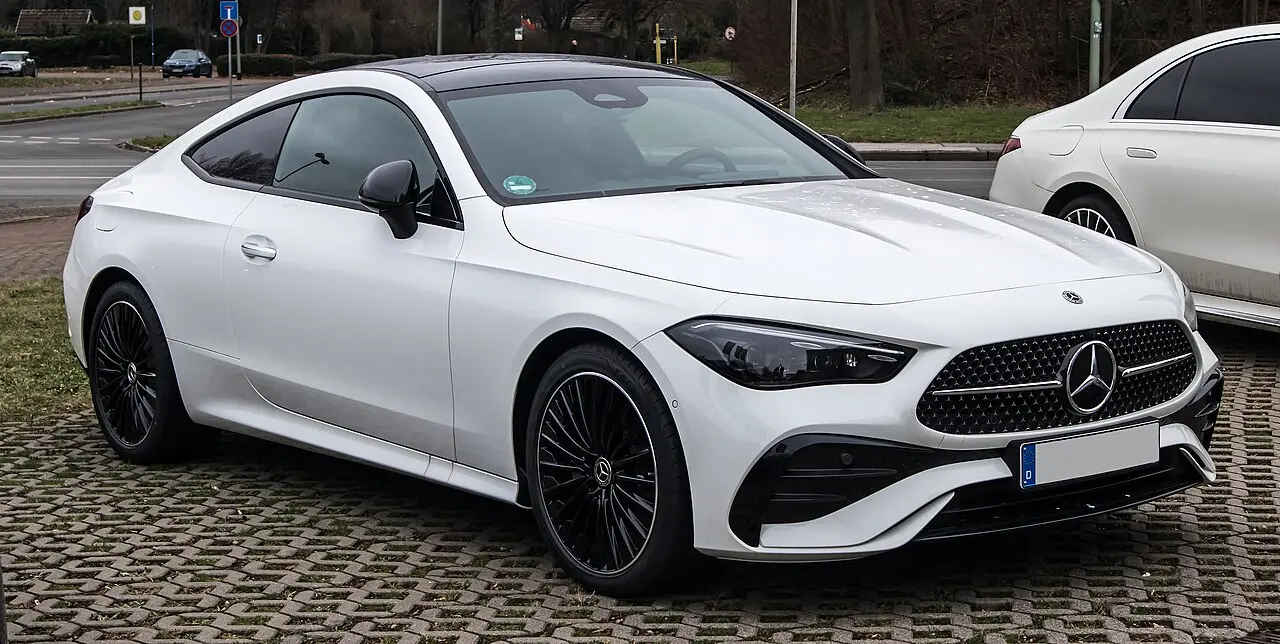
The official data lists 133 versions of the Mercedes-Benz CLE (2021–2027), in the European Union, the United Kingdom, the United States, and Canada. Each market publishes its own figures, measured on its own test procedure.
At a glance
Years in the data
2021–2027
Markets
European Union, United Kingdom, United States, Canada
Engines
2.0 L to 3.0 L
Power
125 kW (170 PS) to 449 kW (610 PS)
Fuels
Hybrid, Plug-in hybrid, Petrol, Diesel
Lowest consumption (United Kingdom)
4.7 L/100 km (WLTP)
Lowest consumption (European Union)
4.8 L/100 km (WLTP)
Lowest consumption (United States)
8.4 L/100 km (EPA)
Plug-in hybrid, weighted (European Union)
0.6 L/100 km (WLTP)
New registrations in the EU
33,684
What is the Mercedes-Benz CLE?
The CLE is a two-door Mercedes-Benz offered as a coupe and a convertible. It brings together the C-Class and E-Class coupe traditions in one model line. The coupe has a flowing fixed roof; the convertible adds open-air driving.
Mercedes-Benz describes the CLE as a distinct series drawing on the concepts and technology of both the C-Class and E-Class. Its long bonnet and sweeping roofline give it the familiar proportions of a Mercedes coupe, while its cabin incorporates current infotainment and comfort features.
Generation and engines
The first CLE generation uses the C236 code for the coupe and A236 for the convertible. The generation began in 2024. It brought the two body styles together in a single model line, with design and technology drawing on the C-Class and E-Class.
In the EU, engines range from 2.0 to 3.0 litres, with power from 125 kW (170 PS) to 330 kW (449 PS). The range includes petrol, diesel, hybrid and plug-in hybrid versions. UK versions have 2.0- to 3.0-litre engines and power from 145 kW (197 PS) to 449 kW (610 PS). US listings identify hybrid powertrains, while Canadian listings identify petrol versions; both cover engines from 2.0 to 3.0 litres.
How economical is the Mercedes-Benz CLE?
The lowest EU figure for non-plug-in versions is 4.8 L/100 km on WLTP. The plug-in hybrid’s official weighted figure starts at 0.6 L/100 km WLTP; it assumes some driving is electric, so it does not represent every journey. The UK low is 4.7 L/100 km on WLTP.
The lowest listed US EPA figure is 8.4 L/100 km, or 28 MPG combined. Canada’s lowest listed result is 8.6 L/100 km on the NRCan 5-cycle test. WLTP, EPA and the Canadian 5-cycle procedure differ, so figures from different markets are not directly comparable.
Where is the CLE sold?
The CLE appears in EU registration figures from 2021 to 2025, UK figures from 2023 to 2026, US figures from 2024 to 2027 and Canadian figures from 2024 to 2026. EU registrations total 33,684. Leading EU versions included 2.0-litre hybrids rated at 145 kW (197 PS) and 150 kW (204 PS).
Questions and answers
What does the CLE replace in Mercedes-Benz’s coupe range?
It brings the C-Class and E-Class coupe traditions into a single model line, offered as a coupe and a convertible.
When did the CLE generation begin?
The first generation, coded C236 for the coupe and A236 for the convertible, began in 2024.
Is there a plug-in hybrid CLE?
Yes. EU listings include plug-in hybrids, with an official weighted WLTP figure starting at 0.6 L/100 km. That figure assumes some driving is electric.
Why do CLE fuel economy figures differ between countries?
The markets use different procedures: WLTP in Europe, EPA in the US and NRCan’s 5-cycle test in Canada.
New cars registered in the EU (plus Norway and Iceland), from the European Environment Agency. Figures on the NEDC procedure until 2020 and on WLTP from 2021; versions are grouped by engine and power, with their number of registrations.
Years and version
Engine
Power
Fuel
Consumption (combined)
CO₂
Electric range
EU registrations
2025
2.0 L
145 kW (197 PS)
Hybrid
4.8 L/100 km WLTP
127 g/km
–
3,926
2025
2.0 L
150 kW (204 PS)
Hybrid
6.7 L/100 km WLTP
152 g/km
–
3,795
2025
2.0 L
150 kW (204 PS)
Plug-in hybrid
1.1 L/100 km WLTP18.5 kWh/100 km WLTP
22 g/km
111 km
2,295
2025
3.0 L
330 kW (449 PS)
Hybrid
9.5 L/100 km WLTP
217 g/km
–
2,019
2025
3.0 L
330 kW (449 PS)
Hybrid
9.5 L/100 km WLTP
216 g/km
–
1,638
2025
2.0 L
190 kW (258 PS)
Hybrid
7.2 L/100 km WLTP
165 g/km
–
1,520
2025
2.0 L
125 kW (170 PS)
Hybrid
6.6 L/100 km WLTP
151 g/km
–
725
2025
3.0 L
280 kW (381 PS)
Hybrid
7.9 L/100 km WLTP
182 g/km
–
491
2025
2.0 L
190 kW (258 PS)
Petrol
7.0 L/100 km WLTP
149 g/km
–
223
2025
3.0 L
280 kW (381 PS)
Hybrid
7.9 L/100 km WLTP
179 g/km
–
194
2025
3.0 L
280 kW (381 PS)
Petrol
7.8 L/100 km WLTP
177 g/km
–
64
2025
3.0 L
280 kW (381 PS)
Petrol
8.0 L/100 km WLTP
182 g/km
–
54
2025
2.0 L
190 kW (258 PS)
Plug-in hybrid
7.2 L/100 km WLTP
139 g/km
85 km
41
2025
2.0 L
145 kW (197 PS)
Plug-in hybrid
4.8 L/100 km WLTP
125 g/km
–
38
2025
3.0 L
330 kW (449 PS)
Plug-in hybrid
9.3 L/100 km WLTP
213 g/km
–
27
2025
3.0 L
330 kW (449 PS)
Plug-in hybrid
9.4 L/100 km WLTP
214 g/km
–
11
2025
3.0 L
330 kW (449 PS)
Petrol
9.4 L/100 km WLTP
214 g/km
–
11
2025
2.0 L
–
Diesel
5.8 L/100 km WLTP
123 g/km
–
10
2024
2.0 L
145 kW (197 PS)
Hybrid
4.8 L/100 km WLTP21.0 kWh/100 km WLTP
127 g/km
–
3,928
2024
2.0 L
150 kW (204 PS)
Hybrid
6.7 L/100 km WLTP
152 g/km
–
3,886
2024
2.0 L
190 kW (258 PS)
Hybrid
7.3 L/100 km WLTP
165 g/km
–
2,571
2024
3.0 L
330 kW (449 PS)
Hybrid
9.5 L/100 km WLTP
216 g/km
–
1,831
2024
3.0 L
280 kW (381 PS)
Hybrid
7.9 L/100 km WLTP
180 g/km
–
1,079
2024
2.0 L
150 kW (204 PS)
Plug-in hybrid
0.6 L/100 km WLTP20.2 kWh/100 km WLTP
13 g/km
111 km
937
2024
2.0 L
125 kW (170 PS)
Hybrid
6.7 L/100 km WLTP
151 g/km
–
94
2024
4.0 L
430 kW (585 PS)
Hybrid
–
370 g/km
–
41
2024
3.0 L
320 kW (435 PS)
Hybrid
–
195 g/km
–
32
2024
2.0 L
190 kW (258 PS)
Plug-in hybrid
–
27 g/km
85 km
26
2024
2.0 L
350 kW (476 PS)
Plug-in hybrid
23.0 kWh/100 km WLTP
195 g/km
–
19
2024
2.0 L
147 kW (200 PS)
Hybrid
–
164 g/km
–
10
United Kingdom 57 versions
New cars on sale in the UK, from the Vehicle Certification Agency. NEDC figures until 2018 and WLTP figures after; years are the editions a version appeared in.
Years and version
Engine
Power
Fuel
Gearbox
Consumption (combined)
CO₂
Electric range
2026CLE 220 d
2.0 L
145 kW (197 PS)
Diesel
9-speed automatic
4.7 L/100 km WLTP
123 g/km
–
2025–2026CLE 220 d
2.0 L
145 kW (197 PS)
Hybrid
9-speed automatic
4.9 L/100 km WLTP
128 g/km
–
2025–2026CLE 220 d
2.0 L
145 kW (197 PS)
Hybrid
9-speed automatic
5.3 L/100 km WLTP
139 g/km
–
2025–2026CLE 220 d
2.0 L
145 kW (197 PS)
Diesel
9-speed automatic
4.7 L/100 km WLTP
122 g/km
–
2025–2026CLE 220 d
2.0 L
145 kW (197 PS)
Diesel
9-speed automatic
5.1 L/100 km WLTP
135 g/km
–
2026CLE 220 d
2.0 L
145 kW (197 PS)
Hybrid
9-speed automatic
4.9 L/100 km WLTP
129 g/km
–
2026CLE 220 d
2.0 L
145 kW (197 PS)
Hybrid
9-speed automatic
5.3 L/100 km WLTP
140 g/km
–
2026CLE 220 d
2.0 L
145 kW (197 PS)
Diesel
9-speed automatic
5.2 L/100 km WLTP
136 g/km
–
2025–2026CLE 200
2.0 L
150 kW (204 PS)
Hybrid
9-speed automatic
6.7 L/100 km WLTP
153 g/km
–
2025–2026CLE 200
2.0 L
150 kW (204 PS)
Hybrid
9-speed automatic
7.2 L/100 km WLTP
163 g/km
–
2025–2026CLE 200
2.0 L
150 kW (204 PS)
Hybrid
9-speed automatic
6.5 L/100 km WLTP
147 g/km
–
2025–2026CLE 200
2.0 L
150 kW (204 PS)
Hybrid
9-speed automatic
7.0 L/100 km WLTP
159 g/km
–
2025–2026CLE 300 e
2.0 L
150 kW (204 PS)
Plug-in hybrid
9-speed automatic
19.1 kWh/100 km WLTP
–
111 km
2025–2026CLE 300 e
2.0 L
150 kW (204 PS)
Plug-in hybrid
9-speed automatic
20.8 kWh/100 km WLTP
–
101 km
2026CLE 200
2.0 L
150 kW (204 PS)
Hybrid
9-speed automatic
7.2 L/100 km WLTP
165 g/km
–
2026CLE 200
2.0 L
150 kW (204 PS)
Hybrid
9-speed automatic
7.0 L/100 km WLTP
160 g/km
–
2025–2026CLE 300 4MATIC
2.0 L
190 kW (258 PS)
Hybrid
9-speed automatic
7.1 L/100 km WLTP
161 g/km
–
2025–2026CLE 300 4MATIC
2.0 L
190 kW (258 PS)
Hybrid
9-speed automatic
7.6 L/100 km WLTP
172 g/km
–
2025–2026CLE 300 4MATIC
2.0 L
190 kW (258 PS)
Hybrid
9-speed automatic
6.8 L/100 km WLTP
155 g/km
–
2025–2026CLE 300 4MATIC
2.0 L
190 kW (258 PS)
Hybrid
9-speed automatic
7.3 L/100 km WLTP
167 g/km
–
2026CLE 300 4MATIC
2.0 L
190 kW (258 PS)
Hybrid
9-speed automatic
7.7 L/100 km WLTP
174 g/km
–
2026CLE 300 4MATIC
2.0 L
190 kW (258 PS)
Hybrid
9-speed automatic
6.8 L/100 km WLTP
156 g/km
–
2026CLE 300 4MATIC
2.0 L
190 kW (258 PS)
Hybrid
9-speed automatic
7.4 L/100 km WLTP
168 g/km
–
2026CLE 300 e
2.0 L
230 kW (313 PS)
Plug-in hybrid
9-speed automatic
14.5 kWh/100 km WLTP
–
111 km
2026CLE 300 e
2.0 L
230 kW (313 PS)
Plug-in hybrid
9-speed automatic
15.5 kWh/100 km WLTP
–
101 km
2025–2026CLE 450 4MATIC
3.0 L
280 kW (381 PS)
Hybrid
9-speed automatic
7.9 L/100 km WLTP
181 g/km
–
2025–2026CLE 450 4MATIC
3.0 L
280 kW (381 PS)
Hybrid
9-speed automatic
8.4 L/100 km WLTP
192 g/km
–
2025–2026CLE 450 4MATIC
3.0 L
280 kW (381 PS)
Hybrid
9-speed automatic
7.6 L/100 km WLTP
174 g/km
–
2025–2026CLE 450 4MATIC
3.0 L
280 kW (381 PS)
Hybrid
9-speed automatic
8.2 L/100 km WLTP
186 g/km
–
2026CLE 450 4MATIC
3.0 L
280 kW (381 PS)
Hybrid
9-speed automatic
8.2 L/100 km WLTP
187 g/km
–
2025–2026AMG CLE 53 4MATIC+
3.0 L
330 kW (449 PS)
Hybrid
9-speed automatic
7.9 L/100 km WLTP
181 g/km
–
2025–2026AMG CLE 53 4MATIC+
3.0 L
330 kW (449 PS)
Hybrid
9-speed automatic
8.4 L/100 km WLTP
192 g/km
–
2025–2026AMG CLE 53 4MATIC+
3.0 L
330 kW (449 PS)
Hybrid
9-speed automatic
9.1 L/100 km WLTP
206 g/km
–
2025–2026AMG CLE 53 4MATIC+
3.0 L
330 kW (449 PS)
Hybrid
9-speed automatic
9.5 L/100 km WLTP
217 g/km
–
2026AMG CLE 53 4MATIC+
3.0 L
330 kW (449 PS)
Hybrid
9-speed automatic
9.8 L/100 km WLTP
222 g/km
–
2024CLE 220 d
2.0 L
197 kW (268 PS)
Diesel
9-speed automatic
4.7 L/100 km WLTP
122 g/km
–
2024CLE 220 d
2.0 L
197 kW (268 PS)
Hybrid
9-speed automatic
4.9 L/100 km WLTP
128 g/km
–
2024CLE 220 d
2.0 L
197 kW (268 PS)
Diesel
9-speed automatic
5.1 L/100 km WLTP
135 g/km
–
2024CLE 220 d
2.0 L
197 kW (268 PS)
Hybrid
9-speed automatic
5.3 L/100 km WLTP
140 g/km
–
2024CLE 300 e
2.0 L
204 kW (277 PS)
Plug-in hybrid
9-speed automatic
20.8 kWh/100 km WLTP
–
101 km
2024CLE 300 e
2.0 L
204 kW (277 PS)
Plug-in hybrid
9-speed automatic
19.1 kWh/100 km WLTP
–
111 km
2024CLE 200
2.0 L
204 kW (277 PS)
Hybrid
9-speed automatic
6.4 L/100 km WLTP
144 g/km
–
2024CLE 200
2.0 L
204 kW (277 PS)
Hybrid
9-speed automatic
6.7 L/100 km WLTP
152 g/km
–
2024CLE 200
2.0 L
204 kW (277 PS)
Hybrid
9-speed automatic
7.1 L/100 km WLTP
160 g/km
–
2024CLE 200
2.0 L
204 kW (277 PS)
Hybrid
9-speed automatic
7.3 L/100 km WLTP
166 g/km
–
2024CLE 300 4MATIC
2.0 L
258 kW (351 PS)
Hybrid
9-speed automatic
7.0 L/100 km WLTP
159 g/km
–
2024CLE 300 4MATIC
2.0 L
258 kW (351 PS)
Hybrid
9-speed automatic
7.3 L/100 km WLTP
165 g/km
–
2024CLE 300 4MATIC
2.0 L
258 kW (351 PS)
Hybrid
9-speed automatic
7.6 L/100 km WLTP
171 g/km
–
2024CLE 300 4MATIC
2.0 L
258 kW (351 PS)
Hybrid
9-speed automatic
7.8 L/100 km WLTP
176 g/km
–
2024CLE 450 4MATIC
3.0 L
381 kW (518 PS)
Hybrid
9-speed automatic
7.6 L/100 km WLTP
174 g/km
–
2024CLE 450 4MATIC
3.0 L
381 kW (518 PS)
Hybrid
9-speed automatic
7.9 L/100 km WLTP
181 g/km
–
2024CLE 450 4MATIC
3.0 L
381 kW (518 PS)
Hybrid
9-speed automatic
8.2 L/100 km WLTP
187 g/km
–
2024CLE 450 4MATIC
3.0 L
381 kW (518 PS)
Hybrid
9-speed automatic
8.4 L/100 km WLTP
192 g/km
–
2024Mercedes-AMG CLE 53 4MATIC+
3.0 L
449 kW (610 PS)
Hybrid
9-speed automatic
9.0 L/100 km WLTP
206 g/km
–
2024Mercedes-AMG CLE 53 4MATIC+
3.0 L
449 kW (610 PS)
Hybrid
9-speed automatic
9.3 L/100 km WLTP
212 g/km
–
2024Mercedes-AMG CLE 53 4MATIC+
3.0 L
449 kW (610 PS)
Hybrid
9-speed automatic
9.5 L/100 km WLTP
216 g/km
–
2024Mercedes-AMG CLE 53 4MATIC+
3.0 L
449 kW (610 PS)
Hybrid
9-speed automatic
9.7 L/100 km WLTP
221 g/km
–
United States 10 versions
Model years sold in the USA, from the EPA and the Department of Energy (fueleconomy.gov). MPG on the EPA test; litres per 100 km = 235.215 ÷ MPG.
Years and version
Engine
Fuel
Gearbox
Drive
Consumption (combined)
CO₂
2027SIDI; Mild Hybrid
2.0 L
Hybrid
9-speed automatic
All-wheel drive
27 MPG (8.7 L/100 km) EPA
202 g/km
2027SIDI; Mild Hybrid
2.0 L
Hybrid
9-speed automatic
All-wheel drive
27 MPG (8.7 L/100 km) EPA
203 g/km
2024–2027SIDI; Mild Hybrid
3.0 L
Hybrid
9-speed automatic
All-wheel drive
26 MPG (9.0 L/100 km) EPA
210 g/km
2024–2027SIDI; Mild Hybrid
3.0 L
Hybrid
9-speed automatic
All-wheel drive
26 MPG (9.0 L/100 km) EPA
211 g/km
2024–2027SIDI; Mild Hybrid
3.0 L
Hybrid
9-speed automatic
All-wheel drive
23 MPG (10.2 L/100 km) EPA
243 g/km
2025–2027SIDI; Mild Hybrid
3.0 L
Hybrid
9-speed automatic
All-wheel drive
22 MPG (10.7 L/100 km) EPA
254 g/km
2025–2026SIDI; Mild Hybrid
2.0 L
Hybrid
9-speed automatic
All-wheel drive
26 MPG (9.0 L/100 km) EPA
211 g/km
2025–2026SIDI; Mild Hybrid
2.0 L
Hybrid
9-speed automatic
All-wheel drive
27 MPG (8.7 L/100 km) EPA
201 g/km
2024SIDI; Mild Hybrid
2.0 L
Hybrid
9-speed automatic
All-wheel drive
26 MPG (9.0 L/100 km) EPA
209 g/km
2024SIDI; Mild Hybrid
2.0 L
Hybrid
9-speed automatic
All-wheel drive
28 MPG (8.4 L/100 km) EPA
201 g/km
Canada 11 versions
Model years sold in Canada, from Natural Resources Canada fuel consumption ratings (5-cycle test).
Years and version
Engine
Fuel
Gearbox
Consumption (combined)
CO₂
2026Subcompact
2.0 L
Petrol
9-speed automatic
8.6 L/100 km 5-cycle
202 g/km
2026Subcompact
2.0 L
Petrol
9-speed automatic
8.7 L/100 km 5-cycle
203 g/km
2024–2026Subcompact
3.0 L
Petrol
9-speed automatic
10.4 L/100 km 5-cycle
243 g/km
2025–2026Subcompact
3.0 L
Petrol
9-speed automatic
10.8 L/100 km 5-cycle
253 g/km
2025–2026Subcompact
3.0 L
Petrol
9-speed automatic
8.9 L/100 km 5-cycle
210 g/km
2026Subcompact
3.0 L
Petrol
9-speed automatic
9.0 L/100 km 5-cycle
211 g/km
2025Subcompact
2.0 L
Petrol
9-speed automatic
9.1 L/100 km 5-cycle
211 g/km
2025Subcompact
2.0 L
Petrol
9-speed automatic
8.6 L/100 km 5-cycle
201 g/km
2025Subcompact
3.0 L
Petrol
9-speed automatic
9.0 L/100 km 5-cycle
211 g/km
2024Subcompact
2.0 L
Petrol
9-speed automatic
8.9 L/100 km 5-cycle
209 g/km
2024Subcompact
2.0 L
Petrol
9-speed automatic
8.6 L/100 km 5-cycle
201 g/km
Versions outside these generations
European Union 19 versions
New cars registered in the EU (plus Norway and Iceland), from the European Environment Agency. Figures on the NEDC procedure until 2020 and on WLTP from 2021; versions are grouped by engine and power, with their number of registrations.
Years and version
Engine
Power
Fuel
Consumption (combined)
CO₂
EU registrations
2023
2.0 L
190 kW (258 PS)
Hybrid
7.2 L/100 km WLTP
172 g/km
585
2023
2.0 L
145 kW (197 PS)
Hybrid
4.8 L/100 km WLTP
126 g/km
575
2023
2.0 L
150 kW (204 PS)
Hybrid
6.5 L/100 km WLTP
153 g/km
459
2023
3.0 L
280 kW (381 PS)
Hybrid
7.7 L/100 km WLTP
200 g/km
105
2023
2.0 L
147 kW (200 PS)
Hybrid
–
164 g/km
59
2023
3.0 L
320 kW (435 PS)
Hybrid
–
195 g/km
29
2023
2.0 L
350 kW (476 PS)
Plug-in hybrid
23.0 kWh/100 km WLTP
167 g/km
17
2023
2.0 L
190 kW (258 PS)
Plug-in hybrid
–
27 g/km
17
2023
3.0 L
330 kW (449 PS)
Hybrid
–
215 g/km
10
2022
2.0 L
190 kW (258 PS)
Hybrid
–
197 g/km
50
2022
3.0 L
280 kW (381 PS)
Hybrid
–
215 g/km
34
2022
2.0 L
147 kW (200 PS)
Hybrid
–
164 g/km
32
2022
2.0 L
350 kW (476 PS)
Plug-in hybrid
23.0 kWh/100 km WLTP
159 g/km
32
2022
3.0 L
320 kW (435 PS)
Hybrid
–
195 g/km
24
2022
2.0 L
190 kW (258 PS)
Plug-in hybrid
–
27 g/km
19
2022
2.0 L
150 kW (204 PS)
Hybrid
–
211 g/km
11
2021
3.0 L
280 kW (381 PS)
Hybrid
–
215 g/km
60
2021
2.0 L
190 kW (258 PS)
Hybrid
–
197 g/km
18
2021
1.5 L
150 kW (204 PS)
Hybrid
–
200 g/km
12
United Kingdom 6 versions
New cars on sale in the UK, from the Vehicle Certification Agency. NEDC figures until 2018 and WLTP figures after; years are the editions a version appeared in.
Years and version
Engine
Power
Fuel
Gearbox
Consumption (combined)
CO₂
2023CLE 220 d
2.0 L
145 kW (197 PS)
Diesel
9-speed automatic
4.7 L/100 km WLTP
123 g/km
2023CLE 220 d
2.0 L
145 kW (197 PS)
Diesel
9-speed automatic
5.2 L/100 km WLTP
137 g/km
2023CLE 200
2.0 L
150 kW (204 PS)
Hybrid
9-speed automatic
6.4 L/100 km WLTP
145 g/km
2023CLE 200
2.0 L
150 kW (204 PS)
Hybrid
9-speed automatic
7.1 L/100 km WLTP
161 g/km
2023CLE 300 4MATIC
2.0 L
190 kW (258 PS)
Hybrid
9-speed automatic
7.0 L/100 km WLTP
159 g/km
2023CLE 300 4MATIC
2.0 L
190 kW (258 PS)
Hybrid
9-speed automatic
7.6 L/100 km WLTP
173 g/km
Official figures are measured on standard test procedures and differ between markets. Your consumption depends on how, where and in what conditions you drive.