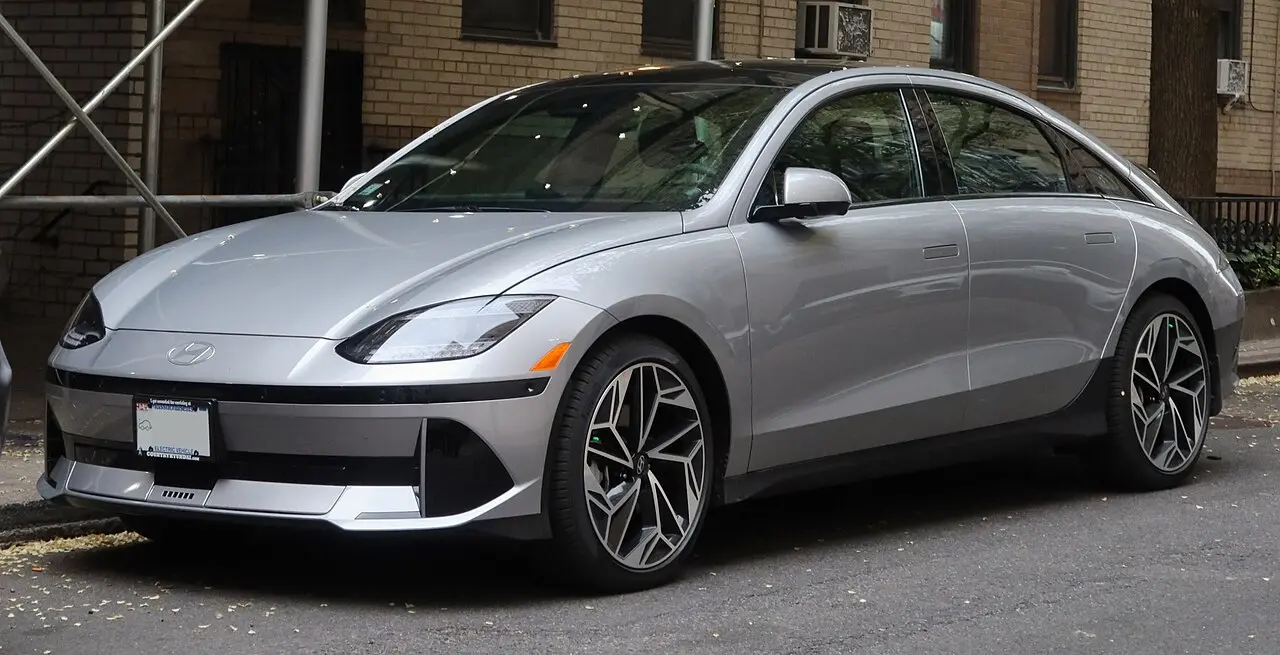
The official data lists 37 versions of the Hyundai IONIQ 6 (2023–2027), in the European Union, the United Kingdom, the United States, and Canada. Each market publishes its own figures, measured on its own test procedure.
At a glance
Years in the data
2023–2027
Markets
European Union, United Kingdom, United States, Canada
Power
56 kW (76 PS) to 478 kW (650 PS)
Fuels
Electric
New registrations in the EU
21,173
What is the Hyundai IONIQ 6?
The IONIQ 6 is an electric four-door sedan with a low, flowing shape. It belongs to Hyundai’s IONIQ electric-car family. Hyundai calls its design an “electrified streamliner”: the smooth profile gives the car a distinctive silhouette, while the cabin is shaped as a comfortable space for everyday journeys.
The first generation, code CE, began in 2022. Hyundai built the IONIQ 6 on its E-GMP electric-vehicle platform, also used across the IONIQ range.
Engines and power
Every listed IONIQ 6 is electric. EU registration figures include outputs from 56 kW (76 PS) to 239 kW (325 PS). UK VCA figures span 168 kW (228 PS) to 478 kW (650 PS), while Canada’s NRCan list runs from 111 kW (151 PS) to 239 kW (325 PS).
How economical is the Hyundai IONIQ 6?
The IONIQ 6 has no petrol or diesel consumption figure because it is electric. EU registration figures for 2023–2025 total 21,173. The most registered listed configuration was the 168 kW (228 PS) version in 2023, with 5,042 registrations; the same output led the 2024 list with 3,637. The 239 kW (325 PS) version recorded 3,620 registrations in 2023.
Official energy-use and CO₂ figures use different regional procedures. Europe uses WLTP or NEDC, the USA uses EPA procedures and Canada uses its 5-cycle test, so the results are best read within their own markets.
Where was the Hyundai IONIQ 6 sold?
The model appears in EU registration figures for 2023–2025, UK VCA figures for 2023–2026, US EPA figures for 2023–2027 and Canadian NRCan figures for 2023–2025. Hyundai offers the IONIQ 6 across Europe and North America, with versions that vary by market.
Questions and answers
Is every Hyundai IONIQ 6 electric?
Yes. All versions listed for the EU, UK, USA and Canada use electric power.
How much power does the IONIQ 6 have?
The listed ranges vary by market: 56–239 kW in EU registration figures, 168–478 kW in the UK, and 111–239 kW in Canada.
When did the first-generation IONIQ 6 begin?
The first generation, code CE, began in 2022.
Why can official efficiency figures differ between countries?
Markets use different test procedures: WLTP or NEDC in Europe, EPA in the USA and the 5-cycle procedure in Canada.
New cars registered in the EU (plus Norway and Iceland), from the European Environment Agency. Figures on the NEDC procedure until 2020 and on WLTP from 2021; versions are grouped by engine and power, with their number of registrations.
Years and version
Engine
Power
Fuel
Consumption (combined)
CO₂
Electric range
EU registrations
2025
Electric motor
168 kW (228 PS)
Electric
15.0 kWh/100 km WLTP
0 g/km
589 km
2,436
2025
Electric motor
239 kW (325 PS)
Electric
16.4 kWh/100 km WLTP
0 g/km
538 km
1,123
2025
Electric motor
111 kW (151 PS)
Electric
14.1 kWh/100 km WLTP
0 g/km
429 km
165
2025
Electric motor
81 kW (110 PS)
Electric
16.3 kWh/100 km WLTP
0 g/km
540 km
109
2025
Electric motor
56 kW (76 PS)
Electric
15.2 kWh/100 km WLTP
0 g/km
580 km
90
2024
Electric motor
168 kW (228 PS)
Electric
14.8 kWh/100 km WLTP
0 g/km
593 km
3,637
2024
Electric motor
239 kW (325 PS)
Electric
16.2 kWh/100 km WLTP
0 g/km
545 km
1,929
2023–2024
Electric motor
111 kW (151 PS)
Electric
13.9 kWh/100 km WLTP
0 g/km
429 km
1,833
2023
Electric motor
168 kW (228 PS)
Electric
14.5 kWh/100 km WLTP
0 g/km
604 km
5,042
2023
Electric motor
239 kW (325 PS)
Electric
16.2 kWh/100 km WLTP
0 g/km
544 km
3,620
2023
Electric motor
73 kW (99 PS)
Electric
16.4 kWh/100 km WLTP
0 g/km
537 km
449
2023
Electric motor
81 kW (110 PS)
Electric
16.7 kWh/100 km WLTP
0 g/km
527 km
354
2023
Electric motor
56 kW (76 PS)
Electric
14.5 kWh/100 km WLTP
0 g/km
605 km
342
2023
Electric motor
150 kW (204 PS)
Electric
16.8 kWh/100 km WLTP
0 g/km
521 km
24
2023
Electric motor
37 kW (50 PS)
Electric
13.9 kWh/100 km WLTP
0 g/km
429 km
20
United Kingdom 7 versions
New cars on sale in the UK, from the Vehicle Certification Agency. NEDC figures until 2018 and WLTP figures after; years are the editions a version appeared in.
Official figures are measured on standard test procedures and differ between markets. Your consumption depends on how, where and in what conditions you drive.