The official data lists 44 versions of the Mercedes-Benz EQS (2020 - 2027), in the European Union, the United Kingdom, the United States, and Canada. Each market publishes its own figures, measured on its own test procedure.
At a glance
Years in the data
2020 - 2027
Markets
European Union, United Kingdom, United States, Canada
Power
210 kW (286 PS) to 484 kW (658 PS)
Fuels
Electric
New registrations in the EU
22,659
What is the Mercedes-Benz EQS?
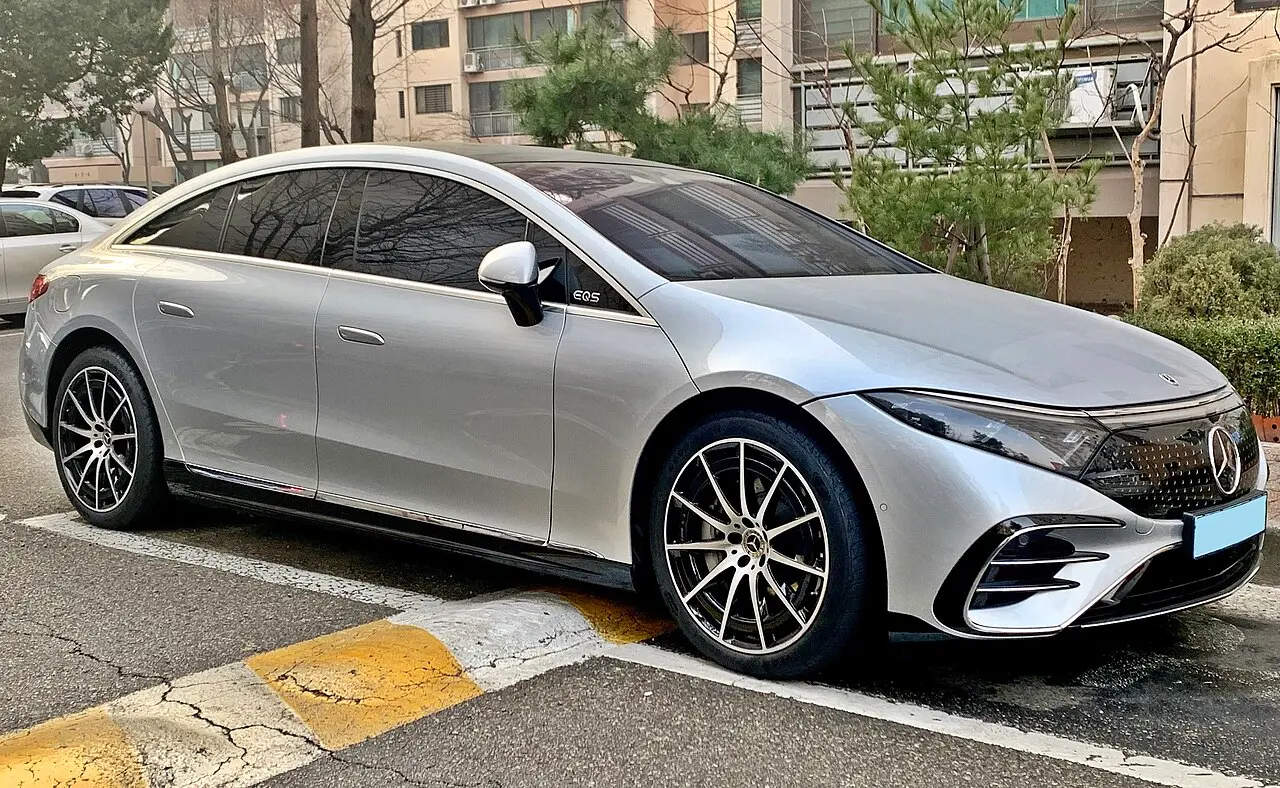
The EQS is a fully electric luxury saloon from Mercedes-Benz’s Mercedes-EQ line. Its smooth, one-bow silhouette and cab-forward layout give it a distinctive shape. Unlike a combustion-engine saloon adapted for electric power, it was designed around an all-electric architecture.
As a large electric saloon, the EQS brings Mercedes-Benz’s luxury-car design approach to battery power. Its long roofline and forward-set cabin shape both the exterior and the passenger space.
Generation and electric power
The EQS generation is V297, introduced in 2021. Its dedicated electric architecture allowed Mercedes-Benz to shape the body and cabin around the electric drivetrain. The resulting design features a one-bow roofline and a cab-forward layout.
EU versions span 210 kW (286 PS) to 484 kW (658 PS). UK listings range from 215 kW (292 PS) to 484 kW (658 PS), while Canadian versions range from 265 kW (360 PS) to 484 kW (658 PS). US listings identify electric versions. Power ranges vary between markets.
How efficient is the EQS?
The EQS is battery-electric, so its efficiency is measured in electricity consumption rather than litres of fuel per 100 kilometres. Its versions differ by market, and fuel-consumption figures do not apply to this car.
For comparisons, European ratings use WLTP or, for older figures, NEDC; the US uses EPA procedures and Canada uses the NRCan 5-cycle test. Those methods differ, so a market’s figures are best read alongside its test procedure.
Where is the EQS sold?
The EQS appears in EU registration figures from 2020 to 2025, UK figures from 2021 to 2026, US figures from 2022 to 2027 and Canadian figures from 2022 to 2026. EU registrations total 22,659. Leading EU versions included electric models rated at 265 kW (360 PS), 245 kW (333 PS) and 385 kW (523 PS).
Questions and answers
Is the EQS fully electric?
Yes. The EQS is a battery-electric luxury saloon.
How many EQS generations are there?
The EQS generation is V297, introduced in 2021.
How much power does the EQS have?
The recorded range depends on market: 210-484 kW in the EU, 215-484 kW in the UK and 265-484 kW in Canada.
Does the EQS have a petrol consumption rating?
No. As an electric car, its efficiency is expressed as electricity consumption rather than litres of fuel per 100 kilometres.
New cars registered in the EU (plus Norway and Iceland), from the European Environment Agency. Figures on the NEDC procedure until 2020 and on WLTP from 2021; versions are grouped by engine and power, with their number of registrations.
Years and version
Engine
Power
Fuel
Consumption (combined)
CO₂
Electric range
EU registrations
2022 - 2025
Electric motor
265 kW (360 PS)
Electric
18.5 - 20.1 kWh/100 km WLTP
0 g/km
624 - 721 km
5,816
2021 - 2025
Electric motor
245 kW (333 PS)
Electric
17.3 - 17.6 kWh/100 km WLTP
0 g/km
705 - 734 km
3,794
2021 - 2025
Electric motor
385 kW (523 PS)
Electric
19.2 - 19.5 kWh/100 km WLTP
0 g/km
642 - 654 km
3,361
2022 - 2025
Electric motor
400 kW (544 PS)
Electric
19.2 - 22.3 kWh/100 km WLTP
0 g/km
547 - 700 km
2,282
2021 - 2025
Electric motor
Not listed
Electric
17.4 - 22.9 kWh/100 km WLTP
0 g/km
542 - 737 km
3,731
2022 - 2025
Electric motor
484 kW (658 PS)
Electric
22.7 - 23.4 kWh/100 km WLTP
0 g/km
534 - 558 km
1,300
2022 - 2025
Electric motor
215 kW (292 PS)
Electric
17.2 - 17.5 kWh/100 km WLTP
0 g/km
601 - 660 km
886
2022 - 2025
Electric motor
330 kW (449 PS)
Electric
19.0 - 19.5 kWh/100 km WLTP
0 g/km
649 - 698 km
678
2021
Electric motor
265 kW (360 PS)
Electric
-
0 g/km
-
80
2021
Electric motor
400 kW (544 PS)
Electric
-
0 g/km
-
80
2021
Electric motor
330 kW (449 PS)
Electric
-
0 g/km
-
68
2021
Electric motor
470 kW (639 PS)
Electric
-
0 g/km
-
56
2021
Electric motor
210 kW (286 PS)
Electric
-
0 g/km
-
50
2021
Electric motor
215 kW (292 PS)
Electric
-
0 g/km
-
14
2021
-
245 kW (333 PS)
Other fuel
17.4 kWh/100 km WLTP
44 g/km
771 km
11
United Kingdom 13 versions
New cars on sale in the UK, from the Vehicle Certification Agency. NEDC figures until 2018 and WLTP figures after; years are the editions a version appeared in.
Years and version
Engine
Power
Fuel
Consumption (combined)
CO₂
Electric range
2024 - 2026EQS 350
Electric motor
215 kW (292 PS)
Electric
16.1 - 19.3 kWh/100 km WLTP
0 g/km
585 - 698 km
2023 - 2026EQS 450+
Electric motor
265 kW (360 PS)
Electric
16.4 - 19.9 kWh/100 km WLTP
0 g/km
627 - 821 km
2023 - 2026EQS 450 4MATIC
Electric motor
265 kW (360 PS)
Electric
17.0 - 24.2 kWh/100 km WLTP
0 g/km
513 - 798 km
2026EQS 400
Electric motor
270 kW (367 PS)
Electric
19.2 kWh/100 km WLTP
0 g/km
681 km
2026EQS 450+
Electric motor
300 kW (408 PS)
Electric
19.2 kWh/100 km WLTP
0 g/km
749 km
2023 - 2026EQS 580 4MATIC
Electric motor
400 kW (544 PS)
Electric
20.0 - 24.2 kWh/100 km WLTP
0 g/km
513 - 673 km
2026EQS 580 4MATIC
Electric motor
430 kW (585 PS)
Electric
19.4 kWh/100 km WLTP
0 g/km
735 km
2025 - 2026Maybach EQS 680
Electric motor
484 kW (658 PS)
Electric
21.8 - 24.1 kWh/100 km WLTP
0 g/km
559 - 618 km
2024Mercedes-AMG EQS 53 4MATIC+
Electric motor
460 kW (625 PS)
Electric
20.9 - 24.2 kWh/100 km WLTP
0 g/km
535 - 626 km
2024Mercedes-Maybach EQS 680
Electric motor
484 kW (658 PS)
Electric
22.0 - 24.1 kWh/100 km WLTP
0 g/km
560 - 611 km
2021 - 2023EQS 450+
Electric motor
245 kW (333 PS)
Electric
15.8 - 19.8 kWh/100 km WLTP
0 g/km
631 - 779 km
2022 - 2023AMG EQS 53 4MATIC+
Electric motor
484 kW (658 PS)
Electric
21.8 - 24.3 kWh/100 km WLTP
0 g/km
513 - 571 km
2023Mercedes-AMG EQS 53 4MATIC+
Electric motor
484 kW (658 PS)
Electric
21.2 - 23.9 kWh/100 km WLTP
0 g/km
505 - 574 km
United States 3 versions
Model years sold in the USA, from the EPA and the Department of Energy (fueleconomy.gov). MPG on the EPA test; litres per 100 km = 235.215 ÷ MPG.
Years and version
Engine
Fuel
Gearbox
Drive
Consumption (combined)
CO₂
Electric range
2022 - 2027
Electric motor
Electric
Automatic
All-wheel drive
76 - 103 MPGe EPA
0 g/km
446 - 597 km
2027
Electric motor
Electric
2-speed automatic
All-wheel drive
112 - 114 MPGe EPA
0 g/km
698 - 713 km
2022 - 2026
Electric motor
Electric
Automatic
Rear-wheel drive
82 - 98 MPGe EPA
0 g/km
491 - 628 km
Canada 6 versions
Model years sold in Canada, from Natural Resources Canada fuel consumption ratings (5-cycle test).
Years and version
Engine
Power
Fuel
Gearbox
Consumption (combined)
CO₂
Electric range
2023 - 2026Full-size
Electric motor
265 kW (360 PS)
Electric
Automatic
20.3 - 22.8 kWh/100 km 5-cycle
0 g/km
547 - 591 km
2023 - 2026Sport utility vehicle: Standard
Electric motor
265 kW (360 PS)
Electric
Automatic
25.2 - 26.7 kWh/100 km 5-cycle
0 g/km
459 - 531 km
2024 - 2026Full-size
Electric motor
400 kW (544 PS)
Electric
Automatic
21.8 - 22.4 kWh/100 km 5-cycle
0 g/km
555 - 597 km
2023 - 2026Sport utility vehicle: Standard
Electric motor
400 kW (544 PS)
Electric
Automatic
25.2 - 27.3 kWh/100 km 5-cycle
0 g/km
459 - 531 km
2023 - 2025Full-size
Electric motor
484 kW (658 PS)
Electric
Automatic
25.5 - 27.9 kWh/100 km 5-cycle
0 g/km
446 - 507 km
2022 - 2023Full-size
Electric motor
385 kW (523 PS)
Electric
Automatic
22.4 - 23.0 kWh/100 km 5-cycle
0 g/km
547 km
Versions outside these generations
European Union 7 versions
New cars registered in the EU (plus Norway and Iceland), from the European Environment Agency. Figures on the NEDC procedure until 2020 and on WLTP from 2021; versions are grouped by engine and power, with their number of registrations.
Years and version
Engine
Power
Fuel
Consumption (combined)
CO₂
EU registrations
2020
Electric motor
385 kW (523 PS)
Electric
-
0 g/km
170
2020
Electric motor
245 kW (333 PS)
Electric
-
0 g/km
134
2020
Electric motor
330 kW (449 PS)
Electric
-
0 g/km
50
2020
Electric motor
210 kW (286 PS)
Electric
-
0 g/km
42
2020
Electric motor
470 kW (639 PS)
Electric
19.9 kWh/100 km NEDC
0 g/km
28
2020
Electric motor
Not listed
Electric
20.9 kWh/100 km NEDC
0 g/km
18
2020
Electric motor
260 kW (354 PS)
Electric
-
0 g/km
10
Mercedes-Benz EQS recalls
34 official safety recalls for the Mercedes-Benz EQS from NHTSA (United States), DVSA (United Kingdom) and the EU Safety Gate, newest first. Recall repairs are normally free at the maker’s dealers.
Reversing warning sound may be incorrect2022 - 2025
Incorrect fuse box may cause power loss or fire2023 - 2024
Mounting brackets may damage side-curtain air bags2023
Battery management software may shut down high-voltage system2023 - 2024
Battery software may cause sudden loss of drive power2023 - 2025
Official figures are measured on standard test procedures and differ between markets. Your consumption depends on how, where and in what conditions you drive.