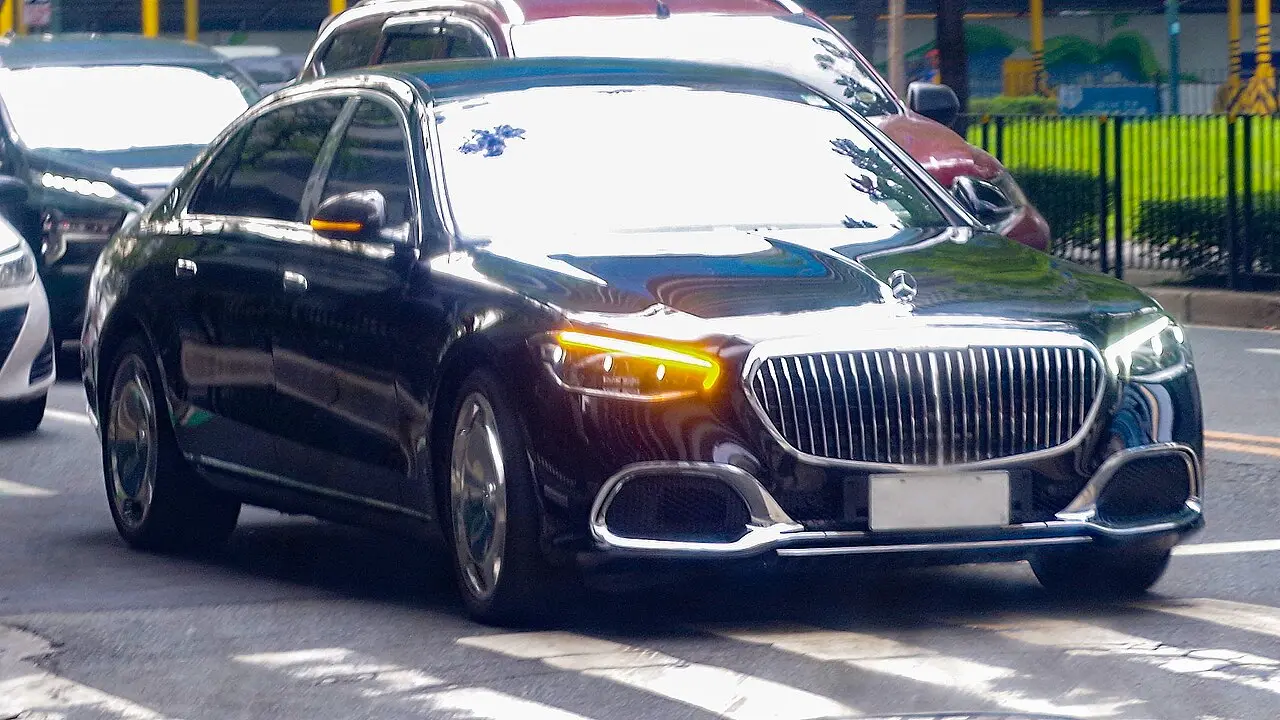
Mercedes-Benz

Mercedes-Benz Maybach

Mercedes-Benz Maybach
Photo: Ethan Llamas / Wikimedia Commons · CC BY-SA 4.0

The official data lists 76 versions of the Mercedes-Benz Maybach (2004–2027), in the European Union, the United Kingdom, France, the United States, and Canada. Each market publishes its own figures, measured on its own test procedure.

At a glance

Years in the data
2004–2027
Markets
European Union, United Kingdom, France, United States, Canada
Engines
4.0 L to 6.0 L
Power
405 kW (551 PS) to 484 kW (658 PS)
Fuels
Petrol, Hybrid, Electric, Plug-in hybrid
Lowest consumption (Canada)
11.3 L/100 km (5-cycle)
Lowest consumption (United States)
12.4 L/100 km (EPA)
Lowest consumption (European Union)
13.6 L/100 km (WLTP)
New registrations in the EU
1,413

What is Mercedes-Maybach?

Mercedes-Maybach is Mercedes-Benz’s luxury line, with the S-Class saloon as one of its best-known models. The current Mercedes-Maybach S-Class is built around the Z223 series and focuses on a spacious, carefully finished cabin, particularly for rear passengers.

The Maybach name has a longer history. Mercedes revived it as a standalone marque in 2002, producing the Maybach 57 and 62 through 2012. The modern Mercedes-Maybach name brings that luxury identity into the Mercedes-Benz range.

Generations and engines

The first modern Maybach generation ran from 2002 to 2012 and included the W240 and V240 models. The current Mercedes-Maybach S-Class generation, identified as I, began in 2021 and uses the Z223 series designation.

Powertrains vary by market and year. EU entries include petrol, hybrid, plug-in hybrid and electric versions. The listed EU engine size is 4.0 litres, with power from 410 kW (557 PS) to 484 kW (658 PS). In North American listings, engine sizes range from 4.0 litres to 6.0 litres.

How economical is Mercedes-Maybach?

Consumption figures depend on the version and the test procedure. The lowest listed EU figure is 13.6 L/100 km on WLTP. The UK figure is 15.9 L/100 km on NEDC, while France’s is 15 L/100 km on NEDC. European WLTP and NEDC procedures differ from the EPA test used in the United States and Canada’s 5-cycle method, so results are best read in their market context.

For the United States, the lowest listed figure is 12.4 L/100 km under EPA, and the best combined rating is 19 MPG. Canada’s lowest listed figure is 11.3 L/100 km under the NRCan 5-cycle test. EU registration figures total 1,413 vehicles from 2010 to 2025, spanning the earlier Maybach era and newer Mercedes-Maybach models.

Where was Mercedes-Maybach sold?

Mercedes-Maybach entries appear in EU, UK, French, US and Canadian figures, with different recorded periods in each market. The name began as a standalone marque and is now used for luxury Mercedes-Benz models, including the S-Class.

Questions and answers

What is the difference between Maybach and Mercedes-Maybach?

Maybach was revived as a standalone marque for the Maybach 57 and 62, produced from 2002 to 2012. Mercedes-Maybach is the name used for luxury Mercedes-Benz models, including the S-Class.

What power does the Mercedes-Maybach range offer?

EU versions range from 410 kW (557 PS) to 484 kW (658 PS).

What is the lowest listed fuel consumption?

The lowest listed figure is 11.3 L/100 km in Canada under the NRCan 5-cycle test.

Which markets have Mercedes-Maybach entries?

Entries appear in the EU, UK, France, US and Canada. Test procedures differ by market, so consumption figures should be read in context.

Maybach I (2002–2012)

Model codes: W240, V240 · References: en.wikipedia.org, autozeitung.de

Show all 27 versions

Maybach I (since 2021)

Mercedes-Benz Maybach I
Photo: Ethan Llamas / Wikimedia Commons · CC BY-SA 4.0

Model codes: Z223 · References: autohints.com, yanase.jp

European Union 18 versions

New cars registered in the EU (plus Norway and Iceland), from the European Environment Agency. Figures on the NEDC procedure until 2020 and on WLTP from 2021; versions are grouped by engine and power, with their number of registrations.

Years and versionEnginePowerFuelConsumption (combined)CO₂Electric rangeEU registrations
20254.0 L410 kW (557 PS)Hybrid13.9 L/100 km WLTP315 g/km–290
20254.0 L430 kW (585 PS)Petrol13.6 L/100 km WLTP310 g/km–154
2025Electric motor484 kW (658 PS)Electric22.4 kWh/100 km WLTP0 g/km560 km103
20254.0 L410 kW (557 PS)Plug-in hybrid13.9 L/100 km WLTP315 g/km–39
20253.0 L300 kW (408 PS)Plug-in hybrid–260 g/km102 km20
20254.0 L430 kW (585 PS)Hybrid–352 g/km–12
20254.0 L450 kW (612 PS)Hybrid–285 g/km–11
20244.0 L410 kW (557 PS)Hybrid14.0 L/100 km WLTP318 g/km–352
2024Electric motor484 kW (658 PS)Electric23.1 kWh/100 km WLTP0 g/km583 km68
20244.0 L430 kW (585 PS)Hybrid–322 g/km–26
20244.0 L450 kW (612 PS)Hybrid–281 g/km–20
2024Electric motor185 kW (252 PS)Electric–0 g/km–19
20244.0 L430 kW (585 PS)Petrol–309 g/km–18
2024Electric motor135 kW (184 PS)Electric–0 g/km–15
20243.0 L300 kW (408 PS)Plug-in hybrid–260 g/km102 km10
2022–2023Electric motor484 kW (658 PS)Electric–0 g/km–29
20234.0 L410 kW (557 PS)Hybrid14.1 L/100 km WLTP315 g/km–23
2023Electric motor135 kW (184 PS)Electric–0 g/km–10

United States 5 versions

Model years sold in the USA, from the EPA and the Department of Energy (fueleconomy.gov). MPG on the EPA test; litres per 100 km = 235.215 ÷ MPG.

Years and versionEngineFuelGearboxDriveConsumption (combined)CO₂
20276.0 LPetrol9-speed automaticAll-wheel drive14 MPG (16.8 L/100 km) EPA379 g/km
2025–20266.0 LPetrol9-speed automaticAll-wheel drive15 MPG (15.7 L/100 km) EPA375 g/km
20246.0 LPetrol9-speed automaticAll-wheel drive15 MPG (15.7 L/100 km) EPA379 g/km
20236.0 LPetrol9-speed automaticAll-wheel drive14 MPG (16.8 L/100 km) EPA384 g/km
20226.0 LPetrol9-speed automaticAll-wheel drive15 MPG (15.7 L/100 km) EPA372 g/km

Canada 14 versions

Model years sold in Canada, from Natural Resources Canada fuel consumption ratings (5-cycle test).

Years and versionEnginePowerFuelGearboxConsumption (combined)CO₂Electric range
2025–2026Full-size4.0 L–Petrol9-speed automatic12.0 L/100 km 5-cycle280 g/km–
2026Two-seater4.0 L–Petrol9-speed automatic14.5 L/100 km 5-cycle347 g/km–
2026Sport utility vehicle: Standard4.0 L–Petrol9-speed automatic15.6 L/100 km 5-cycle364 g/km–
2025–2026Full-size6.0 L–Petrol9-speed automatic16.1 L/100 km 5-cycle375 g/km–
2025Sport utility vehicle: StandardElectric motor484 kW (658 PS)ElectricAutomatic27.3 kWh/100 km 5-cycle0 g/km486 km
2024Sport utility vehicle: StandardElectric motor484 kW (658 PS)ElectricAutomatic25.9 kWh/100 km 5-cycle0 g/km517 km
2024Full-size4.0 L–Petrol9-speed automatic11.3 L/100 km 5-cycle266 g/km–
2024Full-size6.0 L–Petrol9-speed automatic16.1 L/100 km 5-cycle379 g/km–
2023Full-size4.0 L–Petrol9-speed automatic13.0 L/100 km 5-cycle305 g/km–
2023Full-size6.0 L–Petrol9-speed automatic16.4 L/100 km 5-cycle384 g/km–
2022Full-size4.0 L–Petrol9-speed automatic12.9 L/100 km 5-cycle301 g/km–
2022Full-size6.0 L–Petrol9-speed automatic15.7 L/100 km 5-cycle369 g/km–
2021Sport utility vehicle: Standard4.0 L–Petrol9-speed automatic14.8 L/100 km 5-cycle346 g/km–
2021Full-size4.0 L–Petrol9-speed automatic12.9 L/100 km 5-cycle301 g/km–

Versions outside these generations

European Union 1 version

New cars registered in the EU (plus Norway and Iceland), from the European Environment Agency. Figures on the NEDC procedure until 2020 and on WLTP from 2021; versions are grouped by engine and power, with their number of registrations.

Years and versionEnginePowerFuelCO₂EU registrations
20136.0 L463 kW (630 PS)Petrol368 g/km10

United States 6 versions

Model years sold in the USA, from the EPA and the Department of Energy (fueleconomy.gov). MPG on the EPA test; litres per 100 km = 235.215 ÷ MPG.

Years and versionEngineFuelGearboxDriveConsumption (combined)CO₂
2018–20206.0 LPetrol7-speed automaticRear-wheel drive16 MPG (14.7 L/100 km) EPA355 g/km
2018–2019SIDI4.0 LPetrol9-speed automaticFour-wheel drive19 MPG (12.4 L/100 km) EPA283 g/km
2017SIDI4.7 LPetrol9-speed automaticFour-wheel drive19 MPG (12.4 L/100 km) EPA290 g/km
20176.0 LPetrol7-speed automaticRear-wheel drive16 MPG (14.7 L/100 km) EPA351 g/km
20176.0 LPetrol7-speed automaticRear-wheel drive16 MPG (14.7 L/100 km) EPA349 g/km
20166.0 LPetrol7-speed automaticRear-wheel drive15 MPG (15.7 L/100 km) EPA357 g/km

Canada 5 versions

Model years sold in Canada, from Natural Resources Canada fuel consumption ratings (5-cycle test).

Years and versionEngineFuelGearboxConsumption (combined)CO₂
2019–2020Full-size4.0 LPetrol9-speed automatic12.2 L/100 km 5-cycle286 g/km
2019–2020Full-size6.0 LPetrol7-speed automatic15.1 L/100 km 5-cycle355 g/km
2018Full-size6.0 LPetrol9-speed automatic15.1 L/100 km 5-cycle355 g/km
2017Full-size6.0 LPetrol7-speed automatic15.0 L/100 km 5-cycle359 g/km
2016Full-size6.0 LPetrol7-speed automatic15.3 L/100 km 5-cycle359 g/km

Official figures are measured on standard test procedures and differ between markets. Your consumption depends on how, where and in what conditions you drive.