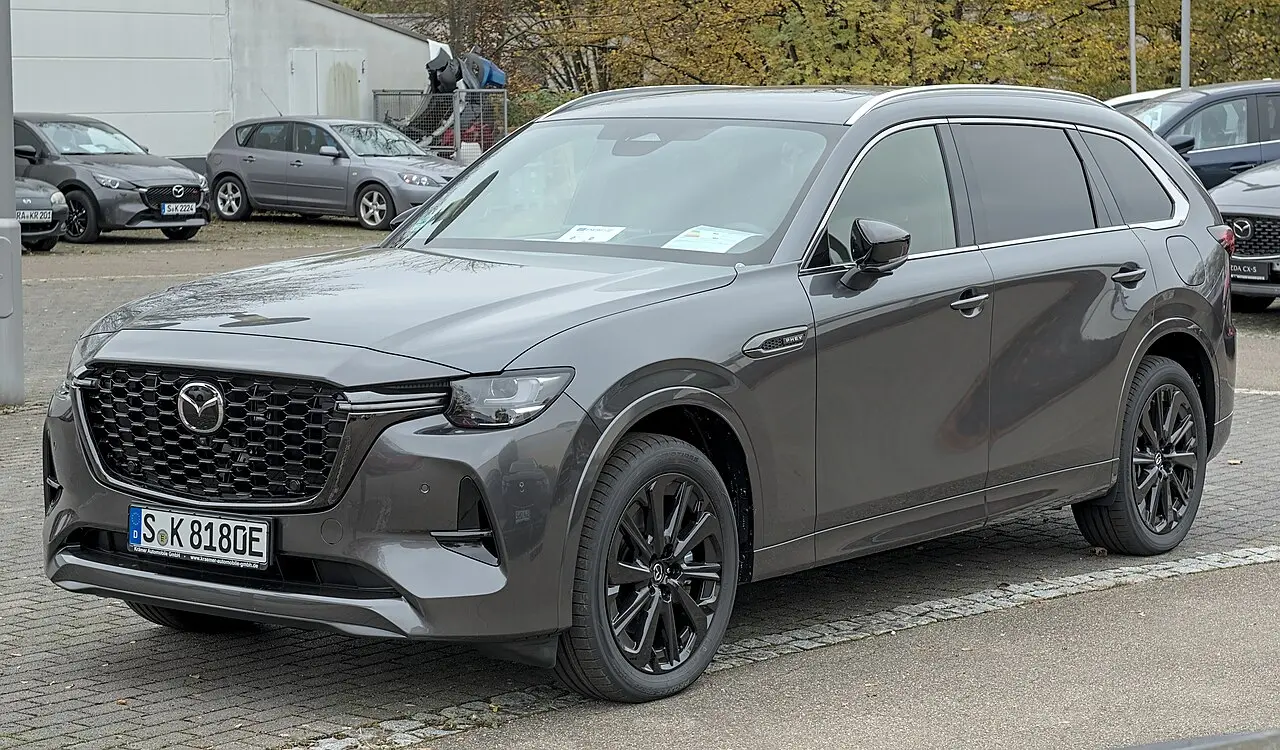
The official data lists 17 versions of the Mazda CX-80 (2024 - 2026), in the European Union and the United Kingdom. Each market publishes its own figures, measured on its own test procedure.
At a glance
Years in the data
2024 - 2026
Markets
European Union, United Kingdom
Engines
2.5 L to 3.3 L
Power
183 kW (249 PS) to 241 kW (328 PS)
Fuels
Plug-in hybrid, Hybrid, Diesel
Lowest consumption (United Kingdom)
5.6 L/100 km (WLTP)
Lowest consumption (European Union)
5.8 L/100 km (WLTP)
Plug-in hybrid, weighted (European Union)
1.6 L/100 km (WLTP)
New registrations in the EU
9,768
What is the Mazda CX-80?
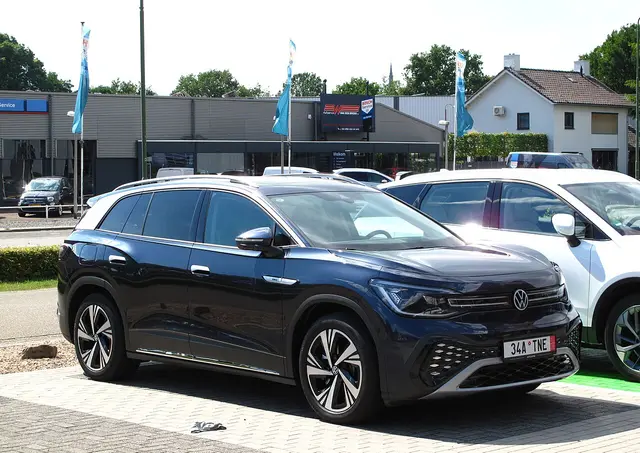
The CX-80 is a large SUV with three rows of seats, designed for families who need space for passengers and luggage. Mazda calls it its first three-row SUV for Europe and the flagship of its European range. It is part of the maker’s large-vehicle line-up, with plug-in hybrid, hybrid and diesel options in the EU.
This is the first generation, introduced in 2025. Mazda unveiled it in Europe in 2024 as a spacious addition to its SUV range. Depending on the version, the cabin can seat six or seven people.
Engines and power
In the EU, the CX-80 has engines ranging from 2.5 L to 3.3 L, with plug-in hybrid, hybrid and diesel versions. Official power figures run from 183 kW (249 PS) to 187 kW (254 PS). UK figures cover 2.5 L to 3.3 L engines and plug-in hybrid and hybrid versions, with power from 187 kW (254 PS) to 241 kW (328 PS).
How economical is the Mazda CX-80?
The lowest listed EU consumption for diesel and hybrid versions is 5.8 L/100 km on the WLTP test. The plug-in hybrid’s lowest official weighted figure is 1.6 L/100 km WLTP; it assumes some driving is electric.
These figures are shaped by the test procedure and, for plug-in hybrids, the assumed amount of electric driving. WLTP is used for both sets of European figures.
Where was the CX-80 sold?
EU registration figures cover 2024 to 2025, while UK specifications cover 2024 to 2026. There were 9,768 EU registrations.
Questions and answers
Is the Mazda CX-80 a seven-seat SUV?
It has three rows and is available with six or seven seats, depending on the version and market.
What powertrains does the CX-80 offer?
The EU range includes plug-in hybrid, hybrid and diesel versions. UK figures cover plug-in hybrid and hybrid versions.
What is the CX-80’s lowest official consumption?
The lowest EU figure is 1.6 L/100 km WLTP for the plug-in hybrid. This weighted result assumes some driving is electric.
When did the CX-80 arrive in Europe?
Mazda unveiled it in Europe in 2024. EU registration figures cover 2024 and 2025.
New cars registered in the EU (plus Norway and Iceland), from the European Environment Agency. Figures on the NEDC procedure until 2020 and on WLTP from 2021; versions are grouped by engine and power, with their number of registrations.
Years and version
Engine
Power
Fuel
Consumption (combined)
CO₂
Electric range
EU registrations
2024 - 2025
2.5 L
-
Plug-in hybrid
1.6 - 1.7 L/100 km WLTP23.5 - 23.8 kWh/100 km WLTP
36 - 38 g/km
60 - 64 km
5,256
2024 - 2025
3.3 L
187 kW (254 PS)
Hybrid
5.8 L/100 km WLTP
150 - 151 g/km
-
4,053
2024 - 2025
3.3 L
183 kW (249 PS)
Hybrid
5.8 L/100 km WLTP
150 - 151 g/km
-
287
2025
3.3 L
Not listed
Diesel
5.8 L/100 km WLTP
149 g/km
-
101
2025
3.3 L
187 kW (254 PS)
Hybrid
5.8 L/100 km WLTP
151 g/km
-
36
2025
2.5 L
Not listed
Hybrid
-
184 g/km
-
35
United Kingdom 11 versions
New cars on sale in the UK, from the Vehicle Certification Agency. NEDC figures until 2018 and WLTP figures after; years are the editions a version appeared in.
Years and version
Engine
Power
Fuel
Gearbox
Consumption (combined)
CO₂
Electric range
2026Mazda CX-80 2.5 327ps AWD Homura Plus Auto / Tan Nappa / Captain / Tech / Pano (03/26) · Mazda CX-80 2.5 327ps AWD Homura Plus Auto / Blk Nappa / Tech / Pano (03/26)
2.5 L
Not listed
Plug-in hybrid
8-speed automatic
8.1 L/100 km WLTP24.4 kWh/100 km WLTP
184 g/km
59 km
2026Mazda CX-80 2.5 327ps AWD Homura Auto / Blk Nappa (03/26) · Mazda CX-80 2.5 327ps AWD Takumi Plus Auto / Wht Nappa / Tech / Pano (03/26)
Official figures are measured on standard test procedures and differ between markets. Your consumption depends on how, where and in what conditions you drive.