Mazda CX-90

Mazda CX-90
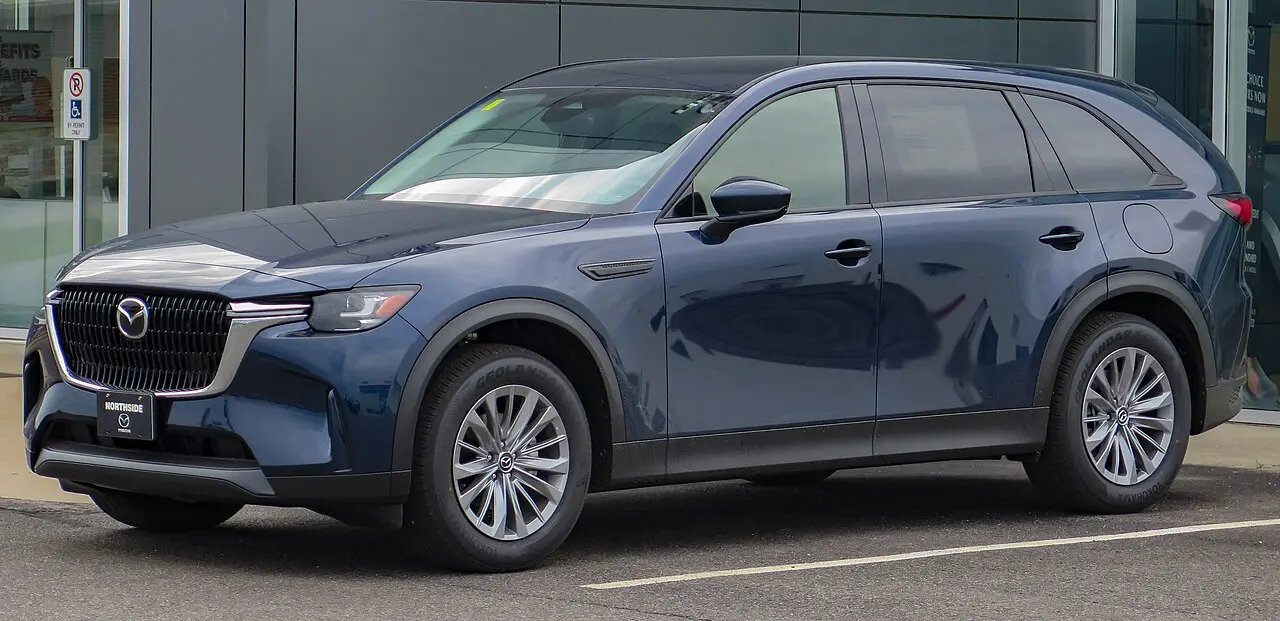
Photo: Elise240SX / Wikimedia Commons · CC BY-SA 4.0

The official data lists 4 versions of the Mazda CX-90 (2024 - 2026), in the United States and Canada. Each market publishes its own figures, measured on its own test procedure.

At a glance

Years in the data
2024 - 2026
Markets
United States, Canada
Engines
2.5 L to 3.3 L
Fuels
Plug-in hybrid, Hybrid, Petrol
Lowest consumption (Canada)
9.3 L/100 km (5-cycle)
Lowest consumption (United States)
9.4 L/100 km (EPA)

What is the Mazda CX-90?

The CX-90 is Mazda’s large, three-row SUV, with space for family passengers and longer journeys. It sits among the brand’s flagship models and wears Mazda’s Kodo design, with a broad stance and clean lines.

Introduced for the 2024 model year, the CX-90 was developed with North American drivers in mind. Its three rows and spacious cabin make it a natural fit for families who need room for passengers and luggage.

Generations, engines and power

The CX-90 is in its first generation, which began in 2024 and continues today. It brought a new platform and electrified powertrains to Mazda’s large SUV range.

The engine sizes span 2.5 L to 3.3 L. The range includes a turbocharged 3.3 L inline-six with a 48-volt mild-hybrid system and a plug-in hybrid that pairs a 2.5 L petrol engine with electric drive. The inline-six gives the CX-90 a smooth, traditional engine feel, while the plug-in hybrid can use electric power for some journeys.

How economical is the Mazda CX-90?

In the United States, EPA figures cover model years 2024-2026. The best combined rating is 25 MPG.

The United States uses EPA testing, while Canada uses the 5-cycle method. European figures use WLTP or NEDC procedures, so ratings from different markets are not directly equivalent. A plug-in hybrid’s weighted figure assumes electric driving; actual fuel use depends on charging and how the vehicle is driven.

Questions and answers

What kind of vehicle is the Mazda CX-90?

It is a large SUV with three rows of seats.

What engines are available?

The range includes a 3.3 L turbocharged inline-six mild hybrid and a plug-in hybrid with a 2.5 L petrol engine.

What is the CX-90’s best combined EPA rating?

The best combined rating is 25 MPG.

Where is the CX-90 sold in these figures?

The figures cover the United States and Canada.

CX-90 first generation (since 2024)

Mazda CX-90 first generation
Photo: Elise240SX / Wikimedia Commons · CC BY-SA 4.0

Sold in: United States and Canada · References: en.wikipedia.org

At a glance: Length 5,100 - 5,121 mm · Kerb weight 2,136 - 2,378 kg · Top speed 204 km/h Specifications, reliability and all versions

United States 2 versions

Model years sold in the USA, from the EPA and the Department of Energy (fueleconomy.gov). MPG on the EPA test; litres per 100 km = 235.215 ÷ MPG.

Years and versionEngineFuelGearboxDriveConsumption (combined)CO₂
2024 - 2026SIDI; PHEV2.5 LPlug-in hybrid8-speed automaticFour-wheel drive25 - 26 MPG (9.0 - 9.4 L/100 km) EPA99 - 104 g/km
2024 - 2026SIDI; Mild Hybrid3.3 LHybrid8-speed automaticFour-wheel drive25 MPG (9.4 L/100 km) EPA220 - 222 g/km

Canada 2 versions

Model years sold in Canada, from Natural Resources Canada fuel consumption ratings (5-cycle test).

Years and versionEngineFuelGearboxConsumption (combined)CO₂Electric range
2024 - 2026Sport utility vehicle: Standard2.5 LPlug-in hybrid8-speed automatic9.2 - 9.4 L/100 km 5-cycle99 - 105 g/km42 - 43 km
2024 - 2026Sport utility vehicle: Standard3.3 LPetrol8-speed automatic9.3 - 9.5 L/100 km 5-cycle216 - 222 g/km -

Mazda CX-90 recalls

11 official safety recalls for the Mazda CX-90 from NHTSA (United States), DVSA (United Kingdom) and the EU Safety Gate, newest first. Recall repairs are normally free at the maker’s dealers.

  • Fuel gauge may show an inaccurate reading2024 - 2025
  • Inverter software may cause loss of drive power2024
  • Engine may not restart after idle stop2024
  • Engine software may cause loss of drive power2024
  • Dash electrical unit may not function properly2024 - 2025

See all 11 recalls

Official figures are measured on standard test procedures and differ between markets. Your consumption depends on how, where and in what conditions you drive.