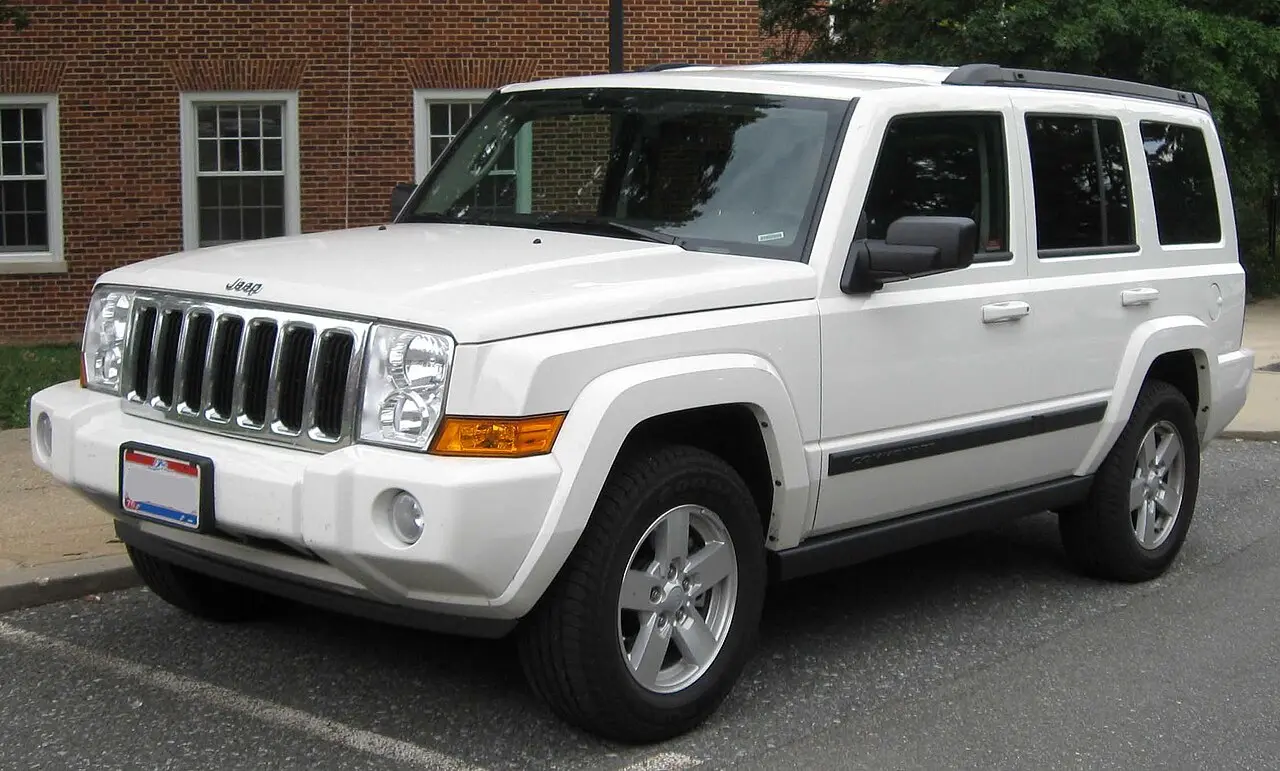
The official data lists 39 versions of the Jeep Commander (2006–2011), in the European Union, the United Kingdom, the United States, and Canada. Each market publishes its own figures, measured on its own test procedure.
At a glance
Years in the data
2006–2011
Markets
European Union, United Kingdom, United States, Canada
Engines
3.0 L to 5.7 L
Fuels
Diesel, Petrol, Flex fuel (E85)
Lowest consumption (United Kingdom)
10.8 L/100 km (NEDC)
Lowest consumption (Canada)
14.6 L/100 km (5-cycle)
Lowest consumption (United States)
14.7 L/100 km (EPA)
New registrations in the EU
454
What is the Jeep Commander?
The Jeep Commander is a large, boxy SUV with three rows of seats. Introduced as a seven-passenger four-wheel-drive Jeep, it brought an extra row to the brand’s lineup. It shared its platform with the Grand Cherokee, while a stepped roof and stadium-style seating made room for passengers in back.
Generations and engines
The Commander had one generation, the XK, sold from 2006 to 2010. Its upright windscreen, squared sides and stepped roof gave it a distinctive profile among Jeep SUVs of the period.
Engine choice varied by market. US and Canadian versions covered petrol engines from 3.7 L to 5.7 L, with flex-fuel E85 options. UK versions ranged from 3.0 L to 5.7 L. EU registration figures include 3.0 L diesel and 4.7 L petrol Commanders, as well as a 3.0 L diesel rated at 155 kW (211 PS) in 2011.
Fuel consumption and markets
Official ratings vary by market and test procedure. The lowest listed UK figure is 10.8 L/100 km on the NEDC test. The best combined EPA rating is 16 MPG; the listed US consumption figure is 14.7 L/100 km. Canada’s lowest listed figure is 14.6 L/100 km on the NRCan 5-cycle test. These results use different procedures and are not directly comparable.
The Commander appeared in the United States, Canada, the UK and the EU. UK figures cover 2007–2009, while EU registrations cover 2010–2011. In the EU figures, the 3.0 L diesel was the most common listed configuration.
Questions and answers
How many generations of Jeep Commander were there?
One: the XK generation, sold from 2006 to 2010.
Was the Jeep Commander a seven-seat SUV?
Yes. Jeep introduced it as a seven-passenger four-wheel-drive model.
What was the Commander’s best listed fuel economy?
The best combined EPA rating was 16 MPG. UK NEDC and Canadian 5-cycle ratings use different test procedures.
Model codes: XK, XH · Sold in: United States, Canada, European Union, and United Kingdom · References: jeep.com, en.wikipedia.org
European Union 4 versions
New cars registered in the EU (plus Norway and Iceland), from the European Environment Agency. Figures on the NEDC procedure until 2020 and on WLTP from 2021; versions are grouped by engine and power, with their number of registrations.
Years and version
Engine
Fuel
CO₂
EU registrations
2010
3.0 L
Diesel
275 g/km
392
2010
4.7 L
Petrol
332 g/km
26
2010
5.7 L
Petrol
370 g/km
12
2010
–
Other fuel
284 g/km
10
United Kingdom 3 versions
New cars on sale in the UK, from the Vehicle Certification Agency. NEDC figures until 2018 and WLTP figures after; years are the editions a version appeared in.
Years and version
Engine
Fuel
Gearbox
Consumption (combined)
CO₂
2007–20093.0 CRD · 3.0crd
3.0 L
Diesel
5-speed automatic
10.8 L/100 km NEDC
284 g/km
2008–20095.7
5.7 L
Petrol
5-speed automatic
15.6 L/100 km NEDC
377 g/km
20075.7
5.7 L
Petrol
5-speed automatic
15.9 L/100 km NEDC
377 g/km
United States 22 versions
Model years sold in the USA, from the EPA and the Department of Energy (fueleconomy.gov). MPG on the EPA test; litres per 100 km = 235.215 ÷ MPG.
Years and version
Engine
Fuel
Gearbox
Drive
Consumption (combined)
CO₂
2009–2010
3.7 L
Petrol
5-speed automatic
Rear-wheel drive
16 MPG (14.7 L/100 km) EPA
345 g/km
2010
3.7 L
Petrol
5-speed automatic
Four-wheel drive
16 MPG (14.7 L/100 km) EPA
345 g/km
2009–2010
5.7 L
Petrol
5-speed automatic
Rear-wheel drive
16 MPG (14.7 L/100 km) EPA
345 g/km
2010
5.7 L
Petrol
5-speed automatic
Four-wheel drive
15 MPG (15.7 L/100 km) EPA
368 g/km
2008–2009CLKUP
3.7 L
Petrol
5-speed automatic
Four- or all-wheel drive
16 MPG (14.7 L/100 km) EPA
345 g/km
2008–2009GAS 340, CLKUP · GAS 340, CMODE
4.7 L
Flex fuel (E85)
5-speed automatic
Rear-wheel drive
15 MPG (15.7 L/100 km) EPA
368 g/km
2009CMODE
4.7 L
Petrol
5-speed automatic
Rear-wheel drive
15 MPG (15.7 L/100 km) EPA
368 g/km
2009CMODE
4.7 L
Petrol
5-speed automatic
Four- or all-wheel drive
15 MPG (15.7 L/100 km) EPA
368 g/km
2009GAS 340, CMODE
4.7 L
Flex fuel (E85)
5-speed automatic
Four- or all-wheel drive
15 MPG (15.7 L/100 km) EPA
368 g/km
2009
5.7 L
Petrol
5-speed automatic
Four- or all-wheel drive
15 MPG (15.7 L/100 km) EPA
368 g/km
2007–2008CLKUP
3.7 L
Petrol
5-speed automatic
Rear-wheel drive
16 MPG (14.7 L/100 km) EPA
345 g/km
2008GAS 340, CLKUP
4.7 L
Flex fuel (E85)
5-speed automatic
Four- or all-wheel drive
14 MPG (16.8 L/100 km) EPA
394 g/km
2006–2008CLKUP
5.7 L
Petrol
5-speed automatic
Four- or all-wheel drive
14 MPG (16.8 L/100 km) EPA
394 g/km
2008CLKUP
5.7 L
Petrol
5-speed automatic
Rear-wheel drive
15 MPG (15.7 L/100 km) EPA
368 g/km
2007CLKUP
3.7 L
Petrol
5-speed automatic
Four- or all-wheel drive
15 MPG (15.7 L/100 km) EPA
368 g/km
2007CLKUP
4.7 L
Flex fuel (E85)
5-speed automatic
Rear-wheel drive
15 MPG (15.7 L/100 km) EPA
368 g/km
2007CLKUP
4.7 L
Flex fuel (E85)
5-speed automatic
Four- or all-wheel drive
15 MPG (15.7 L/100 km) EPA
368 g/km
2006–2007CLKUP
5.7 L
Petrol
5-speed automatic
Rear-wheel drive
15 MPG (15.7 L/100 km) EPA
368 g/km
2006CLKUP
3.7 L
Petrol
5-speed automatic
Rear-wheel drive
16 MPG (14.7 L/100 km) EPA
345 g/km
2006CLKUP
3.7 L
Petrol
5-speed automatic
Four- or all-wheel drive
16 MPG (14.7 L/100 km) EPA
345 g/km
2006CLKUP
4.7 L
Petrol
5-speed automatic
Rear-wheel drive
15 MPG (15.7 L/100 km) EPA
368 g/km
2006CLKUP
4.7 L
Petrol
5-speed automatic
Four- or all-wheel drive
15 MPG (15.7 L/100 km) EPA
368 g/km
Canada 9 versions
Model years sold in Canada, from Natural Resources Canada fuel consumption ratings (5-cycle test).
Years and version
Engine
Fuel
Gearbox
Consumption (combined)
CO₂
2008–2010Sport utility vehicle
3.7 L
Petrol
5-speed automatic
14.6 L/100 km 5-cycle
336 g/km
2009–2010Sport utility vehicle
5.7 L
Petrol
5-speed automatic
15.2 L/100 km 5-cycle
350 g/km
2008–2009Sport utility vehicle
4.7 L
Flex fuel (E85)
5-speed automatic
20.5 L/100 km 5-cycle
328 g/km
2009Sport utility vehicle
4.7 L
Petrol
5-speed automatic
15.2 L/100 km 5-cycle
350 g/km
2006–2008Sport utility vehicle
4.7 L
Petrol
5-speed automatic
15.2 L/100 km 5-cycle
350 g/km
2008Sport utility vehicle
5.7 L
Petrol
5-speed automatic
15.8 L/100 km 5-cycle
363 g/km
2006–2007Sport utility vehicle
3.7 L
Petrol
5-speed automatic
14.8 L/100 km 5-cycle
340 g/km
2007Sport utility vehicle
4.7 L
Flex fuel (E85)
5-speed automatic
23.1 L/100 km 5-cycle
370 g/km
2006–2007Sport utility vehicle
5.7 L
Petrol
5-speed automatic
16.0 L/100 km 5-cycle
368 g/km
Versions outside these generations
European Union 1 version
New cars registered in the EU (plus Norway and Iceland), from the European Environment Agency. Figures on the NEDC procedure until 2020 and on WLTP from 2021; versions are grouped by engine and power, with their number of registrations.
Years and version
Engine
Power
Fuel
CO₂
EU registrations
2011
3.0 L
155 kW (211 PS)
Diesel
284 g/km
14
Official figures are measured on standard test procedures and differ between markets. Your consumption depends on how, where and in what conditions you drive.