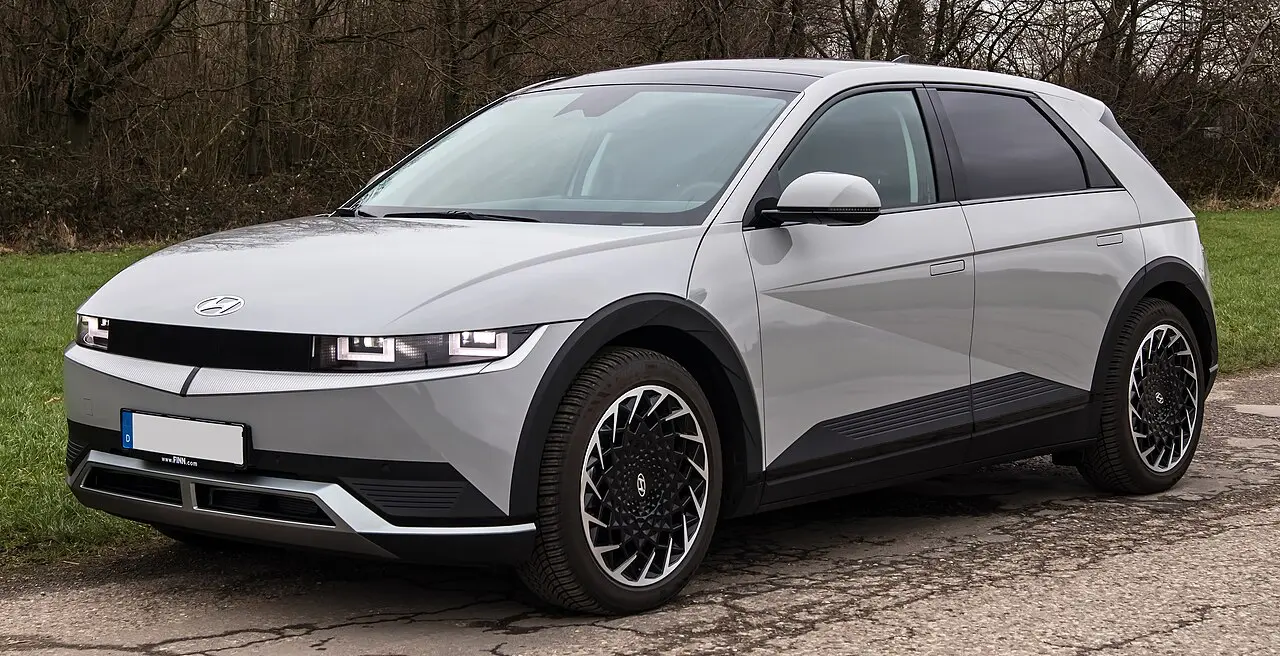
The official data lists 49 versions of the Hyundai IONIQ 5 (2021 - 2027), in the European Union, the United Kingdom, the United States, and Canada. Each market publishes its own figures, measured on its own test procedure.
At a glance
Years in the data
2021 - 2027
Markets
European Union, United Kingdom, United States, Canada
Power
110 kW (150 PS) to 478 kW (650 PS)
Fuels
Electric
New registrations in the EU
125,897
What is the Hyundai IONIQ 5?
The Hyundai IONIQ 5 is a fully electric crossover with a raised stance and angular design. Launched in 2021, it was the first model in Hyundai’s IONIQ electric-car brand. Its pixel-inspired lighting gives it a distinctive look, while its dedicated electric platform allows a flat cabin floor and a flexible interior layout.
The first generation began in 2021 and continues today. The IONIQ 5 brought Hyundai’s E-GMP electric platform to the IONIQ line. Its vehicle-to-load feature can supply electricity to compatible equipment.
Engines and power
Every IONIQ 5 is electric, with no petrol or diesel engine. Recorded power ranges vary by market: 110 kW (150 PS) to 478 kW (650 PS) in EU listings, 125 kW (170 PS) to 478 kW (650 PS) in the UK, and 125 kW (170 PS) to 478 kW (650 PS) in Canada.
Where is the IONIQ 5 sold?
EU registration figures cover 2021 to 2025, with 125,897 cars registered. UK listings cover 2021 to 2026, US listings cover 2022 to 2027, and Canadian listings cover 2022 to 2026. The versions and power ratings listed differ between markets.
How is the IONIQ 5’s efficiency measured?
As a battery electric car, the IONIQ 5 uses electricity rather than petrol or diesel, so fuel consumption in litres per 100 km does not describe its energy use. Test procedures differ by market: Europe uses WLTP, the US uses EPA methods and Canada uses its 5-cycle procedure. Results from these tests are not directly equivalent.
Questions and answers
Is the Hyundai IONIQ 5 a hybrid?
No. The IONIQ 5 listings for the EU, UK, US and Canada are for fully electric versions.
When did the IONIQ 5 generation begin?
Its first generation began in 2021 and continues today.
What is the IONIQ 5’s power range?
EU listings span 110 kW (150 PS) to 478 kW (650 PS); the UK range is 125 kW (170 PS) to 478 kW (650 PS).
At a glance: Length 4,640 - 4,660 mm · Kerb weight 1,805 - 2,020 kg · Top speed 185 - 260 km/h · MOT first-time pass at 3 years: 96.5% (UK average 92.2%) Specifications, reliability and all versions
Show all 49 versions
European Union 18 versions
New cars registered in the EU (plus Norway and Iceland), from the European Environment Agency. Figures on the NEDC procedure until 2020 and on WLTP from 2021; versions are grouped by engine and power, with their number of registrations.
Years and version
Engine
Power
Fuel
Consumption (combined)
CO₂
Electric range
EU registrations
2022 - 2025
Electric motor
168 kW (228 PS)
Electric
16.1 - 17.2 kWh/100 km WLTP
0 g/km
501 - 562 km
35,991
2021 - 2025
Electric motor
160 kW (218 PS)
Electric
16.8 - 17.3 kWh/100 km WLTP
0 g/km
468 - 478 km
31,033
2022 - 2025
Electric motor
239 kW (325 PS)
Electric
18.1 - 18.3 kWh/100 km WLTP
0 g/km
471 - 516 km
17,778
2021 - 2025
Electric motor
125 kW (170 PS)
Electric
16.1 - 16.7 kWh/100 km WLTP
0 g/km
384 - 426 km
11,619
2024 - 2025
Electric motor
478 kW (650 PS)
Electric
21.2 - 21.8 kWh/100 km WLTP
0 g/km
442 - 448 km
3,241
2021 - 2025
Electric motor
124 kW (169 PS)
Electric
16.1 - 16.7 kWh/100 km WLTP
0 g/km
384 - 432 km
3,204
2021 - 2025
Electric motor
Not listed
Electric
17.2 - 18.5 kWh/100 km WLTP
0 g/km
441 - 526 km
11,676
2025
Electric motor
159 kW (216 PS)
Electric
21.2 kWh/100 km WLTP
0 g/km
448 km
57
2024
Electric motor
172 kW (234 PS)
Electric
18.1 kWh/100 km WLTP
0 g/km
360 km
30
2021 - 2023
Electric motor
225 kW (306 PS)
Electric
18.1 - 18.7 kWh/100 km WLTP
0 g/km
437 - 450 km
5,033
2021 - 2023
Electric motor
173 kW (235 PS)
Electric
18.1 kWh/100 km WLTP
0 g/km
360 - 362 km
659
2023
Electric motor
135 kW (184 PS)
Electric
19.1 kWh/100 km WLTP
0 g/km
454 km
28
2023
Electric motor
140 kW (190 PS)
Electric
19.0 kWh/100 km WLTP
0 g/km
457 km
26
2023
Electric motor
240 kW (326 PS)
Electric
19.1 kWh/100 km WLTP
0 g/km
454 km
15
2023
Electric motor
150 kW (204 PS)
Electric
17.6 kWh/100 km WLTP
0 g/km
480 km
14
2021 - 2022
Electric motor
224 kW (305 PS)
Electric
17.9 - 18.2 kWh/100 km WLTP
0 g/km
450 - 457 km
527
2022
Electric motor
110 kW (150 PS)
Electric
17.9 kWh/100 km WLTP
0 g/km
447 km
120
2021
Electric motor
154 kW (209 PS)
Electric
18.7 kWh/100 km WLTP
0 g/km
436 km
4,846
United Kingdom 22 versions
New cars on sale in the UK, from the Vehicle Certification Agency. NEDC figures until 2018 and WLTP figures after; years are the editions a version appeared in.
2025 - 2026IONIQ 5 ULT 77 KWH AWD MY23 · IONIQ 5 NAMSAN 77 KWH AWD MY23 · IONIQ 5 NAMSAN 77 KWH AWD MY24 and 1 more trim
Electric motor
240 kW (326 PS)
Electric
19.1 kWh/100 km WLTP
0 g/km
454 km
2025 - 2026IONIQ 5 ULT 84KWH AWD MY25
Electric motor
240 kW (326 PS)
Electric
18.2 kWh/100 km WLTP
0 g/km
500 km
2024 - 2026IONIQ 5 N · IONIQ 5 N 84 KWH AWD MY24 · IONIQ 5 N 84 KWH AWD MY25 and 1 more trim
Electric motor
478 kW (650 PS)
Electric
21.2 kWh/100 km WLTP
0 g/km
448 km
2023 - 2024Premium AWD
Electric motor
239 kW (325 PS)
Electric
17.9 kWh/100 km WLTP
0 g/km
481 km
2023 - 2024Ultimate AWD · Namsan AWD
Electric motor
239 kW (325 PS)
Electric
19.1 kWh/100 km WLTP
0 g/km
454 km
2021 - 2022Premium · SE Connect · Ultimate
Electric motor
125 kW (170 PS)
Electric
16.7 kWh/100 km WLTP
0 g/km
384 km
2021 - 2022Premium AWD
Electric motor
155 kW (211 PS)
Electric
17.7 kWh/100 km WLTP
0 g/km
460 km
2021 - 2022Ultimate AWD
Electric motor
155 kW (211 PS)
Electric
19.0 kWh/100 km WLTP
0 g/km
430 km
2021 - 2022Premium
Electric motor
160 kW (218 PS)
Electric
16.8 kWh/100 km WLTP
0 g/km
481 km
2021 - 2022Ultimate
Electric motor
160 kW (218 PS)
Electric
17.9 kWh/100 km WLTP
0 g/km
451 km
United States 2 versions
Model years sold in the USA, from the EPA and the Department of Energy (fueleconomy.gov). MPG on the EPA test; litres per 100 km = 235.215 ÷ MPG.
Years and version
Engine
Fuel
Gearbox
Drive
Consumption (combined)
CO₂
Electric range
2022 - 2027
Electric motor
Electric
Automatic
All-wheel drive
78 - 106 MPGe EPA
0 g/km
356 - 467 km
2022 - 2027
Electric motor
Electric
Automatic
Rear-wheel drive
71 - 115 MPGe EPA
0 g/km
270 - 512 km
Canada 7 versions
Model years sold in Canada, from Natural Resources Canada fuel consumption ratings (5-cycle test).
Years and version
Engine
Power
Fuel
Gearbox
Consumption (combined)
CO₂
Electric range
2025 - 2026Sport utility vehicle: Small
Electric motor
168 kW (228 PS)
Electric
Automatic
16.9 kWh/100 km 5-cycle
0 g/km
504 km
2024 - 2026Sport utility vehicle: Small
Electric motor
239 kW (325 PS)
Electric
Automatic
20.1 - 22.2 kWh/100 km 5-cycle
0 g/km
410 - 463 km
2025 - 2026Sport utility vehicle: Small
Electric motor
478 kW (650 PS)
Electric
Automatic
26.7 kWh/100 km 5-cycle
0 g/km
356 km
2025Sport utility vehicle: Small
Electric motor
125 kW (170 PS)
Electric
Automatic
18.5 kWh/100 km 5-cycle
0 g/km
373 km
2022 - 2024Full-size · Sport utility vehicle: Small
Electric motor
168 kW (228 PS)
Electric
Automatic
18.6 kWh/100 km 5-cycle
0 g/km
488 km
2022 - 2023Full-size
Electric motor
125 kW (170 PS)
Electric
Automatic
19.3 kWh/100 km 5-cycle
0 g/km
354 km
2022 - 2023Full-size
Electric motor
239 kW (325 PS)
Electric
Automatic
21.0 - 21.3 kWh/100 km 5-cycle
0 g/km
414 - 422 km
Hyundai IONIQ 5 recalls
21 official safety recalls for the Hyundai IONIQ 5 from NHTSA (United States), DVSA (United Kingdom) and the EU Safety Gate, newest first. Recall repairs are normally free at the maker’s dealers.
High-voltage battery module may have misaligned electrodes2021 - 2023
High-voltage battery cells may cause a fire2023 - 2024
Rear suspension fasteners may loosen and detach2025
Instrument cluster may reboot while driving2025
High-voltage battery bus bar may short-circuit2025 - 2026
Official figures are measured on standard test procedures and differ between markets. Your consumption depends on how, where and in what conditions you drive.