Hyundai

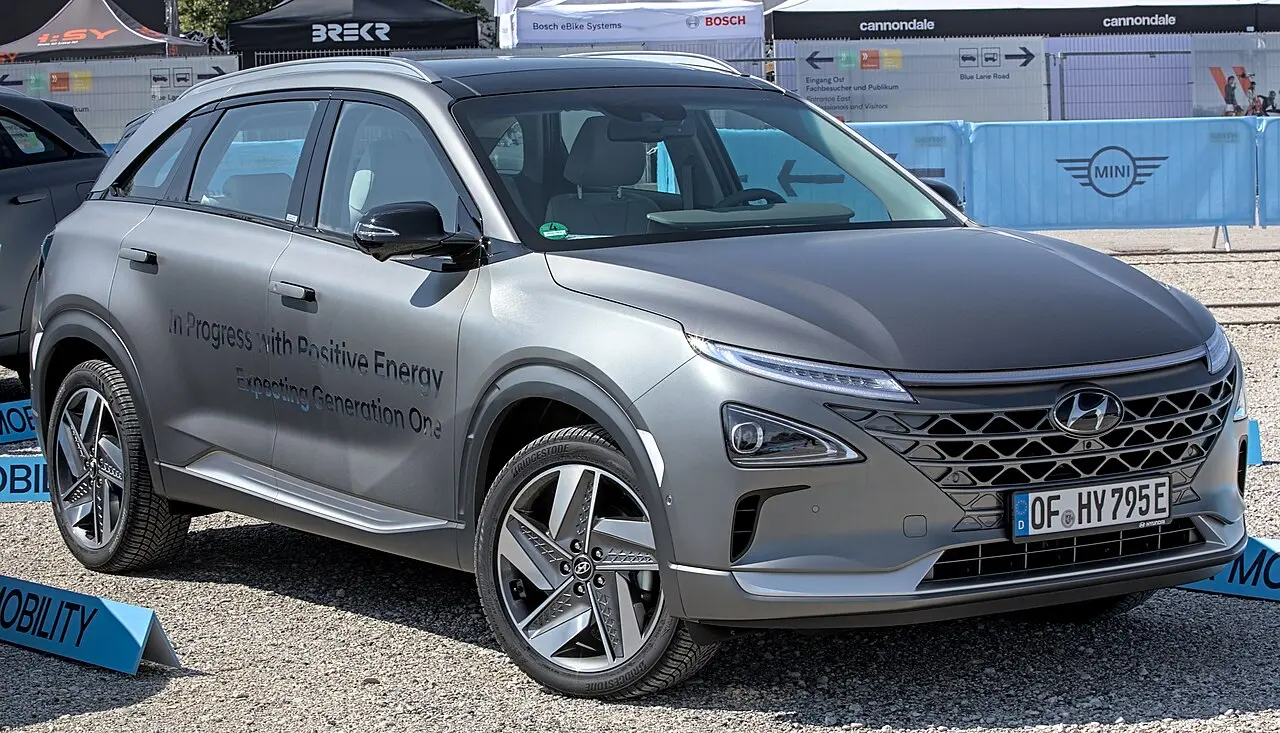
Hyundai Nexo

Hyundai Nexo
Photo: Alexander Migl / Wikimedia Commons · CC BY-SA 4.0

The official data lists 21 versions of the Hyundai Nexo (2018–2026), in the European Union and the United States. Each market publishes its own figures, measured on its own test procedure.

At a glance

Years in the data
2018–2026
Markets
European Union, United States
Power
32 kW (44 PS) to 120 kW (163 PS)
Fuels
Hydrogen, Electric
Lowest consumption (European Union)
1.0 L/100 km (WLTP)
Lowest consumption (United States)
3.5 L/100 km (EPA)
New registrations in the EU
2,737

What is the Hyundai Nexo?

The Nexo is a hydrogen fuel-cell electric SUV, created for drivers who want electric propulsion without plugging in to charge the car. Its fuel cell uses hydrogen to generate electricity for the motor, with water as the tailpipe output. Hyundai introduced it in 2018 as a dedicated fuel-cell model and as a technology-led member of its SUV range. The tall body and SUV format give it the everyday shape of a family vehicle, while its powertrain reflects Hyundai’s long-running work on hydrogen mobility.

Nexo generations

The Nexo’s first generation began in 2018 and is still in production. It was the next commercialized step in Hyundai’s fuel-cell passenger-car development, following the company’s earlier fuel-cell vehicle work. In the European Union, the model appears in registration figures through 2024; in the United States, its listed market years extend from 2019 to 2026.

Power and official consumption

European Union registration versions include power figures from 32 kW (44 PS) to 120 kW (163 PS). The most registered configuration in the years shown is the 120 kW (163 PS) hydrogen version. US versions use hydrogen, and the EPA rates the best combined result at 68 MPG, equivalent to a lowest listed consumption of 3.5 L/100 km.

The reported EU minimum is 1 L/100 km on the WLTP test. That figure reflects the official rating conventions for a hydrogen fuel-cell vehicle; it should not be read as petrol-style fuel use. European WLTP and US EPA procedures differ, so their figures are not directly comparable.

Where was the Nexo sold?

The Nexo appears in European Union registration figures from 2018 to 2024 and in US EPA market years from 2019 to 2026. Its hydrogen powertrain means the practical ownership experience depends on access to hydrogen refuelling, alongside the usual considerations of SUV size and passenger-car use.

Questions and answers

Is the Hyundai Nexo a battery-electric car?

It is an electric vehicle powered by a hydrogen fuel cell, rather than a vehicle that relies on a plug-in battery alone.

How powerful is the Nexo?

European Union versions span 32 kW (44 PS) to 120 kW (163 PS); the US range is listed as hydrogen-powered.

What is the Nexo’s EPA fuel economy?

The best combined EPA rating is 68 MPG, or 3.5 L/100 km. EPA and WLTP procedures differ.

Nexo first generation (since 2018)

Hyundai Nexo first generation
Photo: Alexander Migl / Wikimedia Commons · CC BY-SA 4.0

References: hyundai.news, en.wikipedia.org

European Union 17 versions

New cars registered in the EU (plus Norway and Iceland), from the European Environment Agency. Figures on the NEDC procedure until 2020 and on WLTP from 2021; versions are grouped by engine and power, with their number of registrations.

Years and versionEnginePowerFuelConsumption (combined)CO₂Electric rangeEU registrations
2023–2024–120 kW (163 PS)Hydrogen–0 g/km–69
2023–32 kW (44 PS)Hydrogen–0 g/km–78
2022–120 kW (163 PS)Hydrogen1.0 L/100 km WLTP0 g/km–547
2022–32 kW (44 PS)Hydrogen0.9 L/100 km WLTP0 g/km–19
2021–120 kW (163 PS)Hydrogen1.0 L/100 km WLTP0 g/km9 km319
2021Electric motor32 kW (44 PS)Electric1.0 L/100 km WLTP12.0 kWh/100 km WLTP0 g/km–153
2020–120 kW (163 PS)Hydrogen–0 g/km–428
2020Electric motor32 kW (44 PS)Electric13.7 kWh/100 km NEDC0 g/km–213
2019–2020–32 kW (44 PS)Hydrogen–0 g/km–185
2019–2020–31 kW (42 PS)Hydrogen–0 g/km–20
2019Electric motor32 kW (44 PS)Electric–0 g/km–282
2019–32 kW (44 PS)Other fuel–0 g/km–212
2019–120 kW (163 PS)Hydrogen–0 g/km–80
2019Electric motor120 kW (163 PS)Electric–0 g/km–12
2018Electric motor32 kW (44 PS)Electric21.2 kWh/100 km NEDC0 g/km–96
2018–32 kW (44 PS)Other fuel–0 g/km–14
2018–32 kW (44 PS)Hydrogen–0 g/km–10

United States 4 versions

Model years sold in the USA, from the EPA and the Department of Energy (fueleconomy.gov). MPG on the EPA test; litres per 100 km = 235.215 ÷ MPG.

Years and versionEngineFuelGearboxDriveConsumption (combined)CO₂
2026PMSM–HydrogenAutomaticFront-wheel drive60 MPG (3.9 L/100 km) EPA0 g/km
2026PMSM–HydrogenAutomaticFront-wheel drive68 MPG (3.5 L/100 km) EPA0 g/km
2019–2025PEM–HydrogenAutomaticFront-wheel drive57 MPG (4.1 L/100 km) EPA0 g/km
2019–2025PEM–HydrogenAutomaticFront-wheel drive61 MPG (3.9 L/100 km) EPA0 g/km

Official figures are measured on standard test procedures and differ between markets. Your consumption depends on how, where and in what conditions you drive.