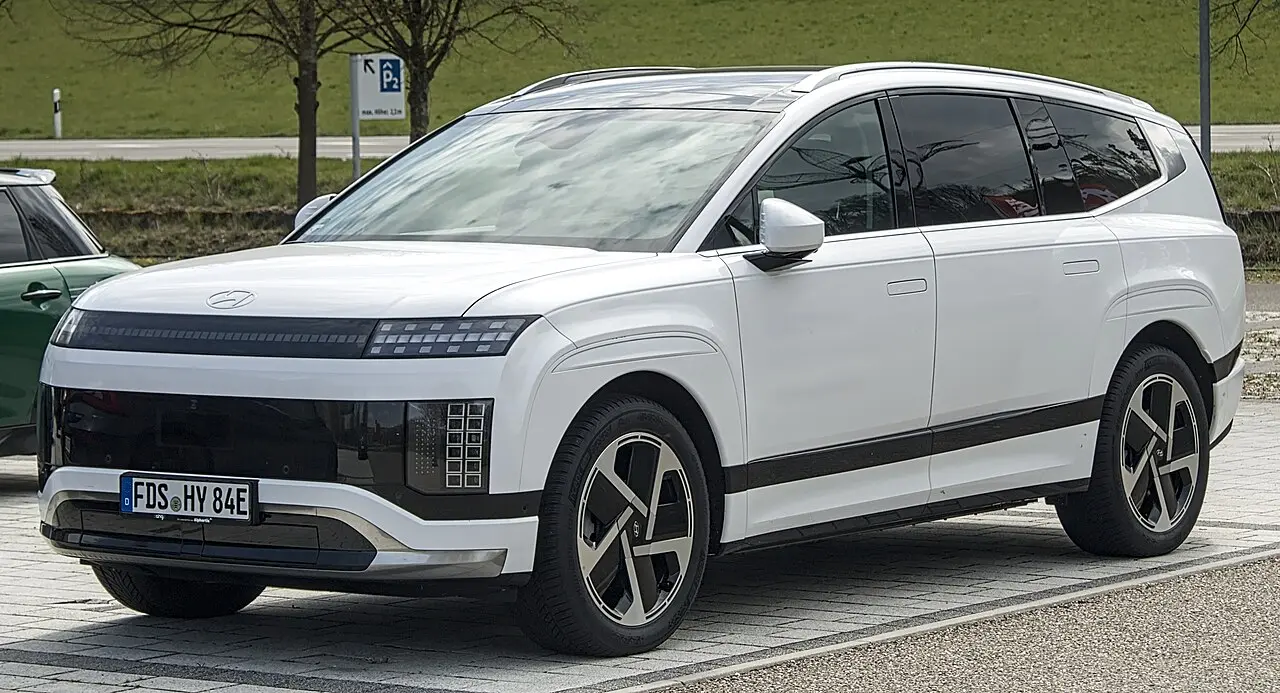
The official data lists 16 versions of the Hyundai IONIQ 9 (2025–2027), in the European Union, the United Kingdom, the United States, and Canada. Each market publishes its own figures, measured on its own test procedure.
At a glance
Years in the data
2025–2027
Markets
European Union, United Kingdom, United States, Canada
Power
78 kW (106 PS) to 315 kW (428 PS)
Fuels
Electric
New registrations in the EU
2,015
What is the Hyundai IONIQ 9?
The IONIQ 9 is a large, three-row electric SUV at the top of Hyundai’s IONIQ family. Its roomy cabin and three rows make it a practical format for households that need space for passengers. The IONIQ 9 extends Hyundai’s electric IONIQ range into a larger SUV.
It uses Hyundai Motor Group’s E-GMP electric vehicle platform. A flat floor helps open up the cabin, while the powertrain is fully electric in every market listed.
IONIQ 9 generation
The IONIQ 9 is in its first generation, identified by the code ME and introduced in 2025. It is a new model rather than a continuation of an earlier Hyundai SUV under the same name.
Engines and power
The IONIQ 9 uses electric motors rather than petrol or diesel engines. EU registration figures show power from 78 kW (106 PS) to 315 kW (428 PS). The UK and Canadian ranges run from 160 kW (218 PS) to 315 kW (428 PS). In EU registrations, the most common version was rated at 226 kW (307 PS).
The US EPA figures also include the IONIQ 9, though they do not list power ratings. When comparing markets, keep in mind that Europe uses WLTP or NEDC procedures, the USA uses EPA ratings and Canada uses a 5-cycle test.
Where is the IONIQ 9 sold?
The IONIQ 9 appears in figures for the EU, the UK, the USA and Canada. EU registrations record 2,015 examples in 2025. The UK figures cover 2025 to 2026, the US EPA figures cover 2026 to 2027, and Canadian figures cover 2026.
Questions and answers
Is the IONIQ 9 fully electric?
Yes. The versions shown for each market use electric power.
How much power does the IONIQ 9 make?
The EU range shown is 78 kW (106 PS) to 315 kW (428 PS). UK and Canadian figures show 160 kW (218 PS) to 315 kW (428 PS).
New cars registered in the EU (plus Norway and Iceland), from the European Environment Agency. Figures on the NEDC procedure until 2020 and on WLTP from 2021; versions are grouped by engine and power, with their number of registrations.
Years and version
Engine
Power
Fuel
Consumption (combined)
CO₂
Electric range
EU registrations
2025
Electric motor
226 kW (307 PS)
Electric
20.5 kWh/100 km WLTP
0 g/km
603 km
1,185
2025
Electric motor
314 kW (427 PS)
Electric
20.6 kWh/100 km WLTP
0 g/km
600 km
343
2025
Electric motor
315 kW (428 PS)
Electric
20.5 kWh/100 km WLTP
0 g/km
599 km
223
2025
Electric motor
160 kW (218 PS)
Electric
19.9 kWh/100 km WLTP
0 g/km
620 km
144
2025
Electric motor
78 kW (106 PS)
Electric
20.5 kWh/100 km WLTP
0 g/km
604 km
86
2025
Electric motor
113 kW (154 PS)
Electric
20.6 kWh/100 km WLTP
0 g/km
600 km
34
United Kingdom 4 versions
New cars on sale in the UK, from the Vehicle Certification Agency. NEDC figures until 2018 and WLTP figures after; years are the editions a version appeared in.
Official figures are measured on standard test procedures and differ between markets. Your consumption depends on how, where and in what conditions you drive.