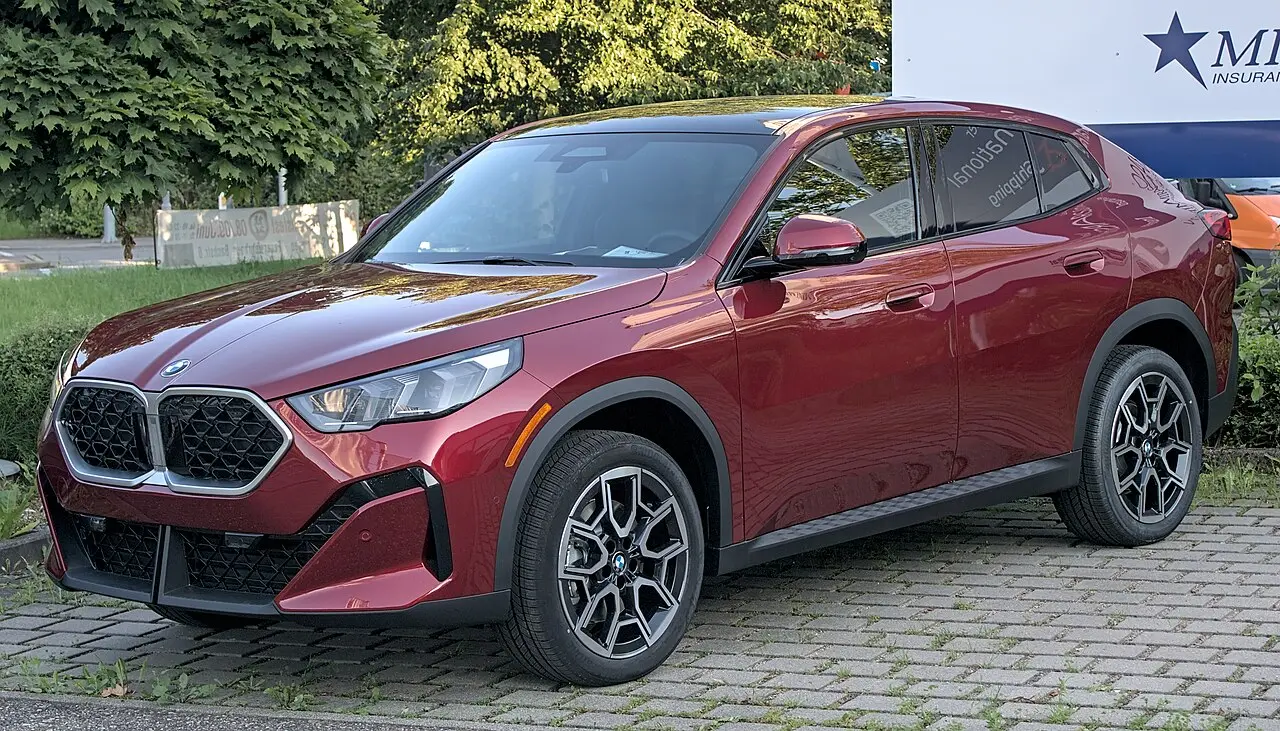
The official data lists 12 versions of the BMW iX2 (2022 - 2026), in the European Union and the United Kingdom. Each market publishes its own figures, measured on its own test procedure.
At a glance
Years in the data
2022 - 2026
Markets
European Union, United Kingdom
Power
140 kW (190 PS) to 230 kW (313 PS)
Fuels
Electric
New registrations in the EU
32,554
What is the BMW iX2?
The BMW iX2 is a fully electric compact crossover with a coupé-like roofline. BMW calls this body style a Sports Activity Coupé. It brings electric drive to the X2, part of BMW’s X model family, and pairs a raised body and rear hatch with a sloping silhouette.
The first-generation iX2, code U10, dates from 2024-today. It arrived with the second-generation X2, which BMW gave a more pronounced coupé shape and larger dimensions than its predecessor. The iX2 shares that design and uses an all-electric drivetrain.
Engines and power
Every listed iX2 version is electric. EU figures span 140 kW (190 PS) to 225 kW (306 PS), while UK figures list 150 kW (204 PS) to 230 kW (313 PS).
In EU registrations, the 150 kW (204 PS) version was the leading seller in both 2024 and 2025. The 225 kW (306 PS) version also featured among the leading sellers in 2025.
How efficient is the BMW iX2?
As an electric car, the iX2 uses electricity rather than petrol or diesel. European electric-car figures generally use WLTP, while US EPA and Canadian 5-cycle results follow different procedures.
Where is the BMW iX2 sold?
The iX2 appears in official figures for the EU and UK. EU registration figures span 2022-2025 and record 32,554 cars; UK figures span 2025-2026. The listed UK versions produce between 150 kW (204 PS) and 230 kW (313 PS).
Questions and answers
Is the BMW iX2 fully electric?
Yes. The listed iX2 versions use electric power rather than petrol or diesel.
What is the BMW iX2’s power output?
EU figures span 140 kW (190 PS) to 225 kW (306 PS); UK figures span 150 kW (204 PS) to 230 kW (313 PS).
Which generation is the BMW iX2?
It is the first generation, code U10, dating from 2024-today.
New cars registered in the EU (plus Norway and Iceland), from the European Environment Agency. Figures on the NEDC procedure until 2020 and on WLTP from 2021; versions are grouped by engine and power, with their number of registrations.
Years and version
Engine
Power
Fuel
Consumption (combined)
CO₂
Electric range
EU registrations
2024 - 2025
Electric motor
150 kW (204 PS)
Electric
16.1 - 16.8 kWh/100 km WLTP
0 g/km
449 - 455 km
18,582
2023 - 2025
Electric motor
225 kW (306 PS)
Electric
17.3 - 18.0 kWh/100 km WLTP
0 g/km
418 - 426 km
9,563
2024 - 2025
Electric motor
Not listed
Electric
16.0 - 17.3 kWh/100 km WLTP
0 g/km
424 - 457 km
4,119
2024 - 2025
Electric motor
140 kW (190 PS)
Electric
17.8 - 17.9 kWh/100 km WLTP
0 g/km
405 - 409 km
184
2023
Electric motor
140 kW (190 PS)
Electric
-
0 g/km
-
23
United Kingdom 6 versions
New cars on sale in the UK, from the Vehicle Certification Agency. NEDC figures until 2018 and WLTP figures after; years are the editions a version appeared in.
Years and version
Engine
Power
Fuel
Gearbox
Consumption (combined)
CO₂
Electric range
2026iX2 eDrive20 M Sport
Electric motor
150 kW (204 PS)
Electric
Automatic
14.2 kWh/100 km WLTP
0 g/km
516 km
2026iX2 eDrive20 Shadow Edition
Electric motor
150 kW (204 PS)
Electric
Automatic
14.4 kWh/100 km WLTP
0 g/km
512 km
2025 - 2026iX2 xDrive30 M Sport
Electric motor
225 kW (306 PS)
Electric
Automatic
17.0 - 17.7 kWh/100 km WLTP
0 g/km
417 - 431 km
2025 - 2026iX2 xDrive30 Shadow Edition
Electric motor
225 kW (306 PS)
Electric
Automatic
17.1 - 17.7 kWh/100 km WLTP
0 g/km
418 - 429 km
2026iX2 xDrive30 M Sport
Electric motor
230 kW (313 PS)
Electric
Automatic
15.3 kWh/100 km WLTP
0 g/km
479 km
2026iX2 xDrive30 Shadow Edition
Electric motor
230 kW (313 PS)
Electric
Automatic
15.4 kWh/100 km WLTP
0 g/km
477 km
Versions outside these generations
European Union 1 version
New cars registered in the EU (plus Norway and Iceland), from the European Environment Agency. Figures on the NEDC procedure until 2020 and on WLTP from 2021; versions are grouped by engine and power, with their number of registrations.
Official figures are measured on standard test procedures and differ between markets. Your consumption depends on how, where and in what conditions you drive.