

BMW iX2 first generation
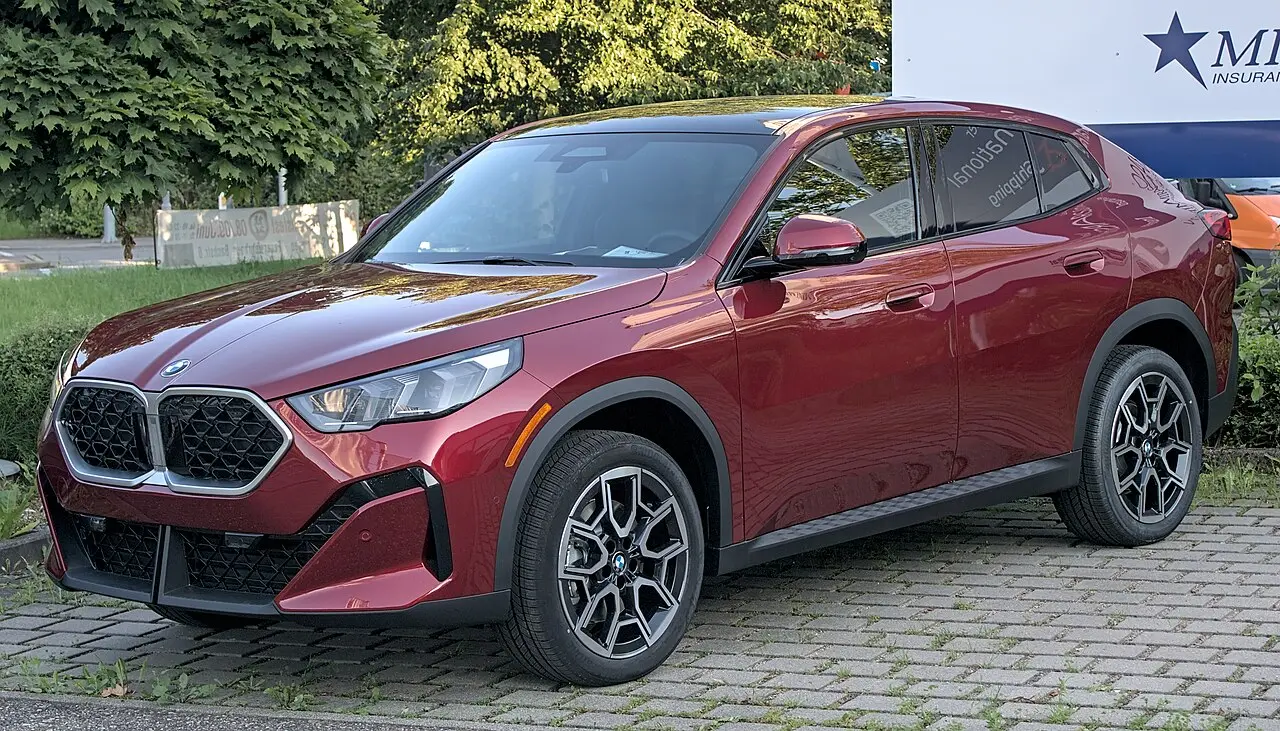
The BMW iX2 first generation (since 2023): dimensions, weights, reliability and the official figures of its 12 versions in the European Union and the United Kingdom.
Model codes: U10
Dimensions, weights and capacity
| Specification | Europe | Wikipedia |
|---|---|---|
| Dimensions | ||
| Length | 4,550 mm RDW | 4,554 mm |
| Width | 1,850 mm RDW | 1,845 mm |
| Height | 1,560 mm RDW | 1,590 mm |
| Wheelbase | 2,690 mm RDW | 2,692 mm |
| Front track | 1,574–1,595 mm ASTRA | – |
| Rear track | 1,575–1,597 mm ASTRA | – |
| Weights and towing | ||
| Kerb weight | 1,860–1,995 kg RDW | 1,645–2,095 kg |
| Mass in running order | 1,960–2,095 kg RDW | – |
| Gross vehicle weight | 2,460–2,605 kg RDW | – |
| Towing, braked trailer | 1,200 kg Traficom | – |
| Towing, unbraked trailer | 750 kg RDW | – |
| Seats and space | ||
| Seats | 5 RDW | – |
| Doors | 4 RDW | – |
| Boot space | 525 L EV DB | – |
| Performance | ||
| Top speed | 170–180 km/h RDW | – |
| 0–100 km/h | 5.6–8.0 s EV DB | – |
| Torque | 247–494 Nm EV DB | – |
| Electric | ||
| Battery capacity (usable) | 64.7–64.8 kWh EV DB | 64.8 kWh |
| Battery capacity (gross) | 66.4–66.5 kWh EV DB | – |
| Range (WLTP) | 449–478 km EV DB | – |
| Energy use | 153–163 Wh/km EV DB | – |
| AC charging power | 11 kW EV DB | – |
| DC fast charging power | 130 kW EV DB | – |
Tyre sizes (most common first): 245/40R20, 245/45R19, 205/65R17, 225/55R18, 195/55R19, 205/60R18
Ranges cover the generation’s versions and body styles; European and North American versions can differ. Sources: RDW type approvals (Netherlands), Wikipedia, ASTRA type approvals (Switzerland), Traficom type approvals (Finland), open EV databases (EV Compare, Open EV Data, Gaia EVDB). Wikipedia figures are used under CC BY-SA 4.0.
All 12 versions of the BMW iX2 first generation
European Union 6 versions
New cars registered in the EU (plus Norway and Iceland), from the European Environment Agency. Figures on the NEDC procedure until 2020 and on WLTP from 2021; versions are grouped by engine and power, with their number of registrations.
| Years and version | Engine | Power | Fuel | Consumption (combined) | CO₂ | Electric range | EU registrations |
|---|---|---|---|---|---|---|---|
| 2024–2025 | Electric motor | 150 kW (204 PS) | Electric | 16.1–16.8 kWh/100 km WLTP | 0 g/km | 449–455 km | 18,582 |
| 2023–2025 | Electric motor | 225 kW (306 PS) | Electric | 17.3–18.0 kWh/100 km WLTP | 0 g/km | 418–426 km | 9,563 |
| 2024–2025 | Electric motor | 68 kW (92 PS) | Electric | 16.0 kWh/100 km WLTP | 0 g/km | 456–457 km | 2,928 |
| 2024–2025 | Electric motor | 104 kW (141 PS) | Electric | 17.2–17.3 kWh/100 km WLTP | 0 g/km | 424–427 km | 1,191 |
| 2024–2025 | Electric motor | 140 kW (190 PS) | Electric | 17.8–17.9 kWh/100 km WLTP | 0 g/km | 405–409 km | 184 |
| 2023 | Electric motor | 140 kW (190 PS) | Electric | – | 0 g/km | – | 23 |
United Kingdom 6 versions
New cars on sale in the UK, from the Vehicle Certification Agency. NEDC figures until 2018 and WLTP figures after; years are the editions a version appeared in.
| Years and version | Engine | Power | Fuel | Gearbox | Consumption (combined) | CO₂ | Electric range |
|---|---|---|---|---|---|---|---|
| 2026iX2 eDrive20 M Sport | Electric motor | 150 kW (204 PS) | Electric | Automatic | 14.2 kWh/100 km WLTP | 0 g/km | 516 km |
| 2026iX2 eDrive20 Shadow Edition | Electric motor | 150 kW (204 PS) | Electric | Automatic | 14.4 kWh/100 km WLTP | 0 g/km | 512 km |
| 2025–2026iX2 xDrive30 M Sport | Electric motor | 225 kW (306 PS) | Electric | Automatic | 17.0–17.7 kWh/100 km WLTP | 0 g/km | 417–431 km |
| 2025–2026iX2 xDrive30 Shadow Edition | Electric motor | 225 kW (306 PS) | Electric | Automatic | 17.1–17.7 kWh/100 km WLTP | 0 g/km | 418–429 km |
| 2026iX2 xDrive30 M Sport | Electric motor | 230 kW (313 PS) | Electric | Automatic | 15.3 kWh/100 km WLTP | 0 g/km | 479 km |
| 2026iX2 xDrive30 Shadow Edition | Electric motor | 230 kW (313 PS) | Electric | Automatic | 15.4 kWh/100 km WLTP | 0 g/km | 477 km |
Similar models from other brands
Official figures are measured on standard test procedures and differ between markets. Your consumption depends on how, where and in what conditions you drive.