Volvo

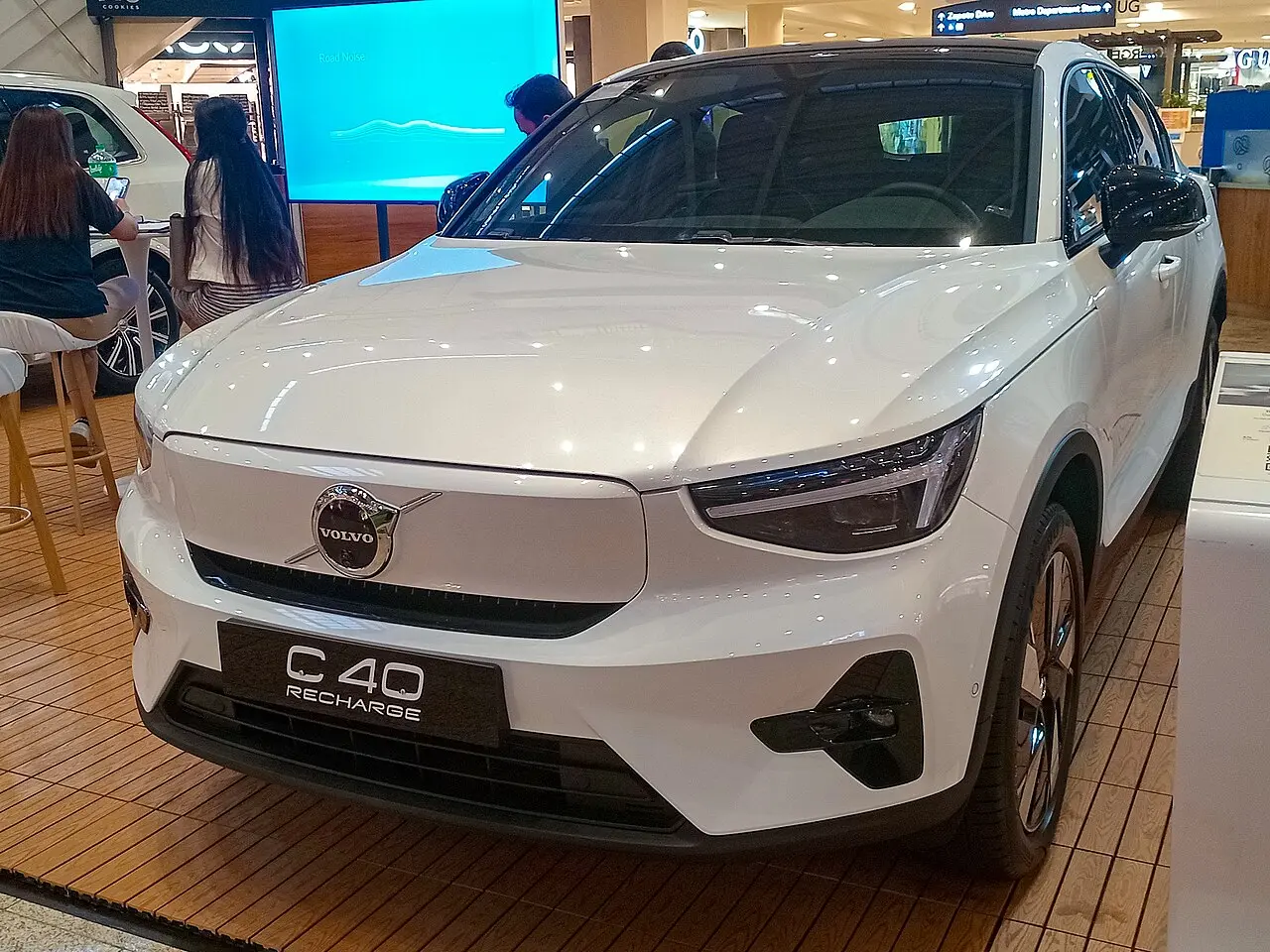
Volvo C40

Volvo C40
Photo: Ethan Llamas / Wikimedia Commons · CC BY-SA 4.0

The official data lists 49 versions of the Volvo C40 (2021–2026), in the European Union, the United Kingdom, the United States, and Canada. Each market publishes its own figures, measured on its own test procedure.

At a glance

Years in the data
2021–2026
Markets
European Union, United Kingdom, United States, Canada
Power
80 kW (109 PS) to 408 kW (555 PS)
Fuels
Electric
New registrations in the EU
40,492

What is the Volvo C40?

The C40 is a compact electric crossover with a sloping, coupe-like roofline. It shares the compact electric-car character of the XC40, with a more tapered shape at the rear. Volvo introduced it as the C40 Recharge.

Volvo renamed the fully electric C40 Recharge the EC40 as part of a wider effort to align the names of its electric models. The C40 is based on Volvo’s CMA platform.

Engines and power

The C40 is fully electric, with single-motor and twin-motor versions. Listed power spans 80 kW (109 PS) to 301 kW (409 PS) in EU registration figures, 170 kW (231 PS) to 408 kW (555 PS) in the UK, and 185 kW (252 PS) to 300 kW (408 PS) in Canada. US figures cover electric versions without stating their power.

The range includes different power outputs and motor arrangements. The most registered individual EU configuration was the 185 kW (252 PS) electric version, with 9,078 registrations across 2023–2025.

How economical is the Volvo C40?

The C40 runs on electricity, so it has no petrol or diesel consumption figure. Official energy use and range vary by version and market. European tests use WLTP or NEDC, while the US EPA and Canada’s 5-cycle procedure use different methods; results from these markets are not directly comparable.

EU registration figures record 40,492 C40s from 2021 to 2025. UK figures cover 2022–2026, while US and Canadian figures cover 2022–2024.

Where was the C40 sold?

The C40 appears in figures for the EU, UK, US and Canada. Volvo introduced it as the C40 Recharge and later renamed the fully electric model EC40.

Questions and answers

Is the Volvo C40 a hybrid?

No. The C40 versions listed for the EU, UK, US and Canada are electric.

What is the difference between the C40 and EC40 names?

Volvo renamed the fully electric C40 Recharge the EC40 as part of its revised naming scheme for electric models.

What is the highest power listed for the C40?

The UK range reaches 408 kW (555 PS).

C40 C40 (2022–2024)

Volvo C40 C40
Photo: Ethan Llamas / Wikimedia Commons · CC BY-SA 4.0

Model codes: CMA · Sold in: United States and Canada · References: volvocars.com, volvocars.com

United States 3 versions

Model years sold in the USA, from the EPA and the Department of Energy (fueleconomy.gov). MPG on the EPA test; litres per 100 km = 235.215 ÷ MPG.

Years and versionEngineFuelGearboxDriveConsumption (combined)CO₂Electric range
2024Electric motorElectricAutomaticRear-wheel drive107 MPGe EPA0 g/km478 km
2024Electric motorElectricAutomaticAll-wheel drive99 MPGe EPA0 g/km414 km
2022–2023Electric motorElectricAutomaticAll-wheel drive87 MPGe EPA0 g/km364 km

Canada 3 versions

Model years sold in Canada, from Natural Resources Canada fuel consumption ratings (5-cycle test).

Years and versionEnginePowerFuelGearboxConsumption (combined)CO₂Electric range
2024Sport utility vehicle: SmallElectric motor185 kW (252 PS)ElectricAutomatic19.6 kWh/100 km 5-cycle0 g/km478 km
2024Sport utility vehicle: SmallElectric motor300 kW (408 PS)ElectricAutomatic21.2 kWh/100 km 5-cycle0 g/km414 km
2022–2023Sport utility vehicle: SmallElectric motor300 kW (408 PS)ElectricAutomatic23.9 kWh/100 km 5-cycle0 g/km364 km

Versions outside these generations

European Union 19 versions

New cars registered in the EU (plus Norway and Iceland), from the European Environment Agency. Figures on the NEDC procedure until 2020 and on WLTP from 2021; versions are grouped by engine and power, with their number of registrations.

Years and versionEnginePowerFuelConsumption (combined)CO₂Electric rangeEU registrations
2023–2025Electric motor185 kW (252 PS)Electric16.5 kWh/100 km WLTP0 g/km575 km9,078
2024–2025Electric motor175 kW (238 PS)Electric16.2 kWh/100 km WLTP0 g/km484 km1,185
2025Electric motor300 kW (408 PS)Electric17.7 kWh/100 km WLTP0 g/km539 km147
2024Electric motor300 kW (408 PS)Electric17.7 kWh/100 km WLTP0 g/km538 km1,458
2024Electric motor170 kW (231 PS)Electric18.2 kWh/100 km WLTP0 g/km433 km101
2023Electric motor170 kW (231 PS)Electric18.2 kWh/100 km WLTP0 g/km434 km6,503
2023Electric motor300 kW (408 PS)Electric20.1 kWh/100 km WLTP0 g/km446 km3,038
2023Electric motor301 kW (409 PS)Electric17.6 kWh/100 km WLTP0 g/km543 km2,204
2023Electric motor238 kW (324 PS)Electric16.2 kWh/100 km WLTP0 g/km483 km756
2022Electric motor170 kW (231 PS)Electric18.6 kWh/100 km WLTP0 g/km427 km5,451
2022Electric motor150 kW (204 PS)Electric20.5 kWh/100 km WLTP0 g/km440 km5,034
2022Electric motor300 kW (408 PS)Electric20.9 kWh/100 km WLTP0 g/km438 km2,263
2022Electric motor80 kW (109 PS)Electric18.9 kWh/100 km WLTP0 g/km436 km735
2022Electric motor160 kW (218 PS)Electric20.7 kWh/100 km WLTP0 g/km441 km485
2021Electric motor150 kW (204 PS)Electric21.0 kWh/100 km WLTP0 g/km439 km836
2021Electric motor300 kW (408 PS)Electric21.0 kWh/100 km WLTP0 g/km438 km516
2021Electric motor160 kW (218 PS)Electric21.0 kWh/100 km WLTP0 g/km439 km466
2021Electric motor80 kW (109 PS)Electric20.9 kWh/100 km WLTP0 g/km440 km218
2021––Other fuel–155 g/km–18

United Kingdom 24 versions

New cars on sale in the UK, from the Vehicle Certification Agency. NEDC figures until 2018 and WLTP figures after; years are the editions a version appeared in.

Years and versionEnginePowerFuelConsumption (combined)CO₂Electric range
2025–2026Recharge Core · Recharge Plus · Recharge UltimateElectric motor170 kW (231 PS)Electric19.3 kWh/100 km WLTP0 g/km437 km
2025–2026Recharge Single Motor CoreElectric motor175 kW (238 PS)Electric16.5 kWh/100 km WLTP0 g/km477 km
2025–2026Recharge Single Motor PlusElectric motor175 kW (238 PS)Electric16.5 kWh/100 km WLTP0 g/km475 km
2025–2026Recharge Single Motor UltimateElectric motor175 kW (238 PS)Electric16.8 kWh/100 km WLTP0 g/km468 km
2025–2026Recharge Twin Plus · Recharge Twin UltimateElectric motor300 kW (408 PS)Electric19.8 kWh/100 km WLTP0 g/km446 km
2025–2026Recharge Twin Motor CoreElectric motor300 kW (408 PS)Electric17.3 kWh/100 km WLTP0 g/km550 km
2025–2026Recharge Twin Motor PlusElectric motor300 kW (408 PS)Electric17.4 kWh/100 km WLTP0 g/km548 km
2025–2026Recharge Twin Motor UltimateElectric motor300 kW (408 PS)Electric17.6 kWh/100 km WLTP0 g/km543 km
2024Recharge Core · Recharge Plus · Recharge UltimateElectric motor231 kW (314 PS)Electric19.3 kWh/100 km WLTP0 g/km437 km
2024Recharge Single Motor CoreElectric motor238 kW (324 PS)Electric16.5 kWh/100 km WLTP0 g/km477 km
2024Recharge Single Motor PlusElectric motor238 kW (324 PS)Electric16.5 kWh/100 km WLTP0 g/km475 km
2024Recharge Single Motor UltimateElectric motor238 kW (324 PS)Electric16.8 kWh/100 km WLTP0 g/km468 km
2024Recharge Twin Plus · Recharge Twin UltimateElectric motor408 kW (555 PS)Electric19.8 kWh/100 km WLTP0 g/km446 km
2024Recharge Twin Motor CoreElectric motor408 kW (555 PS)Electric17.3 kWh/100 km WLTP0 g/km550 km
2024Recharge Twin Motor PlusElectric motor408 kW (555 PS)Electric17.4 kWh/100 km WLTP0 g/km548 km
2024Recharge Twin Motor UltimateElectric motor408 kW (555 PS)Electric17.6 kWh/100 km WLTP0 g/km543 km
2022–2023Recharge Core · Recharge Plus · Recharge UltimateElectric motor170 kW (231 PS)Electric19.3 kWh/100 km WLTP0 g/km437 km
2023Recharge Single Motor CoreElectric motor175 kW (238 PS)Electric16.5 kWh/100 km WLTP0 g/km477 km
2023Recharge Single Motor PlusElectric motor175 kW (238 PS)Electric16.5 kWh/100 km WLTP0 g/km475 km
2023Recharge Single Motor UltimateElectric motor175 kW (238 PS)Electric16.8 kWh/100 km WLTP0 g/km468 km
2022–2023Recharge Twin Plus · Recharge Twin UltimateElectric motor300 kW (408 PS)Electric19.8 kWh/100 km WLTP0 g/km446 km
2023Recharge Twin Motor CoreElectric motor300 kW (408 PS)Electric17.3 kWh/100 km WLTP0 g/km550 km
2023Recharge Twin Motor PlusElectric motor300 kW (408 PS)Electric17.4 kWh/100 km WLTP0 g/km548 km
2023Recharge Twin Motor UltimateElectric motor300 kW (408 PS)Electric17.6 kWh/100 km WLTP0 g/km543 km

Official figures are measured on standard test procedures and differ between markets. Your consumption depends on how, where and in what conditions you drive.