The official data lists 65 versions of the Ford Puma (2000 - 2025), in the European Union and the United Kingdom. Each market publishes its own figures, measured on its own test procedure.
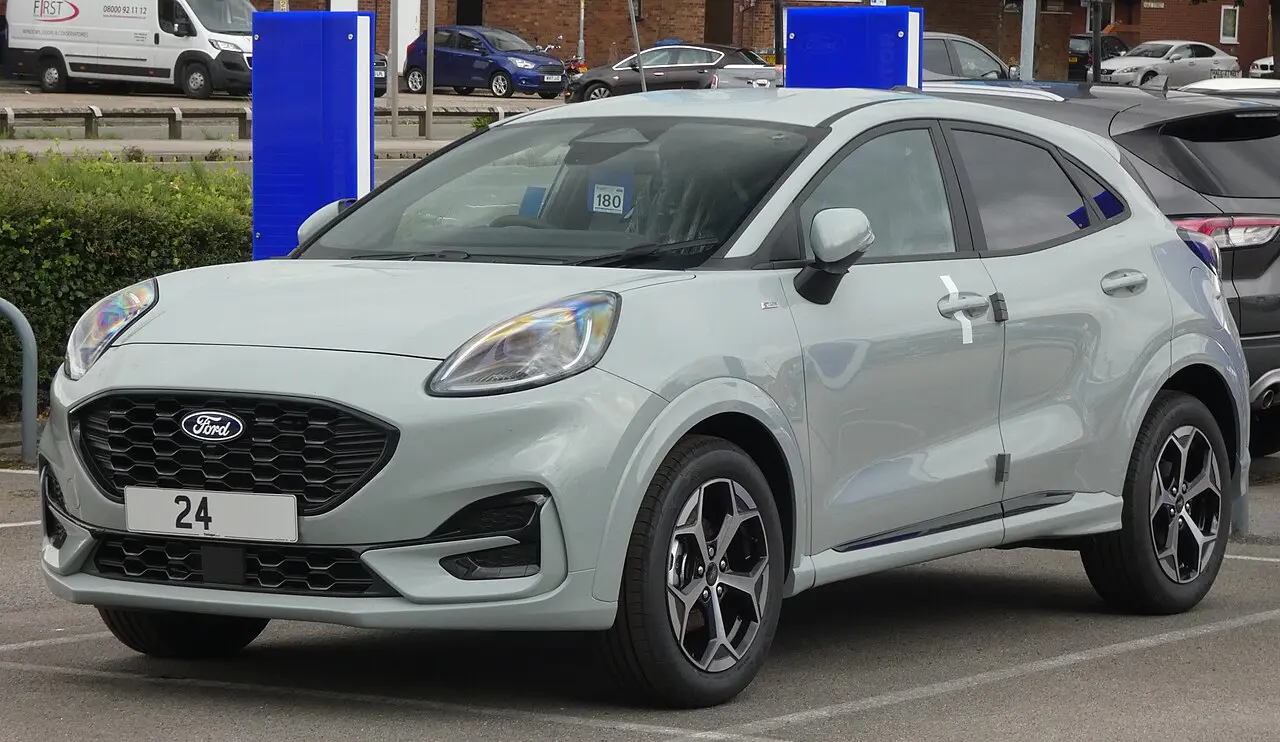
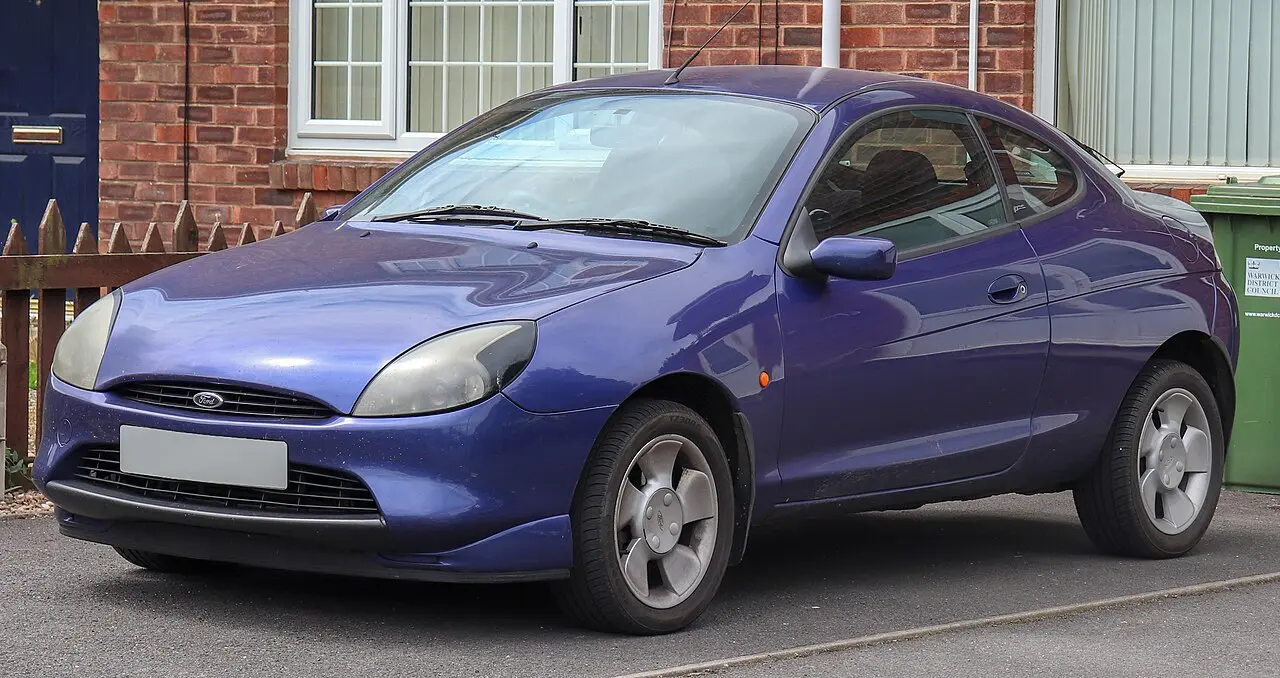
The Puma name belongs to two quite different small Fords. The original was a compact coupé, sold from 1997 to 2002. Ford revived the name for a compact crossover in 2019, giving it a higher stance and a more practical everyday role. The newer Puma sits among Ford’s smaller European crossovers, pairing compact proportions with SUV-inspired styling.
The crossover launched with distinctive headlamps set high on the front wings and mild-hybrid technology. The system uses electric assistance to support the petrol engine. Ford also gave the Puma a flexible load area, including its MegaBox storage compartment.
Puma generations and engines
Generation I, code SE, ran from 1997 to 2002. Generation II, code B2E, began in 2019 and continues in the generation description. The two generations share a name but differ in body style and purpose: a coupé first, then a crossover.
EU figures for the newer Puma cover engines from 1.0 to 1.5 litres and power from 69 kW (94 PS) to 147 kW (200 PS). Listed fuels include petrol, hybrid, electric, plug-in hybrid, flex fuel E85 and diesel. UK figures cover 1.0 to 1.7-litre engines and power from 91 kW (124 PS) to 147 kW (200 PS), with petrol and hybrid versions.
How economical is the Ford Puma?
The lowest EU consumption figure is 4.5 L/100 km on the WLTP test for petrol, diesel or hybrid versions. The UK minimum is 5.2 L/100 km on WLTP.
The EU and UK figures use WLTP, though the versions available differ by market. The plug-in hybrid figure is a weighted result, not a measure of fuel use on every journey.
Where was the Puma sold?
The first Puma generation ran from 1997 to 2002, and the revived crossover began in 2019. EU figures cover the crossover from 2019 onward, while UK figures include both generations. The newer model brought the Puma name back as part of Ford’s European crossover range.
Questions and answers
How many generations of Ford Puma are listed?
Two: Generation I from 1997 to 2002 and Generation II from 2019 onward.
What body style did the original Puma have?
It was a compact coupé; the later Puma is a compact crossover.
What is the lowest listed EU Puma consumption?
The minimum is 4.5 L/100 km WLTP for petrol, diesel or hybrid versions.
Model codes: SE · Sold in: European Union and United Kingdom · References: fordfan.de, autocentrum.pl
At a glance: Length 3,980 mm · Kerb weight 1,008 - 1,013 kg · Top speed 180 - 203 km/h · MOT first-time pass at 13 years and older: 62.8% (UK average 69.2%) Specifications, reliability and all versions
Model codes: B2E · Sold in: European Union and United Kingdom · References: fordfan.de, autocentrum.pl
At a glance: Length 4,210 - 4,230 mm · Kerb weight 1,180 - 1,466 kg · Top speed 160 - 205 km/h · MOT first-time pass at 3 years: 95.7% (UK average 92.2%) Specifications, reliability and all versions
Show all 61 versions
European Union 51 versions
New cars registered in the EU (plus Norway and Iceland), from the European Environment Agency. Figures on the NEDC procedure until 2020 and on WLTP from 2021; versions are grouped by engine and power, with their number of registrations.
Years and version
Engine
Power
Fuel
Consumption (combined)
CO₂
Electric range
EU registrations
2021 - 2025
1.0 L
92 kW (125 PS)
Hybrid
4.8 - 5.6 L/100 km WLTP
125 - 126 g/km
-
297,686
2021 - 2025
1.0 L
91 kW (124 PS)
Hybrid
5.5 - 5.7 L/100 km WLTP
125 - 126 g/km
-
112,911
2021 - 2025
1.0 L
114 kW (155 PS)
Hybrid
5.7 - 5.8 L/100 km WLTP
129 - 130 g/km
-
53,839
2021 - 2025
1.0 L
91 kW (124 PS)
Flex fuel (E85)
5.4 - 5.6 L/100 km WLTP
121 - 127 g/km
-
52,028
2021 - 2025
1.0 L
91 kW (124 PS)
Petrol
5.5 - 5.9 L/100 km WLTP
126 - 134 g/km
-
21,856
2021 - 2025
1.0 L
92 kW (125 PS)
Petrol
5.5 - 5.9 L/100 km WLTP
125 - 140 g/km
-
14,785
2021 - 2025
1.5 L
147 kW (200 PS)
Petrol
6.6 - 6.7 L/100 km WLTP
151 - 155 g/km
-
10,132
2025
Electric motor
123 kW (167 PS)
Electric
13.5 - 13.6 kWh/100 km WLTP
0 g/km
367 km
8,653
2025
Electric motor
124 kW (169 PS)
Electric
16.0 kWh/100 km WLTP
0 g/km
343 km
6,077
2021 - 2025
1.0 L
114 kW (155 PS)
Petrol
5.4 - 5.7 L/100 km WLTP
125 - 129 g/km
-
2,295
2023 - 2025
1.0 L
118 kW (160 PS)
Hybrid
6.0 - 6.2 L/100 km WLTP
136 - 140 g/km
-
2,066
2021 - 2025
1.0 L
92 kW (125 PS)
Hybrid
4.3 - 5.7 L/100 km WLTP
123 - 128 g/km
-
1,654
2023 - 2025
1.0 L
117 kW (159 PS)
Hybrid
6.0 - 6.1 L/100 km WLTP
136 - 139 g/km
-
770
2025
1.0 L
114 kW (155 PS)
Hybrid
5.7 L/100 km WLTP
129 g/km
-
124
2025
1.0 L
118 kW (160 PS)
Hybrid
6.0 L/100 km WLTP
136 g/km
-
11
2022 - 2024
1.0 L
92 kW (125 PS)
Flex fuel (E85)
5.4 L/100 km WLTP
121 g/km
-
854
2021 - 2023
1.5 L
88 kW (120 PS)
Diesel
4.5 L/100 km WLTP
119 g/km
-
19,389
2022 - 2023
1.0 L
70 kW (95 PS)
Petrol
5.6 - 5.9 L/100 km WLTP
128 - 133 g/km
-
811
2023
1.0 L
Not listed
Hybrid
5.6 L/100 km WLTP
125 g/km
-
416
2023
1.0 L
110 kW (150 PS)
Hybrid
5.6 L/100 km WLTP
126 g/km
-
186
2023
1.0 L
81 kW (110 PS)
Hybrid
5.6 L/100 km WLTP
126 g/km
-
89
2023
1.0 L
84 kW (114 PS)
Hybrid
5.5 L/100 km WLTP
125 g/km
-
66
2023
1.0 L
95 kW (129 PS)
Hybrid
5.6 L/100 km WLTP
127 g/km
-
53
2023
1.0 L
96 kW (131 PS)
Hybrid
5.6 L/100 km WLTP
126 g/km
-
51
2023
1.0 L
112 kW (152 PS)
Hybrid
5.6 L/100 km WLTP
125 g/km
-
48
2023
1.0 L
-
Hybrid
5.5 L/100 km WLTP
124 g/km
-
42
2023
1.0 L
72 kW (98 PS)
Hybrid
5.6 L/100 km WLTP
127 g/km
-
39
2023
1.0 L
70 kW (95 PS)
Hybrid
5.6 L/100 km WLTP
126 g/km
-
33
2023
1.0 L
120 kW (163 PS)
Hybrid
5.6 L/100 km WLTP
126 g/km
-
33
2023
1.0 L
85 kW (116 PS)
Hybrid
5.6 L/100 km WLTP
126 g/km
-
30
2023
1.0 L
116 kW (158 PS)
Hybrid
5.5 L/100 km WLTP
124 g/km
-
28
2023
1.0 L
-
Hybrid
5.6 L/100 km WLTP
126 g/km
-
27
2023
1.0 L
69 kW (94 PS)
Hybrid
5.5 L/100 km WLTP
124 g/km
-
20
2023
1.0 L
90 kW (122 PS)
Hybrid
5.6 L/100 km WLTP
126 g/km
-
19
2023
1.0 L
Not listed
Petrol
5.9 L/100 km WLTP
133 g/km
-
12
2023
1.0 L
74 kW (101 PS)
Hybrid
5.7 L/100 km WLTP
128 g/km
-
12
2021
1.0 L
70 kW (95 PS)
Petrol
-
129 g/km
-
4,386
2021
1.0 L
69 kW (94 PS)
Petrol
-
129 g/km
-
932
2021
1.0 L
92 kW (125 PS)
Flex fuel (E85)
-
128 g/km
-
96
2021
1.0 L
91 kW (124 PS)
Diesel
4.3 L/100 km WLTP
127 g/km
-
35
2021
1.0 L
91 kW (124 PS)
Hybrid
-
130 g/km
-
25
2019 - 2020
1.0 L
92 kW (125 PS)
Hybrid
-
96 - 97 g/km
505 km
79,736
2019 - 2020
1.0 L
92 kW (125 PS)
Petrol
-
100 - 106 g/km
-
64,813
2020
1.0 L
91 kW (124 PS)
Hybrid
-
97 g/km
-
37,404
2019 - 2020
1.0 L
114 kW (155 PS)
Hybrid
-
100 g/km
409 km
21,905
2020
1.0 L
91 kW (124 PS)
Petrol
-
104 g/km
-
18,074
2020
1.5 L
88 kW (120 PS)
Diesel
-
99 g/km
-
7,356
2019 - 2020
1.0 L
114 kW (155 PS)
Petrol
-
100 - 103 g/km
-
2,245
2020
1.0 L
70 kW (95 PS)
Petrol
-
103 g/km
-
998
2020
1.5 L
147 kW (200 PS)
Petrol
-
134 g/km
-
792
2020
1.0 L
69 kW (94 PS)
Petrol
-
102 g/km
-
36
United Kingdom 10 versions
New cars on sale in the UK, from the Vehicle Certification Agency. NEDC figures until 2018 and WLTP figures after; years are the editions a version appeared in.
20 official safety recalls for the Ford Puma from NHTSA (United States), DVSA (United Kingdom) and the EU Safety Gate, newest first. Recall repairs are normally free at the maker’s dealers.
Incorrect exhaust system section may be fitted2024 - 2025
Emergency call system may lose functionality2019 - 2024
Tyre information may mismatch on vehicle documents2025
Official figures are measured on standard test procedures and differ between markets. Your consumption depends on how, where and in what conditions you drive.