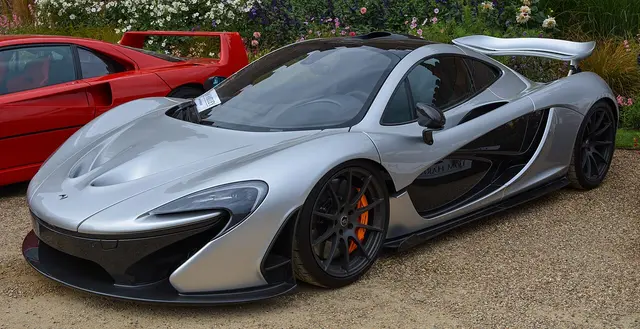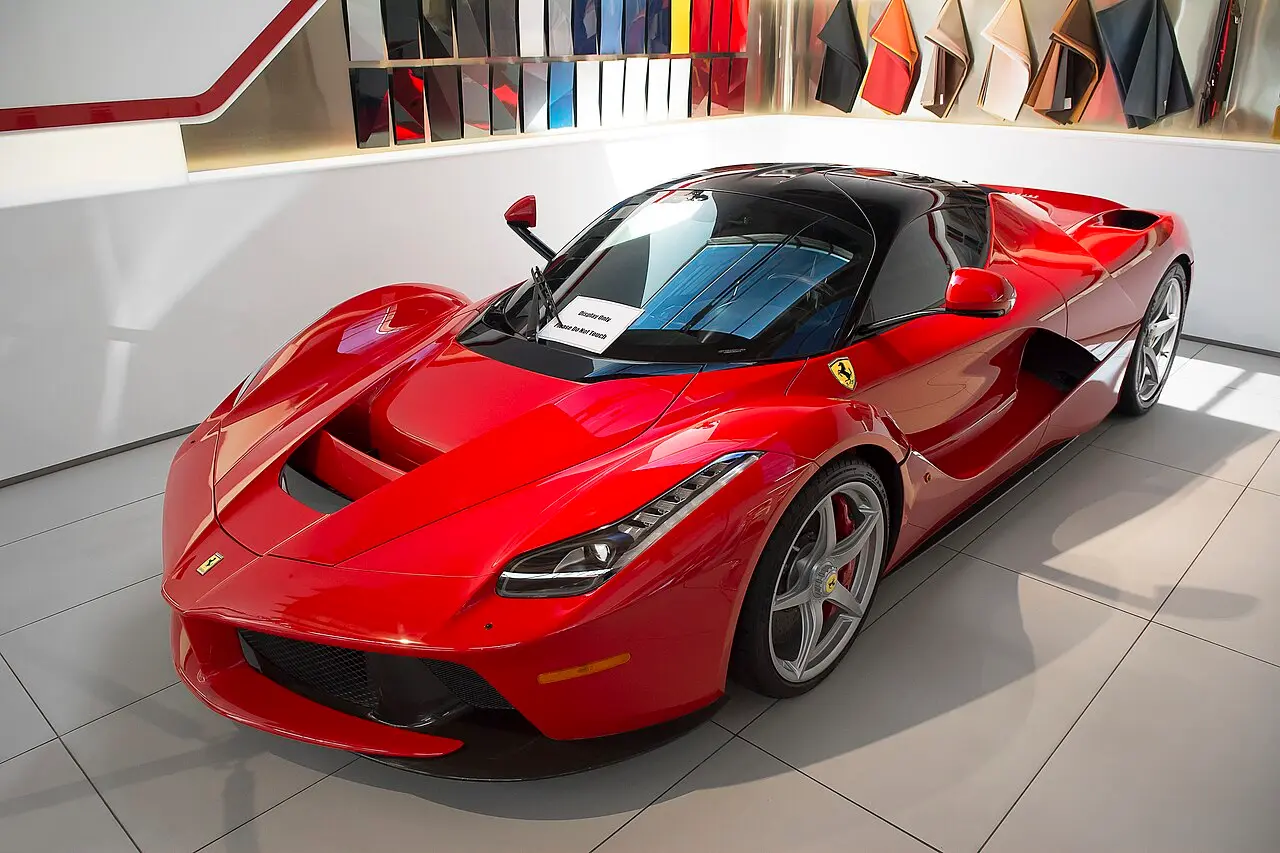
Ferrari LaFerrari

Ferrari LaFerrari
Photo: Axion23 / Wikimedia Commons · CC BY 2.0

The official data lists 6 versions of the Ferrari LaFerrari (2014 - 2018), in the European Union, France, and the United States. Each market publishes its own figures, measured on its own test procedure.

At a glance

Years in the data
2014 - 2018
Markets
European Union, France, United States
Engines
6.3 L to 6.3 L
Power
585 kW (795 PS)
Fuels
Hybrid, Petrol
Lowest consumption (France)
14.0 L/100 km (NEDC)
Lowest consumption (United States)
16.8 L/100 km (EPA)
New registrations in the EU
454

What is the Ferrari LaFerrari?

LaFerrari is a two-seat Ferrari supercar, built as a limited-production flagship rather than a regular model in the range. Its sculpted body and close-fitting cockpit give it a focused character, while its hybrid system brought Ferrari’s HY-KERS technology from Formula 1 to a road car. It belongs to a line of special Ferrari supercars that includes the GTO, F40, F50 and Enzo.

Generation and powertrain

LaFerrari’s F150 generation ran from 2013 to 2016. It pairs a naturally aspirated V12 with Ferrari’s HY-KERS system, which adds electric assistance. The 6.3-litre petrol engine is listed at 585 kW (795 PS) in EU registration figures.

How economical is the Ferrari LaFerrari?

Official fuel-use figures vary by market and test. France’s ADEME lists 14 L/100 km on the NEDC test for hybrid versions in 2014-2015. In the USA, the EPA combined rating is 14 MPG, or 16.8 L/100 km, for 2014-2017. NEDC and EPA procedures differ, so these figures are not directly comparable. EU registrations span 2014-2018, with 454 recorded.

Where was the LaFerrari sold?

LaFerrari appears in European Economic Area registration figures, as well as French and US fuel-economy records. The EU registration period is 2014-2018; France’s record covers 2014-2015, and the EPA record covers 2014-2017. Its hybrid V12 powertrain brought a distinct new character to Ferrari’s flagship supercar line.

Questions and answers

Was the LaFerrari a hybrid?

Yes. Ferrari paired a V12 with its HY-KERS system, adding electric assistance to the combustion engine.

What was the LaFerrari’s official fuel consumption in France?

ADEME lists 14 L/100 km on the NEDC test for hybrid versions in 2014-2015.

What was its EPA fuel economy?

The US EPA combined rating was 14 MPG, or 16.8 L/100 km, for 2014-2017.
LaFerrari (2013 - 2018)

Ferrari LaFerrari
Photo: Axion23 / Wikimedia Commons · CC BY 2.0

Model codes: F150 · References: en.wikipedia.org, cdn.ferrari.com

At a glance: Length 4,720 mm · Kerb weight 1,465 - 1,575 kg · Top speed 360 km/h Specifications, reliability and all versions

European Union 3 versions

New cars registered in the EU (plus Norway and Iceland), from the European Environment Agency. Figures on the NEDC procedure until 2020 and on WLTP from 2021; versions are grouped by engine and power, with their number of registrations.

Years and versionEnginePowerFuelCO₂EU registrations
2014 - 20186.3 L585 kW (795 PS)Petrol330 - 338 g/km394
20166.3 L585 kW (795 PS)Other fuel333 g/km20
2014 - 20156.3 L585 kW (795 PS)Hybrid330 g/km40

France 1 version

New cars on sale in France, from ADEME Car Labelling. NEDC figures until 2015, WLTP figures in the current catalogue.

Years and versionEnginePowerFuelGearboxConsumption (combined)CO₂
2014 - 2015LaFerrari - 585 kW (795 PS)Hybrid7-speed automatic14.0 L/100 km NEDC330 g/km

United States 2 versions

Model years sold in the USA, from the EPA and the Department of Energy (fueleconomy.gov). MPG on the EPA test; litres per 100 km = 235.215 ÷ MPG.

Years and versionEngineFuelGearboxDriveConsumption (combined)CO₂
2017SIDI6.3 LHybrid7-speed automated manualPart-time four-wheel drive13 MPG (18.1 L/100 km) EPA424 g/km
2014SIDI6.3 LHybrid7-speed automated manualRear-wheel drive14 MPG (16.8 L/100 km) EPA413 g/km

Ferrari LaFerrari recalls

10 official safety recalls for the Ferrari LaFerrari from NHTSA (United States), DVSA (United Kingdom) and the EU Safety Gate, newest first. Recall repairs are normally free at the maker’s dealers.

  • Brake fluid reservoir cap may cause fluid leak2013 - 2017
  • Brake reservoir cap may not ventilate properly2005 - 2022
  • Fuel vapour separator fault could cause a fire2017 - 2018
  • Fuel vapor separator may crack and leak2017
  • Driver airbag may deploy incorrectly2014 - 2015

See all 10 recalls

Official figures are measured on standard test procedures and differ between markets. Your consumption depends on how, where and in what conditions you drive.