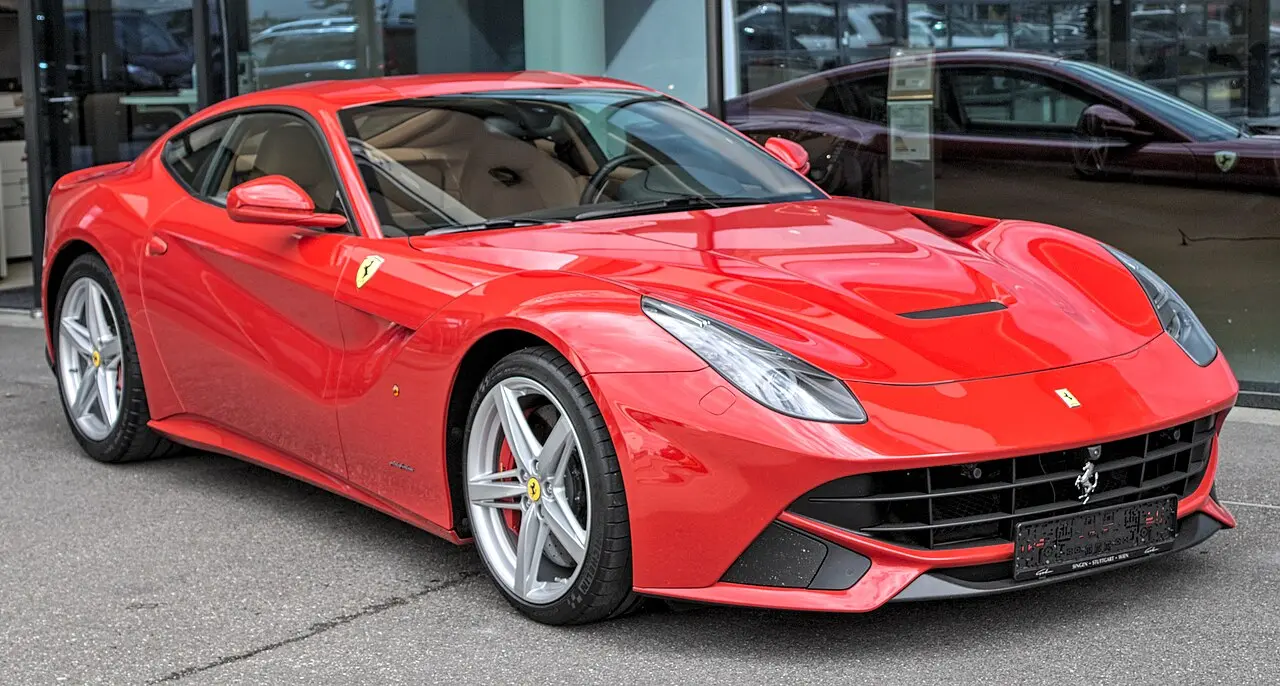
The official data lists 26 versions of the Ferrari F12berlinetta (2012–2018), in the European Union, France, and the United States. Each market publishes its own figures, measured on its own test procedure.
At a glance
Years in the data
2012–2018
Markets
European Union, France, United States
Engines
6.3 L to 6.3 L
Power
541 kW (736 PS) to 570 kW (775 PS)
Fuels
Petrol
Lowest consumption (France)
15.0 L/100 km (NEDC)
Lowest consumption (United States)
16.8 L/100 km (EPA)
New registrations in the EU
3,451
What kind of car is the Ferrari F12berlinetta?
The F12berlinetta is a front-mid-engined V12 coupé, built around Ferrari’s tradition of fast, front-engined grand touring cars. Its low, sculpted body and cabin combine a focused driving position with the comfort and roominess Ferrari describes as part of the car’s design.
Ferrari presented it in 2012 as the first of a new generation of its 12-cylinder cars. The Ferrari Styling Centre and Pininfarina worked together on its shape, which folds aerodynamic features into the bodywork. One distinctive detail is the Aero Bridge, which guides airflow from the bonnet along the sides. The 812 Superfast followed it in Ferrari’s V12 range.
Generations, engines and power
The F12berlinetta is a single-generation model, identified by the internal code F152 and spanning 2012–2017. Its listed engine is a 6.3 L petrol V12. European Union versions range from 541 kW (736 PS) to 570 kW (775 PS); French listings specify 541 kW (736 PS).
The front-mid-engine layout and carefully shaped body give the car its distinctive place in Ferrari’s V12 grand touring tradition. Fuel classifications vary between markets: European Union listings include petrol and other, while the French and US listings specify petrol.
How economical is the Ferrari F12berlinetta?
Official consumption figures vary by market and test procedure. France’s ADEME listings give a lowest figure of 15 L/100 km under NEDC. In the United States, the EPA figure is 16.8 L/100 km, or 14 MPG combined.
NEDC and EPA tests use different procedures, so figures from France and the United States are best understood within their own markets.
Where was the F12berlinetta sold?
The F12berlinetta appears in European Union registration figures, French ADEME listings and US EPA listings. European Union registrations total 3,451 across 2012–2018. The highest listed annual count was 958 in 2013, followed by 724 in 2014 and 508 in 2015.
Questions and answers
What engine does the F12berlinetta have?
It has a 6.3 L petrol V12.
How much power does the F12berlinetta make?
European Union versions range from 541 kW (736 PS) to 570 kW (775 PS). French listings specify 541 kW (736 PS).
What is its official fuel consumption?
France’s lowest listed figure is 15 L/100 km under NEDC. The US EPA figure is 16.8 L/100 km, or 14 MPG combined. These tests use different procedures.
New cars registered in the EU (plus Norway and Iceland), from the European Environment Agency. Figures on the NEDC procedure until 2020 and on WLTP from 2021; versions are grouped by engine and power, with their number of registrations.
Years and version
Engine
Power
Fuel
CO₂
EU registrations
2017–2018
6.3 L
570 kW (775 PS)
Petrol
360 g/km
324
2017
6.3 L
541 kW (736 PS)
Petrol
355 g/km
124
2016
6.3 L
541 kW (736 PS)
Petrol
359 g/km
466
2016
6.3 L
570 kW (775 PS)
Petrol
360 g/km
196
2015
6.3 L
541 kW (736 PS)
Petrol
366 g/km
508
2014
6.3 L
541 kW (736 PS)
Petrol
367 g/km
724
2013
6.3 L
541 kW (736 PS)
Petrol
370 g/km
958
2013
6.3 L
–
Other fuel
380 g/km
12
2012
6.3 L
541 kW (736 PS)
Petrol
368 g/km
97
France 6 versions
New cars on sale in France, from ADEME Car Labelling. NEDC figures until 2015, WLTP figures in the current catalogue.
Years and version
Engine
Power
Fuel
Gearbox
Consumption (combined)
CO₂
2015F12Berlinetta
–
541 kW (736 PS)
Petrol
7-speed automatic
15.0 L/100 km NEDC
350 g/km
2015F12Berlinetta
–
541 kW (736 PS)
Petrol
7-speed automatic
16.3 L/100 km NEDC
380 g/km
2014F12Berlinetta
–
541 kW (736 PS)
Petrol
7-speed automatic
15.0 L/100 km NEDC
350 g/km
2014F12Berlinetta
–
541 kW (736 PS)
Petrol
7-speed automatic
16.3 L/100 km NEDC
380 g/km
2013F12Berlinetta
–
541 kW (736 PS)
Petrol
7-speed automatic
15.0 L/100 km NEDC
350 g/km
2013F12Berlinetta
–
541 kW (736 PS)
Petrol
7-speed automatic
16.3 L/100 km NEDC
380 g/km
United States 10 versions
Model years sold in the USA, from the EPA and the Department of Energy (fueleconomy.gov). MPG on the EPA test; litres per 100 km = 235.215 ÷ MPG.
Years and version
Engine
Fuel
Gearbox
Drive
Consumption (combined)
CO₂
2017SIDI
6.3 L
Petrol
7-speed automated manual
Rear-wheel drive
12 MPG (19.6 L/100 km) EPA
442 g/km
2017SIDI
6.3 L
Petrol
7-speed automated manual
Rear-wheel drive
13 MPG (18.1 L/100 km) EPA
418 g/km
2017SIDI; with Stop-Start option
6.3 L
Petrol
7-speed automated manual
Rear-wheel drive
13 MPG (18.1 L/100 km) EPA
433 g/km
2017SIDI; with Stop-Start option
6.3 L
Petrol
7-speed automated manual
Rear-wheel drive
13 MPG (18.1 L/100 km) EPA
411 g/km
2013–2016SIDI
6.3 L
Petrol
7-speed automated manual
Rear-wheel drive
13 MPG (18.1 L/100 km) EPA
419 g/km
2013–2016SIDI; with Stop-Start Option · SIDI; with Stop-Start option
6.3 L
Petrol
7-speed automated manual
Rear-wheel drive
13 MPG (18.1 L/100 km) EPA
413 g/km
2016SIDI
6.3 L
Petrol
7-speed automated manual
Rear-wheel drive
12 MPG (19.6 L/100 km) EPA
444 g/km
2016SIDI; with Stop-Start option
6.3 L
Petrol
7-speed automated manual
Rear-wheel drive
14 MPG (16.8 L/100 km) EPA
406 g/km
2016SIDI
6.3 L
Petrol
7-speed automated manual
Rear-wheel drive
13 MPG (18.1 L/100 km) EPA
438 g/km
2016SIDI; with Stop-Start option
6.3 L
Petrol
7-speed automated manual
Rear-wheel drive
13 MPG (18.1 L/100 km) EPA
429 g/km
Versions outside these generations
European Union 1 version
New cars registered in the EU (plus Norway and Iceland), from the European Environment Agency. Figures on the NEDC procedure until 2020 and on WLTP from 2021; versions are grouped by engine and power, with their number of registrations.
Years and version
Engine
Power
Fuel
CO₂
EU registrations
2018
6.3 L
541 kW (736 PS)
Petrol
356 g/km
42
Official figures are measured on standard test procedures and differ between markets. Your consumption depends on how, where and in what conditions you drive.