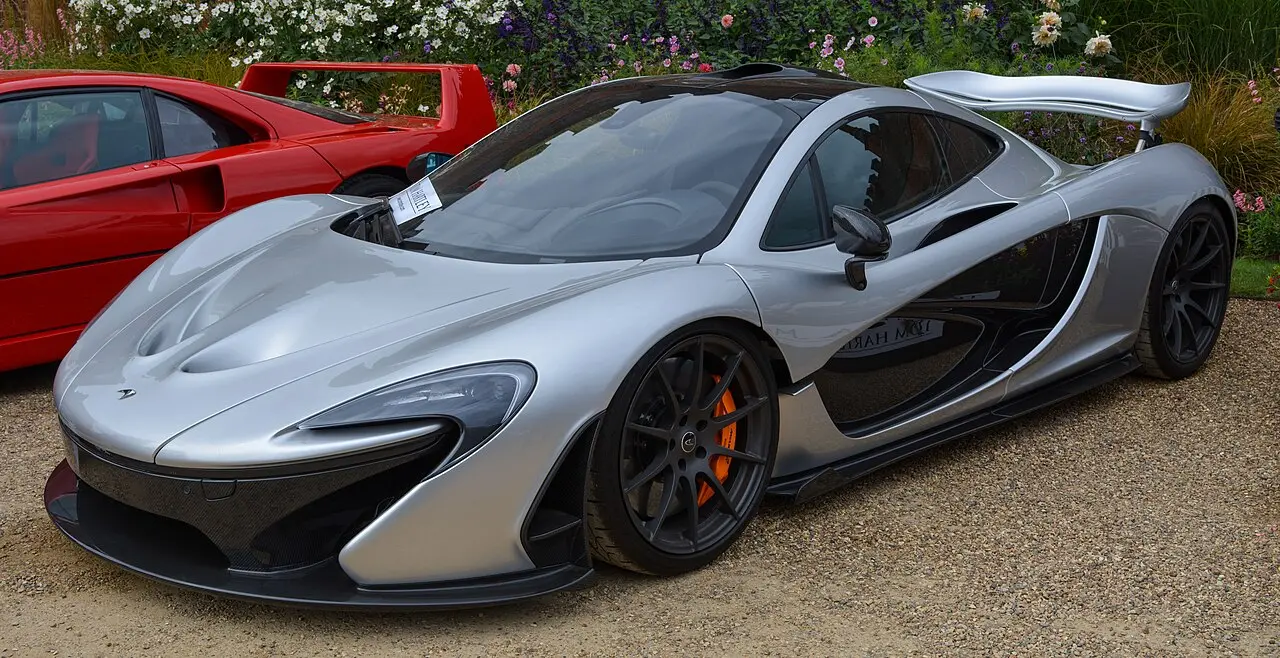
The official data lists 5 versions of the McLaren P1 (2014 - 2016), in the European Union, the United Kingdom, and the United States. Each market publishes its own figures, measured on its own test procedure.
At a glance
Years in the data
2014 - 2016
Markets
European Union, United Kingdom, United States
Engines
3.8 L to 3.8 L
Power
542 kW (737 PS) to 542 kW (737 PS)
Fuels
Petrol, Hybrid, Plug-in hybrid
Plug-in hybrid, weighted (United Kingdom)
8.3 L/100 km (NEDC)
New registrations in the EU
76
What is the McLaren P1?
The P1 is a two-seat plug-in hybrid hypercar from McLaren’s Ultimate Series. Its petrol engine works with an electric motor, bringing electric assistance to a high-performance road car. The P1 also features active aerodynamics, which can adjust to suit driving conditions.
Generation and engines
The P1 generation is listed for 2013-2015. Its 3.8-litre powertrain is listed at 542 kW (737 PS). European Economic Area registrations classify versions as both hybrid and petrol, while UK and US entries identify plug-in hybrid versions.
Fuel consumption
The lowest listed UK weighted figure for the plug-in hybrid is 8.3 L/100 km on NEDC.
Where was it sold?
European Economic Area registrations run from 2014 to 2016 and total 76. The largest listed group is the 3.8-litre hybrid at 542 kW (737 PS) in 2014-2015, with 50 registrations. The petrol classification at the same output accounts for 26 registrations across 2015-2016. UK VCA and US EPA figures cover 2014-2015.
Questions and answers
Is the McLaren P1 a plug-in hybrid?
UK and US entries classify it as a plug-in hybrid. European Economic Area registrations include hybrid and petrol classifications.
How much power does the P1 produce?
Its 3.8-litre powertrain is listed at 542 kW (737 PS).
New cars registered in the EU (plus Norway and Iceland), from the European Environment Agency. Figures on the NEDC procedure until 2020 and on WLTP from 2021; versions are grouped by engine and power, with their number of registrations.
Years and version
Engine
Power
Fuel
Consumption (combined)
CO₂
EU registrations
2015 - 2016
3.8 L
542 kW (737 PS)
Petrol
-
194 g/km
26
2014 - 2015
3.8 L
542 kW (737 PS)
Hybrid
11.3 kWh/100 km NEDC
194 g/km
50
United Kingdom 2 versions
New cars on sale in the UK, from the Vehicle Certification Agency. NEDC figures until 2018 and WLTP figures after; years are the editions a version appeared in.
Years and version
Engine
Power
Fuel
Gearbox
Consumption (combined)
CO₂
Electric range
2015Coupé (737 Ps) standard muffler
3.8 L
542 kW (737 PS)
Plug-in hybrid
-
8.3 L/100 km NEDC1.1 kWh/100 km NEDC
194 g/km
11 km
2014Coupé (737 Ps) standard muffler
3.8 L
542 kW (737 PS)
Plug-in hybrid
Automatic
8.3 L/100 km NEDC1.1 kWh/100 km NEDC
194 g/km
11 km
United States 1 version
Model years sold in the USA, from the EPA and the Department of Energy (fueleconomy.gov). MPG on the EPA test; litres per 100 km = 235.215 ÷ MPG.
Years and version
Engine
Fuel
Gearbox
Drive
Consumption (combined)
CO₂
2014 - 2015PHEV
3.8 L
Plug-in hybrid
7-speed automatic
Rear-wheel drive
17 MPG (13.8 L/100 km) EPA
288 g/km
McLaren P1 recalls
2 official safety recalls for the McLaren P1 from NHTSA (United States), DVSA (United Kingdom) and the EU Safety Gate, newest first. Recall repairs are normally free at the maker’s dealers.
Official figures are measured on standard test procedures and differ between markets. Your consumption depends on how, where and in what conditions you drive.