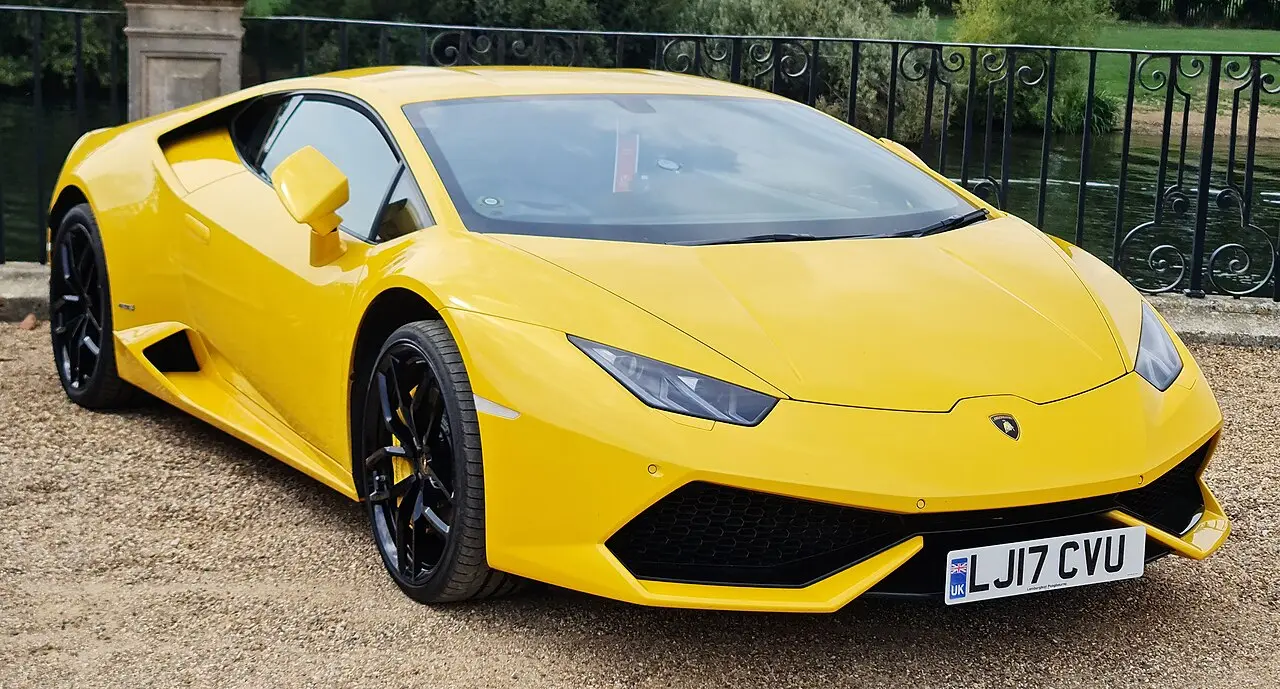
The official data lists 62 versions of the Lamborghini Huracán (2014–2025), in the European Union, the United Kingdom, France, the United States, and Canada. Each market publishes its own figures, measured on its own test procedure.
At a glance
Years in the data
2014–2025
Markets
European Union, United Kingdom, France, United States, Canada
Engines
5.2 L to 5.2 L
Power
426 kW (579 PS) to 470 kW (639 PS)
Fuels
Petrol
Lowest consumption (France)
12.5 L/100 km (NEDC)
Lowest consumption (United Kingdom)
12.5 L/100 km (NEDC)
Lowest consumption (United States)
13.8 L/100 km (EPA)
New registrations in the EU
8,873
What is the Lamborghini Huracán?
The Huracán is a mid-engined supercar powered by a V10. It followed the Gallardo in Lamborghini’s range, bringing the marque’s V10 model into a new design chapter with sharp shapes and all-LED lighting. Its chassis combines carbon fibre and aluminium.
Lamborghini introduced the Huracán in 2014 as the Gallardo’s successor. The model came in coupé and open-top forms, with versions for road and track use.
Generations and engines
The Huracán had one generation, spanning 2014–2024. Across its versions, Lamborghini retained the naturally aspirated 5.2 L petrol V10. EU figures show power from 426 kW (579 PS) to 470 kW (639 PS).
The original Huracán paired its V10 with a seven-speed dual-clutch transmission and all-wheel drive. Later versions brought different body styles and performance-focused setups while keeping the V10 at the heart of the car.
How economical is the Lamborghini Huracán?
Official consumption figures vary by market and test procedure. The lowest listed EU figure is 13.9 L/100 km on WLTP. The UK and France figures list 12.5 L/100 km on NEDC. The EPA figure for the United States is 13.8 L/100 km, or 17 MPG combined; Canada’s NRCan 5-cycle figure is 14.2 L/100 km.
These results use different test procedures: Europe has WLTP and NEDC figures, the USA uses EPA testing, and Canada uses the 5-cycle procedure. They are best read within their own market’s test system.
Where was the Huracán sold?
Official figures are listed for the European Union, the United Kingdom, France, the United States and Canada. EU registrations span 2014–2025, while the Huracán generation ran from 2014–2024.
Questions and answers
What engine does the Lamborghini Huracán have?
The Huracán uses a 5.2 L petrol V10. EU figures show power from 426 kW (579 PS) to 470 kW (639 PS).
When was the Huracán sold?
Its single generation ran from 2014 to 2024. Official EU registrations extend from 2014 to 2025.
What is the Huracán’s official fuel consumption?
The lowest listed figure is 13.9 L/100 km on the EU WLTP test. Other markets use procedures including NEDC, EPA and Canada’s 5-cycle test.
Which markets have official Huracán figures?
Figures are listed for the European Union, the UK, France, the USA and Canada.
New cars registered in the EU (plus Norway and Iceland), from the European Environment Agency. Figures on the NEDC procedure until 2020 and on WLTP from 2021; versions are grouped by engine and power, with their number of registrations.
Years and version
Engine
Power
Fuel
Consumption (combined)
CO₂
EU registrations
2024
5.2 L
470 kW (639 PS)
Petrol
14.4 L/100 km WLTP
331 g/km
703
2024
5.2 L
449 kW (610 PS)
Petrol
14.9 L/100 km WLTP
337 g/km
169
2023
5.2 L
470 kW (639 PS)
Petrol
14.3 L/100 km WLTP
319 g/km
343
2023
5.2 L
449 kW (610 PS)
Petrol
14.8 L/100 km WLTP
332 g/km
59
2022
5.2 L
470 kW (639 PS)
Petrol
14.1 L/100 km WLTP
333 g/km
279
2022
5.2 L
449 kW (610 PS)
Petrol
14.2 L/100 km WLTP
332 g/km
25
2021
5.2 L
470 kW (639 PS)
Petrol
14.0 L/100 km WLTP
334 g/km
708
2021
5.2 L
449 kW (610 PS)
Petrol
13.9 L/100 km WLTP
332 g/km
170
2020
5.2 L
470 kW (639 PS)
Petrol
–
334 g/km
757
2020
5.2 L
449 kW (610 PS)
Petrol
–
326 g/km
123
2020
5.2 L
–
Petrol
–
335 g/km
11
2019
5.2 L
470 kW (639 PS)
Petrol
–
335 g/km
1,098
2019
5.2 L
449 kW (610 PS)
Petrol
–
332 g/km
82
2019
5.2 L
426 kW (579 PS)
Petrol
–
306 g/km
34
2018
5.2 L
470 kW (639 PS)
Petrol
–
331 g/km
990
2018
5.2 L
449 kW (610 PS)
Petrol
–
315 g/km
194
2018
5.2 L
426 kW (579 PS)
Petrol
–
321 g/km
70
2018
6.5 L
–
Petrol
–
394 g/km
14
2017
5.2 L
449 kW (610 PS)
Petrol
–
286 g/km
722
2017
5.2 L
470 kW (639 PS)
Petrol
–
314 g/km
150
2017
5.2 L
426 kW (579 PS)
Petrol
–
281 g/km
118
2016
5.2 L
449 kW (610 PS)
Petrol
–
284 g/km
802
2016
5.2 L
426 kW (579 PS)
Petrol
–
278 g/km
84
2014–2015
5.2 L
449 kW (610 PS)
Petrol
–
290 g/km
982
United Kingdom 1 version
New cars on sale in the UK, from the Vehicle Certification Agency. NEDC figures until 2018 and WLTP figures after; years are the editions a version appeared in.
Years and version
Engine
Fuel
Gearbox
Consumption (combined)
CO₂
2015–2018LP 610-4
5.2 L
Petrol
7-speed automatic
12.5 L/100 km NEDC
290 g/km
France 2 versions
New cars on sale in France, from ADEME Car Labelling. NEDC figures until 2015, WLTP figures in the current catalogue.
Years and version
Engine
Power
Fuel
Gearbox
Consumption (combined)
CO₂
2015HURACAN
–
449 kW (610 PS)
Petrol
7-speed automatic
12.5 L/100 km NEDC
290 g/km
2014HURACAN
–
449 kW (610 PS)
Petrol
7-speed automatic
12.5 L/100 km NEDC
290 g/km
United States 18 versions
Model years sold in the USA, from the EPA and the Department of Energy (fueleconomy.gov). MPG on the EPA test; litres per 100 km = 235.215 ÷ MPG.
Years and version
Engine
Fuel
Gearbox
Drive
Consumption (combined)
CO₂
2024SIDI & PFI
5.2 L
Petrol
7-speed automated manual
Rear-wheel drive
15 MPG (15.7 L/100 km) EPA
370 g/km
2024SIDI & PFI
5.2 L
Petrol
7-speed automated manual
All-wheel drive
15 MPG (15.7 L/100 km) EPA
375 g/km
2022–2023SIDI & PFI
5.2 L
Petrol
7-speed automated manual
All-wheel drive
15 MPG (15.7 L/100 km) EPA
370 g/km
2023SIDI & PFI
5.2 L
Petrol
7-speed automated manual
Rear-wheel drive
15 MPG (15.7 L/100 km) EPA
368 g/km
2020–2022SIDI & PFI
5.2 L
Petrol
7-speed automated manual
Rear-wheel drive
15 MPG (15.7 L/100 km) EPA
370 g/km
2021SIDI & PFI
5.2 L
Petrol
7-speed automated manual
All-wheel drive
15 MPG (15.7 L/100 km) EPA
371 g/km
2020SIDI & PFI
5.2 L
Petrol
7-speed automated manual
All-wheel drive
15 MPG (15.7 L/100 km) EPA
370 g/km
2019SIDI & PFI
5.2 L
Petrol
7-speed automated manual
All-wheel drive
15 MPG (15.7 L/100 km) EPA
368 g/km
2019SIDI & PFI
5.2 L
Petrol
7-speed automated manual
Rear-wheel drive
15 MPG (15.7 L/100 km) EPA
364 g/km
2018SIDI & PFI
5.2 L
Petrol
7-speed automated manual
All-wheel drive
16 MPG (14.7 L/100 km) EPA
354 g/km
2018SIDI & PFI
5.2 L
Petrol
7-speed automated manual
All-wheel drive
15 MPG (15.7 L/100 km) EPA
359 g/km
2018SIDI & PFI
5.2 L
Petrol
7-speed automated manual
Rear-wheel drive
16 MPG (14.7 L/100 km) EPA
336 g/km
2018SIDI & PFI
5.2 L
Petrol
7-speed automated manual
Rear-wheel drive
16 MPG (14.7 L/100 km) EPA
337 g/km
2016–2017SIDI & PFI
5.2 L
Petrol
7-speed automated manual
All-wheel drive
17 MPG (13.8 L/100 km) EPA
331 g/km
2016–2017SIDI & PFI
5.2 L
Petrol
7-speed automated manual
All-wheel drive
16 MPG (14.7 L/100 km) EPA
340 g/km
2017SIDI & PFI
5.2 L
Petrol
7-speed automated manual
Rear-wheel drive
17 MPG (13.8 L/100 km) EPA
331 g/km
2017SIDI & PFI
5.2 L
Petrol
7-speed automated manual
Rear-wheel drive
16 MPG (14.7 L/100 km) EPA
340 g/km
2015SIDI & PFI
5.2 L
Petrol
7-speed automated manual
All-wheel drive
16 MPG (14.7 L/100 km) EPA
338 g/km
Canada 15 versions
Model years sold in Canada, from Natural Resources Canada fuel consumption ratings (5-cycle test).
Years and version
Engine
Fuel
Gearbox
Consumption (combined)
CO₂
2024Two-seater
5.2 L
Petrol
7-speed automated manual
16.1 L/100 km 5-cycle
375 g/km
2024Two-seater
5.2 L
Petrol
7-speed automated manual
15.9 L/100 km 5-cycle
370 g/km
2023Two-seater
5.2 L
Petrol
7-speed automated manual
15.8 L/100 km 5-cycle
368 g/km
2023Two-seater
5.2 L
Petrol
7-speed automated manual
15.9 L/100 km 5-cycle
370 g/km
2020–2022Two-seater
5.2 L
Petrol
7-speed automated manual
15.7 L/100 km 5-cycle
370 g/km
2021–2022Two-seater
5.2 L
Petrol
7-speed automated manual
15.7 L/100 km 5-cycle
371 g/km
2019Two-seater
5.2 L
Petrol
7-speed automated manual
15.9 L/100 km 5-cycle
366 g/km
2019Two-seater
5.2 L
Petrol
7-speed automated manual
15.7 L/100 km 5-cycle
370 g/km
2018Two-seater
5.2 L
Petrol
7-speed automated manual
14.4 L/100 km 5-cycle
336 g/km
2018Two-seater
5.2 L
Petrol
7-speed automated manual
15.0 L/100 km 5-cycle
349 g/km
2018Two-seater
5.2 L
Petrol
7-speed automated manual
14.5 L/100 km 5-cycle
337 g/km
2018Two-seater
5.2 L
Petrol
7-speed automated manual
15.0 L/100 km 5-cycle
350 g/km
2016–2017Two-seater
5.2 L
Petrol
7-speed automated manual
14.2 L/100 km 5-cycle
331 g/km
2016–2017Two-seater
5.2 L
Petrol
7-speed automated manual
14.6 L/100 km 5-cycle
340 g/km
2015Two-seater
5.2 L
Petrol
7-speed automated manual
14.5 L/100 km 5-cycle
334 g/km
Versions outside these generations
European Union 2 versions
New cars registered in the EU (plus Norway and Iceland), from the European Environment Agency. Figures on the NEDC procedure until 2020 and on WLTP from 2021; versions are grouped by engine and power, with their number of registrations.
Years and version
Engine
Power
Fuel
Consumption (combined)
CO₂
EU registrations
2025
5.2 L
470 kW (639 PS)
Petrol
14.4 L/100 km WLTP
333 g/km
153
2025
5.2 L
449 kW (610 PS)
Petrol
14.9 L/100 km WLTP
337 g/km
33
Official figures are measured on standard test procedures and differ between markets. Your consumption depends on how, where and in what conditions you drive.