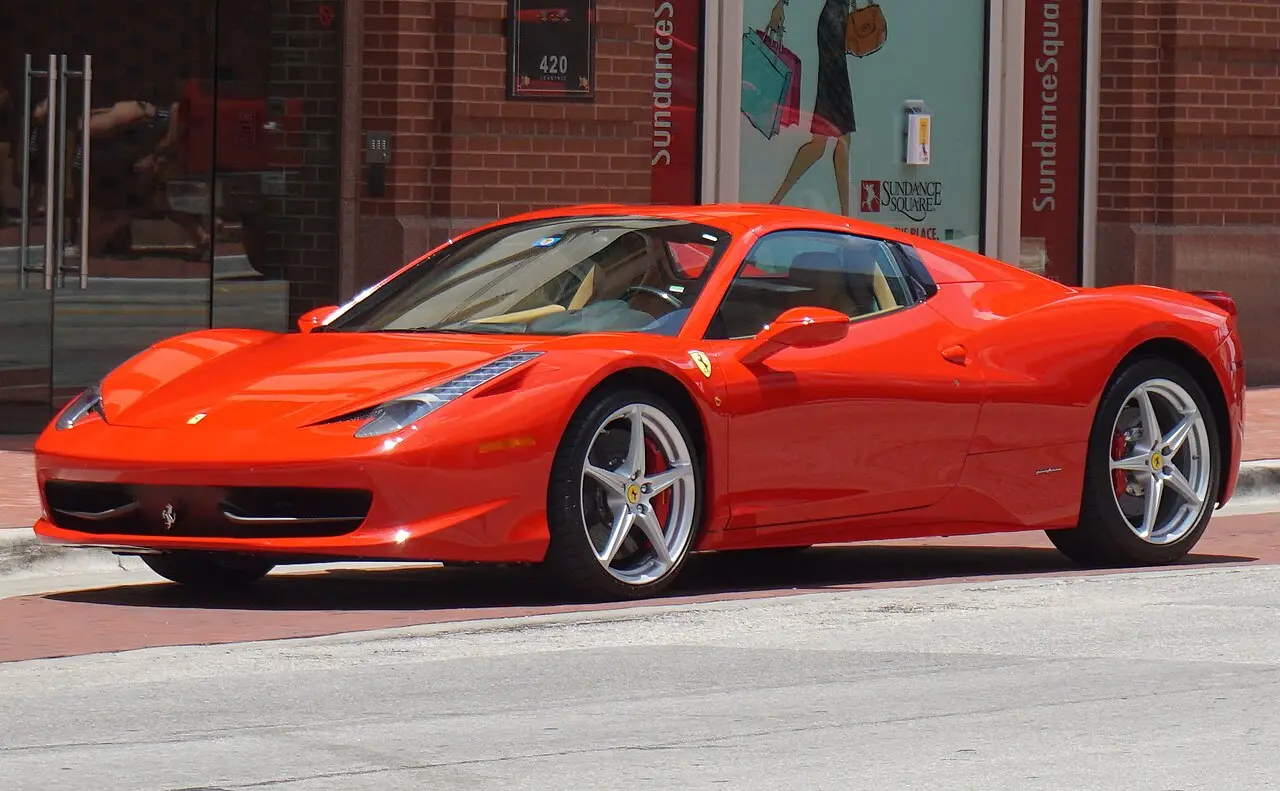
The official data lists 36 versions of the Ferrari 458 Italia (2010–2018), in the European Union, France, and the United States. Each market publishes its own figures, measured on its own test procedure.
At a glance
Years in the data
2010–2018
Markets
European Union, France, United States
Engines
4.5 L to 4.5 L
Power
416 kW (566 PS) to 441 kW (600 PS)
Fuels
Petrol
Lowest consumption (France)
11.8 L/100 km (NEDC)
Lowest consumption (United States)
15.7 L/100 km (EPA)
New registrations in the EU
12,181
What is the Ferrari 458 Italia?
The Ferrari 458 Italia is a mid-engined V8 sports car with a naturally aspirated engine. It belongs to Ferrari’s berlinetta tradition: a low, closed sports car with the engine behind the cabin. Ferrari drew on its racing experience in developing the car’s design and driver controls. The 488 that followed brought turbocharging to this branch of the range.
Generation and engine
The 458 generation ran from 2009 to 2015 and included the Italia coupé, Spider convertible and special-series versions. Its listed engine is a 4.5-litre petrol V8. Across the versions represented in market figures, power ranges from 416 kW (566 PS) to 441 kW (600 PS).
How economical is the Ferrari 458 Italia?
Official consumption figures vary by market and test procedure. France’s ADEME figures list a lowest consumption of 11.8 L/100 km on NEDC. The US EPA figure is 15.7 L/100 km, or 15 MPG combined. NEDC is an older European test procedure, while the EPA uses its own procedure in the United States, so the results are not directly comparable.
Where was the Ferrari 458 Italia sold?
The 458 Italia appears in EU registration figures from 2010 to 2018, France ADEME figures from 2013 to 2015, and US EPA figures from 2010 to 2015. EU registrations total 12,181. The most registered listed version was the 4.5-litre petrol model rated at 416 kW (566 PS), with 2,236 registrations in 2011.
Questions and answers
What engine is in the Ferrari 458 Italia?
It has a 4.5-litre petrol V8, with listed power from 416 kW (566 PS) to 441 kW (600 PS).
When was the 458 generation sold?
The 458 generation ran from 2009 to 2015.
What is its official fuel consumption?
The listed lowest figure is 11.8 L/100 km under France’s NEDC test; the US EPA figure is 15.7 L/100 km, or 15 MPG combined. The procedures differ by market.
New cars registered in the EU (plus Norway and Iceland), from the European Environment Agency. Figures on the NEDC procedure until 2020 and on WLTP from 2021; versions are grouped by engine and power, with their number of registrations.
Years and version
Engine
Power
Fuel
CO₂
EU registrations
2015
4.5 L
441 kW (600 PS)
Petrol
292 g/km
1,402
2015
4.5 L
416 kW (566 PS)
Petrol
297 g/km
244
2015
3.9 L
493 kW (670 PS)
Petrol
269 g/km
12
2014
4.5 L
441 kW (600 PS)
Petrol
296 g/km
1,592
2014
4.5 L
416 kW (566 PS)
Petrol
295 g/km
612
2013
4.5 L
416 kW (566 PS)
Petrol
294 g/km
2,122
2013
4.5 L
441 kW (600 PS)
Petrol
300 g/km
44
2013
4.5 L
–
Other fuel
307 g/km
18
2012
4.5 L
416 kW (566 PS)
Petrol
287 g/km
2,165
2011
4.5 L
416 kW (566 PS)
Petrol
297 g/km
2,236
2010
4.5 L
–
Petrol
307 g/km
1,502
France 18 versions
New cars on sale in France, from ADEME Car Labelling. NEDC figures until 2015, WLTP figures in the current catalogue.
Years and version
Engine
Power
Fuel
Gearbox
Consumption (combined)
CO₂
2015458 ITALIA
–
416 kW (566 PS)
Petrol
7-speed automatic
11.8 L/100 km NEDC
275 g/km
2015458 ITALIA
–
416 kW (566 PS)
Petrol
7-speed automatic
13.3 L/100 km NEDC
307 g/km
2015458 SPIDER
–
416 kW (566 PS)
Petrol
7-speed automatic
11.8 L/100 km NEDC
275 g/km
2015458 SPIDER
–
416 kW (566 PS)
Petrol
7-speed automatic
13.3 L/100 km NEDC
307 g/km
2015458 SPECIALE
–
441 kW (600 PS)
Petrol
7-speed automatic
11.8 L/100 km NEDC
275 g/km
2015458 SPECIALE
–
441 kW (600 PS)
Petrol
7-speed automatic
13.3 L/100 km NEDC
307 g/km
2015458 SPECIALE APERTA
–
441 kW (600 PS)
Petrol
7-speed automatic
11.8 L/100 km NEDC
275 g/km
2015458 SPECIALE APERTA
–
441 kW (600 PS)
Petrol
7-speed automatic
13.3 L/100 km NEDC
307 g/km
2014458 ITALIA
–
416 kW (566 PS)
Petrol
7-speed automatic
11.8 L/100 km NEDC
275 g/km
2014458 ITALIA
–
416 kW (566 PS)
Petrol
7-speed automatic
13.3 L/100 km NEDC
307 g/km
2014458 SPIDER
–
416 kW (566 PS)
Petrol
7-speed automatic
11.8 L/100 km NEDC
275 g/km
2014458 SPIDER
–
416 kW (566 PS)
Petrol
7-speed automatic
13.3 L/100 km NEDC
307 g/km
2014458 SPECIALE
–
441 kW (600 PS)
Petrol
7-speed automatic
11.8 L/100 km NEDC
275 g/km
2014458 SPECIALE
–
441 kW (600 PS)
Petrol
7-speed automatic
13.3 L/100 km NEDC
307 g/km
2013458 ITALIA
–
416 kW (566 PS)
Petrol
7-speed automatic
11.8 L/100 km NEDC
275 g/km
2013458 ITALIA
–
416 kW (566 PS)
Petrol
7-speed automatic
13.3 L/100 km NEDC
307 g/km
2013458 SPIDER
–
416 kW (566 PS)
Petrol
7-speed automatic
11.8 L/100 km NEDC
275 g/km
2013458 SPIDER
–
416 kW (566 PS)
Petrol
7-speed automatic
13.3 L/100 km NEDC
307 g/km
United States 3 versions
Model years sold in the USA, from the EPA and the Department of Energy (fueleconomy.gov). MPG on the EPA test; litres per 100 km = 235.215 ÷ MPG.
Years and version
Engine
Fuel
Gearbox
Drive
Consumption (combined)
CO₂
2013–2015SIDI; · SIDI
4.5 L
Petrol
7-speed automated manual
Rear-wheel drive
14 MPG (16.8 L/100 km) EPA
384 g/km
2013–2015SIDI; with Stop-Start Option
4.5 L
Petrol
7-speed automated manual
Rear-wheel drive
15 MPG (15.7 L/100 km) EPA
378 g/km
2010–2012SIDI · SIDI; with Stop-Start option
4.5 L
Petrol
7-speed automated manual
Rear-wheel drive
14 MPG (16.8 L/100 km) EPA
394 g/km
Versions outside these generations
European Union 4 versions
New cars registered in the EU (plus Norway and Iceland), from the European Environment Agency. Figures on the NEDC procedure until 2020 and on WLTP from 2021; versions are grouped by engine and power, with their number of registrations.
Years and version
Engine
Power
Fuel
CO₂
EU registrations
2018
4.5 L
441 kW (600 PS)
Petrol
299 g/km
24
2017
4.5 L
441 kW (600 PS)
Petrol
295 g/km
28
2016
4.5 L
441 kW (600 PS)
Petrol
290 g/km
146
2016
4.5 L
416 kW (566 PS)
Petrol
300 g/km
34
Official figures are measured on standard test procedures and differ between markets. Your consumption depends on how, where and in what conditions you drive.