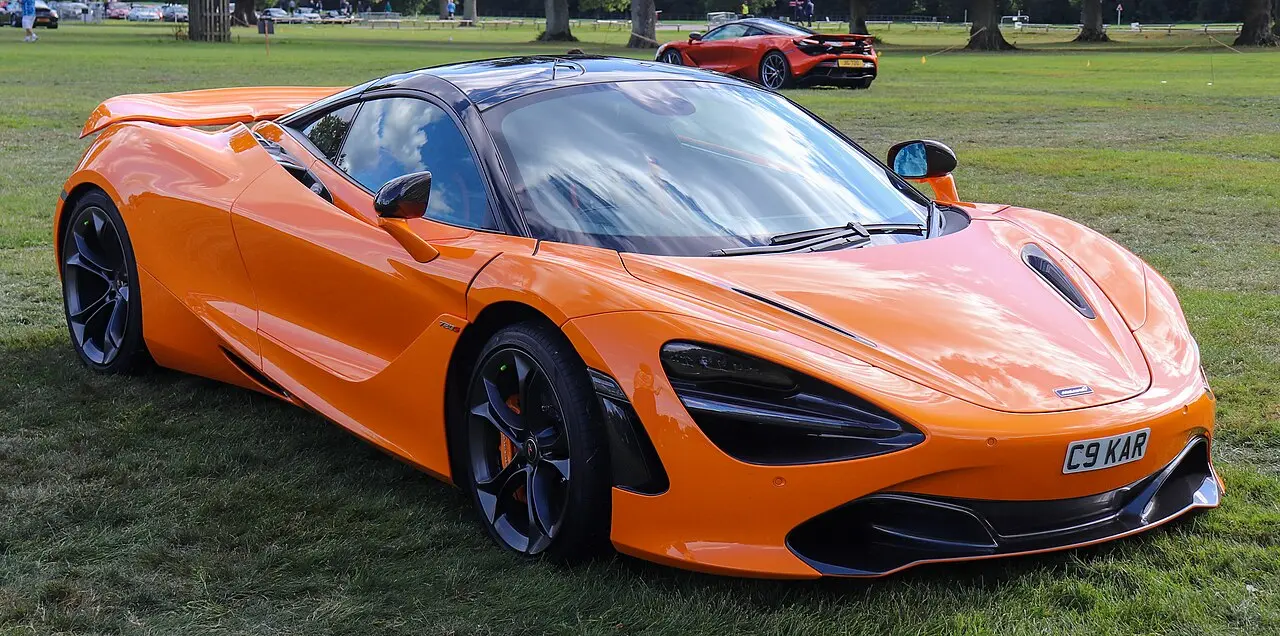
The official data lists 17 versions of the McLaren 720S (2017–2024), in the European Union, the United Kingdom, and the United States. Each market publishes its own figures, measured on its own test procedure.
At a glance
Years in the data
2017–2024
Markets
European Union, United Kingdom, United States
Engines
4.0 L to 4.0 L
Power
530 kW (720 PS) to 530 kW (721 PS)
Fuels
Petrol
Lowest consumption (United Kingdom)
10.7 L/100 km (NEDC)
Lowest consumption (European Union)
12.0 L/100 km (WLTP)
Lowest consumption (United States)
13.1 L/100 km (EPA)
New registrations in the EU
2,471
What is the McLaren 720S?
The 720S is a two-seat, mid-engined supercar in McLaren’s Super Series. It arrived in 2017 with a 4.0-litre petrol engine and a carbon-fibre MonoCage II chassis. Slim pillars and glazed sections help give the driver a broad view from the cabin.
The 720S was the second generation of McLaren’s Super Series. Its generation ran from 2017 to 2022, with a design shaped around airflow and visibility.
Engines and power
The 720S used a 4.0-litre petrol engine. EU figures list 530 kW (721 PS), while UK listings show 530 kW (720 PS) to 530 kW (721 PS).
How economical is the McLaren 720S?
The lowest listed EU figure is 12 L/100 km on the WLTP test. UK figures give 10.7 L/100 km on NEDC, while the US EPA rating is 13.1 L/100 km, or 18 MPG combined. These results use different test procedures, so they are not directly equivalent.
Official EU registration figures span 2017–2024 and total 2,471. The largest annual totals shown are 630 in 2019, 584 in 2018 and 386 in 2017.
Where was the 720S sold?
The 720S was listed in official figures for the European Union, the United Kingdom and the United States. It brought McLaren’s motorsport engineering into a road-going Super Series car, with its carbon-fibre structure at the heart of the design.
Questions and answers
What engine does the McLaren 720S have?
A 4.0-litre petrol engine, listed at 530 kW (721 PS) in EU figures.
What is the 720S’s official fuel consumption?
The lowest listed EU figure is 12 L/100 km on WLTP. UK NEDC is 10.7 L/100 km, and the US EPA figure is 13.1 L/100 km (18 MPG combined).
New cars registered in the EU (plus Norway and Iceland), from the European Environment Agency. Figures on the NEDC procedure until 2020 and on WLTP from 2021; versions are grouped by engine and power, with their number of registrations.
Years and version
Engine
Power
Fuel
Consumption (combined)
CO₂
EU registrations
2022
4.0 L
530 kW (721 PS)
Petrol
12.1 L/100 km WLTP
275 g/km
63
2021
4.0 L
530 kW (721 PS)
Petrol
12.0 L/100 km WLTP
275 g/km
120
2020
4.0 L
530 kW (721 PS)
Petrol
–
252 g/km
352
2019
4.0 L
530 kW (721 PS)
Petrol
–
252 g/km
630
2018
4.0 L
530 kW (721 PS)
Petrol
–
249 g/km
584
2018
4.0 L
–
Petrol
–
249 g/km
292
2017
4.0 L
530 kW (721 PS)
Petrol
–
249 g/km
386
United Kingdom 3 versions
New cars on sale in the UK, from the Vehicle Certification Agency. NEDC figures until 2018 and WLTP figures after; years are the editions a version appeared in.
Years and version
Engine
Power
Fuel
Consumption (combined)
CO₂
2020–2023Coupé (720 Ps) · Spider (720 Ps)
4.0 L
530 kW (721 PS)
Petrol
12.2 L/100 km WLTP
276 g/km
2019Coupé (720 Ps) · Spider (720 Ps)
4.0 L
530 kW (721 PS)
Petrol
12.2 L/100 km WLTP
–
2018Coupé 720PS
4.0 L
530 kW (720 PS)
Petrol
10.7 L/100 km NEDC
249 g/km
United States 5 versions
Model years sold in the USA, from the EPA and the Department of Energy (fueleconomy.gov). MPG on the EPA test; litres per 100 km = 235.215 ÷ MPG.
Years and version
Engine
Fuel
Gearbox
Drive
Consumption (combined)
CO₂
2021–2022
4.0 L
Petrol
7-speed automated manual
Rear-wheel drive
18 MPG (13.1 L/100 km) EPA
314 g/km
2020
4.0 L
Petrol
7-speed automated manual
Rear-wheel drive
18 MPG (13.1 L/100 km) EPA
319 g/km
2020
4.0 L
Petrol
7-speed automated manual
Rear-wheel drive
18 MPG (13.1 L/100 km) EPA
308 g/km
2018–2019
4.0 L
Petrol
7-speed automatic
Rear-wheel drive
18 MPG (13.1 L/100 km) EPA
319 g/km
2019
4.0 L
Petrol
7-speed automatic
Rear-wheel drive
18 MPG (13.1 L/100 km) EPA
308 g/km
Versions outside these generations
European Union 2 versions
New cars registered in the EU (plus Norway and Iceland), from the European Environment Agency. Figures on the NEDC procedure until 2020 and on WLTP from 2021; versions are grouped by engine and power, with their number of registrations.
Years and version
Engine
Power
Fuel
Consumption (combined)
CO₂
EU registrations
2024
4.0 L
530 kW (721 PS)
Petrol
12.2 L/100 km WLTP
282 g/km
12
2023
4.0 L
530 kW (721 PS)
Petrol
12.2 L/100 km WLTP
275 g/km
32
Official figures are measured on standard test procedures and differ between markets. Your consumption depends on how, where and in what conditions you drive.