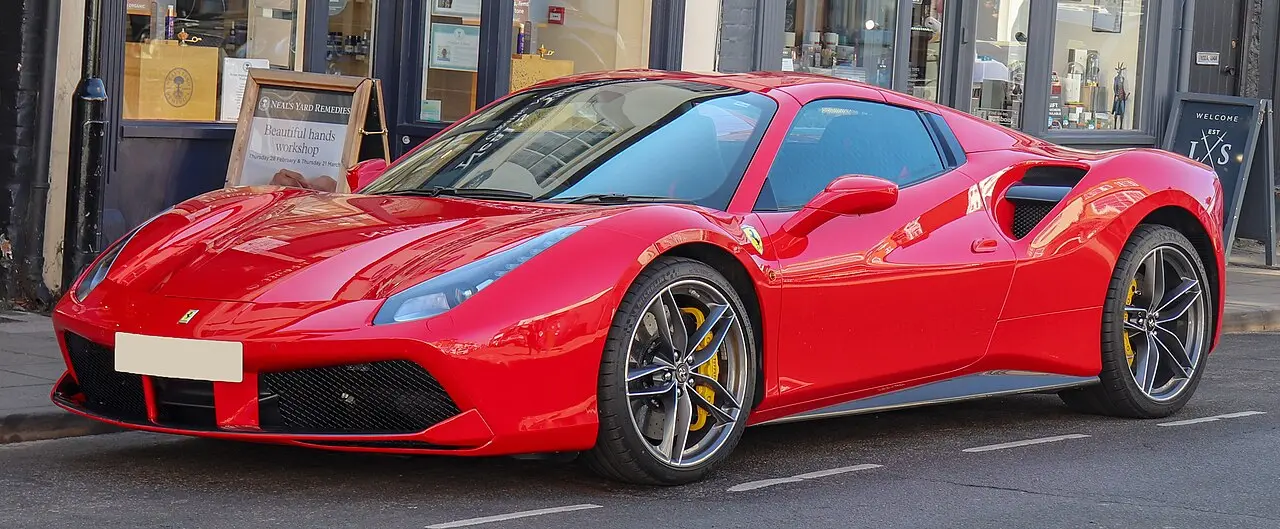
The official data lists 19 versions of the Ferrari 488 (2015–2023), in the European Union, the United Kingdom, and the United States. Each market publishes its own figures, measured on its own test procedure.
At a glance
Years in the data
2015–2023
Markets
European Union, United Kingdom, United States
Engines
3.9 L to 3.9 L
Power
493 kW (670 PS) to 530 kW (721 PS)
Fuels
Petrol
Lowest consumption (United Kingdom)
12.4 L/100 km (WLTP)
Lowest consumption (European Union)
12.5 L/100 km (WLTP)
Lowest consumption (United States)
13.1 L/100 km (EPA)
New registrations in the EU
13,645
What is the Ferrari 488?
The Ferrari 488 is a mid-engined V8 sports car offered as the 488 GTB coupé and 488 Spider convertible. It followed the 458, keeping the mid-rear engine layout but changing from a naturally aspirated V8 to a turbocharged one. The 488 sits in Ferrari’s V8 sports-car range, with a design shaped by aerodynamics and a cockpit focused on the driver.
Generations and engines
The 488 generation ran from 2015 to 2020. Its 3.9-litre petrol V8 has listed power from 493 kW (670 PS) to 530 kW (721 PS), across the GTB, Spider and special-series versions. The GTB is a two-seat berlinetta, Ferrari’s term for a closed sports coupé.
How economical is the Ferrari 488?
Official consumption figures vary by market and test procedure. The lowest listed EU figure is 12.5 L/100 km on WLTP; the UK figure is 12.4 L/100 km, also on WLTP. In the United States, the EPA figure is 13.1 L/100 km, or 18 MPG combined. WLTP and EPA results come from different test procedures, so they are not directly comparable.
Where was the Ferrari 488 sold?
The 488 appears in EU registration figures from 2015 to 2021, UK VCA figures from 2020 to 2023, and US EPA figures from 2016 to 2020. EU registrations total 13,645. The most registered listed version was the 3.9-litre petrol model rated at 493 kW (670 PS), with 2,926 registrations in 2018.
Questions and answers
What engine does the Ferrari 488 have?
It uses a 3.9-litre petrol V8. Listed power ranges from 493 kW (670 PS) to 530 kW (721 PS).
When was the 488 generation sold?
The 488 generation ran from 2015 to 2020.
What is the Ferrari 488’s official consumption?
The lowest listed figures are 12.5 L/100 km on the EU WLTP test, 12.4 L/100 km on UK WLTP, and 13.1 L/100 km (18 MPG combined) under the US EPA test. WLTP and EPA use different procedures.
New cars registered in the EU (plus Norway and Iceland), from the European Environment Agency. Figures on the NEDC procedure until 2020 and on WLTP from 2021; versions are grouped by engine and power, with their number of registrations.
Years and version
Engine
Power
Fuel
CO₂
EU registrations
2020
3.9 L
530 kW (721 PS)
Petrol
264 g/km
2,194
2020
3.9 L
493 kW (670 PS)
Petrol
260 g/km
33
2019
3.9 L
530 kW (721 PS)
Petrol
263 g/km
1,777
2019
3.9 L
493 kW (670 PS)
Petrol
260 g/km
753
2018
3.9 L
493 kW (670 PS)
Petrol
261 g/km
2,926
2018
3.9 L
530 kW (721 PS)
Petrol
264 g/km
108
2017
3.9 L
493 kW (670 PS)
Petrol
261 g/km
2,728
2017
3.9 L
740 kW (1,006 PS)
Petrol
264 g/km
30
2016
3.9 L
493 kW (670 PS)
Petrol
268 g/km
2,360
2015
3.9 L
493 kW (670 PS)
Petrol
266 g/km
422
United Kingdom 2 versions
New cars on sale in the UK, from the Vehicle Certification Agency. NEDC figures until 2018 and WLTP figures after; years are the editions a version appeared in.
Years and version
Engine
Power
Fuel
Gearbox
Consumption (combined)
CO₂
2020–2023Pista · 488 Pista
3.9 L
530 kW (721 PS)
Petrol
7-speed automatic
12.4 L/100 km WLTP
282 g/km
2020–2023Pista Spider · 488 Pista Spider
3.9 L
530 kW (721 PS)
Petrol
7-speed automatic
12.8 L/100 km WLTP
289 g/km
United States 5 versions
Model years sold in the USA, from the EPA and the Department of Energy (fueleconomy.gov). MPG on the EPA test; litres per 100 km = 235.215 ÷ MPG.
Years and version
Engine
Fuel
Gearbox
Drive
Consumption (combined)
CO₂
2019–2020SIDI; Stop-Start · SIDI
3.9 L
Petrol
7-speed automated manual
Rear-wheel drive
17 MPG (13.8 L/100 km) EPA
330 g/km
2019–2020SIDI; Stop-Start · SIDI
3.9 L
Petrol
7-speed automated manual
Rear-wheel drive
17 MPG (13.8 L/100 km) EPA
326 g/km
2016–2019SIDI
3.9 L
Petrol
7-speed automated manual
Rear-wheel drive
18 MPG (13.1 L/100 km) EPA
311 g/km
2017–2019SIDI; with Stop-Start option · SIDI; Stop-Start
3.9 L
Petrol
7-speed automated manual
Rear-wheel drive
18 MPG (13.1 L/100 km) EPA
308 g/km
2016SIDI; with Stop-Start option
3.9 L
Petrol
7-speed automated manual
Rear-wheel drive
18 MPG (13.1 L/100 km) EPA
309 g/km
Versions outside these generations
European Union 2 versions
New cars registered in the EU (plus Norway and Iceland), from the European Environment Agency. Figures on the NEDC procedure until 2020 and on WLTP from 2021; versions are grouped by engine and power, with their number of registrations.
Years and version
Engine
Power
Fuel
Consumption (combined)
CO₂
EU registrations
2021
3.9 L
530 kW (721 PS)
Petrol
12.5 L/100 km WLTP
286 g/km
296
2021
3.9 L
493 kW (670 PS)
Petrol
12.9 L/100 km WLTP
294 g/km
18
Official figures are measured on standard test procedures and differ between markets. Your consumption depends on how, where and in what conditions you drive.