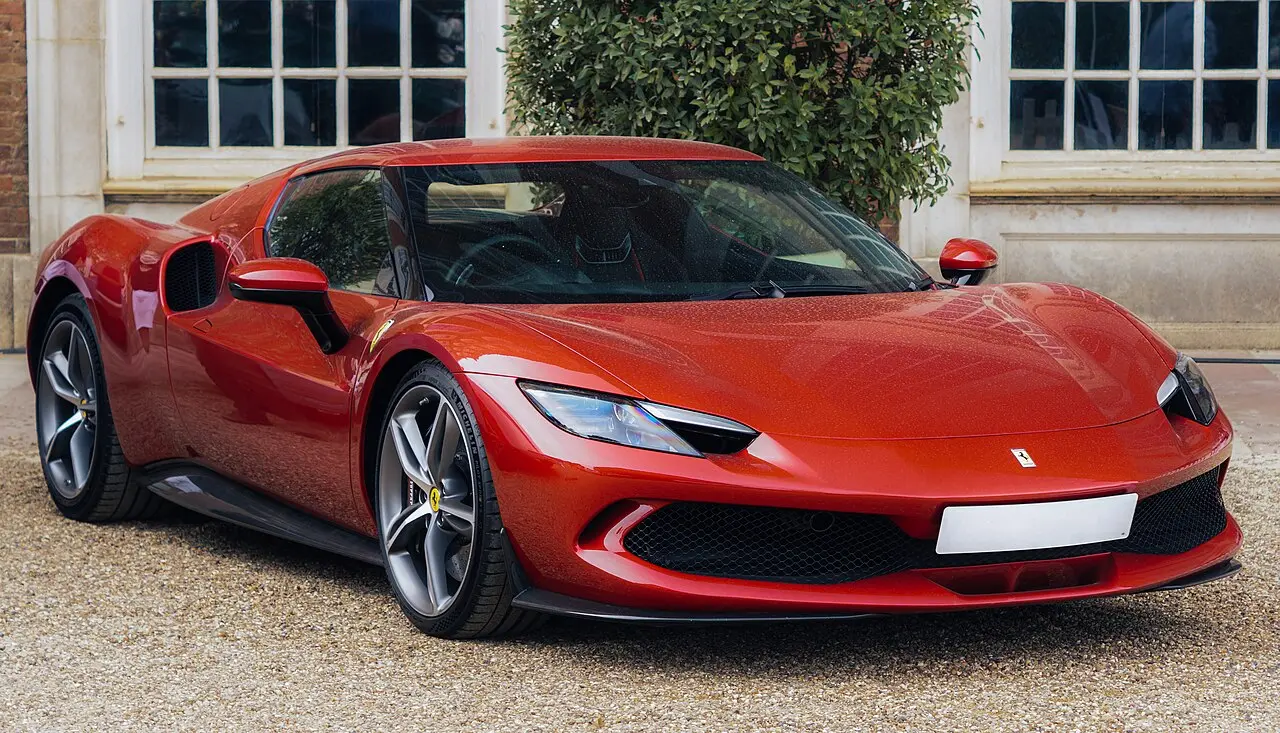
The official data lists 16 versions of the Ferrari 296 (2022–2026), in the European Union, the United States, and Canada. Each market publishes its own figures, measured on its own test procedure.
At a glance
Years in the data
2022–2026
Markets
European Union, United States, Canada
Engines
2.9 L to 3.0 L
Power
488 kW (663 PS)
Fuels
Plug-in hybrid, Hybrid
Lowest consumption (European Union)
9.7 L/100 km (WLTP)
Plug-in hybrid, weighted (European Union)
6.4 L/100 km (WLTP)
Plug-in hybrid, weighted (Canada)
13.0 L/100 km (5-cycle)
New registrations in the EU
3,941
What is the Ferrari 296?
The Ferrari 296 is a mid-engined sports car offered as a coupe, the 296 GTB, and an open-top model, the 296 GTS. Its compact V6 and plug-in hybrid system mark a distinctive branch of Ferrari’s performance-car range. The electric motor can assist the engine or drive the car on its own, giving the 296 a different character from a conventional petrol-only sports car.
Generation and engines
The 296 is one generation, known by the internal code F171, introduced in 2022 and listed through the present. Its 3.0-litre engine is paired with an electric motor. EU figures show combined system power of 488 kW (663 PS); the US and Canadian listings describe a 2.9-litre plug-in hybrid.
How economical is the Ferrari 296?
EU registration figures cover 2022–2025 and include six versions. The lowest listed conventional consumption figure is 9.7 L/100 km on WLTP. For the plug-in hybrid, the lowest official weighted figure is 6.4 L/100 km on WLTP; that calculation assumes that some driving is electric. The EU recorded 3,941 registrations, with the 488 kW plug-in hybrid prominent in the annual figures.
The US EPA lists a weighted plug-in hybrid figure of 13.1 L/100 km for 2022–2026. Canada’s NRCan five-cycle figure is 13 L/100 km for 2024–2026. These values are not direct like-for-like comparisons: European WLTP and US EPA procedures differ, and Canada uses its five-cycle test.
Where was the Ferrari 296 sold?
The 296 appears in official figures for the European Union, the United States and Canada. EU registrations begin in 2022, while US EPA figures begin in 2022 and Canadian NRCan figures in 2024.
Questions and answers
Is the Ferrari 296 a hybrid?
Yes. It is a plug-in hybrid, pairing a 3.0-litre engine in EU figures with an electric motor.
What is the 296’s official EU power figure?
The listed combined output is 488 kW (663 PS).
What is its lowest listed fuel consumption?
The lowest figure is 6.4 L/100 km on WLTP for the plug-in hybrid; it is weighted to assume some electric driving.
New cars registered in the EU (plus Norway and Iceland), from the European Environment Agency. Figures on the NEDC procedure until 2020 and on WLTP from 2021; versions are grouped by engine and power, with their number of registrations.
Years and version
Engine
Power
Fuel
Consumption (combined)
CO₂
Electric range
EU registrations
2025
3.0 L
488 kW (663 PS)
Plug-in hybrid
6.9 L/100 km WLTP16.8 kWh/100 km WLTP
156 g/km
16 km
1,257
2025
3.0 L
488 kW (663 PS)
Hybrid
9.7 L/100 km WLTP
200 g/km
–
87
2024
3.0 L
488 kW (663 PS)
Plug-in hybrid
6.5 L/100 km WLTP14.4 kWh/100 km WLTP
151 g/km
16 km
1,361
2023
3.0 L
488 kW (663 PS)
Plug-in hybrid
6.4 L/100 km WLTP13.5 kWh/100 km WLTP
150 g/km
16 km
923
2022
3.0 L
488 kW (663 PS)
Plug-in hybrid
6.4 L/100 km WLTP13.9 kWh/100 km WLTP
150 g/km
16 km
303
2022
3.0 L
488 kW (663 PS)
Hybrid
–
149 g/km
–
10
United States 6 versions
Model years sold in the USA, from the EPA and the Department of Energy (fueleconomy.gov). MPG on the EPA test; litres per 100 km = 235.215 ÷ MPG.
Years and version
Engine
Fuel
Gearbox
Drive
Consumption (combined)
CO₂
2025–2026SIDI; PHEV
2.9 L
Plug-in hybrid
8-speed automated manual
Rear-wheel drive
18 MPG (13.1 L/100 km) EPA
247 g/km
2026SIDI; PHEV
2.9 L
Plug-in hybrid
8-speed automated manual
Rear-wheel drive
18 MPG (13.1 L/100 km) EPA
250 g/km
2026SIDI; PHEV
2.9 L
Plug-in hybrid
8-speed automated manual
Rear-wheel drive
18 MPG (13.1 L/100 km) EPA
246 g/km
2025SIDI; PHEV
2.9 L
Plug-in hybrid
8-speed automated manual
Rear-wheel drive
18 MPG (13.1 L/100 km) EPA
251 g/km
2023SIDI; PHEV
2.9 L
Plug-in hybrid
8-speed automated manual
Rear-wheel drive
18 MPG (13.1 L/100 km) EPA
251 g/km
2022SIDI; PHEV
2.9 L
Plug-in hybrid
8-speed automated manual
Rear-wheel drive
18 MPG (13.1 L/100 km) EPA
247 g/km
Canada 4 versions
Model years sold in Canada, from Natural Resources Canada fuel consumption ratings (5-cycle test).
Years and version
Engine
Fuel
Gearbox
Consumption (combined)
CO₂
Electric range
2024–2026Two-seater
2.9 L
Plug-in hybrid
8-speed automated manual
13.2 L/100 km 5-cycle
247 g/km
13 km
2025–2026Two-seater
2.9 L
Plug-in hybrid
8-speed automated manual
13.4 L/100 km 5-cycle
251 g/km
13 km
2026Two-seater
2.9 L
Plug-in hybrid
8-speed automated manual
13.0 L/100 km 5-cycle
246 g/km
13 km
2024Two-seater
2.9 L
Plug-in hybrid
8-speed automated manual
13.2 L/100 km 5-cycle
251 g/km
13 km
Official figures are measured on standard test procedures and differ between markets. Your consumption depends on how, where and in what conditions you drive.