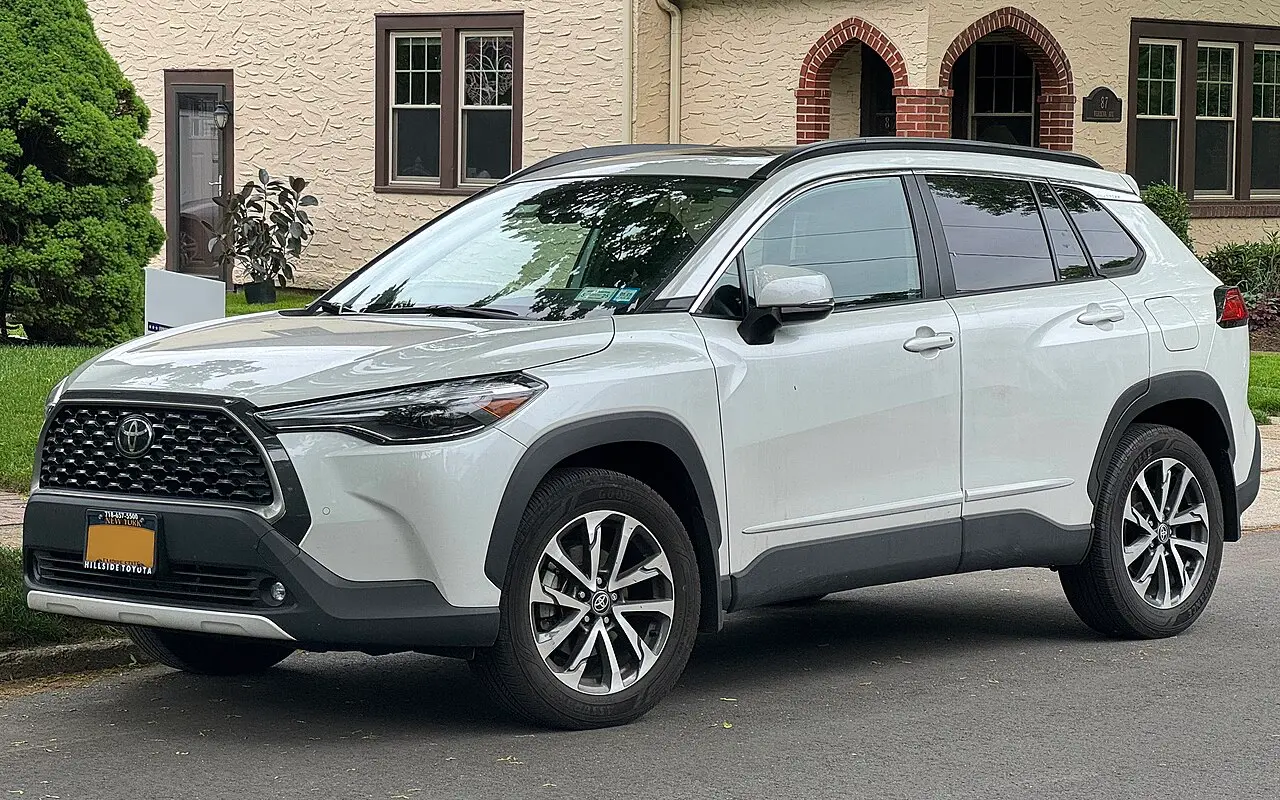
What is the Toyota Corolla Cross?
The Corolla Cross is a compact SUV in Toyota’s Corolla family. It gives the nameplate a taller body and a roomy cabin, with the everyday practicality of an SUV. Toyota introduced it as a new addition to the Corolla series, which also includes cars with sedan, wagon and hatchback bodies.
Generations and engines
The first generation, known as XG10, began in 2022. Toyota describes the Corolla Cross as the first SUV in the Corolla series, combining the family name with an SUV’s space and utility.
Engine choices vary by market. EU registrations include petrol versions from 1.8 L to 2.0 L, with power from 72 kW (98 PS) to 112 kW (152 PS). The US range includes 2.0 L petrol and hybrid versions. Canadian versions use a 2.0 L petrol engine.
How economical is the Toyota Corolla Cross?
The lowest listed EU consumption is 5 L/100 km on the WLTP test. In the United States, the best combined EPA rating is 42 MPG, with a listed figure of 5.6 L/100 km. Canada’s lowest listed figure is also 5.6 L/100 km, measured on the NRCan 5-cycle test. WLTP is used in Europe, EPA in the United States and the 5-cycle test in Canada; the procedures differ, so the results are not directly interchangeable.
In official EU registration figures for 2025, the Corolla Cross recorded 616 registrations. The 1.8 L petrol version with 72 kW (98 PS) accounted for 515.
Where was it sold?
The first generation is listed in the United States and Canada from 2022, and in EU registrations for 2025. The listed US and Canadian model years run through 2026. Engine and fuel choices vary between markets.
Questions and answers
When did the first-generation Corolla Cross arrive?
The first generation, XG10, began in 2022.
What engines are listed for the Corolla Cross?
EU registrations include 1.8 L and 2.0 L petrol versions. The United States lists 2.0 L petrol and hybrid versions, while Canada lists 2.0 L petrol.
What is its lowest listed fuel-consumption figure?
The lowest listed EU figure is 5 L/100 km on WLTP. The US EPA and Canadian NRCan figures are each 5.6 L/100 km, using different test procedures.