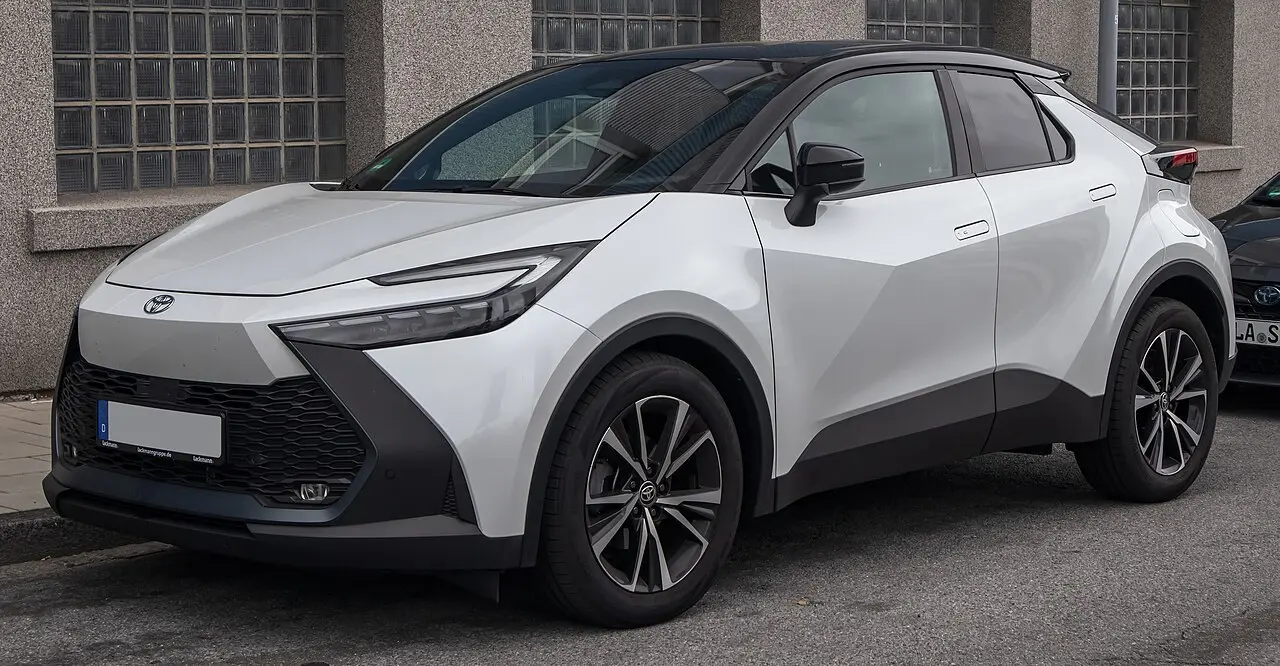
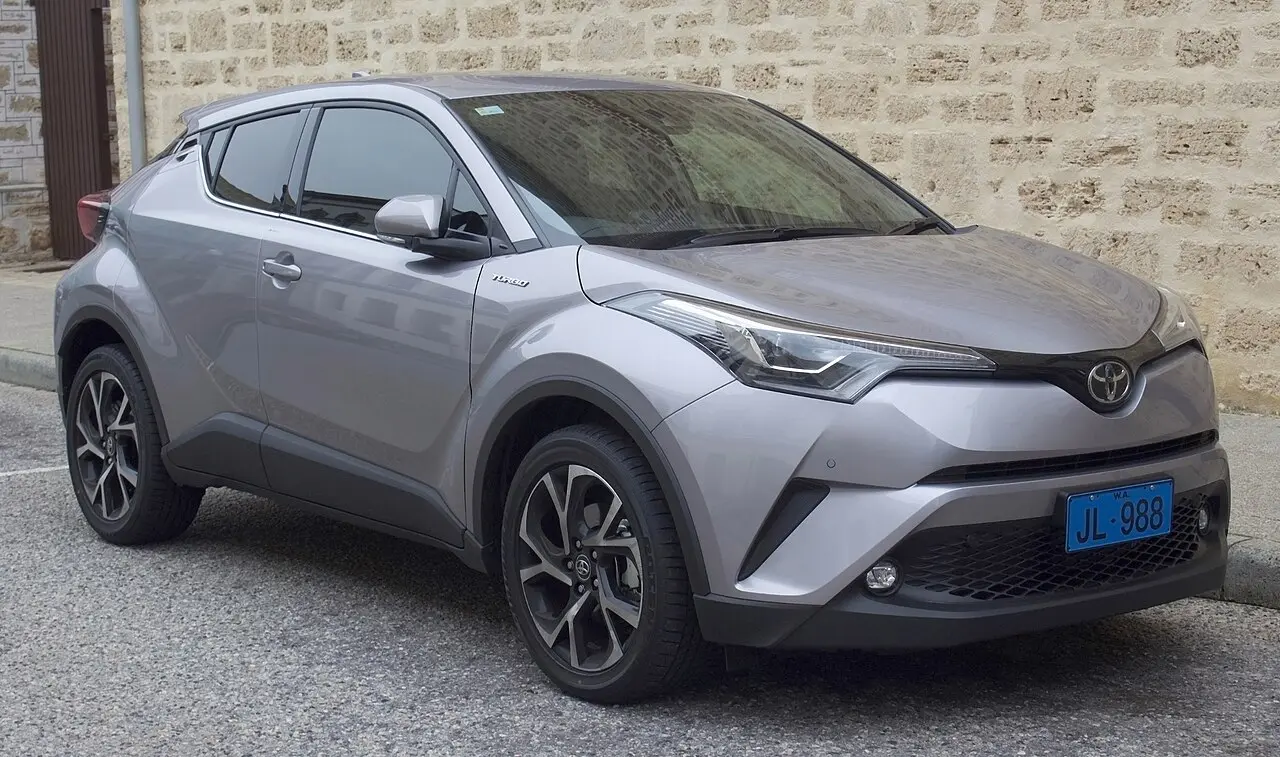
The official data lists 151 versions of the Toyota C-HR (2016–2027), in the European Union, the United Kingdom, France, the United States, and Canada. Each market publishes its own figures, measured on its own test procedure.
At a glance
Years in the data
2016–2027
Markets
European Union, United Kingdom, France, United States, Canada
Engines
1.2 L to 2.0 L
Power
66 kW (90 PS) to 223 kW (303 PS)
Fuels
Hybrid, Plug-in hybrid, Petrol, LPG, Electric
Lowest consumption (United Kingdom)
3.8 L/100 km (NEDC)
Lowest consumption (European Union)
4.3 L/100 km (WLTP)
Lowest consumption (France)
4.8 L/100 km (WLTP)
Plug-in hybrid, weighted (European Union)
0.7 L/100 km (WLTP)
Plug-in hybrid, weighted (United Kingdom)
4.9 L/100 km (WLTP)
New registrations in the EU
1,479,605
What is the Toyota C-HR?
The C-HR is a compact crossover with a five-door body. It brings a crossover shape to Toyota’s passenger-car range, with faceted surfaces that give its exterior a distinctive look.
C-HR generations
The first generation ran from 2016 to 2023 under the AX10 and AX50 codes. It was offered as a hybrid in some markets as well as with a turbo petrol engine. The second generation, coded AX20, began in 2023 and added plug-in hybrid versions to the European range alongside hybrids.
Engines, power and official fuel figures
EU engines range from 1.2 L to 2.0 L, with power from 37 kW (50 PS) to 128 kW (174 PS). European fuel categories include hybrid, plug-in hybrid and petrol. The lowest EU figure is 4.3 L/100 km on WLTP; the plug-in hybrid weighted figure is 0.7 L/100 km, assuming some driving is electric. In the UK, the lowest figure is 3.8 L/100 km on NEDC, while the plug-in hybrid figure is 4.9 L/100 km on WLTP. The US EPA low is 8.1 L/100 km and Canada’s 5-cycle low is 8.2 L/100 km. WLTP, NEDC, EPA and Canada’s 5-cycle tests use different procedures, so cross-market figures are not directly comparable.
Where was the C-HR sold?
The C-HR appears in EU registration figures from 2016 to 2025 and UK figures from 2017 to 2026. French figures cover 2026, while US EPA figures begin in 2018 and run through 2027; Canadian figures run from 2018 to 2026. EU registrations total 1,479,605 over that period.
Questions and answers
How many generations of Toyota C-HR are listed?
Two: the first generation ran from 2016 to 2023, and the AX20 second generation began in 2023.
What is the lowest listed C-HR fuel consumption?
The lowest figure is 0.7 L/100 km for an EU plug-in hybrid on WLTP, a weighted result that assumes some driving is electric. The lowest EU figure outside that plug-in hybrid result is 4.3 L/100 km on WLTP.
What engine sizes are listed for the C-HR in the EU?
EU engines range from 1.2 L to 2.0 L, with power from 37 kW (50 PS) to 128 kW (174 PS).
Which markets have C-HR figures?
Figures cover the EU, UK, France, the United States and Canada, with years varying by market.
Model codes: AX20 · Sold in: European Union, United Kingdom, and France · References: en.wikipedia.org
European Union 18 versions
New cars registered in the EU (plus Norway and Iceland), from the European Environment Agency. Figures on the NEDC procedure until 2020 and on WLTP from 2021; versions are grouped by engine and power, with their number of registrations.
Years and version
Engine
Power
Fuel
Consumption (combined)
CO₂
Electric range
EU registrations
2025
1.8 L
72 kW (98 PS)
Hybrid
4.8 L/100 km WLTP
108 g/km
–
51,070
2025
2.0 L
111 kW (151 PS)
Plug-in hybrid
0.7 L/100 km WLTP15.2 kWh/100 km WLTP
20 g/km
67 km
29,402
2025
2.0 L
112 kW (152 PS)
Hybrid
4.9 L/100 km WLTP
110 g/km
–
10,321
2025
2.0 L
120 kW (163 PS)
Plug-in hybrid
0.7 L/100 km WLTP15.7 kWh/100 km WLTP
37 g/km
67 km
1,299
2025
1.8 L
72 kW (98 PS)
Plug-in hybrid
4.8 L/100 km WLTP
107 g/km
–
1,081
2025
2.0 L
113 kW (154 PS)
Plug-in hybrid
1.6 L/100 km WLTP10.8 kWh/100 km WLTP
51 g/km
67 km
1,053
2025
1.8 L
72 kW (98 PS)
Petrol
4.8 L/100 km WLTP
107 g/km
–
577
2025
2.0 L
112 kW (152 PS)
Plug-in hybrid
4.8 L/100 km WLTP
109 g/km
–
444
2025
2.0 L
98 kW (133 PS)
Hybrid
5.0 L/100 km WLTP
113 g/km
–
161
2025
2.0 L
112 kW (152 PS)
Petrol
5.3 L/100 km WLTP
119 g/km
–
146
2025
2.0 L
113 kW (154 PS)
Hybrid
5.0 L/100 km WLTP
114 g/km
–
99
2025
1.8 L
–
LPG
5.8 L/100 km WLTP
102 g/km
–
19
2024
1.8 L
72 kW (98 PS)
Hybrid
4.8 L/100 km WLTP
108 g/km
–
62,569
2024
2.0 L
112 kW (152 PS)
Hybrid
4.9 L/100 km WLTP
112 g/km
–
32,172
2024
2.0 L
111 kW (151 PS)
Plug-in hybrid
0.8 L/100 km WLTP15.2 kWh/100 km WLTP
19 g/km
67 km
9,973
2023
1.8 L
72 kW (98 PS)
Hybrid
4.9 L/100 km WLTP
111 g/km
–
61,057
2023
2.0 L
112 kW (152 PS)
Hybrid
5.3 L/100 km WLTP
119 g/km
–
25,914
2023
2.0 L
112 kW (152 PS)
Hybrid
–
29 g/km
–
11
United Kingdom 42 versions
New cars on sale in the UK, from the Vehicle Certification Agency. NEDC figures until 2018 and WLTP figures after; years are the editions a version appeared in.
New cars on sale in France, from ADEME Car Labelling. NEDC figures until 2015, WLTP figures in the current catalogue.
Years and version
Engine
Power
Fuel
Gearbox
Consumption (combined)
CO₂
2026Toyota C-HR 1.8L Hybride (122ch) GR SPORT MC19 · Toyota C-HR 1.8L Hybride (122ch) Edition MC19 · Toyota C-HR 1.8L Hybride (122ch) Distinctive MC19 and 1 more trim
1.8 L
72 kW (98 PS)
Hybrid
Continuously variable (CVT)
4.8 L/100 km WLTP
109 g/km
2026Toyota C-HR 2.0L Hybrid Dynamic Force (184ch) GR SPORT MC19 · Toyota C-HR 2.0L Hybrid Dynamic Force (184ch) Collection MC19
2.0 L
112 kW (152 PS)
Hybrid
Continuously variable (CVT)
5.3 L/100 km WLTP
120 g/km
Versions outside these generations
United States 2 versions
Model years sold in the USA, from the EPA and the Department of Energy (fueleconomy.gov). MPG on the EPA test; litres per 100 km = 235.215 ÷ MPG.
Years and version
Engine
Fuel
Gearbox
Drive
Consumption (combined)
CO₂
Electric range
2026–2027
Electric motor
Electric
Automatic
All-wheel drive
117 MPGe EPA
0 g/km
462 km
2026
Electric motor
Electric
Automatic
All-wheel drive
112 MPGe EPA
0 g/km
439 km
Canada 3 versions
Model years sold in Canada, from Natural Resources Canada fuel consumption ratings (5-cycle test).
Years and version
Engine
Power
Fuel
Gearbox
Consumption (combined)
CO₂
Electric range
2026Sport utility vehicle: Small
Electric motor
167 kW (227 PS)
Electric
Automatic
16.2 kWh/100 km 5-cycle
0 g/km
496 km
2026Sport utility vehicle: Small
Electric motor
255 kW (347 PS)
Electric
Automatic
18.1 kWh/100 km 5-cycle
0 g/km
452 km
2026Sport utility vehicle: Small
Electric motor
255 kW (347 PS)
Electric
Automatic
18.7 kWh/100 km 5-cycle
0 g/km
438 km
Official figures are measured on standard test procedures and differ between markets. Your consumption depends on how, where and in what conditions you drive.