Peugeot

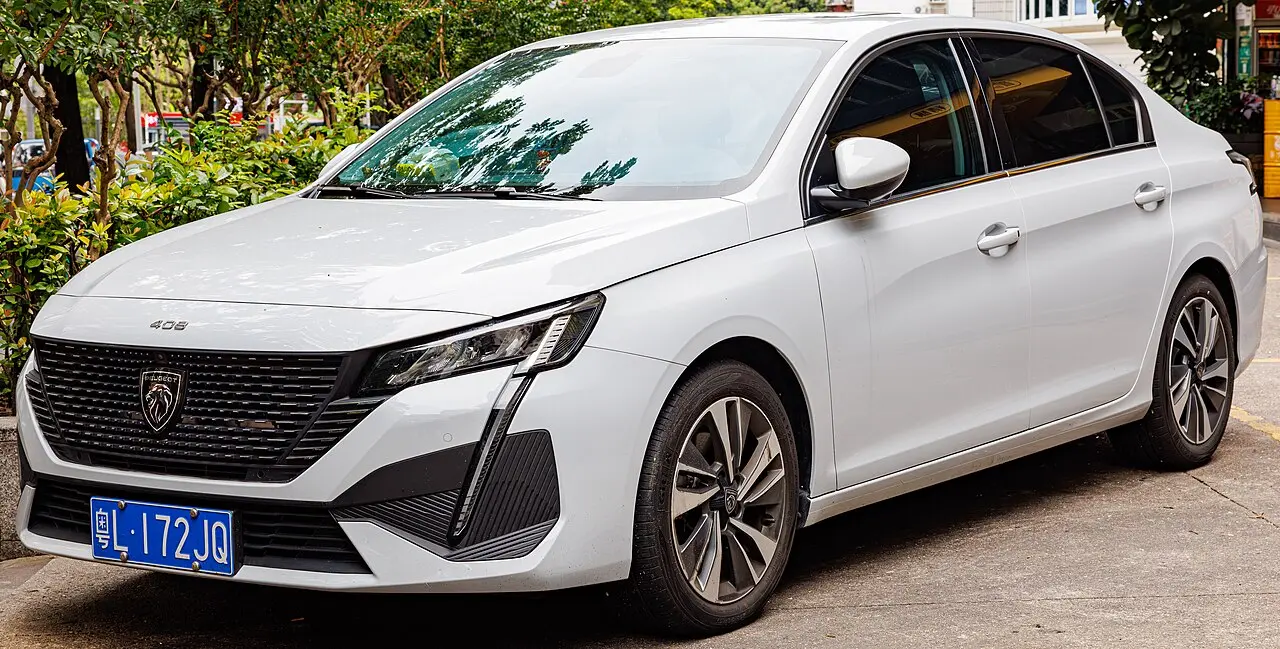
Peugeot 408

Peugeot 408
Photo: Dinkun Chen / Wikimedia Commons · CC BY-SA 4.0

The official data lists 49 versions of the Peugeot 408 (2022–2026), in the European Union and the United Kingdom. Each market publishes its own figures, measured on its own test procedure.

At a glance

Years in the data
2022–2026
Markets
European Union, United Kingdom
Engines
1.2 L to 1.6 L
Power
96 kW (131 PS) to 210 kW (286 PS)
Fuels
Petrol, Hybrid, Plug-in hybrid, Electric
Lowest consumption (United Kingdom)
4.8 L/100 km (WLTP)
Lowest consumption (European Union)
5.1 L/100 km (WLTP)
Plug-in hybrid, weighted (European Union)
1.1 L/100 km (WLTP)
Plug-in hybrid, weighted (United Kingdom)
5.8 L/100 km (WLTP)
New registrations in the EU
53,894

What is the Peugeot 408?

The Peugeot 408 is a five-door family fastback with a crossover-influenced stance. Introduced in 2022, it brought a new shape to Peugeot’s range, combining the silhouette of a saloon with a sloping fastback rear and five-door access. Its sharply sculpted design gives it a distinctive place in the line-up.

Peugeot 408 generations

The 408 has one generation, introduced in 2022. It brought a fresh fastback design to Peugeot’s range.

Engines and power

In EU registration figures, the 408 spans 1.2-litre to 1.6-litre engines and 96 kW (131 PS) to 157 kW (213 PS). The listed fuel types are petrol, hybrid, plug-in hybrid and electric. UK VCA figures cover the same engine-size range, with power from 96 kW (131 PS) to 210 kW (286 PS), and include those same fuel types.

How economical is the Peugeot 408?

The lowest EU petrol, diesel or hybrid figure is 5.1 L/100 km on WLTP; the lowest plug-in hybrid figure is 1.1 L/100 km. That plug-in figure is weighted and assumes some driving is electric. UK VCA figures list 4.8 L/100 km as the lowest petrol, diesel or hybrid figure and 5.8 L/100 km for plug-in hybrid, both on WLTP. WLTP is the European test procedure; it differs from the EPA procedure in the USA and the five-cycle test used in Canada.

Where was the Peugeot 408 sold?

Official figures cover the European Union and the United Kingdom. EU registrations total 53,894 for 2022–2025, while UK VCA figures cover 2023–2026.

Questions and answers

What kind of car is the Peugeot 408?

It is a five-door family fastback with a crossover-influenced stance.

When did the current 408 generation begin?

The single generation began in 2022.

What is the lowest EU plug-in hybrid consumption figure?

1.1 L/100 km on WLTP, a weighted figure that assumes part of the driving is electric.

Which markets have official 408 figures?

The European Union and the United Kingdom.

408 408 (since 2022)

Peugeot 408 408
Photo: Dinkun Chen / Wikimedia Commons · CC BY-SA 4.0

Sold in: European Union and United Kingdom · References: de.wikipedia.org, largus.fr

European Union 18 versions

New cars registered in the EU (plus Norway and Iceland), from the European Environment Agency. Figures on the NEDC procedure until 2020 and on WLTP from 2021; versions are grouped by engine and power, with their number of registrations.

Years and versionEnginePowerFuelConsumption (combined)CO₂Electric rangeEU registrations
2022–20251.2 L96 kW (131 PS)Petrol6.0 L/100 km WLTP136 g/km–22,757
20251.2 L100 kW (136 PS)Hybrid5.1 L/100 km WLTP115 g/km–10,081
20251.6 L132 kW (179 PS)Plug-in hybrid1.5 L/100 km WLTP16.3 kWh/100 km WLTP34 g/km59 km2,959
2025Electric motor157 kW (213 PS)Electric15.0 kWh/100 km WLTP0 g/km451 km624
20251.6 L110 kW (150 PS)Plug-in hybrid1.4 L/100 km WLTP16.5 kWh/100 km WLTP33 g/km55 km132
20251.6 L–Hybrid5.8 L/100 km WLTP138 g/km–87
2025Electric motor104 kW (141 PS)Electric15.0 kWh/100 km WLTP0 g/km451 km44
20251.2 L100 kW (136 PS)Petrol5.1 L/100 km WLTP114 g/km–38
20251.2 L100 kW (136 PS)Plug-in hybrid5.1 L/100 km WLTP115 g/km–23
20241.2 L100 kW (136 PS)Petrol5.1 L/100 km WLTP115 g/km–3,644
20241.6 L110 kW (150 PS)Plug-in hybrid1.4 L/100 km WLTP16.2 kWh/100 km WLTP30 g/km56 km3,520
20241.6 L132 kW (179 PS)Plug-in hybrid1.4 L/100 km WLTP16.0 kWh/100 km WLTP31 g/km57 km1,860
2024Electric motor157 kW (213 PS)Electric15.2 kWh/100 km WLTP0 g/km449 km41
20231.6 L132 kW (179 PS)Plug-in hybrid1.2 L/100 km WLTP14.5 kWh/100 km WLTP27 g/km63 km4,664
20231.6 L110 kW (150 PS)Plug-in hybrid1.1 L/100 km WLTP14.7 kWh/100 km WLTP26 g/km64 km2,544
20231.2 L100 kW (136 PS)Hybrid5.1 L/100 km WLTP115 g/km–18
20231.2 L67 kW (91 PS)Petrol6.0 L/100 km WLTP136 g/km–10
20221.6 L132 kW (179 PS)Plug-in hybrid1.2 L/100 km WLTP14.8 kWh/100 km WLTP27 g/km63 km848

United Kingdom 31 versions

New cars on sale in the UK, from the Vehicle Certification Agency. NEDC figures until 2018 and WLTP figures after; years are the editions a version appeared in.

Years and versionEnginePowerFuelGearboxConsumption (combined)CO₂Electric range
2025–2026Electric 58 kWh · Electric 58 kWh 210 (VL)Electric motor157 kW (213 PS)ElectricAutomatic14.4 kWh/100 km WLTP0 g/km471 km
2025–2026Electric 58 kWh · Electric 58 kWh 210 (VH)Electric motor157 kW (213 PS)ElectricAutomatic17.7 kWh/100 km WLTP0 g/km383 km
2025–2026PureTech 130 FPHNST-E11E00 · PureTech 130 FPHNST-E11E01 · PureTech 130 FPHNST-E11F00 and 1 more trim1.2 L96 kW (131 PS)Petrol8-speed automatic6.0 L/100 km WLTP135 g/km–
2025–2026PureTech 130 FPHNST-E11E00 · PureTech 130 FPHNST-E11E01 · PureTech 130 FPHNST-E11F00 and 1 more trim1.2 L96 kW (131 PS)Petrol8-speed automatic7.0 L/100 km WLTP158 g/km–
2025–2026HYBRID 136 e-DSC6 FPHPYC-E1UN00 · HYBRID 136 e-DSC6 GT · HYBRID 145 e-DSC61.2 L100 kW (136 PS)Hybrid6-speed automatic4.8 L/100 km WLTP108 g/km–
2025–2026HYBRID 136 e-DSC6 FPHPYC-E1UN00 · HYBRID 136 e-DSC6 GT1.2 L100 kW (136 PS)Hybrid7-speed automatic5.9 L/100 km WLTP133 g/km–
2025–2026HYBRID 145 e-DSC61.2 L100 kW (136 PS)Hybrid6-speed automatic5.9 L/100 km WLTP133 g/km–
2026HYBRID 145 e-DSC6 (VH)1.2 L107 kW (145 PS)Hybrid6-speed automatic5.9 L/100 km WLTP133 g/km–
2026HYBRID 145 e-DSC6 (VL)1.2 L107 kW (145 PS)Hybrid6-speed automatic4.8 L/100 km WLTP108 g/km–
2025–2026HYBRID 1801.6 L110 kW (150 PS)Plug-in hybrid8-speed automatic6.0 L/100 km WLTP16.0 kWh/100 km WLTP137 g/km56 km
2025–2026HYBRID 1801.6 L110 kW (150 PS)Plug-in hybrid8-speed automatic6.8 L/100 km WLTP17.4 kWh/100 km WLTP154 g/km53 km
2025–2026HYBRID 2251.6 L132 kW (179 PS)Plug-in hybrid7-speed automatic5.8 L/100 km WLTP12.7 kWh/100 km WLTP131 g/km70 km
2025–2026HYBRID 2251.6 L132 kW (179 PS)Plug-in hybrid7-speed automatic6.7 L/100 km WLTP13.8 kWh/100 km WLTP151 g/km83 km
2026HYBRID 240 (VH)1.6 L165 kW (224 PS)Plug-in hybrid7-speed automatic6.7 L/100 km WLTP13.8 kWh/100 km WLTP151 g/km83 km
2026HYBRID 240 (VL)1.6 L165 kW (224 PS)Plug-in hybrid7-speed automatic5.8 L/100 km WLTP12.7 kWh/100 km WLTP131 g/km70 km
2024Electric 58 kWh (VH)Electric motor210 kW (286 PS)ElectricAutomatic17.7 kWh/100 km WLTP0 g/km383 km
2024Electric 58 kWh (VL)Electric motor210 kW (286 PS)ElectricAutomatic14.4 kWh/100 km WLTP0 g/km471 km
2024PureTech 130 (VL) FPHNST-E11E00 · PureTech 130 (VL) FPHNST-E11E01 · PureTech 130 (VL) FPHNST-E11F00 and 1 more trim1.2 L131 kW (178 PS)Petrol8-speed automatic6.0 L/100 km WLTP135 g/km–
2024PureTech 130 (VH) FPHNST-E11E00 · PureTech 130 (VH) FPHNST-E11E01 · PureTech 130 (VH) FPHNST-E11F00 and 1 more trim1.2 L131 kW (178 PS)Petrol8-speed automatic7.0 L/100 km WLTP158 g/km–
2024HYBRID 136 e-DSC6 (VL) FPHPYC-E1UN00 · HYBRID 136 e-DSC6 (VL) GT1.2 L136 kW (185 PS)Hybrid6-speed automatic4.8 L/100 km WLTP108 g/km–
2024HYBRID 136 e-DSC6 (VH) FPHPYC-E1UN00 · HYBRID 136 e-DSC6 (VH) GT1.2 L136 kW (185 PS)Hybrid7-speed automatic5.9 L/100 km WLTP133 g/km–
2024HYBRID 180 (VH)1.6 L150 kW (204 PS)Plug-in hybrid8-speed automatic6.8 L/100 km WLTP17.4 kWh/100 km WLTP154 g/km53 km
2024HYBRID 180 (VL)1.6 L150 kW (204 PS)Plug-in hybrid8-speed automatic6.0 L/100 km WLTP16.0 kWh/100 km WLTP137 g/km56 km
2024HYBRID 225 (VH)1.6 L179 kW (243 PS)Plug-in hybrid8-speed automatic6.8 L/100 km WLTP16.9 kWh/100 km WLTP154 g/km55 km
2024HYBRID 225 (VL)1.6 L179 kW (243 PS)Plug-in hybrid8-speed automatic6.0 L/100 km WLTP16.0 kWh/100 km WLTP137 g/km56 km
2023PureTech 130 (VL)1.2 L96 kW (131 PS)Petrol8-speed automatic5.9 L/100 km WLTP133 g/km–
2023PureTech 130 (VH)1.2 L96 kW (131 PS)Petrol8-speed automatic6.9 L/100 km WLTP156 g/km–
2023HYBRID 180 (VL)1.6 L110 kW (150 PS)Plug-in hybrid8-speed automatic6.0 L/100 km WLTP17.7 kWh/100 km WLTP137 g/km67 km
2023HYBRID 180 (VH)1.6 L110 kW (150 PS)Plug-in hybrid8-speed automatic6.8 L/100 km WLTP19.4 kWh/100 km WLTP154 g/km59 km
2023HYBRID 225 (VL)1.6 L132 kW (179 PS)Plug-in hybrid8-speed automatic6.0 L/100 km WLTP17.7 kWh/100 km WLTP137 g/km67 km
2023HYBRID 225 (VH)1.6 L132 kW (179 PS)Plug-in hybrid8-speed automatic6.8 L/100 km WLTP18.7 kWh/100 km WLTP154 g/km60 km

Official figures are measured on standard test procedures and differ between markets. Your consumption depends on how, where and in what conditions you drive.