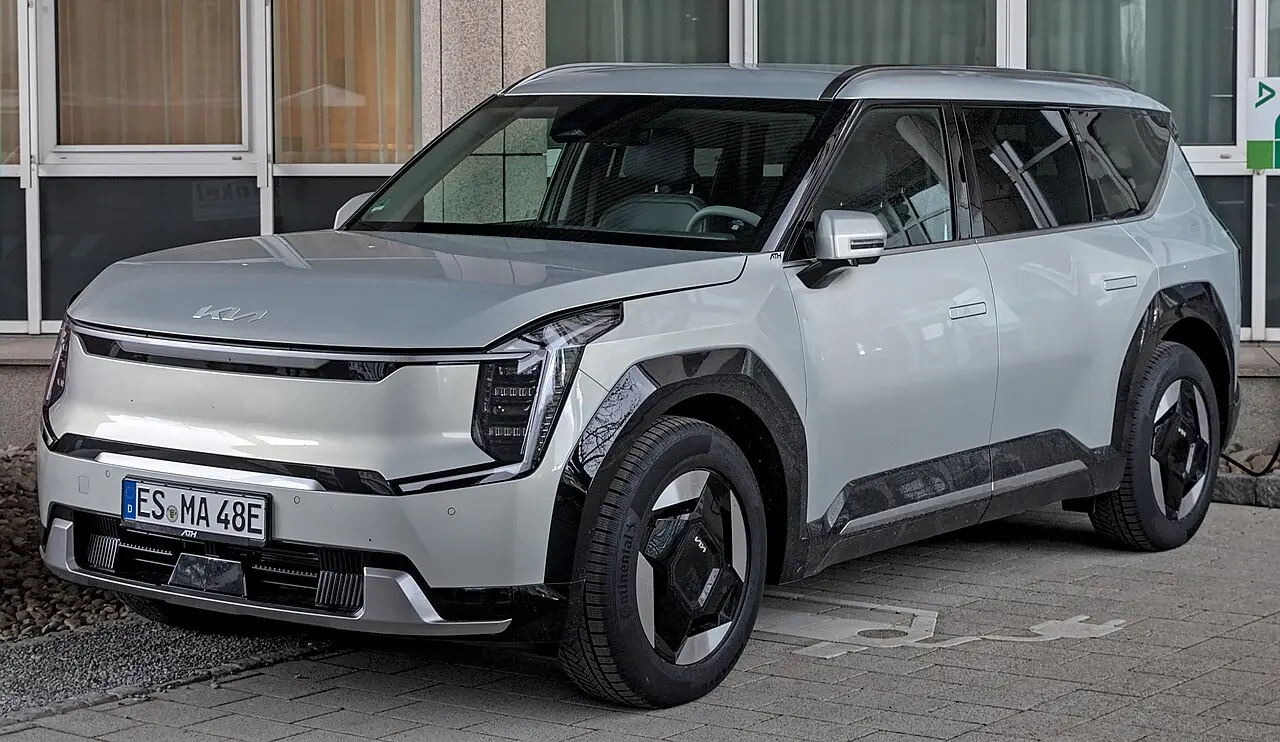
The official data lists 40 versions of the Kia EV9 (2023–2026), in the European Union, the United Kingdom, the United States, and Canada. Each market publishes its own figures, measured on its own test procedure.
At a glance
Years in the data
2023–2026
Markets
European Union, United Kingdom, United States, Canada
Power
113 kW (154 PS) to 384 kW (522 PS)
Fuels
Electric
New registrations in the EU
17,639
What is the Kia EV9?
The EV9 is a large, three-row electric SUV and Kia’s electric flagship. Its upright, geometric shape gives it a distinct SUV profile, while the cabin is arranged for family and group travel. Kia describes it as its first three-row electric flagship SUV. Its flat-floor electric platform helps make space for passengers across all three rows.
The first generation began in 2024. EU registrations start in 2023, while UK, US and Canadian entries begin in 2024.
Generations and power
The EV9 has one generation, listed from 2024 to today. All versions across these markets are electric. EU power ranges from 113 kW (154 PS) to 374 kW (508 PS); UK figures span 149 kW (203 PS) to 384 kW (522 PS), and Canada spans 149 kW (203 PS) to 374 kW (508 PS).
In EU registrations, the most common listed configuration produced 283 kW (385 PS), with another close variant at 282 kW (383 PS).
How does the Kia EV9 use energy?
As an electric SUV, the EV9 uses electricity rather than petrol or diesel. Official efficiency ratings are tied to each market’s test procedure, so figures from different countries need care when compared. Europe uses WLTP or the older NEDC procedure, the US uses EPA testing, and Canada uses a 5-cycle test.
Where is the Kia EV9 sold?
The EV9 is sold in the European Union, the United Kingdom, the United States and Canada. EU registration figures span 2023–2025 and total 17,639. UK, US and Canadian entries begin in 2024 and extend through 2026.
Questions and answers
How many rows does the Kia EV9 have?
It is a three-row SUV.
Is the Kia EV9 electric?
Yes. Versions in the EU, UK, US and Canada use electric power.
How much power does the EV9 produce?
The listed range is 113 kW (154 PS) to 384 kW (522 PS), depending on market.
When did the EV9 go on sale in the markets listed?
EU registrations begin in 2023; UK, US and Canadian entries begin in 2024.
New cars registered in the EU (plus Norway and Iceland), from the European Environment Agency. Figures on the NEDC procedure until 2020 and on WLTP from 2021; versions are grouped by engine and power, with their number of registrations.
Years and version
Engine
Power
Fuel
Consumption (combined)
CO₂
Electric range
EU registrations
2025
Electric motor
282 kW (383 PS)
Electric
22.1 kWh/100 km WLTP
0 g/km
506 km
3,512
2025
Electric motor
283 kW (385 PS)
Electric
23.5 kWh/100 km WLTP
0 g/km
495 km
2,192
2025
Electric motor
150 kW (204 PS)
Electric
20.0 kWh/100 km WLTP
0 g/km
562 km
614
2025
Electric motor
160 kW (218 PS)
Electric
23.9 kWh/100 km WLTP
0 g/km
392 km
424
2025
Electric motor
374 kW (508 PS)
Electric
21.7 kWh/100 km WLTP
0 g/km
510 km
166
2025
Electric motor
113 kW (154 PS)
Electric
22.4 kWh/100 km WLTP
0 g/km
505 km
142
2025
Electric motor
141 kW (192 PS)
Electric
22.2 kWh/100 km WLTP
0 g/km
521 km
42
2025
Electric motor
149 kW (203 PS)
Electric
20.2 kWh/100 km WLTP
0 g/km
562 km
38
2025
Electric motor
53 kW (72 PS)
Electric
20.1 kWh/100 km WLTP
0 g/km
564 km
19
2024
Electric motor
283 kW (385 PS)
Electric
22.7 kWh/100 km WLTP
0 g/km
506 km
6,548
United Kingdom 10 versions
New cars on sale in the UK, from the Vehicle Certification Agency. NEDC figures until 2018 and WLTP figures after; years are the editions a version appeared in.
Years and version
Engine
Power
Fuel
Gearbox
Consumption (combined)
CO₂
Electric range
2026Air 99.8kWh 200bhp RWD 1-Speed Auto
Electric motor
150 kW (204 PS)
Electric
Automatic
19.9 kWh/100 km WLTP
0 g/km
563 km
2026GT-Line 99.8kWh 378bhp AWD 1-Speed Auto
Electric motor
283 kW (385 PS)
Electric
Automatic
22.2 kWh/100 km WLTP
0 g/km
510 km
2026GT-Line S 99.8kWh 378bhp AWD 1-Speed Auto (7 seater) · GT-Line S 99.8kWh 378bhp AWD 1-Speed Auto (6 seater)
Electric motor
283 kW (385 PS)
Electric
Automatic
22.0 kWh/100 km WLTP
0 g/km
505 km
2026GT 99.8kWh 501bhp AWD 1-Speed Auto (7 seater) · GT 99.8kWh 501bhp AWD 1-Speed Auto (6 seater)
Electric motor
374 kW (508 PS)
Electric
Automatic
21.7 kWh/100 km WLTP
0 g/km
510 km
2025'Air' 99.8kWh 200bhp RWD 1-Speed Auto
Electric motor
149 kW (203 PS)
Electric
Automatic
19.9 kWh/100 km WLTP
0 g/km
561 km
2025'GT-Line' 99.8kWh 378bhp AWD 1-Speed Auto
Electric motor
282 kW (383 PS)
Electric
Automatic
22.2 kWh/100 km WLTP
0 g/km
508 km
2025'GT-Line S' 99.8kWh 378bhp AWD 1-Speed Auto (7 seater)
Electric motor
282 kW (383 PS)
Electric
Automatic
22.8 kWh/100 km WLTP
0 g/km
503 km
2025'GT-Line S' 99.8kWh 378bhp AWD 1-Speed Auto (6 seater)
Electric motor
282 kW (383 PS)
Electric
Automatic
22.0 kWh/100 km WLTP
0 g/km
503 km
2024EV9 'Air' 99.8kWh 200bhp 1-Speed Auto (RWD)
Electric motor
203 kW (276 PS)
Electric
–
20.2 kWh/100 km WLTP
0 g/km
563 km
2024EV9 'GT-Line' 99.8kWh 378bhp 1-Speed Auto (AWD) · EV9 'GT-Line S' 99.8kWh 378bhp 1-Speed Auto (7St) (AWD) · EV9 'GT-Line S' 99.8kWh 378bhp 1-Speed Auto (6St Swivel) (AWD)
Electric motor
384 kW (522 PS)
Electric
–
22.8 kWh/100 km WLTP
0 g/km
505 km
United States 9 versions
Model years sold in the USA, from the EPA and the Department of Energy (fueleconomy.gov). MPG on the EPA test; litres per 100 km = 235.215 ÷ MPG.
Years and version
Engine
Fuel
Gearbox
Drive
Consumption (combined)
CO₂
Electric range
2026
Electric motor
Electric
Automatic
Rear-wheel drive
88 MPGe EPA
0 g/km
370 km
2026
Electric motor
Electric
Automatic
Rear-wheel drive
89 MPGe EPA
0 g/km
491 km
2026
Electric motor
Electric
Automatic
All-wheel drive
84 MPGe EPA
0 g/km
455 km
2026
Electric motor
Electric
Automatic
All-wheel drive
82 MPGe EPA
0 g/km
451 km
2026
Electric motor
Electric
Automatic
All-wheel drive
78 MPGe EPA
0 g/km
418 km
2024–2025
Electric motor
Electric
Automatic
Rear-wheel drive
89 MPGe EPA
0 g/km
489 km
2024–2025
Electric motor
Electric
Automatic
Rear-wheel drive
88 MPGe EPA
0 g/km
370 km
2024–2025
Electric motor
Electric
Automatic
All-wheel drive
83 MPGe EPA
0 g/km
451 km
2024–2025
Electric motor
Electric
Automatic
All-wheel drive
80 MPGe EPA
0 g/km
435 km
Canada 8 versions
Model years sold in Canada, from Natural Resources Canada fuel consumption ratings (5-cycle test).
Years and version
Engine
Power
Fuel
Gearbox
Consumption (combined)
CO₂
Electric range
2026Sport utility vehicle: Standard
Electric motor
149 kW (203 PS)
Electric
Automatic
23.6 kWh/100 km 5-cycle
0 g/km
491 km
2024–2026Sport utility vehicle: Standard
Electric motor
160 kW (218 PS)
Electric
Automatic
23.6 kWh/100 km 5-cycle
0 g/km
370 km
2026Sport utility vehicle: Standard
Electric motor
282 kW (383 PS)
Electric
Automatic
24.9 kWh/100 km 5-cycle
0 g/km
455 km
2026Sport utility vehicle: Standard
Electric motor
282 kW (383 PS)
Electric
Automatic
25.5 kWh/100 km 5-cycle
0 g/km
451 km
2026Sport utility vehicle: Standard
Electric motor
374 kW (508 PS)
Electric
Automatic
26.7 kWh/100 km 5-cycle
0 g/km
418 km
2024–2025Sport utility vehicle: Standard
Electric motor
149 kW (203 PS)
Electric
Automatic
23.6 kWh/100 km 5-cycle
0 g/km
489 km
2024–2025Sport utility vehicle: Standard
Electric motor
282 kW (383 PS)
Electric
Automatic
25.5 kWh/100 km 5-cycle
0 g/km
451 km
2024–2025Sport utility vehicle: Standard
Electric motor
282 kW (383 PS)
Electric
Automatic
26.1 kWh/100 km 5-cycle
0 g/km
435 km
Versions outside these generations
European Union 3 versions
New cars registered in the EU (plus Norway and Iceland), from the European Environment Agency. Figures on the NEDC procedure until 2020 and on WLTP from 2021; versions are grouped by engine and power, with their number of registrations.
Years and version
Engine
Power
Fuel
Consumption (combined)
CO₂
Electric range
EU registrations
2023–2024
Electric motor
150 kW (204 PS)
Electric
20.2 kWh/100 km WLTP
0 g/km
563 km
1,079
2023
Electric motor
283 kW (385 PS)
Electric
22.8 kWh/100 km WLTP
0 g/km
505 km
2,850
2023
Electric motor
320 kW (435 PS)
Electric
–
0 g/km
–
13
Official figures are measured on standard test procedures and differ between markets. Your consumption depends on how, where and in what conditions you drive.