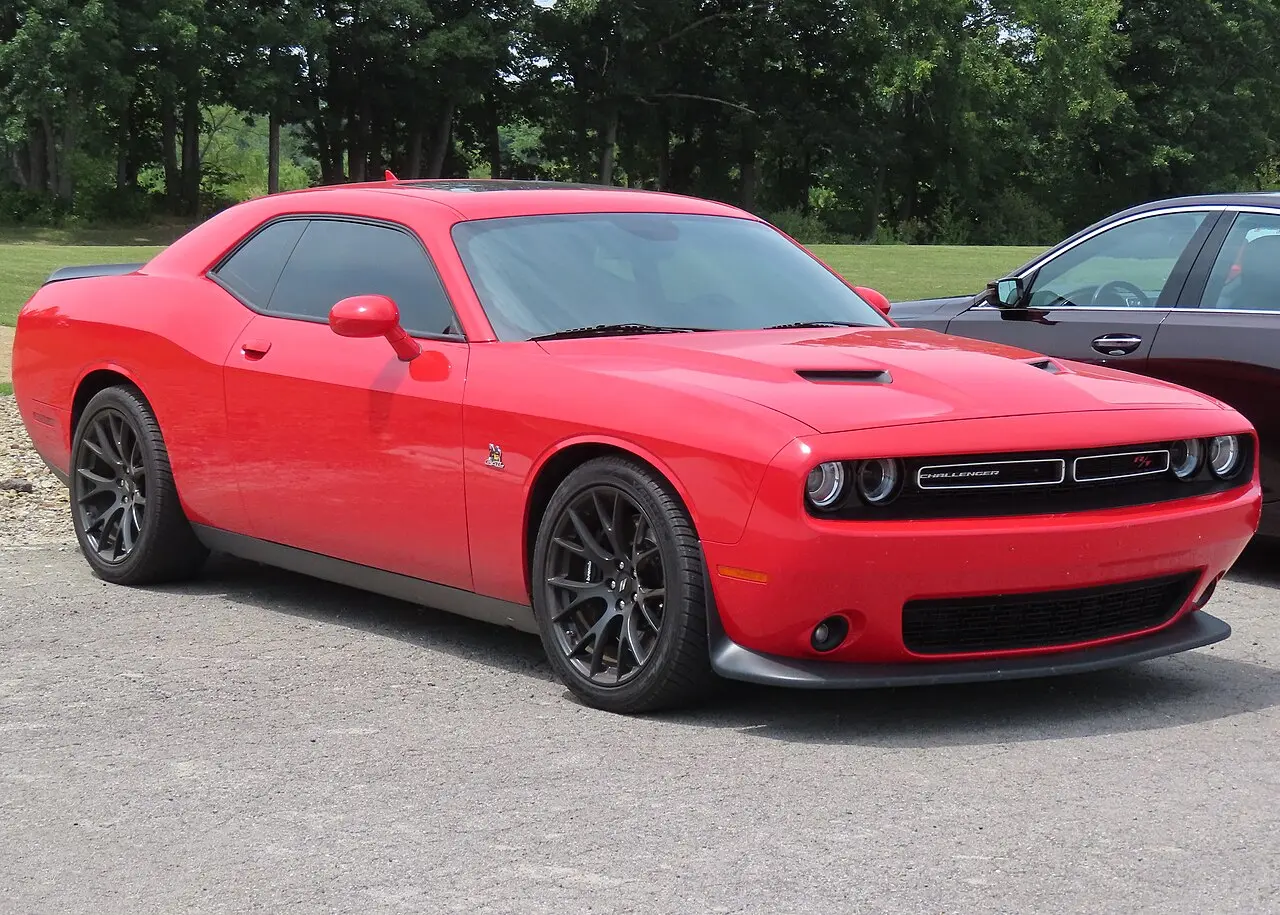
The official data lists 67 versions of the Dodge Challenger (2008 - 2025), in the European Union, the United States, and Canada. Each market publishes its own figures, measured on its own test procedure.
At a glance
Years in the data
2008 - 2025
Markets
European Union, United States, Canada
Engines
3.5 L to 6.4 L
Power
224 kW (305 PS) to 601 kW (817 PS)
Fuels
Petrol, Flex fuel (E85)
Lowest consumption (United States)
10.2 L/100 km (EPA)
Lowest consumption (Canada)
10.3 L/100 km (5-cycle)
Lowest consumption (European Union)
12.9 L/100 km (WLTP)
New registrations in the EU
4,626
What is the Dodge Challenger?
The Challenger is a two-door Dodge muscle coupe with styling that recalls the classic model. Its long bonnet, broad stance and rear-seat cabin give it the feel of a personal performance car.
The third generation ran from 2008 to 2023. It brought the Challenger name back with retro-inspired styling, then developed through updates and a wide range of engine choices, from V6 versions to high-output V8 models.
Engines and power
EU registration figures from 2016 to 2025 include petrol engines from 3.6 to 6.4 litres, as well as E85 flex-fuel versions. Listed power ranges from 224 kW (305 PS) to 601 kW (817 PS). US EPA listings cover 2008-2023, with 3.5- to 6.4-litre engines and petrol or E85 fuel. Canadian NRCan listings cover 2009-2023, with the same fuels and engine sizes from 3.5 to 6.4 litres.
How economical is the Dodge Challenger?
The lowest listed EU consumption is 12.9 L/100 km on the WLTP test. The lowest US figure is 10.2 L/100 km, and the best combined EPA rating is 23 MPG. Canada’s lowest listed figure is 10.3 L/100 km on the 5-cycle test. WLTP, EPA and Canada’s 5-cycle procedures differ, so results are best read within each market.
Where was the Challenger sold?
EU registration figures cover 2016-2025. US EPA listings cover 2008-2023, while Canadian NRCan listings cover 2009-2023.
Questions and answers
How many generations did the modern Challenger have?
The modern Challenger is identified as the third generation, running from 2008 to 2023.
What is the most powerful listed EU Challenger?
The EU range reaches 601 kW (817 PS), with a 6.4-litre engine listing.
What is the lowest listed EU consumption?
The lowest EU figure is 12.9 L/100 km on the WLTP test.
New cars registered in the EU (plus Norway and Iceland), from the European Environment Agency. Figures on the NEDC procedure until 2020 and on WLTP from 2021; versions are grouped by engine and power, with their number of registrations.
Years and version
Engine
Power
Fuel
Consumption (combined)
CO₂
EU registrations
2022 - 2025
5.7 L
277 kW (377 PS)
Petrol
-
297 - 298 g/km
442
2021 - 2025
6.4 L
362 kW (492 PS)
Petrol
-
302 - 322 g/km
751
2025
6.2 L
535 kW (727 PS)
Petrol
13.9 L/100 km WLTP
320 g/km
113
2025
6.2 L
601 kW (817 PS)
Petrol
14.1 L/100 km WLTP
335 g/km
19
2024
6.4 L
362 kW (492 PS)
Petrol
12.9 L/100 km WLTP
308 g/km
308
2023 - 2024
6.2 L
601 kW (817 PS)
Petrol
-
349 - 355 g/km
110
2021 - 2024
6.2 L
535 kW (727 PS)
Petrol
-
315 - 393 g/km
229
2019 - 2023
3.6 L
227 kW (309 PS)
Petrol
-
218 - 237 g/km
247
2021 - 2023
3.6 L
227 kW (309 PS)
Petrol
-
260 - 276 g/km
95
2023
5.7 L
277 kW (377 PS)
Flex fuel (E85)
-
-
14
2021
6.2 L
595 kW (809 PS)
Petrol
-
419 g/km
78
2021
6.2 L
594 kW (808 PS)
Petrol
-
416 g/km
12
2016 - 2020
6.4 L
362 kW (492 PS)
Petrol
-
298 - 328 g/km
1,140
2019 - 2020
6.2 L
535 kW (727 PS)
Petrol
-
396 - 401 g/km
372
2020
3.6 L
227 kW (309 PS)
Petrol
-
255 g/km
92
2016 - 2020
6.2 L
527 kW (717 PS)
Petrol
-
360 - 396 g/km
132
2016 - 2020
3.6 L
227 kW (309 PS)
Petrol
-
250 - 275 g/km
84
2019 - 2020
3.6 L
224 kW (305 PS)
Petrol
-
236 - 245 g/km
118
2020
6.2 L
594 kW (808 PS)
Petrol
-
416 g/km
24
2020
6.2 L
-
Petrol
-
355 g/km
14
2019
5.7 L
277 kW (377 PS)
Petrol
-
318 g/km
10
2018
3.6 L
-
Petrol
-
253 g/km
10
2016
-
362 kW (492 PS)
Petrol
-
329 g/km
122
2016
-
527 kW (717 PS)
Petrol
-
368 g/km
56
2016
-
280 kW (381 PS)
Petrol
-
331 g/km
20
2016
5.7 L
280 kW (381 PS)
Petrol
-
324 g/km
14
United States 19 versions
Model years sold in the USA, from the EPA and the Department of Energy (fueleconomy.gov). MPG on the EPA test; litres per 100 km = 235.215 ÷ MPG.
Years and version
Engine
Fuel
Gearbox
Drive
Consumption (combined)
CO₂
2015 - 2023
3.6 L
Petrol
8-speed automatic
Rear-wheel drive
23 MPG (10.2 L/100 km) EPA
242 - 244 g/km
2017 - 2023
3.6 L
Petrol
8-speed automatic
All-wheel drive
21 MPG (11.2 L/100 km) EPA
258 g/km
2010 - 2023
5.7 L
Petrol
6-speed manual
Rear-wheel drive
18 MPG (13.1 L/100 km) EPA
306 - 308 g/km
2015 - 2023
5.7 L
Petrol
8-speed automatic
Rear-wheel drive
19 MPG (12.4 L/100 km) EPA
290 g/km
2015 - 2023Hellcat engine
6.2 L
Petrol
6-speed manual
Rear-wheel drive
16 MPG (14.7 L/100 km) EPA
352 - 353 g/km
2015 - 2023Hellcat engine
6.2 L
Petrol
8-speed automatic
Rear-wheel drive
15 - 16 MPG (14.7 - 15.7 L/100 km) EPA
339 - 358 g/km
2022 - 2023
6.2 L
Petrol
8-speed automatic
Rear-wheel drive
15 MPG (15.7 L/100 km) EPA
355 g/km
2023FFV
6.2 L
Flex fuel (E85)
8-speed automatic
Rear-wheel drive
13 MPG (18.1 L/100 km) EPA
440 g/km
2011 - 2023
6.4 L
Petrol
6-speed manual
Rear-wheel drive
17 MPG (13.8 L/100 km) EPA
324 - 325 g/km
2015 - 2023
6.4 L
Petrol
8-speed automatic
Rear-wheel drive
18 MPG (13.1 L/100 km) EPA
302 - 311 g/km
2011 - 2014
3.6 L
Petrol
5-speed automatic
Rear-wheel drive
21 MPG (11.2 L/100 km) EPA
262 - 265 g/km
2013 - 2014
5.7 L
Petrol
5-speed automatic
Rear-wheel drive
18 - 19 MPG (12.4 - 13.1 L/100 km) EPA
296 - 303 g/km
2011 - 2014
6.4 L
Petrol
5-speed automatic
Rear-wheel drive
16 - 17 MPG (13.8 - 14.7 L/100 km) EPA
323 - 345 g/km
2009 - 2012CMODE
5.7 L
Petrol
5-speed automatic
Rear-wheel drive
19 MPG (12.4 L/100 km) EPA
291 g/km
2009 - 2010
3.5 L
Petrol
5-speed automatic
Rear-wheel drive
20 MPG (11.8 L/100 km) EPA
276 g/km
2008 - 2010CMODE
6.1 L
Petrol
5-speed automatic
Rear-wheel drive
15 MPG (15.7 L/100 km) EPA
368 g/km
2009 - 2010
6.1 L
Petrol
6-speed manual
Rear-wheel drive
16 MPG (14.7 L/100 km) EPA
345 g/km
2009CMODE
3.5 L
Petrol
4-speed automatic
Rear-wheel drive
20 MPG (11.8 L/100 km) EPA
276 g/km
2009SIL
5.7 L
Petrol
6-speed manual
Rear-wheel drive
19 MPG (12.4 L/100 km) EPA
291 g/km
Canada 22 versions
Model years sold in Canada, from Natural Resources Canada fuel consumption ratings (5-cycle test).
Years and version
Engine
Fuel
Gearbox
Consumption (combined)
CO₂
2015 - 2023Mid-size
3.6 L
Petrol
8-speed automatic
10.3 - 11.0 L/100 km 5-cycle
237 - 258 g/km
2015 - 2023Mid-size
5.7 L
Petrol
8-speed automatic
12.3 L/100 km 5-cycle
283 - 289 g/km
2014 - 2023Mid-size
5.7 L
Petrol
6-speed manual
13.1 L/100 km 5-cycle
301 - 307 g/km
2015 - 2023Mid-size
6.2 L
Petrol
8-speed automatic
14.5 - 18.8 L/100 km 5-cycle
338 - 440 g/km
2015 - 2023Mid-size
6.2 L
Petrol
6-speed manual
15.1 L/100 km 5-cycle
347 - 353 g/km
2023Mid-size
6.2 L
Flex fuel (E85)
8-speed automatic
25.0 L/100 km 5-cycle
419 g/km
2016 - 2023Mid-size
6.4 L
Petrol
6-speed manual
13.9 L/100 km 5-cycle
325 - 326 g/km
2015 - 2023Mid-size
6.4 L
Petrol
8-speed automatic
12.9 - 13.1 L/100 km 5-cycle
297 - 307 g/km
2018Mid-size
3.6 L
Flex fuel (E85)
8-speed automatic
15.0 L/100 km 5-cycle
248 g/km
2011 - 2015Compact · Mid-size
6.4 L
Petrol
6-speed manual
13.9 L/100 km 5-cycle
320 g/km
2011 - 2014Compact · Mid-size
3.6 L
Petrol
5-speed automatic
11.2 L/100 km 5-cycle
258 g/km
2014Mid-size
5.7 L
Petrol
5-speed automatic
12.8 L/100 km 5-cycle
294 g/km
2012 - 2014Compact · Mid-size
6.4 L
Petrol
5-speed automatic
13.8 L/100 km 5-cycle
317 g/km
2009 - 2013Full-size · Compact
5.7 L
Petrol
5-speed automatic
12.6 L/100 km 5-cycle
290 g/km
2012 - 2013Compact
5.7 L
Petrol
6-speed manual
13.1 L/100 km 5-cycle
301 g/km
2010 - 2011Full-size · Compact
5.7 L
Petrol
6-speed manual
12.9 L/100 km 5-cycle
297 g/km
2011Compact
6.4 L
Petrol
5-speed automatic
14.4 L/100 km 5-cycle
331 g/km
2010Full-size
3.5 L
Petrol
5-speed automatic
11.6 L/100 km 5-cycle
267 g/km
2009 - 2010Full-size
6.1 L
Petrol
5-speed automatic
15.4 L/100 km 5-cycle
354 g/km
2009 - 2010Full-size
6.1 L
Petrol
6-speed manual
14.4 L/100 km 5-cycle
331 g/km
2009Full-size
3.5 L
Petrol
4-speed automatic
11.9 L/100 km 5-cycle
274 g/km
2009Full-size
5.7 L
Petrol
6-speed manual
12.5 L/100 km 5-cycle
288 g/km
Dodge Challenger recalls
39 official safety recalls for the Dodge Challenger from NHTSA (United States), DVSA (United Kingdom) and the EU Safety Gate, newest first. Recall repairs are normally free at the maker’s dealers.
Passenger airbag may deploy incorrectly2009 - 2014
Passenger airbag propellant may degrade2007 - 2013
Official figures are measured on standard test procedures and differ between markets. Your consumption depends on how, where and in what conditions you drive.