The official data lists 108 versions of the BMW M4 (2014–2027), in the European Union, the United Kingdom, France, the United States, and Canada. Each market publishes its own figures, measured on its own test procedure.
At a glance
Years in the data
2014–2027
Markets
European Union, United Kingdom, France, United States, Canada
Engines
3.0 L to 3.0 L
Power
317 kW (431 PS) to 497 kW (676 PS)
Fuels
Petrol
Lowest consumption (United Kingdom)
8.3 L/100 km (NEDC)
Lowest consumption (France)
8.8 L/100 km (NEDC)
Lowest consumption (European Union)
9.9 L/100 km (WLTP)
New registrations in the EU
80,299
What is the BMW M4?
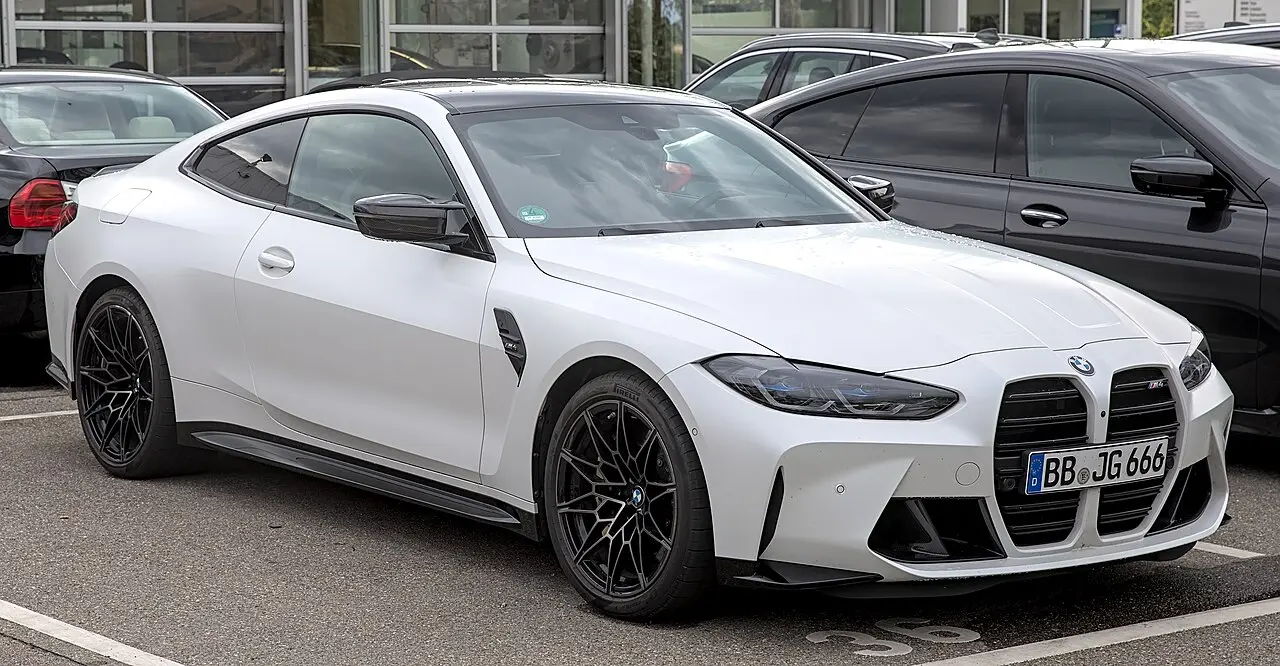
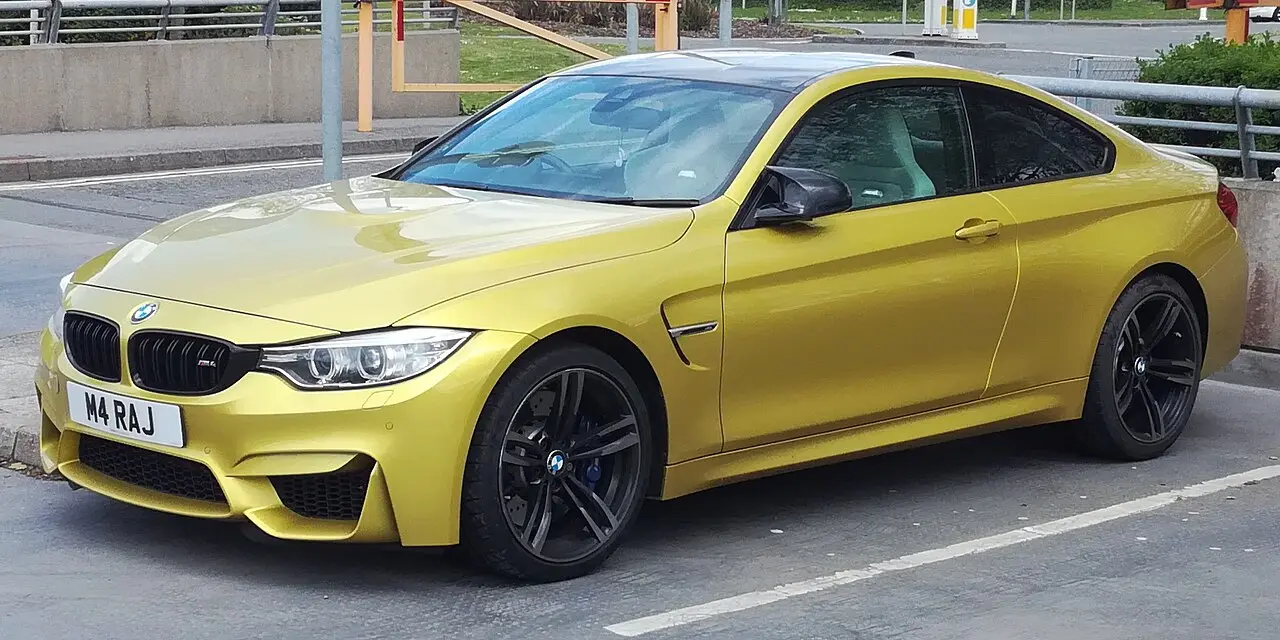
The BMW M4 is a high-performance coupé and convertible from BMW M, the brand’s performance division. The model carries on the two-door role once associated with the M3, with a road-going design shaped by BMW M’s motorsport roots.
The first M4 generation, the F82 coupé and F83 convertible, ran from 2014 to 2020. The G82 coupé and G83 convertible generation began in 2021. BMW introduced the M4 name in 2014 as part of a change that left the M3 badge for the saloon and gave the coupé and convertible their own name. The first M4 used a turbocharged straight-six in place of the previous M3 coupé’s naturally aspirated V8.
Engines and power
The M4 versions in the market figures use a 3.0-litre petrol engine. EU versions from 2014 to 2025 range from 317 kW (431 PS) to 497 kW (676 PS). French versions from 2015 to 2026 range from 317 kW (431 PS) to 375 kW (510 PS). UK figures list a 390 kW (530 PS) version from 2014 to 2026.
In the EU, the 317 kW (431 PS) version led registrations in 2015, with 11,135. The 331 kW (450 PS) version led in 2017 and 2018.
How economical is the BMW M4?
Official fuel consumption figures vary by market and test procedure. The lowest listed figure is 8.3 L/100 km on the UK NEDC test. France’s NEDC figure is 8.8 L/100 km, and the EU WLTP figure is 9.9 L/100 km. The US EPA figure is 11.8 L/100 km, with a combined rating of 20 MPG. Canada’s 5-cycle figure is 11.6 L/100 km. European WLTP and older NEDC tests differ from US EPA testing and Canada’s 5-cycle procedure.
Where is the BMW M4 sold?
The M4 appears in EU EEA registration figures from 2014 to 2025, UK VCA figures from 2014 to 2026, French ADEME figures from 2015 to 2026, US EPA figures from 2015 to 2027, and Canadian NRCan figures from 2015 to 2026. EU registrations total 80,299 from 2014 to 2025. Across its two generations, the M4 has been available as a coupé and a convertible.
Questions and answers
What engine does the BMW M4 use?
The M4 versions in these market figures use a 3.0-litre petrol engine.
When did the BMW M4 generations run?
The F82/F83 generation ran from 2014 to 2020. The G82/G83 generation began in 2021.
What is the BMW M4’s official fuel consumption?
The lowest listed figures range from 8.3 L/100 km on the UK NEDC test to 11.8 L/100 km on the US EPA test. Canada’s 5-cycle figure is 11.6 L/100 km.
New cars registered in the EU (plus Norway and Iceland), from the European Environment Agency. Figures on the NEDC procedure until 2020 and on WLTP from 2021; versions are grouped by engine and power, with their number of registrations.
Years and version
Engine
Power
Fuel
Consumption (combined)
CO₂
EU registrations
2025
3.0 L
390 kW (530 PS)
Petrol
10.2 L/100 km WLTP
230 g/km
2,071
2025
3.0 L
405 kW (551 PS)
Petrol
10.2 L/100 km WLTP
232 g/km
308
2025
3.0 L
375 kW (510 PS)
Petrol
9.9 L/100 km WLTP
224 g/km
296
2025
3.0 L
353 kW (480 PS)
Petrol
10.0 L/100 km WLTP
230 g/km
29
2025
3.0 L
390 kW (530 PS)
Petrol
–
236 g/km
17
2024
3.0 L
375 kW (510 PS)
Petrol
10.0 L/100 km WLTP
228 g/km
1,530
2024
3.0 L
390 kW (530 PS)
Petrol
10.1 L/100 km WLTP
229 g/km
1,516
2024
3.0 L
405 kW (551 PS)
Petrol
10.1 L/100 km WLTP
231 g/km
134
2023–2024
3.0 L
353 kW (480 PS)
Petrol
10.0 L/100 km WLTP
228 g/km
70
2023
3.0 L
375 kW (510 PS)
Petrol
10.1 L/100 km WLTP
221 g/km
3,143
2022–2023
3.0 L
405 kW (551 PS)
Petrol
10.0 L/100 km WLTP
225 g/km
338
2023
3.0 L
390 kW (530 PS)
Petrol
–
–
19
2023
3.0 L
405 kW (551 PS)
Petrol
–
–
16
2022
3.0 L
375 kW (510 PS)
Petrol
10.0 L/100 km WLTP
229 g/km
3,305
2022
3.0 L
353 kW (480 PS)
Petrol
10.0 L/100 km WLTP
228 g/km
54
2022
3.0 L
375 kW (510 PS)
Petrol
–
–
12
2021
3.0 L
375 kW (510 PS)
Petrol
9.9 L/100 km WLTP
230 g/km
4,205
2021
3.0 L
353 kW (480 PS)
Petrol
10.3 L/100 km WLTP
237 g/km
173
2021
3.0 L
331 kW (450 PS)
Petrol
9.9 L/100 km WLTP
226 g/km
132
2021
3.0 L
405 kW (551 PS)
Petrol
–
–
58
2021
3.0 L
375 kW (510 PS)
Petrol
–
–
20
2021
3.0 L
317 kW (431 PS)
Petrol
9.8 L/100 km WLTP
228 g/km
10
United Kingdom 6 versions
New cars on sale in the UK, from the Vehicle Certification Agency. NEDC figures until 2018 and WLTP figures after; years are the editions a version appeared in.
Years and version
Engine
Power
Fuel
Gearbox
Consumption (combined)
CO₂
2025–2026M4 Competition Coupé with M xDrive
3.0 L
390 kW (530 PS)
Petrol
8-speed automatic
10.1 L/100 km WLTP
226 g/km
2025–2026M4 Competition Coupé with M xDrive
3.0 L
390 kW (530 PS)
Petrol
8-speed automatic
10.0 L/100 km WLTP
229 g/km
2025–2026M4 Competition Convertible with M xDrive
3.0 L
390 kW (530 PS)
Petrol
8-speed automatic
10.3 L/100 km WLTP
231 g/km
2025–2026M4 Competition Convertible with M xDrive
3.0 L
390 kW (530 PS)
Petrol
8-speed automatic
10.2 L/100 km WLTP
233 g/km
2026M4 Competition M xDrive Convertible
3.0 L
390 kW (530 PS)
Petrol
8-speed automatic
10.3 L/100 km WLTP
233 g/km
2026M4 Competition M xDrive Convertible
3.0 L
390 kW (530 PS)
Petrol
8-speed automatic
10.2 L/100 km WLTP
232 g/km
France 3 versions
New cars on sale in France, from ADEME Car Labelling. NEDC figures until 2015, WLTP figures in the current catalogue.
Model years sold in the USA, from the EPA and the Department of Energy (fueleconomy.gov). MPG on the EPA test; litres per 100 km = 235.215 ÷ MPG.
Years and version
Engine
Fuel
Gearbox
Drive
Consumption (combined)
CO₂
2021–2027SIDI
3.0 L
Petrol
6-speed manual
Rear-wheel drive
19 MPG (12.4 L/100 km) EPA
293 g/km
2021–2027SIDI
3.0 L
Petrol
8-speed automatic
Rear-wheel drive
19 MPG (12.4 L/100 km) EPA
292 g/km
2025–2027SIDI
3.0 L
Petrol
8-speed automatic
All-wheel drive
18 MPG (13.1 L/100 km) EPA
293 g/km
2025–2027SIDI
3.0 L
Petrol
8-speed automatic
All-wheel drive
18 MPG (13.1 L/100 km) EPA
298 g/km
2025SIDI
3.0 L
Petrol
8-speed automatic
All-wheel drive
18 MPG (13.1 L/100 km) EPA
297 g/km
2022–2024SIDI
3.0 L
Petrol
8-speed automatic
All-wheel drive
18 MPG (13.1 L/100 km) EPA
301 g/km
2022–2024SIDI
3.0 L
Petrol
8-speed automatic
All-wheel drive
18 MPG (13.1 L/100 km) EPA
296 g/km
2023SIDI
3.0 L
Petrol
8-speed automatic
Rear-wheel drive
18 MPG (13.1 L/100 km) EPA
301 g/km
Canada 9 versions
Model years sold in Canada, from Natural Resources Canada fuel consumption ratings (5-cycle test).
Years and version
Engine
Fuel
Gearbox
Consumption (combined)
CO₂
2022–2026Subcompact
3.0 L
Petrol
6-speed manual
12.6 L/100 km 5-cycle
293 g/km
2025–2026Subcompact
3.0 L
Petrol
8-speed automatic
12.9 L/100 km 5-cycle
297 g/km
2025–2026Subcompact
3.0 L
Petrol
8-speed automatic
12.7 L/100 km 5-cycle
293 g/km
2025Subcompact
3.0 L
Petrol
8-speed automatic
12.6 L/100 km 5-cycle
292 g/km
2025Subcompact
3.0 L
Petrol
8-speed automatic
12.9 L/100 km 5-cycle
297 g/km
2022–2024Subcompact
3.0 L
Petrol
8-speed automatic
12.9 L/100 km 5-cycle
301 g/km
2022–2024Subcompact
3.0 L
Petrol
8-speed automatic
12.7 L/100 km 5-cycle
296 g/km
2023Subcompact
3.0 L
Petrol
8-speed automatic
12.9 L/100 km 5-cycle
301 g/km
2022Subcompact
3.0 L
Petrol
8-speed automatic
12.6 L/100 km 5-cycle
292 g/km
Official figures are measured on standard test procedures and differ between markets. Your consumption depends on how, where and in what conditions you drive.