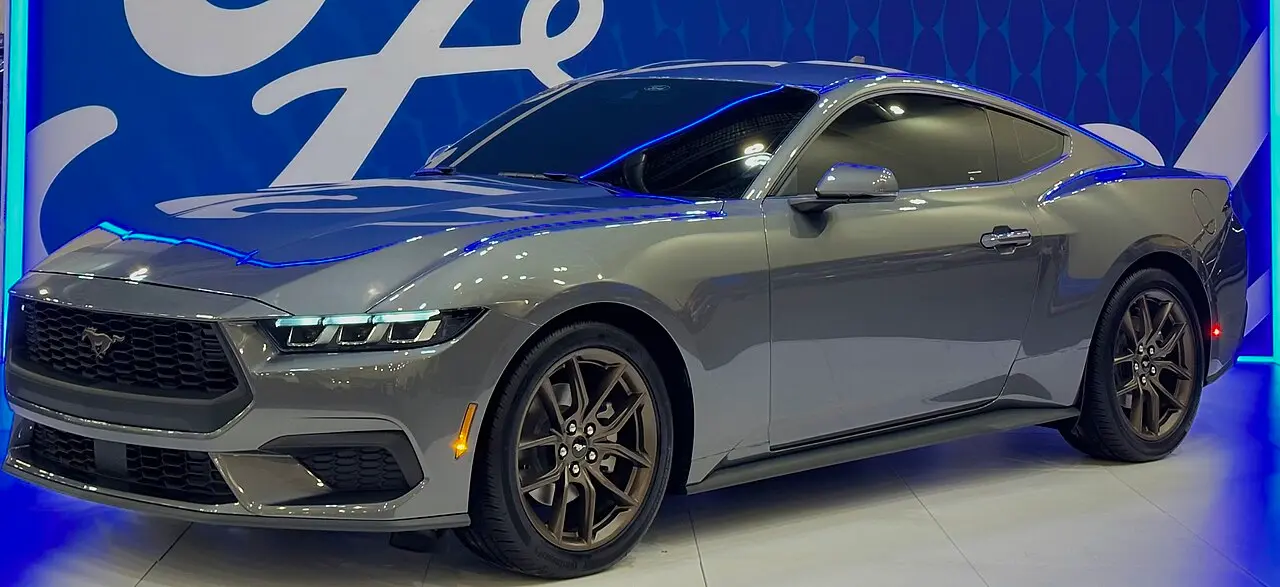
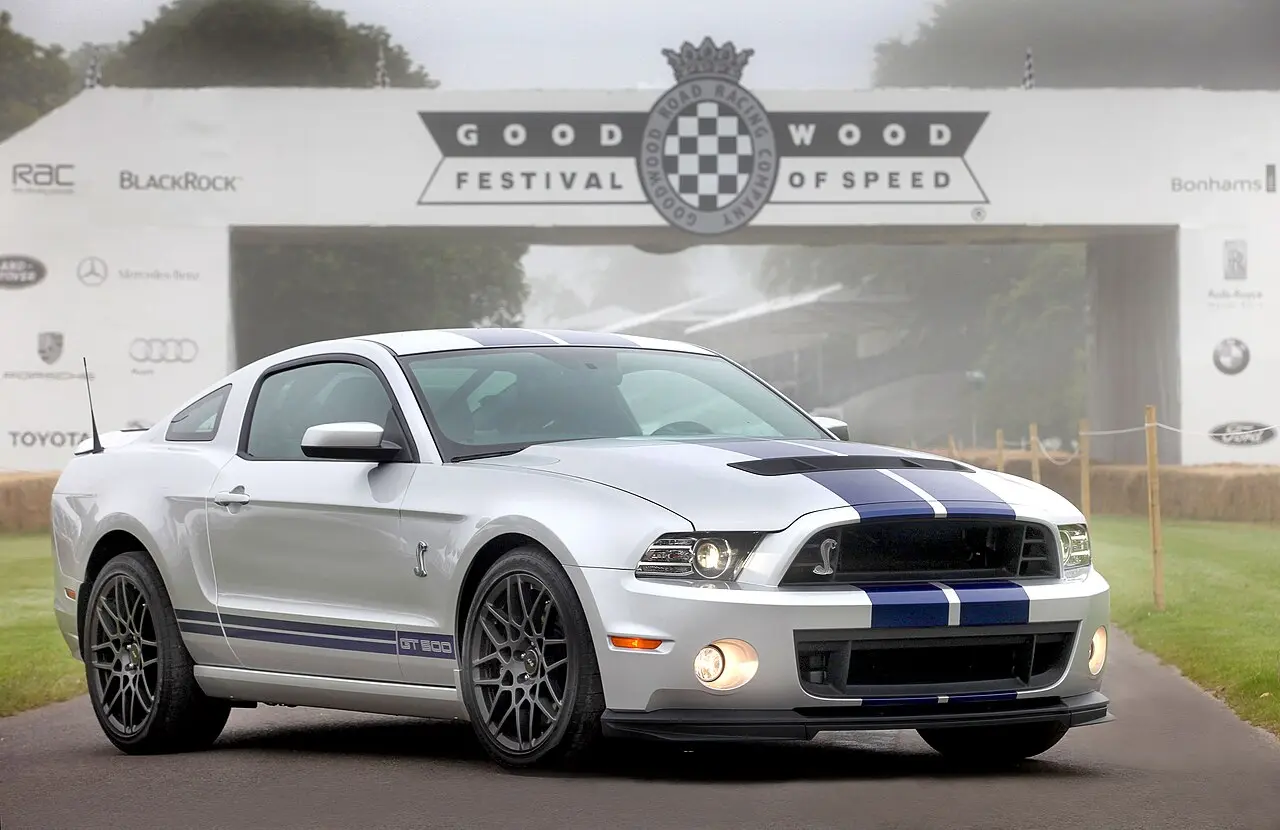
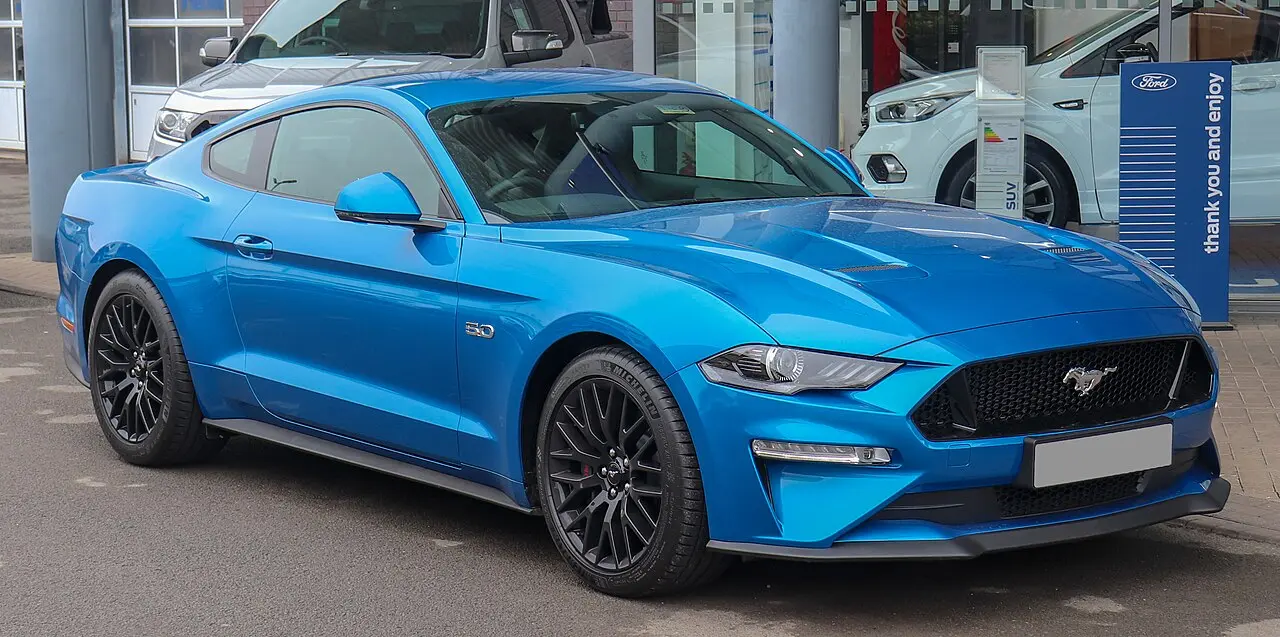
The official data lists 508 versions of the Ford Mustang (1984–2026), in the European Union, the United Kingdom, France, the United States, and Canada. Each market publishes its own figures, measured on its own test procedure.
At a glance
Years in the data
1984–2026
Markets
European Union, United Kingdom, France, United States, Canada
Engines
2.3 L to 5.4 L
Power
124 kW (169 PS) to 567 kW (771 PS)
Fuels
Petrol, Electric, LPG
Lowest consumption (United Kingdom)
8.0 L/100 km (NEDC)
Lowest consumption (United States)
9.0 L/100 km (EPA)
Lowest consumption (European Union)
9.1 L/100 km (WLTP)
New registrations in the EU
130,406
What is the Ford Mustang?
The Mustang is Ford’s sporty coupe and convertible, known for its long bonnet, short rear deck and performance-focused character. Ford introduced it in 1964, and it became one of the company’s best-known models. The Mustang helped establish the pony-car style: a sporty-looking car with a distinctive shape and an everyday role.
The name has endured through successive generations, with the Mustang eventually reaching buyers beyond the United States. Its design has changed over the years, while the coupe and convertible forms have remained part of its identity.
Mustang generations and engines
The generations listed here begin with the third generation, Fox, from 1979 to 1993. The fourth, SN95, ran from 1994 to 2004; the fifth, S197, from 2005 to 2014; and the sixth, S550, from 2015 to 2023. The seventh generation, S650, began in 2024. The Fox generation introduced a new chapter in the Mustang’s design, and later generations continued to update its styling and technology.
EU figures from 2010 to 2025 span 2.3 L to 5.2 L engines and power from 100 kW (136 PS) to 567 kW (771 PS). Fuel listings include petrol, LPG and other categories. UK figures from 2015 to 2024 list petrol engines from 2.3 L to 5.0 L, with power from 213 kW (290 PS) to 460 kW (625 PS). US EPA listings cover petrol engines from 2.3 L to 5.4 L.
Fuel consumption
The lowest listed EU consumption is 9.1 L/100 km on WLTP. The UK low is 8 L/100 km on NEDC, and France’s 2026 listing gives 11.2 L/100 km WLTP. In the USA, the lowest listed figure is 9 L/100 km on the EPA test, with a best combined rating of 26 MPG. Canada’s lowest listed figure is 9.1 L/100 km under NRCan 5-cycle testing. WLTP and NEDC in Europe, EPA in the USA and 5-cycle testing in Canada use different procedures, so results are best read within their own markets.
Where was it sold?
EU registration figures cover 2010–2025, UK figures cover 2015–2024, French listings cover 2026, US EPA listings cover 1984–2026, and Canadian NRCan listings cover 1995–2026. EU figures record 130,406 Mustang registrations over the period. The 5.0 L petrol versions rated at 310 kW (421 PS) and 331 kW (450 PS) were among the leading EU configurations in the listed years.
Questions and answers
When did the Mustang first appear?
Ford introduced the Mustang in 1964.
What are the latest generations listed?
The sixth generation, S550, ran from 2015 to 2023. The seventh generation, S650, began in 2024.
What is the lowest listed fuel consumption in the USA?
The lowest listed EPA figure is 9 L/100 km. The best combined EPA rating shown is 26 MPG.
Why do official consumption figures differ by country?
Test procedures differ by market: Europe uses WLTP or NEDC, the USA uses EPA testing, and Canada uses NRCan 5-cycle testing.
New cars registered in the EU (plus Norway and Iceland), from the European Environment Agency. Figures on the NEDC procedure until 2020 and on WLTP from 2021; versions are grouped by engine and power, with their number of registrations.
Years and version
Engine
Power
Fuel
Consumption (combined)
CO₂
EU registrations
2025
5.0 L
328 kW (446 PS)
Petrol
12.2 L/100 km WLTP
278 g/km
1,577
2025
5.0 L
334 kW (454 PS)
Petrol
12.3 L/100 km WLTP
281 g/km
775
2025
5.0 L
330 kW (449 PS)
Petrol
11.3 L/100 km WLTP
261 g/km
25
2025
5.0 L
338 kW (460 PS)
Petrol
12.0 L/100 km WLTP
275 g/km
12
2024
5.0 L
328 kW (446 PS)
Petrol
12.2 L/100 km WLTP
278 g/km
1,087
2024
5.0 L
334 kW (454 PS)
Petrol
12.3 L/100 km WLTP
281 g/km
645
2024
5.0 L
330 kW (449 PS)
Petrol
11.5 L/100 km WLTP
262 g/km
509
2024
5.0 L
338 kW (460 PS)
Petrol
11.8 L/100 km WLTP
272 g/km
332
United Kingdom 6 versions
New cars on sale in the UK, from the Vehicle Certification Agency. NEDC figures until 2018 and WLTP figures after; years are the editions a version appeared in.
Years and version
Engine
Power
Fuel
Gearbox
Consumption (combined)
CO₂
20245.0 V8 Fastback · 5.0 V8 Convertible
5.0 L
450 kW (612 PS)
Petrol
10-speed automatic
11.2 L/100 km WLTP
256 g/km
20245.0 V8 Fastback · 5.0 V8 Convertible
5.0 L
450 kW (612 PS)
Petrol
10-speed automatic
11.6 L/100 km WLTP
265 g/km
20245.0 V8 Fastback · 5.0 V8 Convertible
5.0 L
450 kW (612 PS)
Petrol
6-speed manual
11.8 L/100 km WLTP
268 g/km
20245.0 V8 Fastback · 5.0 V8 Convertible
5.0 L
450 kW (612 PS)
Petrol
6-speed manual
12.1 L/100 km WLTP
276 g/km
20245.0 V8 MACH1
5.0 L
460 kW (625 PS)
Petrol
10-speed automatic
11.7 L/100 km WLTP
270 g/km
20245.0 V8 MACH1
5.0 L
460 kW (625 PS)
Petrol
6-speed manual
12.4 L/100 km WLTP
284 g/km
France 1 version
New cars on sale in France, from ADEME Car Labelling. NEDC figures until 2015, WLTP figures in the current catalogue.
Years and version
Engine
Power
Fuel
Gearbox
Consumption (combined)
CO₂
2026MUSTANG Fastback 5.0 V8 - BVA
5.0 L
330 kW (449 PS)
Petrol
Automatic
11.2 L/100 km WLTP
256 g/km
United States 13 versions
Model years sold in the USA, from the EPA and the Department of Energy (fueleconomy.gov). MPG on the EPA test; litres per 100 km = 235.215 ÷ MPG.
Years and version
Engine
Fuel
Gearbox
Drive
Consumption (combined)
CO₂
2026SIDI & PFI
2.3 L
Petrol
10-speed automatic
Rear-wheel drive
26 MPG (9.0 L/100 km) EPA
212 g/km
2024–2026
5.0 L
Petrol
10-speed automatic
Rear-wheel drive
17 MPG (13.8 L/100 km) EPA
326 g/km
2024–2026with Stop-Start
5.0 L
Petrol
6-speed manual
Rear-wheel drive
18 MPG (13.1 L/100 km) EPA
307 g/km
2025–2026
5.0 L
Petrol
6-speed manual
Rear-wheel drive
17 MPG (13.8 L/100 km) EPA
331 g/km
2026
5.0 L
Petrol
10-speed automatic
Rear-wheel drive
19 MPG (12.4 L/100 km) EPA
291 g/km
2025–2026
5.2 L
Petrol
8-speed automated manual
Rear-wheel drive
12 MPG (19.6 L/100 km) EPA
460 g/km
2025SIDI & PFI
2.3 L
Petrol
10-speed automatic
Rear-wheel drive
26 MPG (9.0 L/100 km) EPA
213 g/km
2024–2025with Stop-Start
5.0 L
Petrol
10-speed automatic
Rear-wheel drive
19 MPG (12.4 L/100 km) EPA
290 g/km
2024SIDI & PFI
2.3 L
Petrol
10-speed automatic
Rear-wheel drive
24 MPG (9.8 L/100 km) EPA
229 g/km
2024SIDI & PFI
2.3 L
Petrol
10-speed automatic
Rear-wheel drive
26 MPG (9.0 L/100 km) EPA
212 g/km
2024
5.0 L
Petrol
6-speed manual
Rear-wheel drive
17 MPG (13.8 L/100 km) EPA
320 g/km
2024
5.0 L
Petrol
10-speed automatic
Rear-wheel drive
18 MPG (13.1 L/100 km) EPA
306 g/km
2024
5.0 L
Petrol
6-speed manual
Rear-wheel drive
17 MPG (13.8 L/100 km) EPA
332 g/km
Canada 20 versions
Model years sold in Canada, from Natural Resources Canada fuel consumption ratings (5-cycle test).
Official figures are measured on standard test procedures and differ between markets. Your consumption depends on how, where and in what conditions you drive.