The official data lists 119 versions of the Citroën DS 3 (2010 - 2019), in the European Union, the United Kingdom, and France. Each market publishes its own figures, measured on its own test procedure.
At a glance
Years in the data
2010 - 2019
Markets
European Union, United Kingdom, France
Engines
1.2 L to 1.6 L
Power
50 kW (68 PS) to 153 kW (208 PS)
Fuels
Diesel, Petrol, LPG, Hybrid
Lowest consumption (France)
3.0 L/100 km (NEDC)
Lowest consumption (United Kingdom)
3.4 L/100 km (NEDC)
New registrations in the EU
641,501
What is the Citroën DS 3?
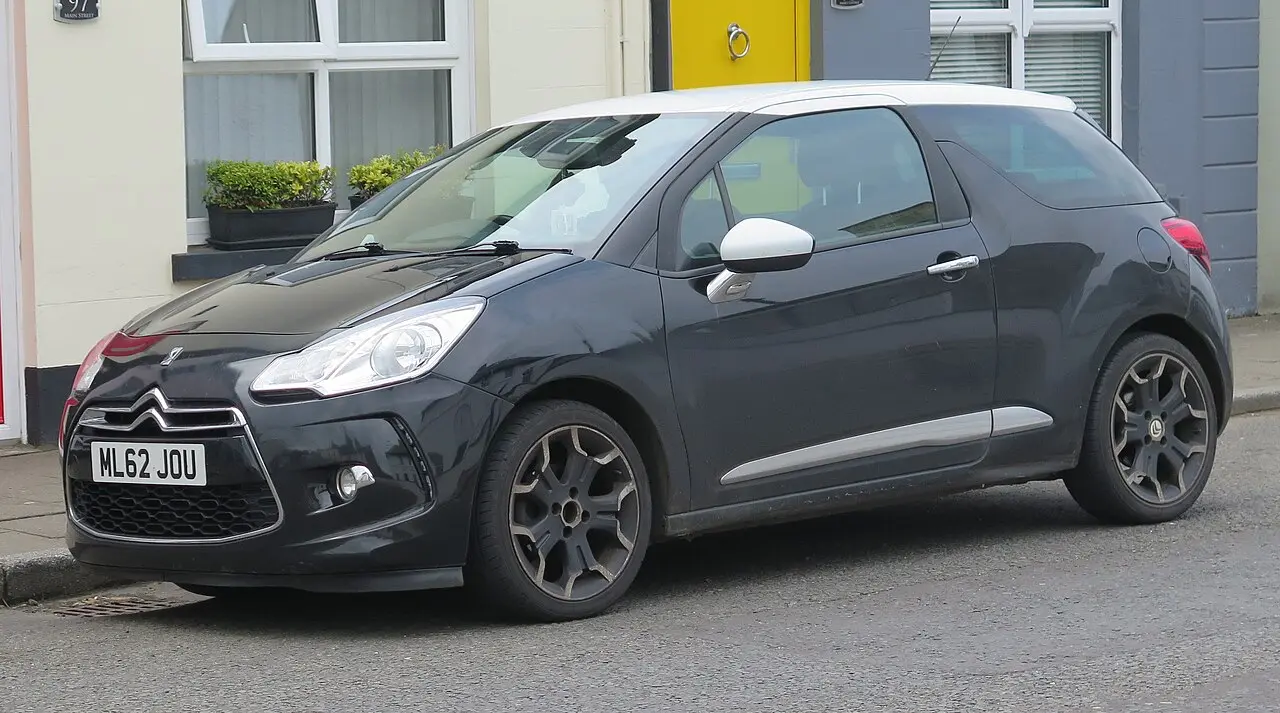
The DS 3 is a small hatchback introduced as the first car in Citroën’s DS line. The line gave the brand’s compact models a more distinctive design and finish. The DS 3 paired a compact shape suited to city streets with a choice of more powerful versions.
Its first generation ran from 2010 to 2015. EU registrations for the model span 2010 to 2019.
Engines and power
EU versions ranged from 1.2 to 1.6 litres and from 50 kW (68 PS) to 153 kW (208 PS). In the UK, engines also ranged from 1.2 to 1.6 litres, with power from 67 kW (91 PS) to 112 kW (152 PS). Petrol and diesel versions were listed in the UK and France. EU registrations also include LPG, hybrid and other fuel classifications.
The highest listed power in the EU and French ranges is 152 kW (207 PS), giving the DS 3 a broad spread from modest output to more spirited performance.
How economical is the DS 3?
The lowest listed consumption is 3.4 L/100 km in the UK and 3 L/100 km in France, both on the NEDC test cycle. These standardized results may differ from everyday consumption. UK figures cover 2010 to 2015, French figures cover 2012 to 2015, and EU registrations span 2010 to 2019.
The EU recorded 641,501 registrations across 52 versions. The most registered entries include 1.6-litre diesel models rated at 68 kW (92 PS).
Questions and answers
What years was the first DS 3 generation sold?
Generation I ran from 2010 to 2015.
How much power did the DS 3 make?
The EU range spanned 50 kW (68 PS) to 153 kW (208 PS).
What is its lowest listed consumption?
France lists 3 L/100 km on NEDC; the UK low is 3.4 L/100 km, also on NEDC.
At a glance: Length 3,950 mm · Kerb weight 950 - 1,140 kg · Top speed 174 - 214 km/h · MOT first-time pass at 9 - 12 years: 66.6% (UK average 77.9%) Specifications, reliability and all versions
Show all 117 versions
European Union 39 versions
New cars registered in the EU (plus Norway and Iceland), from the European Environment Agency. Figures on the NEDC procedure until 2020 and on WLTP from 2021; versions are grouped by engine and power, with their number of registrations.
Years and version
Engine
Power
Fuel
CO₂
EU registrations
2011 - 2015
1.6 L
68 kW (92 PS)
Diesel
95 - 101 g/km
223,520
2011 - 2015
1.6 L
88 kW (120 PS)
Petrol
141 - 147 g/km
123,056
2012 - 2015
1.2 L
60 kW (82 PS)
Petrol
105 - 107 g/km
47,043
2011 - 2015
1.6 L
115 kW (156 PS)
Petrol
135 - 151 g/km
30,378
2011 - 2015
1.4 L
50 kW (68 PS)
Diesel
95 - 102 g/km
17,354
2012 - 2015
1.6 L
84 kW (114 PS)
Diesel
99 - 100 g/km
13,222
2014 - 2015
1.2 L
Not listed
Petrol
106 - 107 g/km
6,114
2014 - 2015
1.2 L
81 kW (110 PS)
Petrol
106 - 107 g/km
5,852
2013 - 2015
1.6 L
88 kW (120 PS)
Diesel
94 g/km
4,744
2014 - 2015
1.6 L
73 kW (99 PS)
Diesel
85 - 87 g/km
3,318
2011 - 2015
1.6 L
149 kW (203 PS)
Petrol
149 g/km
2,890
2011 - 2015
1.6 L
152 kW (207 PS)
Petrol
149 g/km
2,415
2014 - 2015
1.6 L
121 kW (165 PS)
Petrol
129 g/km
1,616
2011 - 2015
1.6 L
110 kW (150 PS)
Petrol
132 - 152 g/km
1,239
2011 - 2015
1.4 L
70 kW (95 PS)
LPG
128 - 129 g/km
784
2014 - 2015
1.6 L
55 kW (75 PS)
Diesel
90 g/km
730
2014 - 2015
1.6 L
Not listed
Petrol
129 g/km
630
2014 - 2015
1.6 L
85 kW (116 PS)
Diesel
94 g/km
366
2015
1.6 L
73 kW (99 PS)
Hybrid
83 g/km
122
2015
1.2 L
60 kW (82 PS)
Hybrid
107 g/km
96
2015
1.6 L
68 kW (92 PS)
Hybrid
95 g/km
36
2015
1.6 L
121 kW (165 PS)
Hybrid
129 g/km
10
2011 - 2014
1.6 L
82 kW (111 PS)
Diesel
99 - 111 g/km
30,718
2011 - 2014
1.4 L
70 kW (95 PS)
Petrol
130 - 133 g/km
16,853
2010 - 2014
-
Not listed
Petrol
136 - 146 g/km
1,410
2013
1.6 L
Not listed
Other fuel
98 g/km
2,314
2013
1.4 L
Not listed
Other fuel
99 g/km
720
2013
1.2 L
Not listed
Other fuel
106 g/km
410
2013
1.6 L
Not listed
Other fuel
141 g/km
224
2013
1.4 L
Not listed
Other fuel
134 g/km
24
2012
-
Not listed
Diesel
96 g/km
204
2012
1.6 L
Not listed
Diesel
136 g/km
36
2011
1.4 L
72 kW (98 PS)
Petrol
134 g/km
12
2011
1.5 L
Not listed
Diesel
107 g/km
10
2010
1.6 L
Not listed
Diesel
108 g/km
48,264
2010
1.6 L
Not listed
Petrol
147 g/km
37,977
2010
1.4 L
Not listed
Petrol
134 g/km
6,820
2010
1.4 L
Not listed
Diesel
107 g/km
740
2010
-
Not listed
Other fuel
137 g/km
26
United Kingdom 38 versions
New cars on sale in the UK, from the Vehicle Certification Agency. NEDC figures until 2018 and WLTP figures after; years are the editions a version appeared in.
New cars registered in the EU (plus Norway and Iceland), from the European Environment Agency. Figures on the NEDC procedure until 2020 and on WLTP from 2021; versions are grouped by engine and power, with their number of registrations.
Years and version
Engine
Power
Fuel
CO₂
EU registrations
2016 - 2019
1.6 L
73 kW (99 PS)
Diesel
87 - 89 g/km
1,082
2016 - 2018
1.6 L
55 kW (75 PS)
Diesel
90 g/km
2,760
2016 - 2018
1.2 L
60 kW (82 PS)
Petrol
95 - 108 g/km
2,480
2016 - 2018
1.2 L
81 kW (110 PS)
Petrol
103 - 108 g/km
1,478
2016 - 2018
1.2 L
96 kW (131 PS)
Petrol
105 g/km
410
2016 - 2018
1.6 L
88 kW (120 PS)
Diesel
94 g/km
410
2016 - 2018
1.6 L
153 kW (208 PS)
Petrol
125 g/km
148
2016 - 2017
1.6 L
88 kW (120 PS)
Petrol
129 - 137 g/km
54
2016 - 2017
1.6 L
121 kW (165 PS)
Petrol
129 g/km
194
2016
1.6 L
68 kW (92 PS)
Diesel
95 g/km
90
2016
1.4 L
50 kW (68 PS)
Diesel
98 g/km
58
2016
1.6 L
115 kW (156 PS)
Petrol
135 g/km
26
2016
1.6 L
85 kW (116 PS)
Diesel
94 g/km
14
Citroën DS 3 recalls
37 official safety recalls for the Citroën DS 3 from NHTSA (United States), DVSA (United Kingdom) and the EU Safety Gate, newest first. Recall repairs are normally free at the maker’s dealers.
Airbag inflator may rupture2008 - 2019
Airbag inflator may rupture2008 - 2019
Timing belt debris may affect brake assistance2017
Timing belt material may affect the brake vacuum pump2017 - 2018
Timing belt material may affect brake vacuum pump2016 - 2017
Official figures are measured on standard test procedures and differ between markets. Your consumption depends on how, where and in what conditions you drive.