The official data lists 62 versions of the Citroën C3 Picasso (2009 - 2019), in the European Union, the United Kingdom, and France. Each market publishes its own figures, measured on its own test procedure.
At a glance
Years in the data
2009 - 2019
Markets
European Union, United Kingdom, France
Engines
1.2 L to 1.6 L
Power
66 kW (90 PS) to 90 kW (122 PS)
Fuels
Diesel, Petrol, LPG, Hybrid
Lowest consumption (United Kingdom)
3.9 L/100 km (NEDC)
Lowest consumption (France)
4.0 L/100 km (NEDC)
New registrations in the EU
725,833
What is the Citroën C3 Picasso?
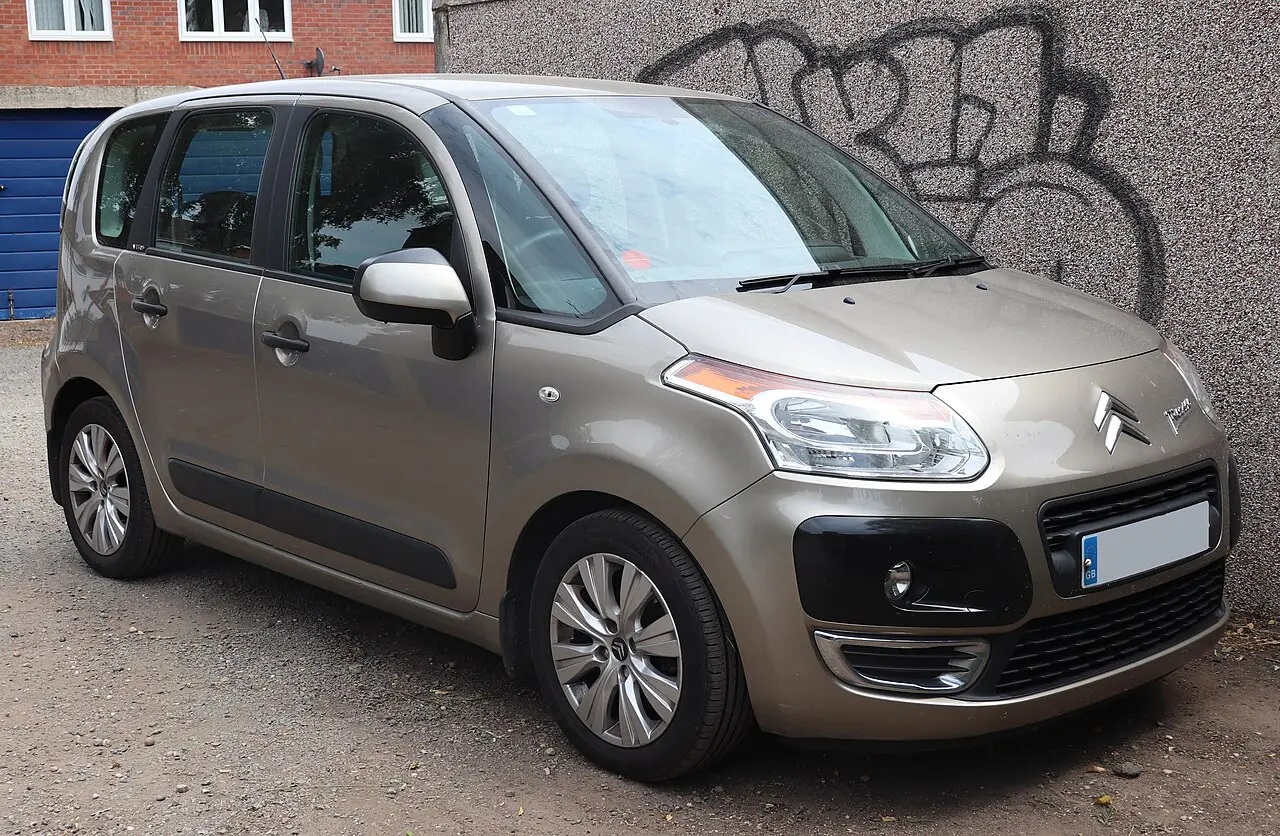
The C3 Picasso is a small, five-door MPV designed to make family space fit within a compact car. Its upright body and broad windows give the cabin an airy feel, while the boxy shape makes it easy to use day to day. It sat at the smaller end of Citroën’s Picasso people-carrier range, alongside the C4 Picasso and Grand C4 Picasso. Citroën launched it in 2008.
Generations and engines
The C3 Picasso had one generation, sold from 2008 to 2017. Its squared-off shape and focus on interior room remained central throughout its run.
EU versions ranged from 1.2 to 1.6 litres, with power from 66 kW (90 PS) to 88 kW (120 PS). The UK range covered the same engine-size span, with power from 67 kW (91 PS) to 90 kW (122 PS). Petrol and diesel versions were listed in the UK and France. EU registrations also include LPG, hybrid and other fuel classifications.
How economical is the Citroën C3 Picasso?
The lowest listed UK consumption is 3.9 L/100 km on the NEDC test. France’s lowest listed figure is 4 L/100 km, also on NEDC. These are standardized test results; everyday consumption varies with driving conditions.
EU registrations total 725,833 across 24 versions from 2010 to 2019. The most registered entries include 1.6-litre diesel versions, among them a 68 kW (92 PS) model. UK figures cover 2009 to 2017, and French figures cover 2012 to 2015.
Questions and answers
How many generations of C3 Picasso were sold?
One: Generation I, from 2008 to 2017.
What engine sizes were available?
EU and UK versions ranged from 1.2 to 1.6 litres.
What is the lowest official fuel consumption listed?
The UK figure is 3.9 L/100 km on NEDC; France’s lowest listed figure is 4 L/100 km, also on NEDC.
At a glance: Length 4,080 - 4,100 mm · Kerb weight 1,176 - 1,265 kg · Top speed 178 - 188 km/h · MOT first-time pass at 6 - 8 years: 85.7% (UK average 86.4%) Specifications, reliability and all versions
Show all 62 versions
European Union 24 versions
New cars registered in the EU (plus Norway and Iceland), from the European Environment Agency. Figures on the NEDC procedure until 2020 and on WLTP from 2021; versions are grouped by engine and power, with their number of registrations.
Years and version
Engine
Power
Fuel
CO₂
EU registrations
2019
1.5 L
Not listed
Diesel
115 g/km
192
2015 - 2018
1.2 L
81 kW (110 PS)
Petrol
115 g/km
54,584
2015 - 2018
1.6 L
73 kW (99 PS)
Diesel
100 - 101 g/km
69,940
2011 - 2017
1.4 L
70 kW (95 PS)
Petrol
139 - 152 g/km
90,646
2015 - 2017
1.2 L
Not listed
Petrol
115 g/km
6,764
2011 - 2016
1.6 L
68 kW (92 PS)
Diesel
107 - 120 g/km
297,897
2011 - 2015
1.6 L
88 kW (120 PS)
Petrol
142 - 155 g/km
39,026
2012 - 2015
1.6 L
84 kW (114 PS)
Diesel
119 - 125 g/km
9,237
2011 - 2015
1.4 L
70 kW (95 PS)
LPG
134 - 144 g/km
7,223
2015
1.6 L
73 kW (99 PS)
Hybrid
101 g/km
706
2015
1.2 L
81 kW (110 PS)
Hybrid
115 g/km
684
2015
1.6 L
68 kW (92 PS)
Hybrid
109 g/km
206
2015
1.4 L
70 kW (95 PS)
Hybrid
140 g/km
20
2011 - 2013
1.6 L
82 kW (111 PS)
Diesel
125 - 127 g/km
14,141
2010 - 2012
-
Not listed
Petrol
148 - 159 g/km
672
2011 - 2012
-
Not listed
Diesel
120 - 121 g/km
28
2012
1.6 L
84 kW (114 PS)
Petrol
137 g/km
10
2011
1.6 L
66 kW (90 PS)
Diesel
123 g/km
1,904
2011
1.6 L
80 kW (109 PS)
Diesel
130 g/km
230
2010
1.6 L
Not listed
Diesel
125 g/km
100,888
2010
1.4 L
Not listed
Petrol
154 g/km
21,502
2010
1.6 L
Not listed
Petrol
161 g/km
9,231
2010
-
Not listed
Other fuel
145 g/km
68
2010
1.6 L
Not listed
Petrol
161 g/km
34
United Kingdom 25 versions
New cars on sale in the UK, from the Vehicle Certification Agency. NEDC figures until 2018 and WLTP figures after; years are the editions a version appeared in.
Years and version
Engine
Power
Fuel
Gearbox
Consumption (combined)
CO₂
2015 - 2017PureTech 110
1.2 L
Not listed
Petrol
5-speed manual
5.0 L/100 km NEDC
115 g/km
2015 - 2017BlueHDi 100
1.6 L
Not listed
Diesel
5-speed manual
3.9 L/100 km NEDC
101 g/km
2012 - 2015VTi 95
1.4 L
Not listed
Petrol
5-speed manual
6.3 L/100 km NEDC
145 g/km
2015HDi 115
1.6 L
Not listed
Diesel
6-speed manual
4.6 L/100 km NEDC
119 g/km
2012 - 2015HDi 90
1.6 L
Not listed
Diesel
5-speed manual
4.1 - 4.6 L/100 km NEDC
107 - 119 g/km
2012 - 2015VTi 120
1.6 L
Not listed
Petrol
5-speed manual
6.4 L/100 km NEDC
149 g/km
2015VTi 120 ETG6
1.6 L
Not listed
Petrol
6-speed automated manual
6.0 L/100 km NEDC
137 g/km
2013 - 2014VTi 95
1.4 L
Not listed
Petrol
Manual
6.3 L/100 km NEDC
145 g/km
2013 - 2014HDi 90
1.6 L
Not listed
Diesel
Manual
4.1 - 4.2 L/100 km NEDC
107 - 112 g/km
2014HDi 115
1.6 L
Not listed
Diesel
Manual
4.6 L/100 km NEDC
119 g/km
2013 - 2014VTi 120
1.6 L
Not listed
Petrol
Manual
6.4 L/100 km NEDC
149 g/km
2014VTi 120 EGS6
1.6 L
Not listed
Petrol
Automatic
6.0 L/100 km NEDC
137 g/km
2013HDi 110 · HDi 115
1.6 L
Not listed
Diesel
Manual
4.8 L/100 km NEDC
125 g/km
2013VTi 120 EGS6
1.6 L
Not listed
Petrol
Automatic
6.0 L/100 km NEDC
137 g/km
2012HDi 110
1.6 L
Not listed
Diesel
6-speed manual
4.8 L/100 km NEDC
125 g/km
2012VTi 120 EGS6
1.6 L
Not listed
Petrol
6-speed automated manual
6.0 L/100 km NEDC
137 g/km
2009 - 20101.4VTi 95hp 16" wheels · 1.4 VTi 95hp with energy saving tyres
12 official safety recalls for the Citroën C3 Picasso from NHTSA (United States), DVSA (United Kingdom) and the EU Safety Gate, newest first. Recall repairs are normally free at the maker’s dealers.
Timing belt material may affect brake vacuum pump2014 - 2017
Engine software calibration may cause excess NOx emissions2013 - 2016
Front seat airbag may not deploy in a side impact2016
Official figures are measured on standard test procedures and differ between markets. Your consumption depends on how, where and in what conditions you drive.