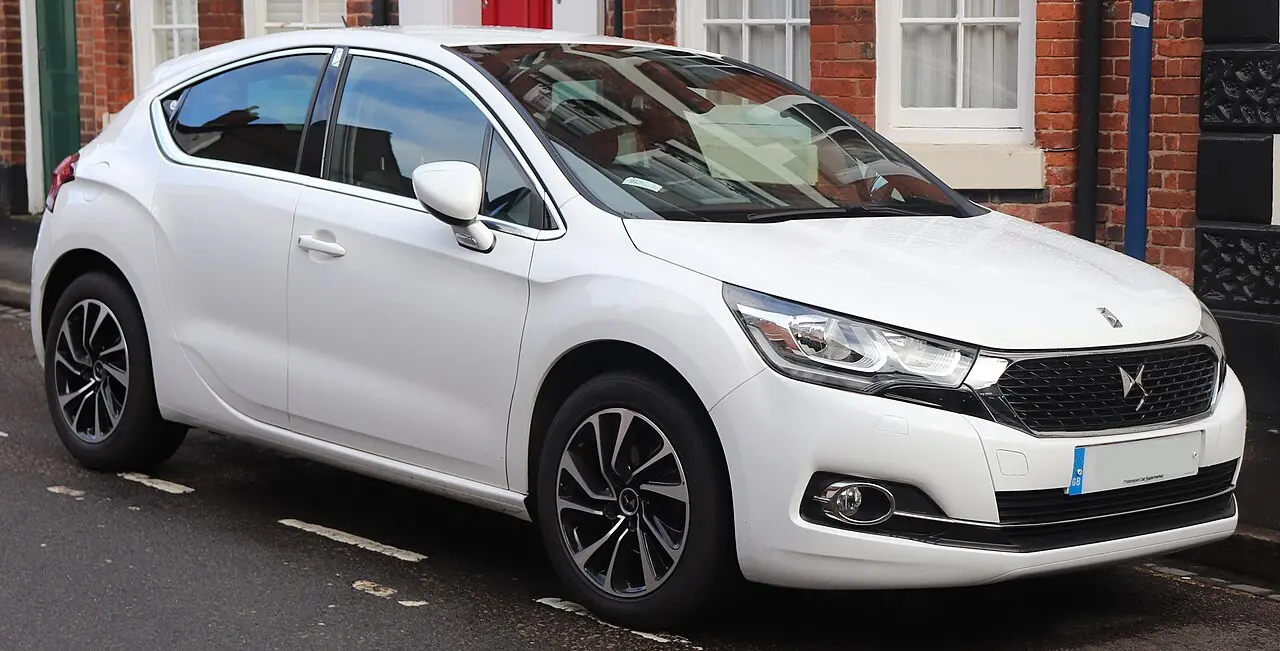
The official data lists 156 versions of the Citroën DS 4 (2010–2019), in the European Union, the United Kingdom, and France. Each market publishes its own figures, measured on its own test procedure.
At a glance
Years in the data
2010–2019
Markets
European Union, United Kingdom, France
Engines
1.2 L to 2.0 L
Power
68 kW (92 PS) to 147 kW (200 PS)
Fuels
Diesel, Petrol, Hybrid
Lowest consumption (France)
3.7 L/100 km (NEDC)
Lowest consumption (United Kingdom)
3.9 L/100 km (NEDC)
New registrations in the EU
216,895
What is the DS 4?
The DS 4 was a compact car in Citroën’s DS line, which gave familiar Citroën models more distinctive styling and cabin details. It blended hatchback and crossover cues, with a raised stance and coupe-like profile. Its shape and everyday practicality made it a distinctive choice for drivers who wanted a compact family car.
The first generation ran from 2011 to 2015. EU registrations span 2010 to 2019.
Engines and power
Across EU registrations, the DS 4 had petrol, diesel, hybrid and other fuel types, with engines from 1.2 to 2.0 litres. Power ranged from 68 kW (92 PS) to 147 kW (200 PS). The most registered versions were 1.6-litre diesels, including 82 kW (111 PS) and 84 kW (114 PS) variants.
How economical is the DS 4?
Official consumption figures vary by market and test procedure. UK VCA figures for 2012–2015 give a lowest stated consumption of 3.9 L/100 km on NEDC. French ADEME figures for the same years give 3.7 L/100 km, also on NEDC.
Where was the DS 4 sold?
EU registration figures cover 2010–2019, with 216,895 registrations. UK VCA and French ADEME figures cover 2012–2015. Petrol and diesel versions appear in all three markets; EU and French figures also include hybrid and other fuel types.
Questions and answers
When was the first-generation DS 4 sold?
The first generation ran from 2011 to 2015.
What engines were available?
EU registrations show engines from 1.2 to 2.0 litres and power from 68 kW (92 PS) to 147 kW (200 PS), across petrol, diesel, hybrid and other fuel types.
What is the lowest official consumption figure listed?
French ADEME figures report 3.7 L/100 km on NEDC for 2012–2015.
New cars registered in the EU (plus Norway and Iceland), from the European Environment Agency. Figures on the NEDC procedure until 2020 and on WLTP from 2021; versions are grouped by engine and power, with their number of registrations.
Years and version
Engine
Power
Fuel
CO₂
EU registrations
2015
1.6 L
84 kW (114 PS)
Diesel
113 g/km
6,956
2015
1.6 L
88 kW (120 PS)
Diesel
102 g/km
3,988
2015
1.2 L
96 kW (131 PS)
Petrol
118 g/km
2,856
2015
2.0 L
110 kW (150 PS)
Diesel
102 g/km
1,832
2015
2.0 L
133 kW (181 PS)
Diesel
115 g/km
1,130
2015
1.6 L
85 kW (116 PS)
Diesel
102 g/km
956
2015
2.0 L
100 kW (136 PS)
Diesel
130 g/km
758
2015
1.6 L
88 kW (120 PS)
Petrol
144 g/km
626
2015
2.0 L
120 kW (163 PS)
Diesel
139 g/km
610
2015
1.6 L
121 kW (165 PS)
Petrol
129 g/km
432
2015
1.6 L
68 kW (92 PS)
Diesel
115 g/km
260
2015
1.6 L
120 kW (163 PS)
Petrol
165 g/km
156
2015
1.6 L
147 kW (200 PS)
Petrol
149 g/km
120
2015
1.2 L
–
Petrol
120 g/km
68
2015
2.0 L
110 kW (150 PS)
Hybrid
102 g/km
12
2015
1.6 L
84 kW (114 PS)
Hybrid
114 g/km
10
2014
1.6 L
84 kW (114 PS)
Diesel
113 g/km
24,852
2014
2.0 L
120 kW (163 PS)
Diesel
139 g/km
5,192
2014
1.6 L
88 kW (120 PS)
Petrol
144 g/km
4,002
2014
2.0 L
100 kW (136 PS)
Diesel
131 g/km
2,938
2014
1.6 L
120 kW (163 PS)
Petrol
178 g/km
520
2014
1.6 L
147 kW (200 PS)
Petrol
149 g/km
468
2014
1.6 L
68 kW (92 PS)
Diesel
115 g/km
228
2014
1.2 L
96 kW (131 PS)
Petrol
119 g/km
168
2014
1.6 L
88 kW (120 PS)
Diesel
101 g/km
94
2014
1.6 L
82 kW (111 PS)
Diesel
118 g/km
42
2014
2.0 L
133 kW (181 PS)
Diesel
114 g/km
24
2014
2.0 L
110 kW (150 PS)
Diesel
103 g/km
20
2014
1.6 L
121 kW (165 PS)
Petrol
129 g/km
16
2014
1.6 L
85 kW (116 PS)
Diesel
100 g/km
14
2014
1.6 L
84 kW (114 PS)
Petrol
113 g/km
12
2013
1.6 L
84 kW (114 PS)
Diesel
114 g/km
27,194
2013
2.0 L
120 kW (163 PS)
Diesel
136 g/km
7,552
2013
1.6 L
88 kW (120 PS)
Petrol
144 g/km
4,786
2013
2.0 L
100 kW (136 PS)
Diesel
132 g/km
3,482
2013
1.6 L
–
Other fuel
112 g/km
2,918
2013
1.6 L
82 kW (111 PS)
Diesel
117 g/km
2,890
2013
1.6 L
120 kW (163 PS)
Petrol
180 g/km
758
2013
1.6 L
147 kW (200 PS)
Petrol
149 g/km
660
2013
1.6 L
–
Other fuel
150 g/km
448
2013
1.6 L
68 kW (92 PS)
Diesel
115 g/km
232
2013
2.0 L
–
Other fuel
139 g/km
152
2013
–
–
Diesel
115 g/km
78
2013
1.6 L
84 kW (114 PS)
Petrol
113 g/km
18
2013
1.6 L
115 kW (156 PS)
Petrol
149 g/km
14
2012
1.6 L
82 kW (111 PS)
Diesel
117 g/km
33,967
2012
2.0 L
120 kW (163 PS)
Diesel
133 g/km
12,279
2012
1.6 L
88 kW (120 PS)
Petrol
145 g/km
4,351
2012
1.6 L
147 kW (200 PS)
Petrol
149 g/km
1,452
2012
1.6 L
120 kW (163 PS)
Petrol
177 g/km
1,083
2012
2.0 L
100 kW (136 PS)
Diesel
134 g/km
983
2012
1.6 L
84 kW (114 PS)
Diesel
115 g/km
877
2012
1.6 L
115 kW (156 PS)
Petrol
149 g/km
403
2012
1.6 L
68 kW (92 PS)
Diesel
115 g/km
308
2012
–
–
Diesel
118 g/km
120
2012
–
–
Petrol
147 g/km
44
2011
1.6 L
82 kW (111 PS)
Diesel
117 g/km
25,318
2011
2.0 L
120 kW (163 PS)
Diesel
134 g/km
9,924
2011
1.6 L
147 kW (200 PS)
Petrol
150 g/km
4,198
2011
1.6 L
88 kW (120 PS)
Petrol
145 g/km
2,452
2011
1.6 L
115 kW (156 PS)
Petrol
146 g/km
1,578
2011
1.6 L
68 kW (92 PS)
Diesel
115 g/km
134
2011
–
–
Petrol
147 g/km
90
2011
–
–
Diesel
117 g/km
10
2011
1.6 L
120 kW (163 PS)
Petrol
178 g/km
10
United Kingdom 21 versions
New cars on sale in the UK, from the Vehicle Certification Agency. NEDC figures until 2018 and WLTP figures after; years are the editions a version appeared in.
New cars registered in the EU (plus Norway and Iceland), from the European Environment Agency. Figures on the NEDC procedure until 2020 and on WLTP from 2021; versions are grouped by engine and power, with their number of registrations.
Official figures are measured on standard test procedures and differ between markets. Your consumption depends on how, where and in what conditions you drive.