The official data lists 101 versions of the BMW 2 Series Active Tourer (2014 - 2026), in the European Union and the United Kingdom. Each market publishes its own figures, measured on its own test procedure.
At a glance
Years in the data
2014 - 2026
Markets
European Union, United Kingdom
Engines
1.5 L to 2.0 L
Power
75 kW (102 PS) to 240 kW (326 PS)
Fuels
Petrol, Plug-in hybrid, Diesel, Hybrid
Lowest consumption (United Kingdom)
3.8 L/100 km (NEDC)
Lowest consumption (European Union)
4.5 L/100 km (WLTP)
Plug-in hybrid, weighted (European Union)
0.7 L/100 km (WLTP)
Plug-in hybrid, weighted (United Kingdom)
2.0 L/100 km (NEDC)
New registrations in the EU
504,089
What is the BMW 2 Series Active Tourer?
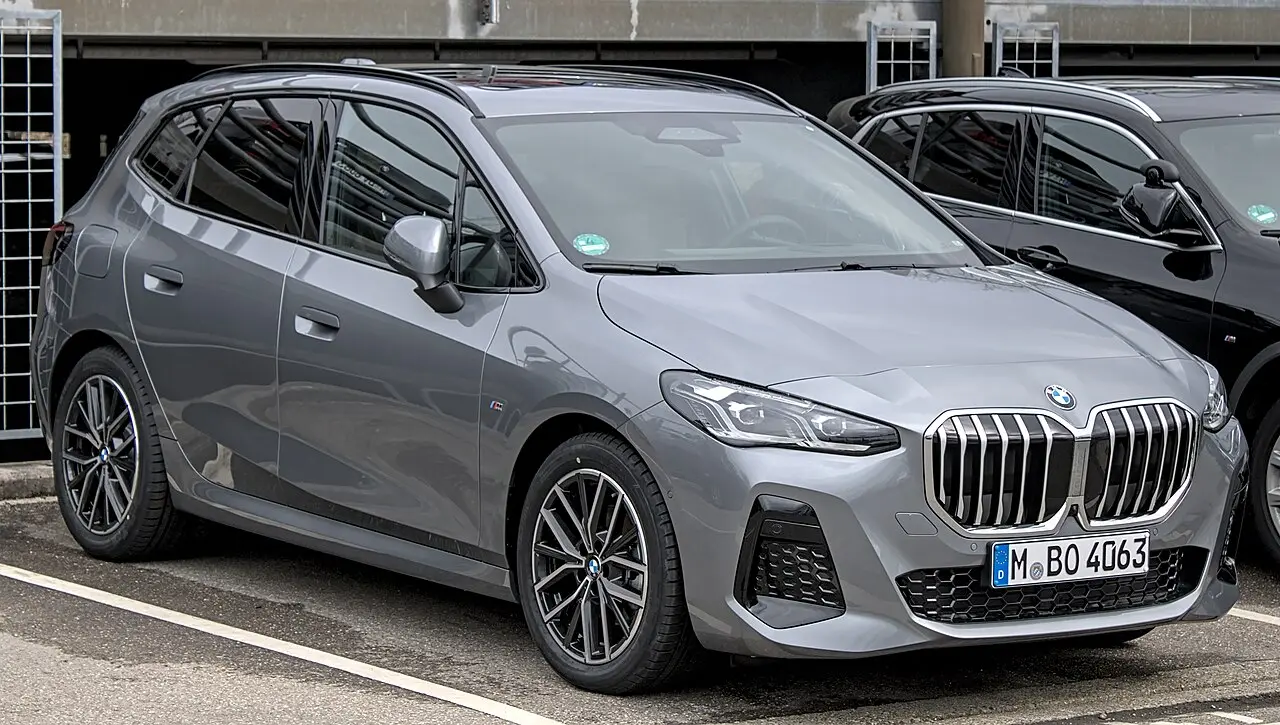
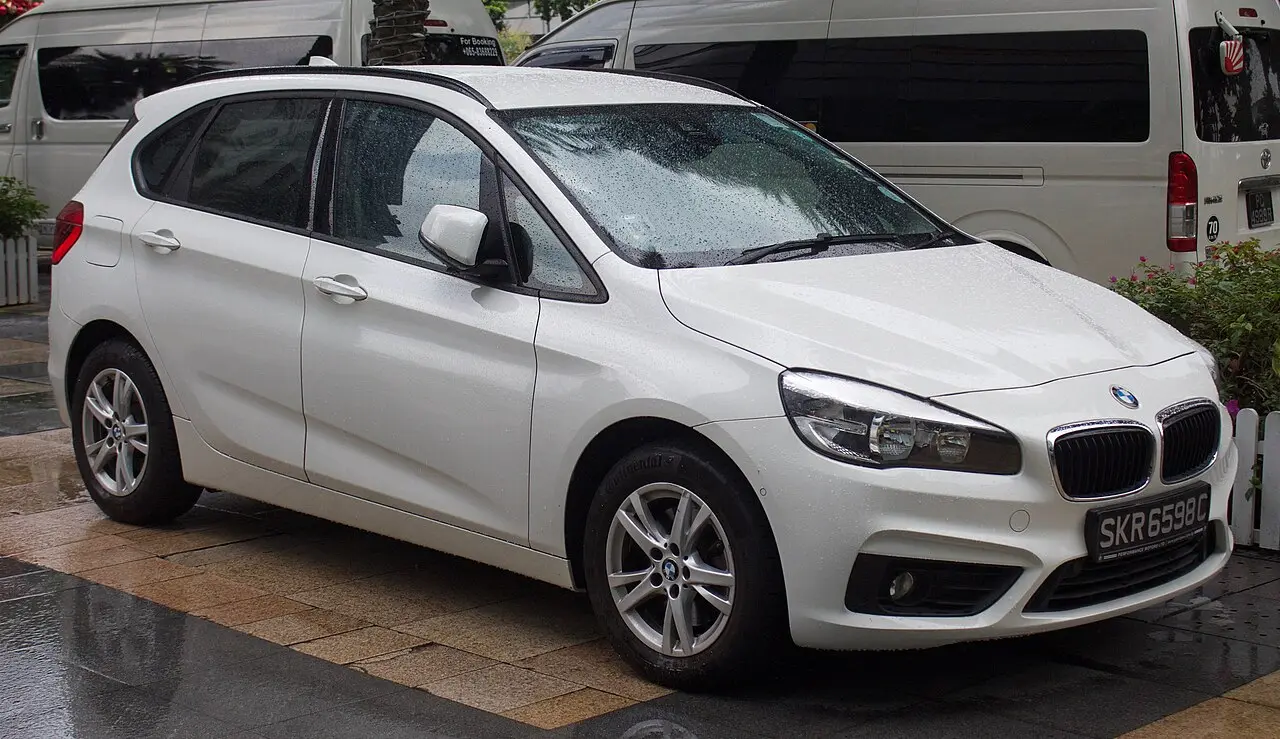
The BMW 2 Series Active Tourer is a compact people carrier with a taller body than the 2 Series Coupé. Its upright shape makes room for passengers and luggage while keeping the car suited to everyday use. It is the space-focused member of the 2 Series family.
Introduced in 2014, the Active Tourer brought front-wheel drive and three-cylinder engines to BMW’s production line-up. That gave the brand a new kind of compact family car, with a practical cabin and an alternative to its traditional rear-wheel-drive layout.
BMW 2 Series Active Tourer generations
The first generation, F45, ran from 2014 to 2021. The second, U06, began in 2021. The newer model kept the compact people-carrier format and included electrified options, among them plug-in hybrids. Both generations appear in EU and UK listings.
Engines and power
EU listings cover 1.5- to 2.0-litre engines, with power from 75 kW (102 PS) to 170 kW (231 PS). In the UK, engines also range from 1.5 to 2.0 litres, while power runs from 125 kW (170 PS) to 240 kW (326 PS). The range includes petrol and diesel versions, alongside hybrid and plug-in hybrid options.
How economical is the BMW 2 Series Active Tourer?
The lowest listed non-plug-in figure in the EU is 4.5 L/100 km on WLTP. The lowest plug-in hybrid figure is 0.7 L/100 km on WLTP, an official weighted result that assumes some driving is electric. In the UK, the lowest listed figures are 3.8 L/100 km for non-plug-in versions and 2 L/100 km for plug-in hybrids, both on NEDC.
WLTP and NEDC are European test procedures and use different methods. The plug-in hybrid figure also assumes a share of electric driving, so it is not directly comparable with a non-plug-in result.
Where was the BMW 2 Series Active Tourer sold?
The Active Tourer appears in EU and UK listings. EU registration figures span 2014-2025 and total 504,089. Its taller cabin and adaptable layout give it a practical role within the 2 Series family.
Questions and answers
When was the BMW 2 Series Active Tourer introduced?
The first-generation F45 began in 2014.
What are the Active Tourer generations?
They are the F45 (2014-2021) and U06 (from 2021).
Is the BMW 2 Series Active Tourer available as a plug-in hybrid?
Yes. Plug-in hybrid versions appear in both EU and UK listings.
What is its lowest listed EU fuel-consumption figure?
It is 0.7 L/100 km for a plug-in hybrid on WLTP, weighted on the assumption that some driving is electric.
2 Series Active Tourer first generation (2014 - 2021)
New cars registered in the EU (plus Norway and Iceland), from the European Environment Agency. Figures on the NEDC procedure until 2020 and on WLTP from 2021; versions are grouped by engine and power, with their number of registrations.
Years and version
Engine
Power
Fuel
Consumption (combined)
CO₂
Electric range
EU registrations
2022 - 2025
1.5 L
100 kW (136 PS)
Petrol
6.3 L/100 km WLTP
142 - 143 g/km
-
24,957
2022 - 2025
1.5 L
100 kW (136 PS) (engine only)
Plug-in hybrid
0.7 - 2.2 L/100 km WLTP14.6 - 16.2 kWh/100 km WLTP
15 - 22 g/km
86 - 90 km
21,514
2022 - 2025
2.0 L
110 kW (150 PS)
Diesel
4.8 - 4.9 L/100 km WLTP
127 - 129 g/km
-
19,579
2022 - 2025
1.5 L
115 kW (156 PS)
Hybrid
5.7 - 6.1 L/100 km WLTP
130 - 138 g/km
-
12,634
2023 - 2025
1.5 L
90 kW (122 PS)
Petrol
6.2 - 6.3 L/100 km WLTP
141 g/km
-
3,475
2022 - 2025
1.5 L
110 kW (150 PS) (engine only)
Plug-in hybrid
0.7 - 3.9 L/100 km WLTP14.9 - 16.4 kWh/100 km WLTP
15 - 22 g/km
85 - 89 km
2,675
2022 - 2025
2.0 L
150 kW (204 PS)
Hybrid
6.0 - 6.2 L/100 km WLTP
136 - 142 g/km
-
1,935
2024 - 2025
2.0 L
110 kW (150 PS)
Hybrid
4.5 - 4.6 L/100 km WLTP
119 - 120 g/km
-
987
2022 - 2025
1.5 L
100 kW (136 PS)
Hybrid
5.8 - 6.1 L/100 km WLTP
127 - 138 g/km
-
146
2022 - 2024
2.0 L
100 kW (136 PS)
Diesel
4.8 - 4.9 L/100 km WLTP
126 - 128 g/km
-
481
2023
1.5 L
115 kW (156 PS)
Petrol
-
147 g/km
-
26
2023
1.5 L
92 kW (125 PS) (engine only)
Plug-in hybrid
13.5 kWh/100 km WLTP
35 g/km
54 km
25
2023
1.5 L
80 kW (109 PS) (engine only)
Plug-in hybrid
0.7 L/100 km WLTP14.5 kWh/100 km WLTP
15 g/km
90 km
14
2023
1.5 L
Not listed
Plug-in hybrid
14.5 kWh/100 km WLTP
26 g/km
91 km
11
2023
1.5 L
110 kW (150 PS)
Hybrid
-
112 g/km
-
11
2022
1.5 L
92 kW (125 PS) (engine only)
Plug-in hybrid
2.7 L/100 km WLTP13.8 kWh/100 km WLTP
35 g/km
55 km
172
2022
2.0 L
131 kW (178 PS)
Petrol
6.3 L/100 km WLTP
143 g/km
-
26
2022
1.5 L
85 kW (116 PS)
Diesel
4.6 L/100 km WLTP
127 g/km
-
12
United Kingdom 20 versions
New cars on sale in the UK, from the Vehicle Certification Agency. NEDC figures until 2018 and WLTP figures after; years are the editions a version appeared in.
Years and version
Engine
Power
Fuel
Gearbox
Consumption (combined)
CO₂
Electric range
2025 - 2026220i Sport Active Tourer
1.5 L
125 kW (170 PS)
Hybrid
7-speed automatic
5.7 - 5.9 L/100 km WLTP
129 - 134 g/km
-
2025 - 2026220i Luxury Active Tourer
1.5 L
125 kW (170 PS)
Hybrid
7-speed automatic
5.7 - 6.0 L/100 km WLTP
129 - 135 g/km
-
2025 - 2026220i M Sport Active Tourer
1.5 L
125 kW (170 PS)
Hybrid
7-speed automatic
5.8 - 5.9 L/100 km WLTP
131 - 135 g/km
-
2026220i Luxury · 220i Sport
1.5 L
125 kW (170 PS)
Hybrid
7-speed automatic
5.7 L/100 km WLTP
129 g/km
-
2026220i M Sport
1.5 L
125 kW (170 PS)
Hybrid
7-speed automatic
5.9 L/100 km WLTP
135 g/km
-
2025 - 2026225e Sport Active Tourer
1.5 L
180 kW (245 PS)
Plug-in hybrid
7-speed automatic
16.7 kWh/100 km WLTP
-
82 km
2025 - 2026225e Sport Active Tourer · 225e Luxury Active Tourer · 225e xDrive M Sport Active Tourer
1.5 L
180 kW (245 PS)
Plug-in hybrid
7-speed automatic
16.0 kWh/100 km WLTP
-
86 km
2025 - 2026225e Luxury Active Tourer · 225e xDrive M Sport Active Tourer
1.5 L
180 kW (245 PS)
Plug-in hybrid
7-speed automatic
16.9 kWh/100 km WLTP
-
81 km
2026225e xDrive Luxury · 225e xDrive Sport
1.5 L
180 kW (245 PS)
Plug-in hybrid
7-speed automatic
11.5 kWh/100 km WLTP
60 g/km
85 km
2026225e xDrive M Sport
1.5 L
180 kW (245 PS)
Plug-in hybrid
7-speed automatic
11.6 kWh/100 km WLTP
62 g/km
83 km
2026225e xDrive M Sport Executive Edition
1.5 L
180 kW (245 PS)
Plug-in hybrid
7-speed automatic
12.9 kWh/100 km WLTP
49 g/km
86 km
2025 - 2026230e Luxury Active Tourer · 230e xDrive M Sport Active Tourer
1.5 L
240 kW (326 PS)
Plug-in hybrid
7-speed automatic
16.0 - 16.9 kWh/100 km WLTP
-
81 - 87 km
2026230e xDrive Luxury
1.5 L
240 kW (326 PS)
Plug-in hybrid
7-speed automatic
11.9 kWh/100 km WLTP
66 g/km
80 km
2026230e xDrive M Sport
1.5 L
240 kW (326 PS)
Plug-in hybrid
7-speed automatic
11.7 kWh/100 km WLTP
62 g/km
83 km
2025 - 2026223i Sport Active Tourer
2.0 L
160 kW (218 PS)
Hybrid
7-speed automatic
5.9 - 6.1 L/100 km WLTP
133 - 138 g/km
-
2025 - 2026223i Luxury Active Tourer
2.0 L
160 kW (218 PS)
Hybrid
7-speed automatic
5.9 - 6.2 L/100 km WLTP
135 - 140 g/km
-
2025 - 2026223i M Sport Active Tourer
2.0 L
160 kW (218 PS)
Hybrid
7-speed automatic
5.9 - 6.1 L/100 km WLTP
135 - 139 g/km
-
2026223i Luxury
2.0 L
160 kW (218 PS)
Hybrid
7-speed automatic
5.9 L/100 km WLTP
133 g/km
-
2026223i M Sport
2.0 L
160 kW (218 PS)
Hybrid
7-speed automatic
6.1 L/100 km WLTP
139 g/km
-
2026223i Sport
2.0 L
160 kW (218 PS)
Hybrid
7-speed automatic
6.1 L/100 km WLTP
138 g/km
-
Versions outside these generations
Show all 14 versions
European Union 14 versions
New cars registered in the EU (plus Norway and Iceland), from the European Environment Agency. Figures on the NEDC procedure until 2020 and on WLTP from 2021; versions are grouped by engine and power, with their number of registrations.
Years and version
Engine
Power
Fuel
Consumption (combined)
CO₂
Electric range
EU registrations
2021
1.5 L
100 kW (136 PS)
Petrol
6.1 L/100 km WLTP13.4 kWh/100 km WLTP
139 g/km
-
3,613
2021
1.5 L
92 kW (125 PS) (engine only)
Plug-in hybrid
2.4 L/100 km WLTP14.4 kWh/100 km WLTP
36 g/km
54 km
3,191
2021
2.0 L
110 kW (150 PS)
Diesel
5.0 L/100 km WLTP
133 g/km
-
2,074
2021
1.5 L
85 kW (116 PS)
Diesel
4.6 L/100 km WLTP
126 g/km
-
1,533
2021
2.0 L
131 kW (178 PS)
Petrol
6.3 L/100 km WLTP
144 g/km
-
1,233
2021
1.5 L
80 kW (109 PS)
Petrol
6.0 L/100 km WLTP
140 g/km
-
625
2021
1.5 L
103 kW (140 PS)
Petrol
6.5 L/100 km WLTP
148 g/km
-
546
2021
1.5 L
100 kW (136 PS) (engine only)
Plug-in hybrid
1.8 L/100 km WLTP14.7 kWh/100 km WLTP
40 g/km
52 km
502
2021
2.0 L
140 kW (190 PS)
Diesel
5.1 L/100 km WLTP
134 g/km
-
175
2021
1.5 L
115 kW (156 PS)
Hybrid
6.2 L/100 km WLTP
141 g/km
-
128
2021
2.0 L
141 kW (192 PS)
Petrol
6.8 L/100 km WLTP
154 g/km
-
124
2021
2.0 L
150 kW (204 PS)
Hybrid
6.3 L/100 km WLTP
144 g/km
-
92
2021
2.0 L
170 kW (231 PS)
Petrol
7.1 L/100 km WLTP
162 g/km
-
82
2021
2.0 L
100 kW (136 PS)
Diesel
4.8 L/100 km WLTP
133 g/km
-
14
BMW 2 Series Active Tourer recalls
14 official safety recalls for the BMW 2 Series Active Tourer from NHTSA (United States), DVSA (United Kingdom) and the EU Safety Gate, newest first. Recall repairs are normally free at the maker’s dealers.
Airbag inflator may rupture2014 - 2017
Front seat belt torsion bar may be damaged2025
48V ground cable may be incorrectly torqued2025
Front-end screws may be undertightened2023
Brake unit weld may fail and increase stopping distance2023 - 2024
Official figures are measured on standard test procedures and differ between markets. Your consumption depends on how, where and in what conditions you drive.