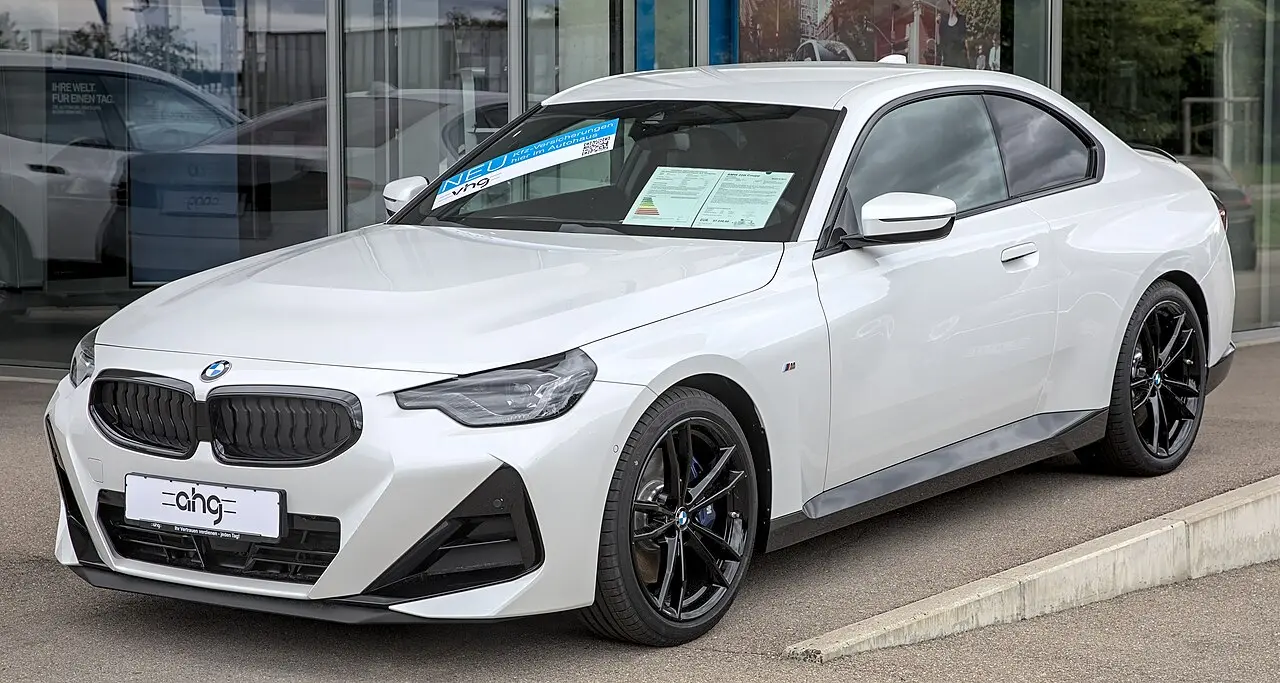
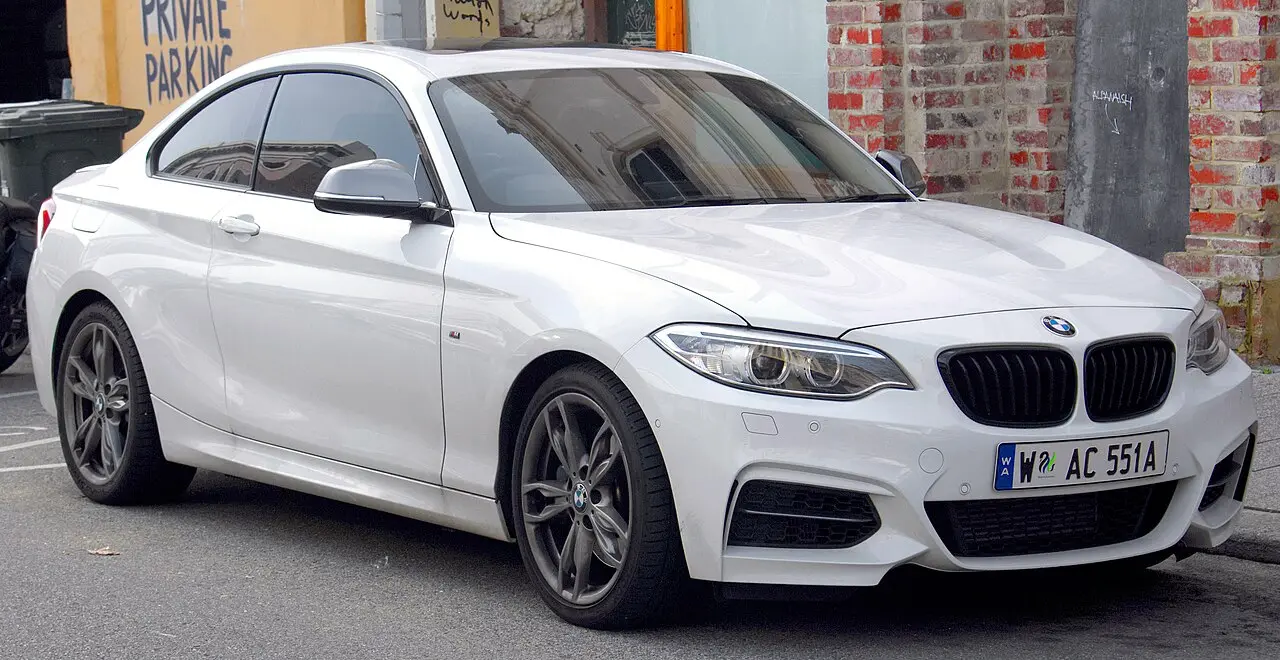
The official data lists 494 versions of the BMW 2 Series (2010–2026), in the European Union, the United Kingdom, France, the United States, and Canada. Each market publishes its own figures, measured on its own test procedure.
At a glance
Years in the data
2010–2026
Markets
European Union, United Kingdom, France, United States, Canada
Engines
1.5 L to 3.0 L
Power
70 kW (95 PS) to 250 kW (340 PS)
Fuels
Petrol, Plug-in hybrid, Hybrid, Diesel
Lowest consumption (France)
3.8 L/100 km (NEDC)
Lowest consumption (United Kingdom)
3.9 L/100 km (NEDC)
Lowest consumption (European Union)
4.3 L/100 km (WLTP)
Plug-in hybrid, weighted (France)
0.6 L/100 km (WLTP)
Plug-in hybrid, weighted (European Union)
0.7 L/100 km (WLTP)
New registrations in the EU
641,586
What is the BMW 2 Series?
The BMW 2 Series is a compact model family that includes a two-door Coupé and a convertible. The Coupé and convertible sit below larger BMW models, with a more personal, driver-focused feel. Their rear-wheel-drive layout sets them apart from BMW’s front-wheel-drive compact models.
BMW uses the 2 Series name for several body styles, so engines and figures vary by version and market. The EU listings include models from before the first-generation Coupé arrived in 2014, as well as a mix of petrol, diesel, hybrid and plug-in hybrid versions.
BMW 2 Series generations
The first generation comprised the F22 Coupé and F23 Convertible, which ran from 2014 to 2021. The second-generation G42 Coupé followed from 2022. It kept the compact, rear-wheel-drive format while bringing updated design and technology. The Active Tourer is a separate 2 Series model with a more practical body and its own generations.
Engines and power
In EU listings, engines range from 1.5 to 3.0 litres and power from 70 kW (95 PS) to 250 kW (340 PS). In the UK, the range is 1.5 to 3.0 litres and 135 kW (184 PS) to 288 kW (392 PS). These figures span different versions and body styles.
European and UK listings include petrol and diesel versions, as well as hybrid and plug-in hybrid entries in some markets. The US and Canadian listings include petrol versions with 2.0-litre engines.
How economical is the BMW 2 Series?
The lowest listed non-plug-in figure in the EU is 4.3 L/100 km on WLTP. The lowest plug-in hybrid figure is 0.7 L/100 km on WLTP, a weighted result that assumes some driving is electric. France lists 3.8 L/100 km on NEDC for non-plug-in versions and 0.6 L/100 km on WLTP for plug-in hybrids.
The UK low is 3.9 L/100 km on NEDC. The USA lists 7.8 L/100 km under EPA testing, while Canada lists 8.4 L/100 km under its 5-cycle procedure. WLTP and NEDC are European test procedures; EPA and Canadian 5-cycle testing use different methods, so results across markets are not directly comparable.
Where was the BMW 2 Series sold?
The 2 Series appears in listings for the EU, UK, France, the United States and Canada. EU registration figures span 2010–2025 and total 641,586. Its two Coupé generations are listed across these markets, while body styles and powertrain choices vary by country.
Questions and answers
What are the BMW 2 Series Coupé generations?
The first generation comprises the F22 Coupé and F23 Convertible (2014–2021); the second is the G42 Coupé, which began in 2022.
What is the lowest listed EU fuel consumption?
It is 0.7 L/100 km for a plug-in hybrid on WLTP, a weighted figure that assumes some driving is electric.
Which engines are listed for the BMW 2 Series?
EU listings cover 1.5- to 3.0-litre engines; the US and Canadian listings include 2.0-litre petrol engines.
Model codes: G42 · Sold in: European Union, France, United Kingdom, United States, and Canada · References: en.wikipedia.org, press.bmwgroup.com
European Union 75 versions
New cars registered in the EU (plus Norway and Iceland), from the European Environment Agency. Figures on the NEDC procedure until 2020 and on WLTP from 2021; versions are grouped by engine and power, with their number of registrations.
Years and version
Engine
Power
Fuel
Consumption (combined)
CO₂
Electric range
EU registrations
2025
1.5 L
115 kW (156 PS)
Hybrid
5.4 L/100 km WLTP
122 g/km
–
4,888
2025
2.0 L
110 kW (150 PS)
Hybrid
4.3 L/100 km WLTP
113 g/km
–
1,833
2025
2.0 L
150 kW (204 PS)
Hybrid
6.1 L/100 km WLTP
139 g/km
–
1,393
2025
1.5 L
90 kW (122 PS)
Petrol
5.9 L/100 km WLTP
134 g/km
–
1,308
2025
2.0 L
110 kW (150 PS)
Diesel
4.7 L/100 km WLTP
123 g/km
–
1,111
2025
2.0 L
135 kW (184 PS)
Petrol
6.5 L/100 km WLTP
149 g/km
–
899
2025
2.0 L
115 kW (156 PS)
Petrol
6.6 L/100 km WLTP
150 g/km
–
638
2024–2025
2.0 L
145 kW (197 PS)
Hybrid
4.8 L/100 km WLTP
125 g/km
–
605
2025
2.0 L
180 kW (245 PS)
Petrol
6.8 L/100 km WLTP
154 g/km
–
540
2025
1.5 L
100 kW (136 PS)
Petrol
5.9 L/100 km WLTP
136 g/km
–
371
2025
2.0 L
140 kW (190 PS)
Hybrid
5.0 L/100 km WLTP
132 g/km
–
298
2025
1.5 L
100 kW (136 PS)
Plug-in hybrid
0.9 L/100 km WLTP15.9 kWh/100 km WLTP
21 g/km
88 km
266
2025
2.0 L
131 kW (178 PS)
Petrol
6.3 L/100 km WLTP
144 g/km
–
123
2025
1.5 L
115 kW (156 PS)
Plug-in hybrid
5.4 L/100 km WLTP
122 g/km
–
46
2025
1.5 L
130 kW (177 PS)
Plug-in hybrid
0.8 L/100 km WLTP16.3 kWh/100 km WLTP
19 g/km
88 km
39
2025
1.5 L
100 kW (136 PS)
Hybrid
5.4 L/100 km WLTP
122 g/km
–
25
2025
1.5 L
115 kW (156 PS)
Petrol
–
130 g/km
–
14
2025
2.0 L
110 kW (150 PS)
Plug-in hybrid
4.3 L/100 km WLTP
112 g/km
–
12
2023–2024
1.5 L
100 kW (136 PS)
Petrol
5.8 L/100 km WLTP
134 g/km
–
10,101
2023–2024
1.5 L
85 kW (116 PS)
Diesel
4.7 L/100 km WLTP
123 g/km
–
2,385
2022–2024
2.0 L
115 kW (156 PS)
Petrol
6.6 L/100 km WLTP
149 g/km
–
2,017
2024
2.0 L
131 kW (178 PS)
Petrol
6.4 L/100 km WLTP
144 g/km
–
1,638
2024
2.0 L
135 kW (184 PS)
Petrol
6.5 L/100 km WLTP
147 g/km
–
1,123
2024
2.0 L
110 kW (150 PS)
Diesel
4.9 L/100 km WLTP
128 g/km
–
748
2024
2.0 L
150 kW (204 PS)
Hybrid
6.5 L/100 km WLTP
148 g/km
–
678
2024
2.0 L
180 kW (245 PS)
Petrol
6.7 L/100 km WLTP
153 g/km
–
504
2024
2.0 L
140 kW (190 PS)
Diesel
5.2 L/100 km WLTP
136 g/km
–
501
2024
1.5 L
100 kW (136 PS)
Plug-in hybrid
0.8 L/100 km WLTP16.2 kWh/100 km WLTP
19 g/km
87 km
496
2024
2.0 L
140 kW (190 PS)
Hybrid
4.9 L/100 km WLTP
127 g/km
–
483
2024
1.5 L
130 kW (177 PS)
Plug-in hybrid
0.8 L/100 km WLTP16.4 kWh/100 km WLTP
19 g/km
87 km
82
2024
1.5 L
115 kW (156 PS)
Hybrid
5.4 L/100 km WLTP
123 g/km
–
23
2024
2.0 L
110 kW (150 PS)
Hybrid
4.4 L/100 km WLTP
115 g/km
–
23
2024
1.5 L
115 kW (156 PS)
Petrol
–
–
–
15
2024
3.0 L
275 kW (374 PS)
Petrol
8.1 L/100 km WLTP
185 g/km
–
15
2024
2.0 L
150 kW (204 PS)
Petrol
6.4 L/100 km WLTP
144 g/km
–
13
2023
2.0 L
131 kW (178 PS)
Petrol
6.3 L/100 km WLTP
144 g/km
–
1,623
2023
2.0 L
110 kW (150 PS)
Diesel
4.9 L/100 km WLTP
129 g/km
–
1,400
2023
2.0 L
135 kW (184 PS)
Petrol
6.4 L/100 km WLTP
147 g/km
–
1,201
2023
2.0 L
140 kW (190 PS)
Diesel
5.2 L/100 km WLTP
137 g/km
–
1,045
2023
1.5 L
100 kW (136 PS)
Plug-in hybrid
0.7 L/100 km WLTP14.6 kWh/100 km WLTP
16 g/km
90 km
697
2023
2.0 L
150 kW (204 PS)
Hybrid
6.6 L/100 km WLTP
149 g/km
–
691
2023
2.0 L
180 kW (245 PS)
Petrol
6.8 L/100 km WLTP
154 g/km
–
529
2023
2.0 L
140 kW (190 PS)
Hybrid
4.8 L/100 km WLTP
124 g/km
–
447
2023
2.0 L
145 kW (197 PS)
Hybrid
4.7 L/100 km WLTP
124 g/km
–
418
2023
1.5 L
130 kW (177 PS)
Plug-in hybrid
0.7 L/100 km WLTP14.8 kWh/100 km WLTP
15 g/km
90 km
89
2023
1.5 L
110 kW (150 PS)
Plug-in hybrid
0.6 L/100 km WLTP14.5 kWh/100 km WLTP
20 g/km
89 km
49
2023
2.0 L
150 kW (204 PS)
Petrol
–
160 g/km
–
36
2023
2.0 L
100 kW (136 PS)
Diesel
4.8 L/100 km WLTP
126 g/km
–
32
2023
1.5 L
115 kW (156 PS)
Hybrid
5.9 L/100 km WLTP
135 g/km
–
26
2023
1.5 L
115 kW (156 PS)
Petrol
–
–
–
23
2023
2.0 L
120 kW (163 PS)
Hybrid
4.8 L/100 km WLTP
124 g/km
–
14
2023
3.0 L
275 kW (374 PS)
Petrol
8.6 L/100 km WLTP
195 g/km
–
14
2023
2.0 L
150 kW (204 PS)
Hybrid
–
149 g/km
–
12
2023
1.5 L
67 kW (91 PS)
Petrol
–
129 g/km
–
11
2023
2.0 L
67 kW (91 PS)
Diesel
–
127 g/km
–
11
2022
1.5 L
100 kW (136 PS)
Petrol
5.7 L/100 km WLTP
133 g/km
–
5,032
2022
2.0 L
110 kW (150 PS)
Diesel
4.8 L/100 km WLTP
130 g/km
–
2,538
2022
2.0 L
135 kW (184 PS)
Petrol
6.5 L/100 km WLTP
147 g/km
–
1,799
2022
2.0 L
131 kW (178 PS)
Petrol
6.2 L/100 km WLTP
144 g/km
–
1,709
2022
2.0 L
140 kW (190 PS)
Diesel
5.1 L/100 km WLTP
137 g/km
–
1,403
2022
1.5 L
85 kW (116 PS)
Diesel
4.5 L/100 km WLTP
122 g/km
–
1,265
2022
2.0 L
140 kW (190 PS)
Hybrid
4.7 L/100 km WLTP
124 g/km
–
718
2022
1.5 L
100 kW (136 PS)
Plug-in hybrid
0.7 L/100 km WLTP14.7 kWh/100 km WLTP
16 g/km
89 km
354
2022
2.0 L
180 kW (245 PS)
Petrol
6.7 L/100 km WLTP
153 g/km
–
220
2022
2.0 L
150 kW (204 PS)
Hybrid
6.6 L/100 km WLTP
150 g/km
–
154
2022
1.5 L
130 kW (177 PS)
Plug-in hybrid
0.7 L/100 km WLTP15.0 kWh/100 km WLTP
16 g/km
89 km
136
2022
2.0 L
100 kW (136 PS)
Diesel
4.9 L/100 km WLTP
128 g/km
–
64
2022
2.0 L
100 kW (136 PS)
Petrol
7.9 L/100 km WLTP
179 g/km
–
33
2022
2.0 L
145 kW (197 PS)
Hybrid
4.8 L/100 km WLTP
126 g/km
–
27
2022
2.0 L
120 kW (163 PS)
Hybrid
4.7 L/100 km WLTP
124 g/km
–
25
2022
1.5 L
110 kW (150 PS)
Plug-in hybrid
–
–
–
13
2022
1.5 L
206 kW (280 PS)
Petrol
–
130 g/km
–
13
2022
2.0 L
206 kW (280 PS)
Petrol
–
144 g/km
–
11
2022
1.5 L
80 kW (109 PS)
Petrol
6.1 L/100 km WLTP
145 g/km
–
10
2022
2.0 L
185 kW (252 PS)
Petrol
7.9 L/100 km WLTP
181 g/km
–
10
United Kingdom 11 versions
New cars on sale in the UK, from the Vehicle Certification Agency. NEDC figures until 2018 and WLTP figures after; years are the editions a version appeared in.
Years and version
Engine
Power
Fuel
Gearbox
Consumption (combined)
CO₂
2025–2026220i M Sport Coupé
2.0 L
135 kW (184 PS)
Petrol
8-speed automatic
6.7 L/100 km WLTP
146 g/km
2025–2026220i M Sport Coupé
2.0 L
135 kW (184 PS)
Petrol
8-speed automatic
6.4 L/100 km WLTP
152 g/km
2026220i M Sport
2.0 L
135 kW (184 PS)
Petrol
8-speed automatic
6.6 L/100 km WLTP
150 g/km
2026220i M Sport Pro
2.0 L
135 kW (184 PS)
Petrol
8-speed automatic
6.5 L/100 km WLTP
147 g/km
2025–2026230i M Sport Coupé
2.0 L
180 kW (245 PS)
Petrol
8-speed automatic
7.1 L/100 km WLTP
151 g/km
2025–2026230i M Sport Coupé
2.0 L
180 kW (245 PS)
Petrol
8-speed automatic
6.6 L/100 km WLTP
161 g/km
2026230i M Sport
2.0 L
180 kW (245 PS)
Petrol
8-speed automatic
6.6 L/100 km WLTP
151 g/km
2026230i M Sport Pro
2.0 L
180 kW (245 PS)
Petrol
8-speed automatic
6.7 L/100 km WLTP
152 g/km
2025–2026M240i xDrive Coupé
3.0 L
275 kW (374 PS)
Petrol
8-speed automatic
8.8 L/100 km WLTP
185 g/km
2025–2026M240i xDrive Coupé
3.0 L
275 kW (374 PS)
Petrol
8-speed automatic
8.1 L/100 km WLTP
200 g/km
2026M240i xDrive
3.0 L
288 kW (392 PS)
Hybrid
8-speed automatic
7.3 L/100 km WLTP
166 g/km
France 14 versions
New cars on sale in France, from ADEME Car Labelling. NEDC figures until 2015, WLTP figures in the current catalogue.
Model years sold in the USA, from the EPA and the Department of Energy (fueleconomy.gov). MPG on the EPA test; litres per 100 km = 235.215 ÷ MPG.
Years and version
Engine
Fuel
Gearbox
Drive
Consumption (combined)
CO₂
2024–2026SIDI
2.0 L
Petrol
8-speed automatic
Rear-wheel drive
30 MPG (7.8 L/100 km) EPA
184 g/km
2025–2026SIDI
2.0 L
Petrol
8-speed automatic
All-wheel drive
28 MPG (8.4 L/100 km) EPA
194 g/km
2023–2024SIDI
2.0 L
Petrol
8-speed automatic
All-wheel drive
27 MPG (8.7 L/100 km) EPA
205 g/km
2023–2024SIDI
2.0 L
Petrol
8-speed automatic
Front-wheel drive
28 MPG (8.4 L/100 km) EPA
196 g/km
2024SIDI
2.0 L
Petrol
8-speed automatic
All-wheel drive
28 MPG (8.4 L/100 km) EPA
195 g/km
2022–2023SIDI
2.0 L
Petrol
8-speed automatic
Rear-wheel drive
29 MPG (8.1 L/100 km) EPA
186 g/km
2023SIDI
2.0 L
Petrol
8-speed automatic
All-wheel drive
28 MPG (8.4 L/100 km) EPA
195 g/km
2022SIDI
2.0 L
Petrol
8-speed automatic
All-wheel drive
27 MPG (8.7 L/100 km) EPA
204 g/km
2022SIDI
2.0 L
Petrol
8-speed automatic
Front-wheel drive
28 MPG (8.4 L/100 km) EPA
195 g/km
Canada 4 versions
Model years sold in Canada, from Natural Resources Canada fuel consumption ratings (5-cycle test).
Years and version
Engine
Fuel
Gearbox
Consumption (combined)
CO₂
2025–2026Subcompact
2.0 L
Petrol
8-speed automatic
8.4 L/100 km 5-cycle
194 g/km
2024Compact
2.0 L
Petrol
8-speed automatic
8.8 L/100 km 5-cycle
205 g/km
2024Subcompact
2.0 L
Petrol
8-speed automatic
8.4 L/100 km 5-cycle
195 g/km
2023Subcompact
2.0 L
Petrol
8-speed automatic
8.4 L/100 km 5-cycle
195 g/km
Versions outside these generations
European Union 3 versions
New cars registered in the EU (plus Norway and Iceland), from the European Environment Agency. Figures on the NEDC procedure until 2020 and on WLTP from 2021; versions are grouped by engine and power, with their number of registrations.
Official figures are measured on standard test procedures and differ between markets. Your consumption depends on how, where and in what conditions you drive.