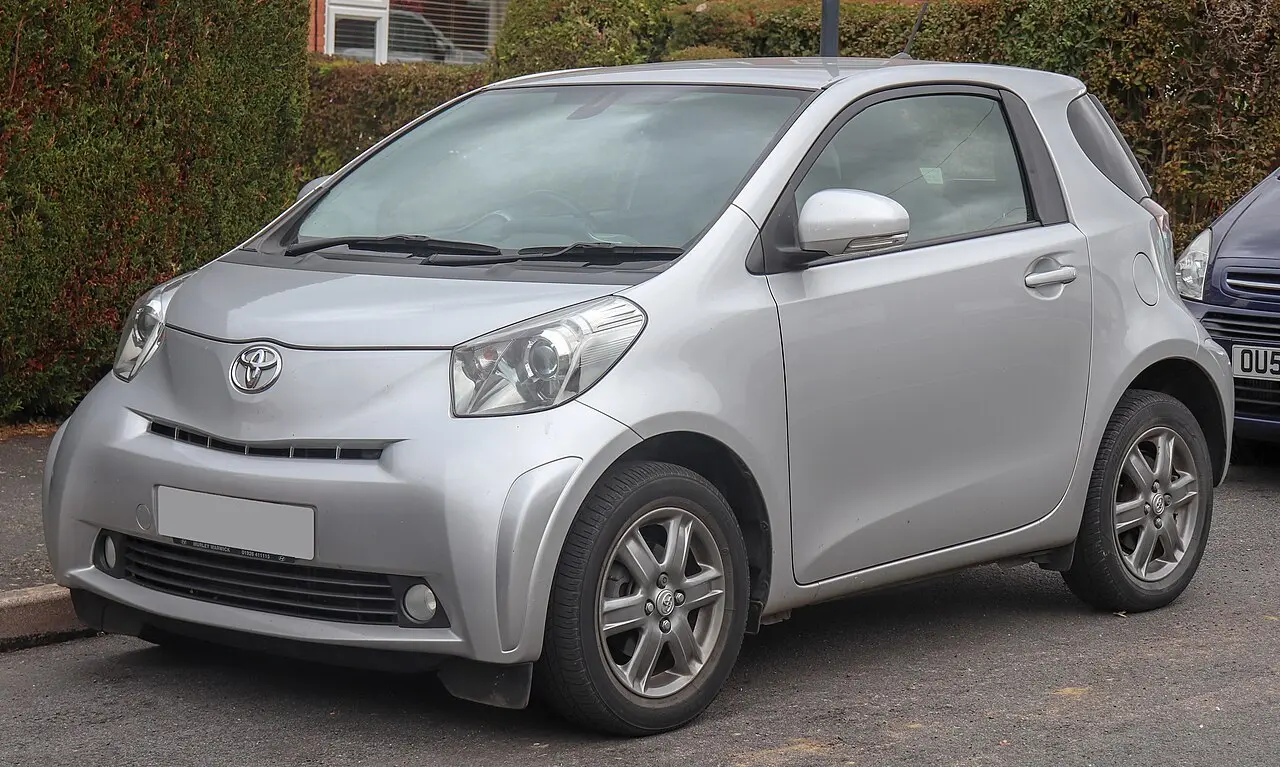
The official data lists 31 versions of the Toyota iQ (2009 - 2015), in the European Union, the United Kingdom, and France. Each market publishes its own figures, measured on its own test procedure.
At a glance
Years in the data
2009 - 2015
Markets
European Union, United Kingdom, France
Engines
1.0 L to 1.4 L
Power
50 kW (68 PS) to 72 kW (98 PS)
Fuels
Petrol, Diesel
Lowest consumption (France)
4.0 L/100 km (NEDC)
Lowest consumption (United Kingdom)
4.3 L/100 km (NEDC)
New registrations in the EU
102,246
What is the Toyota iQ?
The iQ is a small city car with an unusual 3+1 seating layout: Toyota designed it to carry three adults and a child, or luggage, in its compact cabin. Its space-saving design helped distinguish it from a conventional small two-seat runabout.
Toyota’s first and only iQ generation ran from 2010-2015 in the EU. The car’s distinctive packaging arranged the cabin and components to make better use of its small footprint.
Engines and power
EU figures list engine sizes from 1.0 L to 1.4 L and power from 50 kW (68 PS) to 72 kW (98 PS). The 1.0 L petrol was the most registered configuration in the EU entries. UK listings cover petrol engines from 1.0 L to 1.3 L, while French listings include petrol and diesel versions.
How economical is the Toyota iQ?
The UK listing gives a lowest consumption of 4.3 L/100 km on NEDC; the French listing gives 4 L/100 km, also on NEDC. Official EU registration figures cover 2010-2015 and total 102,246 registrations. These are results from the European NEDC test procedure.
Where was the Toyota iQ sold?
The iQ appears in EU, UK and French market listings. Its compact design and 3+1 cabin layout made it a distinctive choice for urban driving.
Questions and answers
What is the Toyota iQ’s seating layout?
Toyota designed its 3+1 layout for three adults and a child, or luggage.
What engine sizes and power were listed in the EU?
EU entries span 1.0 L to 1.4 L and 50 kW (68 PS) to 72 kW (98 PS).
What is the lowest stated iQ fuel consumption?
The French listing gives 4 L/100 km on NEDC; the UK listing gives 4.3 L/100 km, also on NEDC.
When was the iQ sold in the EU?
Its first and only listed generation ran from 2010-2015.
At a glance: Length 2,990 mm · Kerb weight 820 - 835 kg · Top speed 150 - 170 km/h · MOT first-time pass at 13 years and older: 84.0% (UK average 69.2%) Specifications, reliability and all versions
Show all 31 versions
European Union 11 versions
New cars registered in the EU (plus Norway and Iceland), from the European Environment Agency. Figures on the NEDC procedure until 2020 and on WLTP from 2021; versions are grouped by engine and power, with their number of registrations.
Years and version
Engine
Power
Fuel
CO₂
EU registrations
2011 - 2015
1.0 L
50 kW (68 PS)
Petrol
104 - 105 g/km
45,110
2011 - 2015
1.3 L
72 kW (98 PS)
Petrol
118 - 120 g/km
9,900
2010 - 2014
-
Not listed
Petrol
108 - 116 g/km
3,682
2013
1.3 L
Not listed
Other fuel
120 g/km
236
2013
1.0 L
Not listed
Other fuel
101 g/km
86
2011 - 2013
1.4 L
66 kW (90 PS)
Diesel
104 g/km
1,470
2010
1.0 L
Not listed
Petrol
104 g/km
33,824
2010
1.3 L
Not listed
Petrol
116 g/km
5,812
2010
1.4 L
Not listed
Diesel
104 g/km
2,042
2010
-
Not listed
Other fuel
110 g/km
44
2010
-
Not listed
Diesel
103 g/km
40
United Kingdom 12 versions
New cars on sale in the UK, from the Vehicle Certification Agency. NEDC figures until 2018 and WLTP figures after; years are the editions a version appeared in.
4 official safety recalls for the Toyota iQ from NHTSA (United States), DVSA (United Kingdom) and the EU Safety Gate, newest first. Recall repairs are normally free at the maker’s dealers.
Turbocharger oil may cause engine damage or fire2008 - 2010
Brake contamination may reduce braking efficiency2008 - 2010
Power steering sensor may misread road vibrations2008 - 2010
Accelerator pedal may return slowly or fail to return to idle2008 - 2009
Official figures are measured on standard test procedures and differ between markets. Your consumption depends on how, where and in what conditions you drive.