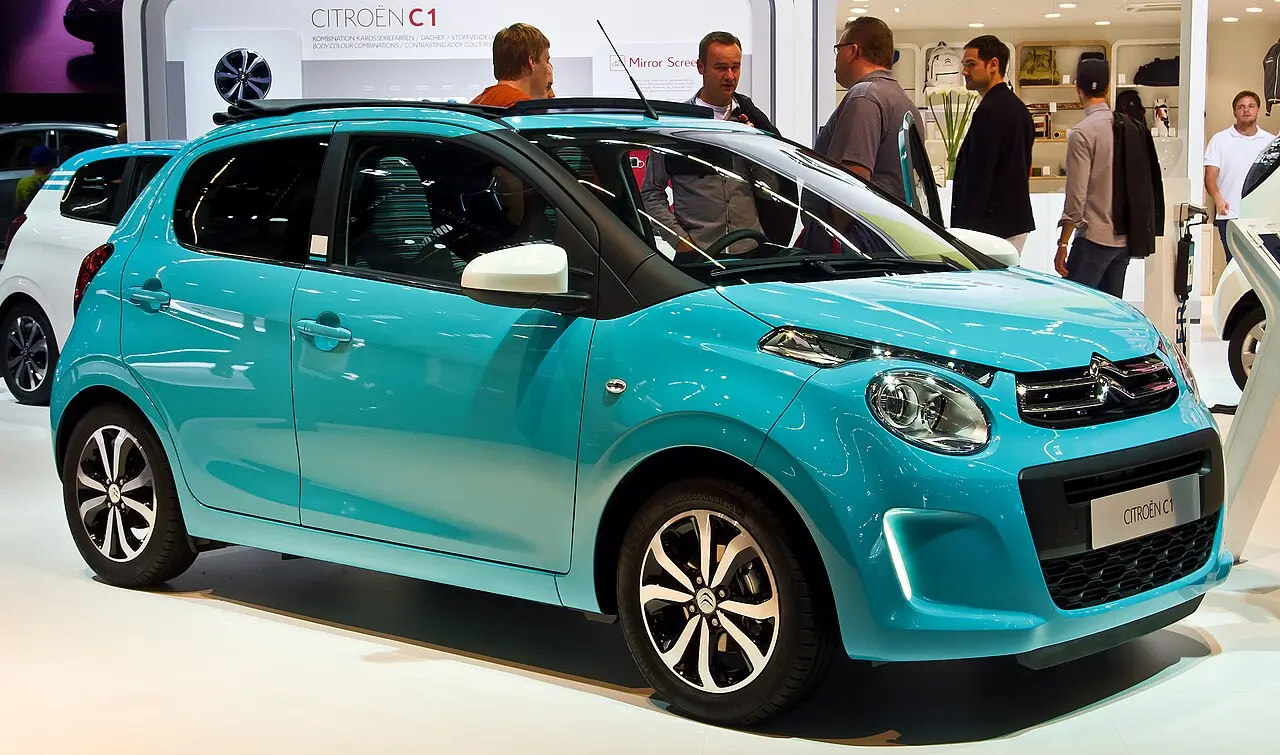
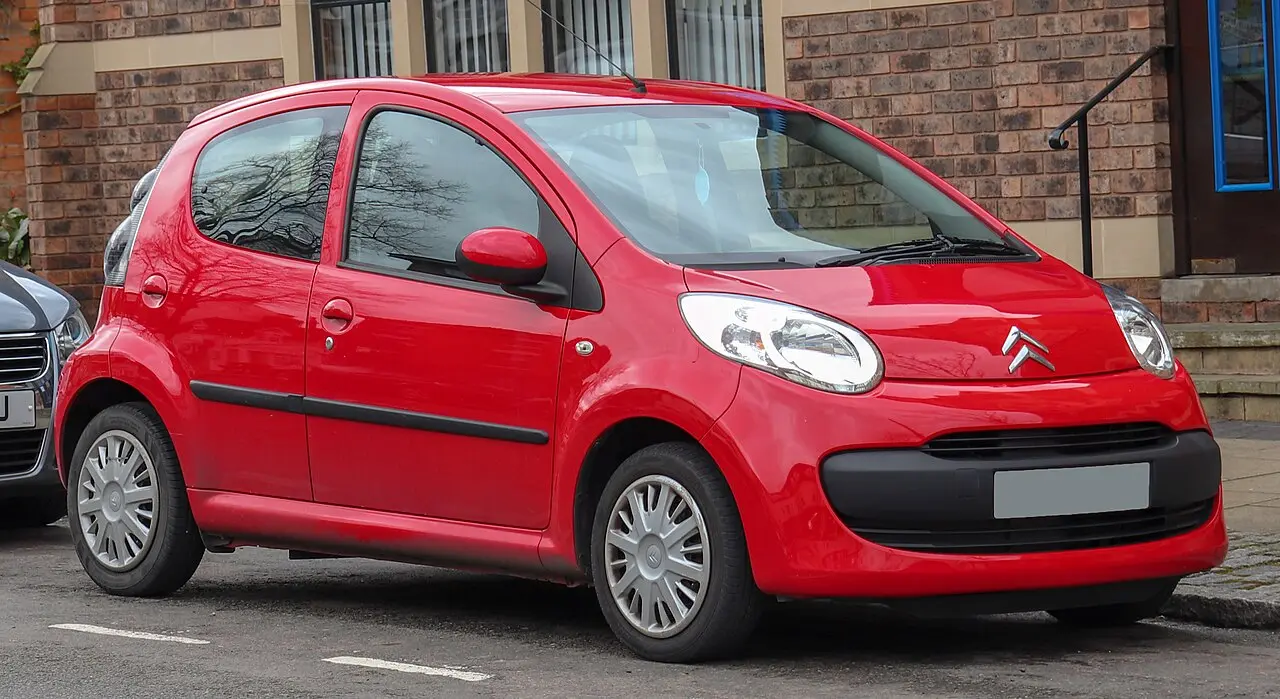
The official data lists 79 versions of the Citroën C1 (2006–2023), in the European Union, the United Kingdom, and France. Each market publishes its own figures, measured on its own test procedure.
At a glance
Years in the data
2006–2023
Markets
European Union, United Kingdom, France
Engines
1.0 L to 1.4 L
Power
40 kW (54 PS) to 90 kW (122 PS)
Fuels
Petrol, Electric, Hybrid, Diesel
Lowest consumption (France)
3.8 L/100 km (NEDC)
Lowest consumption (United Kingdom)
3.8 L/100 km (NEDC)
Lowest consumption (European Union)
4.7 L/100 km (WLTP)
New registrations in the EU
1,350,861
What is the Citroën C1?
The C1 is a small city car, made for everyday journeys and easy manoeuvring. It sat at the smallest end of Citroën’s range, with a compact hatchback shape suited to urban driving and local trips. Citroën introduced it in 2005, and production ended in 2022.
The first generation ran from 2005 to 2014. Generation II followed from 2014 to 2022, with a refreshed design and three-door and five-door body styles. Some versions had an Airscape canvas roof. Both generations kept the C1’s city-car focus.
Engines and power
In the EU, the C1’s engine range spans 1.0 L to 1.4 L, with power from 40 kW (54 PS) to 90 kW (122 PS). The UK range also spans 1.0 L to 1.4 L; the listed power figure is 53 kW (72 PS). French listings cover petrol versions with power from 50 kW (68 PS) to 60 kW (82 PS).
Petrol versions appear across all three markets. The EU listings also include electric, hybrid, diesel and other fuel types, while UK listings include diesel. The available engines and fuels varied by country and year.
Fuel consumption and registrations
The lowest listed consumption is 4.7 L/100 km in the EU, measured on the WLTP test. The UK and France each list a lowest figure of 3.8 L/100 km on NEDC. WLTP and NEDC are different European test procedures, so their results are not directly comparable.
Official EU registration figures cover 2010 to 2022 and total 1,350,861. The UK figures cover 2006 to 2023, while the French figures cover 2012 to 2015.
Questions and answers
When was the Citroën C1 sold?
The first generation ran from 2005 to 2014, followed by Generation II from 2014 to 2022. Official EU registration figures cover 2010 to 2022; UK figures cover 2006 to 2023, and French figures cover 2012 to 2015.
What is the lowest listed fuel consumption?
The lowest listed figure is 3.8 L/100 km on the NEDC test in the UK and France. The EU figure is 4.7 L/100 km on WLTP.
What engine sizes were available?
The EU and UK ranges span 1.0 L to 1.4 L. The French listings cover petrol versions.
Was the C1 offered with more than one body style?
Yes. Generation II came as a three-door or five-door hatchback, and some versions had an Airscape canvas roof.
New cars registered in the EU (plus Norway and Iceland), from the European Environment Agency. Figures on the NEDC procedure until 2020 and on WLTP from 2021; versions are grouped by engine and power, with their number of registrations.
Years and version
Engine
Power
Fuel
Consumption (combined)
CO₂
EU registrations
2022
1.0 L
53 kW (72 PS)
Petrol
4.7 L/100 km WLTP
109 g/km
3,088
2021
1.0 L
53 kW (72 PS)
Petrol
4.7 L/100 km WLTP
110 g/km
62,515
2020
1.0 L
53 kW (72 PS)
Petrol
–
86 g/km
79,217
2019
1.0 L
53 kW (72 PS)
Petrol
–
90 g/km
97,538
2015–2019
1.2 L
–
Petrol
–
99 g/km
45,208
2018–2019
1.2 L
60 kW (82 PS)
Petrol
–
99 g/km
8,603
2019
1.0 L
51 kW (69 PS)
Petrol
–
94 g/km
84
2018
1.0 L
53 kW (72 PS)
Petrol
1.4 kWh/100 km NEDC
92 g/km
54,082
2018
1.0 L
51 kW (69 PS)
Petrol
–
94 g/km
32,557
2018
Electric motor
–
Electric
–
0 g/km
10
2017
1.0 L
51 kW (69 PS)
Petrol
–
94 g/km
68,664
2017
1.2 L
60 kW (82 PS)
Petrol
–
99 g/km
25,878
2017
1.0 L
77 kW (105 PS)
Petrol
–
95 g/km
602
2017
1.2 L
90 kW (122 PS)
Petrol
–
99 g/km
52
2016
1.0 L
51 kW (69 PS)
Petrol
–
94 g/km
80,870
2016
1.2 L
60 kW (82 PS)
Petrol
–
99 g/km
19,992
2015
1.0 L
51 kW (69 PS)
Petrol
–
95 g/km
89,108
2015
1.2 L
60 kW (82 PS)
Petrol
–
99 g/km
18,280
2015
1.0 L
51 kW (69 PS)
Hybrid
–
92 g/km
6,074
2015
1.2 L
60 kW (82 PS)
Hybrid
–
99 g/km
272
2015
1.0 L
50 kW (68 PS)
Petrol
–
100 g/km
160
2014
1.0 L
50 kW (68 PS)
Petrol
–
101 g/km
63,434
2014
1.0 L
51 kW (69 PS)
Petrol
–
94 g/km
32,068
2014
1.2 L
60 kW (82 PS)
Petrol
–
99 g/km
10,072
2014
–
–
Petrol
–
102 g/km
80
United Kingdom 15 versions
New cars on sale in the UK, from the Vehicle Certification Agency. NEDC figures until 2018 and WLTP figures after; years are the editions a version appeared in.
Years and version
Engine
Power
Fuel
Gearbox
Consumption (combined)
CO₂
2020–20231.0L S&S 5-speed manual
1.0 L
53 kW (72 PS)
Petrol
5-speed manual
5.2 L/100 km WLTP
117 g/km
2020–20231.0L S&S 5-speed manual
1.0 L
53 kW (72 PS)
Petrol
5-speed manual
5.7 L/100 km WLTP
109 g/km
2019VTi 72 ETG
1.0 L
53 kW (72 PS)
Petrol
5-speed automatic
5.5 L/100 km WLTP
–
2019VTi 72 manual
1.0 L
53 kW (72 PS)
Petrol
5-speed manual
4.9 L/100 km WLTP
–
2019VTi 72 manual
1.0 L
53 kW (72 PS)
Petrol
5-speed manual
5.3 L/100 km WLTP
–
2015–2018VTi 68
1.0 L
–
Petrol
5-speed manual
4.1 L/100 km NEDC
95 g/km
2018VTi 72 ETG
1.0 L
–
Petrol
5-speed automated manual
4.2 L/100 km NEDC
95 g/km
2018VTi 72
1.0 L
–
Petrol
5-speed manual
4.1 L/100 km NEDC
93 g/km
2015–2018PureTech 82
1.2 L
–
Petrol
5-speed manual
4.3 L/100 km NEDC
99 g/km
2015–2017VTi 68 ETG
1.0 L
–
Petrol
5-speed automated manual
4.2 L/100 km NEDC
97 g/km
2015–2016VTi 68 S&S
1.0 L
–
Petrol
5-speed manual
3.8 L/100 km NEDC
88 g/km
2014e-VTi 68 Airdream
1.0 L
–
Petrol
Manual
3.8 L/100 km NEDC
88 g/km
2014VTi 68
1.0 L
–
Petrol
Manual
4.1 L/100 km NEDC
95 g/km
2014VTi 68 ETG
1.0 L
–
Petrol
Automatic
4.2 L/100 km NEDC
97 g/km
2014VTi 82
1.2 L
–
Petrol
Manual
4.3 L/100 km NEDC
99 g/km
France 11 versions
New cars on sale in France, from ADEME Car Labelling. NEDC figures until 2015, WLTP figures in the current catalogue.
2015nouvelle C1 3P Vti (82ch) BVM5 · nouvelle C1 5P Vti (82ch) BVM5 · nouvelle C1 3P découvrable Vti (82ch) BVM5 and 1 more trim
–
60 kW (82 PS)
Petrol
5-speed manual
4.3 L/100 km NEDC
99 g/km
2014C1 3P 1.0i BMP
–
50 kW (68 PS)
Petrol
5-speed automatic
4.5 L/100 km NEDC
104 g/km
2014C1 3P 1.0i BVM
–
50 kW (68 PS)
Petrol
5-speed manual
4.3 L/100 km NEDC
99 g/km
2014C1 3P 1.0i ETG
–
50 kW (68 PS)
Petrol
5-speed manual
4.4 L/100 km NEDC
102 g/km
2014C1 5P 1.0i BMP
–
50 kW (68 PS)
Petrol
5-speed automatic
4.5 L/100 km NEDC
104 g/km
2014C1 5P 1.0i BVM
–
50 kW (68 PS)
Petrol
5-speed manual
4.3 L/100 km NEDC
99 g/km
2014C1 5P 1.0i ETG
–
50 kW (68 PS)
Petrol
5-speed manual
4.4 L/100 km NEDC
102 g/km
Official figures are measured on standard test procedures and differ between markets. Your consumption depends on how, where and in what conditions you drive.