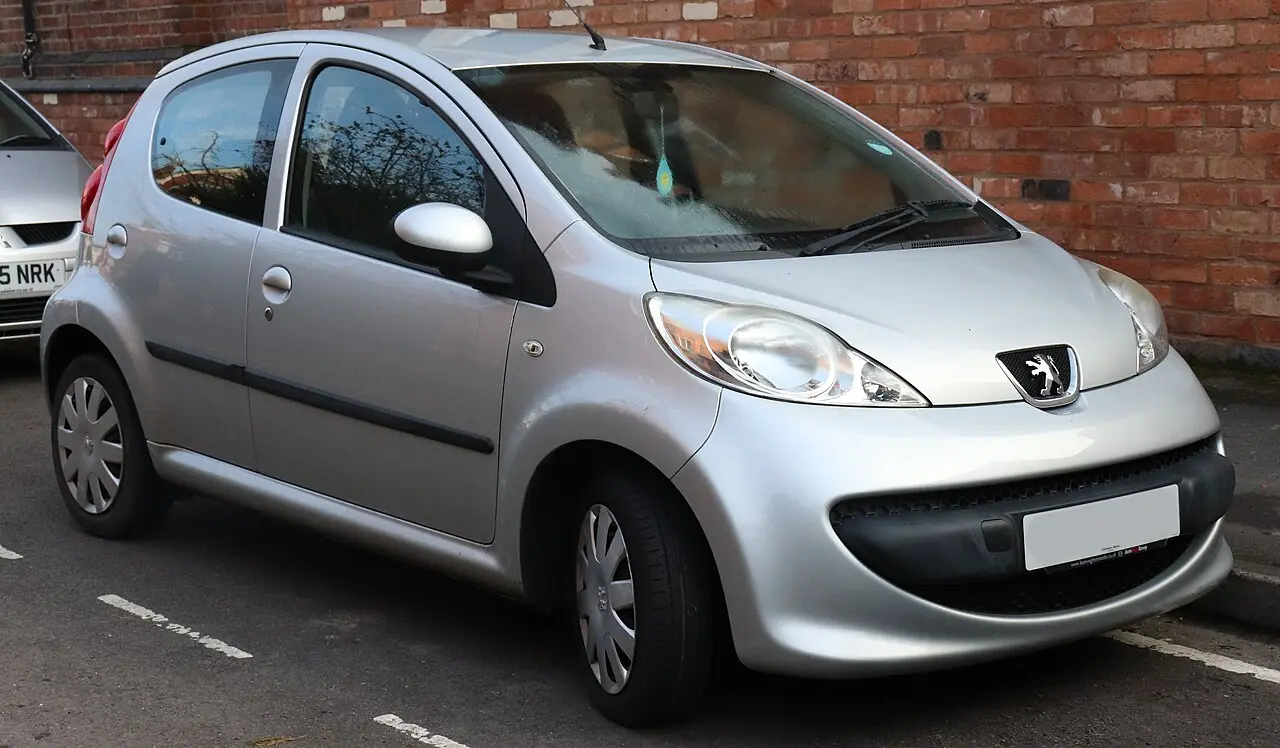
The official data lists 35 versions of the Peugeot 107 (2006–2015), in the European Union, the United Kingdom, and France. Each market publishes its own figures, measured on its own test procedure.
At a glance
Years in the data
2006–2015
Markets
European Union, United Kingdom, France
Engines
1.0 L to 1.4 L
Power
40 kW (54 PS) to 51 kW (69 PS)
Fuels
Petrol, Diesel
Lowest consumption (France)
4.3 L/100 km (NEDC)
Lowest consumption (United Kingdom)
4.3 L/100 km (NEDC)
New registrations in the EU
634,437
What is the Peugeot 107?
The Peugeot 107 is a small city car built for everyday trips and easy parking. Its compact hatchback body makes it well suited to crowded streets, while its four-seat layout keeps it useful for singles, couples and small households.
It sat at the entry point of Peugeot’s passenger-car range. The 107 was developed with Toyota and Citroën as part of a shared project; the related models were the Aygo and C1, each with distinct styling.
Generations and engines
The 107 had one generation, known as B0, produced from 2005 to 2014. Petrol versions were offered alongside a diesel in some European markets.
EU registration figures span engines from 1.0 L to 1.4 L, with power from 40 kW (54 PS) to 50 kW (68 PS). UK figures list 1.0 L petrol engines producing 49 kW (66 PS) to 51 kW (69 PS). French figures list a 1.0 L petrol engine rated at 50 kW (68 PS).
Fuel consumption and markets
The lowest listed consumption is 4.3 L/100 km on the NEDC test, in the UK and French figures. EU registrations cover 2010–2015, while UK figures cover 2006–2014 and French figures cover 2012–2014.
The 107 recorded 634,437 EU registrations over the period shown. Its compact body and small petrol engine made it a natural fit for urban journeys and occasional trips farther afield.
Questions and answers
When was the Peugeot 107 sold?
Its single B0 generation ran from 2005 to 2014. EU registration figures cover 2010–2015, and UK figures cover 2006–2014.
What engines did the Peugeot 107 have?
EU figures span 1.0 L to 1.4 L engines and 40 kW (54 PS) to 50 kW (68 PS). UK figures list 1.0 L petrol engines.
How much fuel does the Peugeot 107 use?
The lowest listed figure is 4.3 L/100 km on the NEDC test, in the UK and French figures.
Was the Peugeot 107 related to the Toyota Aygo?
Yes. It was developed in a shared project with Toyota and Citroën; the related cars were the Aygo and C1.
Model codes: B0 · Sold in: European Union, United Kingdom, and France · References: en.wikipedia.org
European Union 12 versions
New cars registered in the EU (plus Norway and Iceland), from the European Environment Agency. Figures on the NEDC procedure until 2020 and on WLTP from 2021; versions are grouped by engine and power, with their number of registrations.
Years and version
Engine
Power
Fuel
CO₂
EU registrations
2013–2014
1.0 L
50 kW (68 PS)
Petrol
101 g/km
157,540
2013
1.0 L
–
Other fuel
102 g/km
776
2013
–
–
Petrol
102 g/km
34
2012
1.0 L
50 kW (68 PS)
Petrol
103 g/km
129,771
2012
–
–
Petrol
102 g/km
2,246
2011
1.0 L
50 kW (68 PS)
Petrol
106 g/km
162,792
2011
–
–
Petrol
105 g/km
2,582
2011
1.4 L
40 kW (54 PS)
Diesel
109 g/km
310
2010
1.0 L
–
Petrol
105 g/km
172,424
2010
1.4 L
–
Diesel
109 g/km
3,608
2010
–
–
Petrol
106 g/km
2,148
2010
–
–
Other fuel
107 g/km
38
United Kingdom 15 versions
New cars on sale in the UK, from the Vehicle Certification Agency. NEDC figures until 2018 and WLTP figures after; years are the editions a version appeared in.
2008–20091.0 (68 bhp) 5 door · 1.0 (68 bhp) 3 door
1.0 L
51 kW (69 PS)
Petrol
5-speed automatic
4.6 L/100 km NEDC
109 g/km
20091.0 (68 bhp)
1.0 L
51 kW (69 PS)
Petrol
5-speed manual
4.6 L/100 km NEDC
109 g/km
20081.0 (68 bhp)
1.0 L
51 kW (69 PS)
Petrol
5-speed manual
4.6 L/100 km NEDC
108 g/km
20081.0 (68 bhp) 3 door
1.0 L
51 kW (69 PS)
Petrol
5-speed automatic
4.6 L/100 km NEDC
108 g/km
2006–20071.0 (65 bhp)
1.0 L
49 kW (66 PS)
Petrol
5-speed manual
4.6 L/100 km NEDC
109 g/km
2006–20071.0 (65 bhp)
1.0 L
49 kW (66 PS)
Petrol
5-speed automatic
4.6 L/100 km NEDC
109 g/km
France 6 versions
New cars on sale in France, from ADEME Car Labelling. NEDC figures until 2015, WLTP figures in the current catalogue.
Years and version
Engine
Power
Fuel
Gearbox
Consumption (combined)
CO₂
2014107 3P 1.0e Blue Lion
–
50 kW (68 PS)
Petrol
5-speed manual
4.3 L/100 km NEDC
99 g/km
2014107 5P 1.0e 2-tronic Blue Lion BVMP
–
50 kW (68 PS)
Petrol
5-speed automatic
4.5 L/100 km NEDC
104 g/km
2014107 5P 1.0e Blue Lion BVM5
–
50 kW (68 PS)
Petrol
5-speed manual
4.3 L/100 km NEDC
99 g/km
2012–2013107 3P 1.0e Blue Lion
–
50 kW (68 PS)
Petrol
5-speed manual
4.3 L/100 km NEDC
99 g/km
2012–2013107 5P 1.0e 2-tronic Blue Lion · 107 5P 1.0e 2-tronic Blue Lion BVMP
–
50 kW (68 PS)
Petrol
5-speed automatic
4.5 L/100 km NEDC
104 g/km
2012–2013107 5P 1.0e Blue Lion · 107 5P 1.0e Blue Lion BVM5
–
50 kW (68 PS)
Petrol
5-speed manual
4.3 L/100 km NEDC
99 g/km
Versions outside these generations
European Union 2 versions
New cars registered in the EU (plus Norway and Iceland), from the European Environment Agency. Figures on the NEDC procedure until 2020 and on WLTP from 2021; versions are grouped by engine and power, with their number of registrations.
Years and version
Engine
Power
Fuel
CO₂
EU registrations
2015
1.0 L
50 kW (68 PS)
Petrol
100 g/km
158
2015
1.4 L
–
Diesel
109 g/km
10
Official figures are measured on standard test procedures and differ between markets. Your consumption depends on how, where and in what conditions you drive.