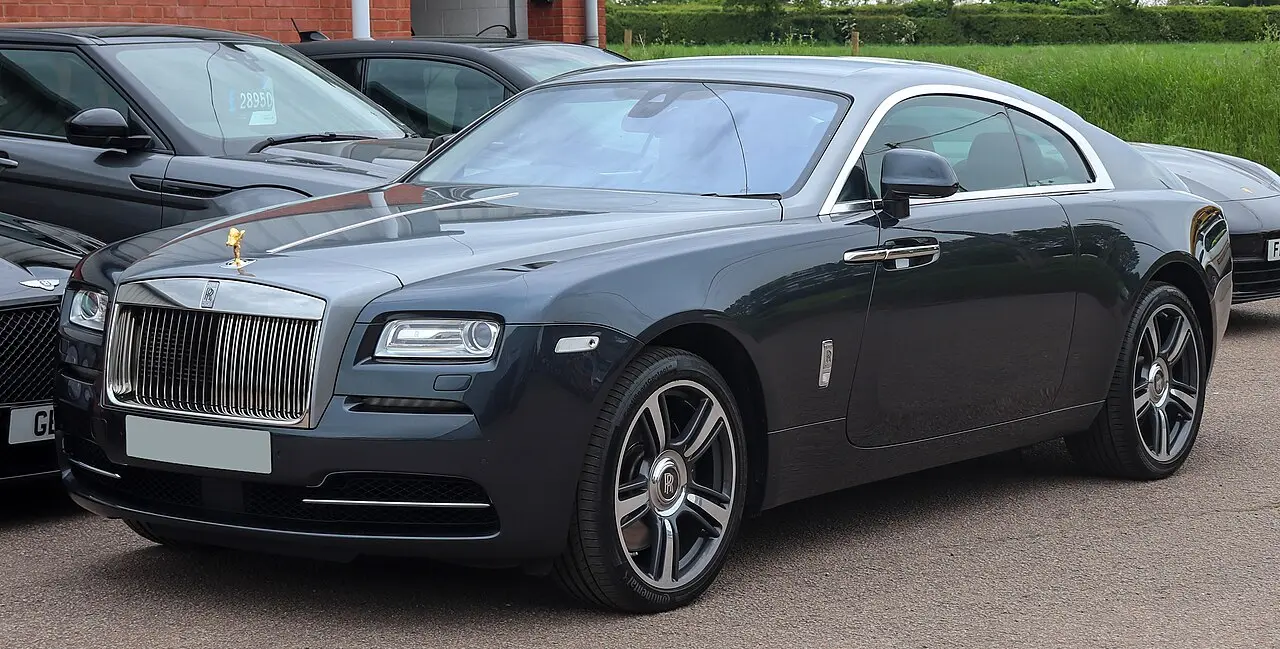
The official data lists 14 versions of the Rolls-Royce Wraith (2013 - 2026), in the European Union, the United Kingdom, France, the United States, and Canada. Each market publishes its own figures, measured on its own test procedure.
At a glance
Years in the data
2013 - 2026
Markets
European Union, United Kingdom, France, United States, Canada
Engines
6.6 L to 6.6 L
Power
441 kW (600 PS) to 465 kW (632 PS)
Fuels
Petrol, Electric
Lowest consumption (France)
14.0 L/100 km (NEDC)
Lowest consumption (United Kingdom)
14.0 L/100 km (NEDC)
Lowest consumption (Canada)
15.6 L/100 km (5-cycle)
New registrations in the EU
2,668
What is the Rolls-Royce Wraith?
The Wraith is a two-door fastback coupé with a grand touring character. Introduced in 2013, it brought a more expressive shape to the Rolls-Royce range alongside the Phantom and Ghost saloons. Its sweeping roofline sets it apart, while the cabin retains the marque’s focus on craftsmanship and comfort.
The Wraith’s listed generation ran from 2014 to 2023. Rolls-Royce introduced the model in 2013, and a Black Badge version followed in 2016. Production ended in 2023.
Engines and power
Wraith versions in the listed markets use a 6.6-litre petrol engine. EU power figures range from 441 kW (600 PS) to 465 kW (632 PS); France lists 465 kW (632 PS). UK figures list 441 kW (600 PS).
How economical is the Rolls-Royce Wraith?
The lowest listed consumption is 14 L/100 km in UK and French NEDC figures. The United States EPA result is 15.7 L/100 km, or 15 MPG combined, and Canada’s NRCan 5-cycle figure is 15.6 L/100 km. Test procedures differ: Europe uses WLTP or NEDC, the USA uses EPA testing and Canada uses its 5-cycle procedure, so these results are not directly comparable.
Where was the Wraith sold?
Official figures cover the European Union, the United Kingdom, France, the United States and Canada. EU registration figures span 2013 to 2023. The listed UK figures run from 2014 to 2026, while US and Canadian figures run from 2014 to 2021. With its fastback shape, the Wraith brought a coupé to the contemporary Rolls-Royce range.
Questions and answers
When was the Rolls-Royce Wraith sold?
The listed generation years are 2014 to 2023. Rolls-Royce introduced the model in 2013.
What engine and power does the Wraith have?
Listed versions use a 6.6-litre petrol engine. EU power figures range from 441 kW (600 PS) to 465 kW (632 PS).
What is the Wraith’s official fuel consumption?
The lowest listed figure is 14 L/100 km in UK and French NEDC results. EPA and Canadian 5-cycle figures use different procedures.
Was the Wraith sold in the United States and Canada?
Yes. The Wraith appears in official US EPA and Canadian NRCan figures.
At a glance: Length 5,270 - 5,290 mm · Kerb weight 2,335 kg · Top speed 250 km/h · MOT first-time pass at 6 - 8 years: 95.7% (UK average 86.4%) Specifications, reliability and all versions
Show all 14 versions
European Union 5 versions
New cars registered in the EU (plus Norway and Iceland), from the European Environment Agency. Figures on the NEDC procedure until 2020 and on WLTP from 2021; versions are grouped by engine and power, with their number of registrations.
Years and version
Engine
Power
Fuel
Consumption (combined)
CO₂
EU registrations
2021 - 2023
6.6 L
441 kW (600 PS)
Petrol
15.7 - 15.9 L/100 km WLTP
351 - 360 g/km
56
2022
Electric motor
-
Electric
-
0 g/km
30
2022
Electric motor
-
Electric
-
0 g/km
12
2019 - 2020
6.6 L
441 kW (600 PS)
Petrol
-
365 - 366 g/km
274
2013 - 2019
6.6 L
465 kW (632 PS)
Petrol
-
326 - 330 g/km
2,296
United Kingdom 6 versions
New cars on sale in the UK, from the Vehicle Certification Agency. NEDC figures until 2018 and WLTP figures after; years are the editions a version appeared in.
Years and version
Engine
Power
Fuel
Gearbox
Consumption (combined)
CO₂
2020 - 2023Wraith
6.6 L
441 kW (600 PS)
Petrol
8-speed automatic
15.7 - 16.0 L/100 km WLTP
357 - 363 g/km
2020 - 2023Wraith Black Badge Edition
6.6 L
441 kW (600 PS)
Petrol
8-speed automatic
15.7 - 16.2 L/100 km WLTP
358 - 370 g/km
2019Wraith
6.6 L
441 kW (600 PS)
Petrol
8-speed automatic
15.7 - 16.2 L/100 km WLTP
-
2019Wraith Black Badge Edition
6.6 L
441 kW (600 PS)
Petrol
8-speed automatic
16.0 - 16.3 L/100 km WLTP
-
2014 - 2018Wraith
6.6 L
Not listed
Petrol
8-speed automatic
14.0 - 14.3 L/100 km NEDC
327 g/km
2017 - 2018Wraith Black Badge
6.6 L
Not listed
Petrol
8-speed automatic
14.6 L/100 km NEDC
333 g/km
France 1 version
New cars on sale in France, from ADEME Car Labelling. NEDC figures until 2015, WLTP figures in the current catalogue.
Years and version
Engine
Power
Fuel
Gearbox
Consumption (combined)
CO₂
2014 - 2015WRAITH
-
465 kW (632 PS)
Petrol
8-speed automatic
14.0 L/100 km NEDC
327 g/km
United States 1 version
Model years sold in the USA, from the EPA and the Department of Energy (fueleconomy.gov). MPG on the EPA test; litres per 100 km = 235.215 ÷ MPG.
Years and version
Engine
Fuel
Gearbox
Drive
Consumption (combined)
CO₂
2014 - 2021SIDI
6.6 L
Petrol
8-speed automatic
Rear-wheel drive
14 - 15 MPG (15.7 - 16.8 L/100 km) EPA
359 - 388 g/km
Canada 1 version
Model years sold in Canada, from Natural Resources Canada fuel consumption ratings (5-cycle test).
Years and version
Engine
Fuel
Gearbox
Consumption (combined)
CO₂
2014 - 2021Mid-size
6.6 L
Petrol
8-speed automatic
15.6 - 16.6 L/100 km 5-cycle
359 - 388 g/km
Versions outside these generations
United Kingdom 2 versions
New cars on sale in the UK, from the Vehicle Certification Agency. NEDC figures until 2018 and WLTP figures after; years are the editions a version appeared in.
Official figures are measured on standard test procedures and differ between markets. Your consumption depends on how, where and in what conditions you drive.