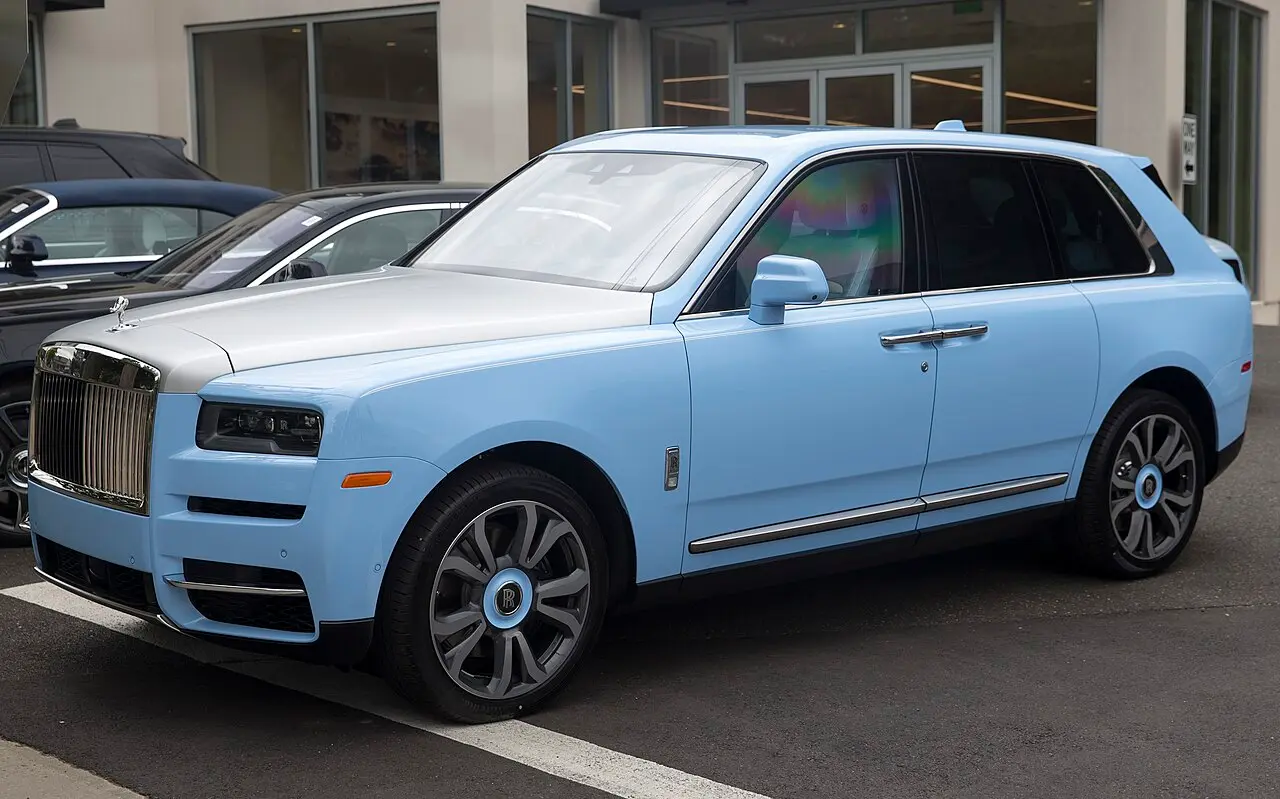
Rolls-Royce Cullinan

Rolls-Royce Cullinan
Photo: Mr.choppers / Wikimedia Commons · CC BY-SA 3.0

The official data lists 17 versions of the Rolls-Royce Cullinan (2016 - 2027), in the European Union, the United Kingdom, France, the United States, and Canada. Each market publishes its own figures, measured on its own test procedure.

At a glance

Years in the data
2016 - 2027
Markets
European Union, United Kingdom, France, United States, Canada
Engines
6.7 L to 6.7 L
Power
400 kW (544 PS) to 441 kW (600 PS)
Fuels
Petrol, Electric
Lowest consumption (European Union)
15.1 L/100 km (WLTP)
Lowest consumption (United Kingdom)
15.6 L/100 km (WLTP)
Lowest consumption (Canada)
16.3 L/100 km (5-cycle)
New registrations in the EU
2,532

What is the Rolls-Royce Cullinan?

Cullinan is Rolls-Royce’s luxury SUV, bringing the marque’s formal design and hand-finished character to a taller, more versatile body. It sits alongside the saloons and coupés in the range, with the added ability to travel beyond paved roads.

Cullinan generations

The first Cullinan generation ran from 2019 to 2024, using Rolls-Royce’s Architecture of Luxury. Cullinan Series II followed from 2025 on the same architecture, with updated styling and technology.

Engines and power

Cullinan uses a 6.7-litre petrol engine. EU registration figures show power from 400 kW (544 PS) to 441 kW (600 PS). UK figures range from 420 kW (571 PS) to 441 kW (600 PS), while France lists a 441 kW (600 PS) version. US and Canadian listings cover petrol versions.

How economical is the Rolls-Royce Cullinan?

The lowest listed official consumption is 15.1 L/100 km in the EU on WLTP. The UK figure is 15.6 L/100 km and France lists 16.4 L/100 km, both on WLTP. Canada lists 16.3 L/100 km under its 5-cycle procedure. The US EPA figure is 16.8 L/100 km, or 14 MPG combined. Test procedures differ: Europe uses WLTP, the USA uses EPA testing and Canada uses the 5-cycle test.

Where was the Cullinan sold?

Cullinan appears in official figures for the EU, UK, France, USA and Canada. EU registrations span 2016 to 2025 and total 2,532. UK figures cover 2019 to 2026, France lists a version for 2026, US figures cover 2019 to 2027, and Canadian figures cover 2019 to 2026.

Questions and answers

Is the Cullinan a Rolls-Royce SUV?

Yes. It is Rolls-Royce’s luxury SUV. Its first generation ran from 2019 to 2024, followed by Cullinan Series II from 2025.

What engine does the Cullinan use?

The listed engine is a 6.7-litre petrol unit, with power varying by market and version.

What is the Cullinan’s official fuel consumption?

The lowest listed figure is 15.1 L/100 km on the EU WLTP test. US EPA and Canadian 5-cycle results use different procedures.

Is there an electric Cullinan?

The EU listing includes petrol and electric fuels. The UK, France, US and Canadian listings cover petrol versions.
Cullinan (2018 - 2024)

Rolls-Royce Cullinan
Photo: Mr.choppers / Wikimedia Commons · CC BY-SA 3.0

Model codes: Architecture of Luxury · References: en.wikipedia.org, press.rolls-roycemotorcars.com

At a glance: Length 5,340 - 5,360 mm · Kerb weight 2,635 - 2,700 kg · Top speed 250 km/h Specifications, reliability and all versions

Show all 12 versions

Cullinan Series II (since 2025)

Rolls-Royce Cullinan Series II
No photo of this generation yet; the photo shows the Rolls-Royce Cullinan (2018 - 2024).Photo: Mr.choppers / Wikimedia Commons · CC BY-SA 3.0

Model codes: Architecture of Luxury · References: en.wikipedia.org, jdpower.com

At a glance: Length 5,360 mm · Kerb weight 2,700 - 2,705 kg · Top speed 250 km/h Specifications, reliability and all versions

European Union 4 versions

New cars registered in the EU (plus Norway and Iceland), from the European Environment Agency. Figures on the NEDC procedure until 2020 and on WLTP from 2021; versions are grouped by engine and power, with their number of registrations.

Years and versionEnginePowerFuelConsumption (combined)CO₂EU registrations
20256.7 L441 kW (600 PS)Petrol16.2 L/100 km WLTP368 g/km150
20256.7 L420 kW (571 PS)Petrol16.2 L/100 km WLTP366 g/km87
20256.7 L400 kW (544 PS)Petrol16.4 L/100 km WLTP375 g/km57
2025Electric motor - Electric - 0 g/km21

France 1 version

New cars on sale in France, from ADEME Car Labelling. NEDC figures until 2015, WLTP figures in the current catalogue.

Years and versionEnginePowerFuelGearboxConsumption (combined)CO₂
2026CULLINAN6.7 L441 kW (600 PS)Petrol8-speed automatic16.4 L/100 km WLTP373 g/km

United States 1 version

Model years sold in the USA, from the EPA and the Department of Energy (fueleconomy.gov). MPG on the EPA test; litres per 100 km = 235.215 ÷ MPG.

Years and versionEngineFuelGearboxDriveConsumption (combined)CO₂
2025 - 2027SIDI6.7 LPetrol8-speed automaticAll-wheel drive13 - 14 MPG (16.8 - 18.1 L/100 km) EPA378 - 408 g/km

Canada 1 version

Model years sold in Canada, from Natural Resources Canada fuel consumption ratings (5-cycle test).

Years and versionEngineFuelGearboxConsumption (combined)CO₂
2025 - 2026Sport utility vehicle: Standard6.7 LPetrol8-speed automatic16.4 L/100 km 5-cycle379 g/km

Versions outside these generations

European Union 1 version

New cars registered in the EU (plus Norway and Iceland), from the European Environment Agency. Figures on the NEDC procedure until 2020 and on WLTP from 2021; versions are grouped by engine and power, with their number of registrations.

Years and versionEnginePowerFuelCO₂EU registrations
20166.6 L420 kW (571 PS)Petrol340 g/km44

Rolls-Royce Cullinan recalls

8 official safety recalls for the Rolls-Royce Cullinan from NHTSA (United States), DVSA (United Kingdom) and the EU Safety Gate, newest first. Recall repairs are normally free at the maker’s dealers.

  • Rear seat belt bolts may loosen2019 - 2024
  • Rear seat bolts may damage seat belts or allow backrests to move2020 - 2026
  • Low-pressure fuel line may be incorrectly secured2024
  • Fuel tank feed line connection may be incorrectly fitted2021
  • Passenger seat belt retractor may deactivate early2021

See all 8 recalls

Official figures are measured on standard test procedures and differ between markets. Your consumption depends on how, where and in what conditions you drive.