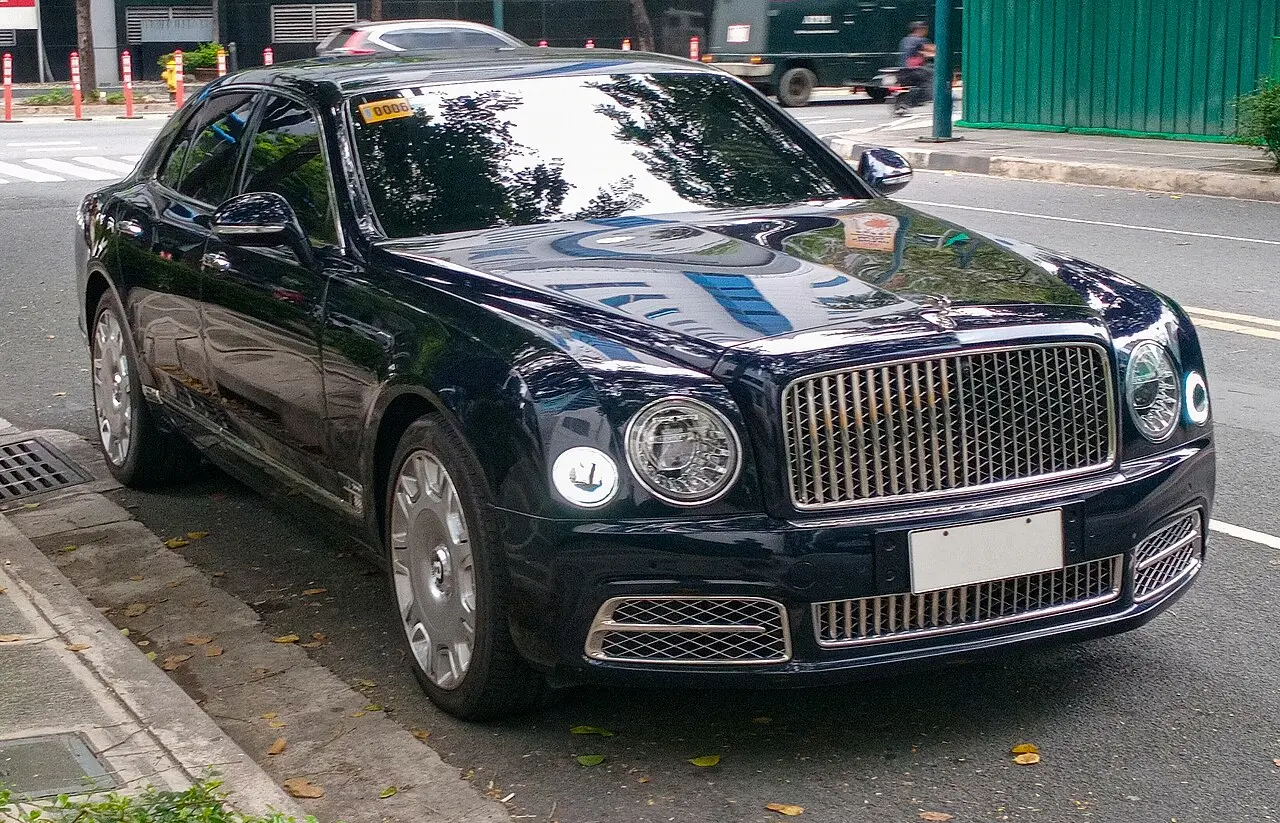
The official data lists 41 versions of the Bentley Mulsanne (2010–2020), in the European Union, the United Kingdom, France, the United States, and Canada. Each market publishes its own figures, measured on its own test procedure.
At a glance
Years in the data
2010–2020
Markets
European Union, United Kingdom, France, United States, Canada
Engines
6.8 L to 6.8 L
Power
377 kW (513 PS) to 395 kW (537 PS)
Fuels
Petrol
Lowest consumption (France)
14.6 L/100 km (NEDC)
Lowest consumption (United Kingdom)
14.6 L/100 km (NEDC)
Lowest consumption (United States)
16.8 L/100 km (EPA)
New registrations in the EU
3,088
What is the Bentley Mulsanne?
The Mulsanne was Bentley’s flagship luxury saloon for a decade. Its formal shape and spacious cabin suited both owners who preferred to be driven and those who liked taking the wheel themselves. Bentley hand-built it in Crewe, carrying forward the Arnage’s place at the top of the range.
Named after the Mulsanne Corner at the Le Mans race circuit, the car joined Bentley’s tradition of luxury and performance. A 2014 facelift brought updated styling and interior options. The range later added the Mulsanne Speed and an Extended Wheelbase model, with extra rear legroom for chauffeur-driven journeys.
Engines and power
The Mulsanne used a 6.8 L petrol engine. Across versions listed in the European Union and the UK, power ranged from 377 kW (513 PS) to 395 kW (537 PS). Bentley describes its V8 as twin-turbocharged, delivering the smooth, strong performance expected of a large luxury saloon.
How economical is the Bentley Mulsanne?
The lowest listed consumption is 14.6 L/100 km on the NEDC test in both the UK and France. The US EPA figure is 16.8 L/100 km, or 14 MPG combined. Canada’s NRCan-5-cycle figure is 17.3 L/100 km.
These results use different test procedures, so they are best understood within their own markets. Europe uses NEDC here, while the United States uses EPA testing and Canada uses the 5-cycle method.
Where was it sold?
The Mulsanne appears in official figures for the European Union, the United Kingdom, France, the United States and Canada. EU registration figures record 3,088 cars from 2010 to 2020. The US and Canadian listings cover 2011 to 2020.
Questions and answers
How many generations of Mulsanne were there?
The Mulsanne generation ran from 2011 to 2020.
What engine did the Mulsanne use?
It used a 6.8 L petrol engine. Listed European and UK power ranged from 377 kW (513 PS) to 395 kW (537 PS).
What is its official fuel consumption?
The lowest listed figures are 14.6 L/100 km on NEDC in the UK and France, 16.8 L/100 km on the US EPA test, and 17.3 L/100 km on Canada’s 5-cycle test.
New cars registered in the EU (plus Norway and Iceland), from the European Environment Agency. Figures on the NEDC procedure until 2020 and on WLTP from 2021; versions are grouped by engine and power, with their number of registrations.
Years and version
Engine
Power
Fuel
CO₂
EU registrations
2020
6.8 L
395 kW (537 PS)
Petrol
350 g/km
107
2020
6.8 L
377 kW (513 PS)
Petrol
350 g/km
26
2019
6.8 L
377 kW (513 PS)
Petrol
350 g/km
178
2019
6.8 L
395 kW (537 PS)
Petrol
349 g/km
22
2017–2018
6.8 L
395 kW (537 PS)
Petrol
342 g/km
212
2018
6.8 L
377 kW (513 PS)
Petrol
342 g/km
20
2017
6.8 L
377 kW (513 PS)
Petrol
364 g/km
308
2016
6.8 L
395 kW (537 PS)
Petrol
342 g/km
424
2016
6.8 L
377 kW (513 PS)
Petrol
356 g/km
18
2014–2015
6.8 L
395 kW (537 PS)
Petrol
342 g/km
378
2015
6.8 L
377 kW (513 PS)
Petrol
378 g/km
30
2014
6.8 L
377 kW (513 PS)
Petrol
393 g/km
343
2013
6.8 L
377 kW (513 PS)
Petrol
393 g/km
272
2012
6.8 L
377 kW (513 PS)
Petrol
393 g/km
286
2011
6.8 L
377 kW (513 PS)
Petrol
393 g/km
360
United Kingdom 8 versions
New cars on sale in the UK, from the Vehicle Certification Agency. NEDC figures until 2018 and WLTP figures after; years are the editions a version appeared in.
New cars on sale in France, from ADEME Car Labelling. NEDC figures until 2015, WLTP figures in the current catalogue.
Years and version
Engine
Power
Fuel
Gearbox
Consumption (combined)
CO₂
2015MULSANNE
–
377 kW (513 PS)
Petrol
8-speed automatic
14.6 L/100 km NEDC
342 g/km
2015MULSANNE SPEED
–
395 kW (537 PS)
Petrol
8-speed automatic
14.6 L/100 km NEDC
342 g/km
2014MULSANNE
–
377 kW (513 PS)
Petrol
8-speed automatic
16.9 L/100 km NEDC
393 g/km
2012–2013MULSANNE
–
377 kW (513 PS)
Petrol
8-speed automatic
16.9 L/100 km NEDC
393 g/km
United States 5 versions
Model years sold in the USA, from the EPA and the Department of Energy (fueleconomy.gov). MPG on the EPA test; litres per 100 km = 235.215 ÷ MPG.
Years and version
Engine
Fuel
Gearbox
Drive
Consumption (combined)
CO₂
2019–2020
6.8 L
Petrol
8-speed automatic
Rear-wheel drive
12 MPG (19.6 L/100 km) EPA
465 g/km
2016–2018
6.8 L
Petrol
8-speed automatic
Rear-wheel drive
14 MPG (16.8 L/100 km) EPA
405 g/km
2017
6.8 L
Petrol
8-speed automatic
Rear-wheel drive
13 MPG (18.1 L/100 km) EPA
430 g/km
2013–2015
6.8 L
Petrol
8-speed automatic
Rear-wheel drive
13 MPG (18.1 L/100 km) EPA
428 g/km
2011–2012
6.8 L
Petrol
8-speed automatic
Rear-wheel drive
13 MPG (18.1 L/100 km) EPA
425 g/km
Canada 8 versions
Model years sold in Canada, from Natural Resources Canada fuel consumption ratings (5-cycle test).
Years and version
Engine
Fuel
Gearbox
Consumption (combined)
CO₂
2019–2020Mid-size
6.8 L
Petrol
8-speed automatic
20.0 L/100 km 5-cycle
465 g/km
2018Mid-size
6.8 L
Petrol
8-speed automatic
17.3 L/100 km 5-cycle
405 g/km
2017Mid-size
6.8 L
Petrol
8-speed automatic
17.5 L/100 km 5-cycle
407 g/km
2017Mid-size
6.8 L
Petrol
8-speed automatic
18.3 L/100 km 5-cycle
430 g/km
2016Mid-size
6.8 L
Petrol
8-speed automatic
17.5 L/100 km 5-cycle
408 g/km
2015Mid-size
6.8 L
Petrol
8-speed automatic
18.2 L/100 km 5-cycle
419 g/km
2013–2014Mid-size
6.8 L
Petrol
8-speed automatic
19.0 L/100 km 5-cycle
437 g/km
2011–2012Mid-size
6.8 L
Petrol
8-speed automatic
18.6 L/100 km 5-cycle
428 g/km
Versions outside these generations
European Union 1 version
New cars registered in the EU (plus Norway and Iceland), from the European Environment Agency. Figures on the NEDC procedure until 2020 and on WLTP from 2021; versions are grouped by engine and power, with their number of registrations.
Years and version
Engine
Fuel
CO₂
EU registrations
2010
6.8 L
Petrol
393 g/km
104
Official figures are measured on standard test procedures and differ between markets. Your consumption depends on how, where and in what conditions you drive.