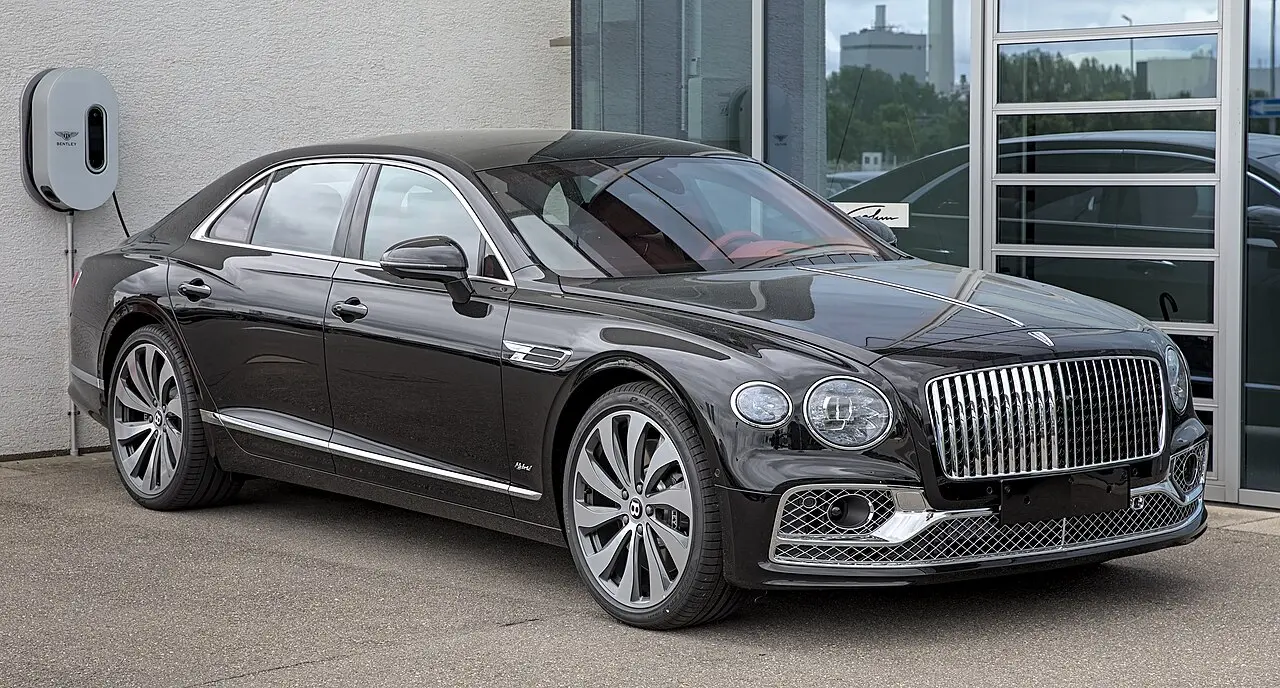
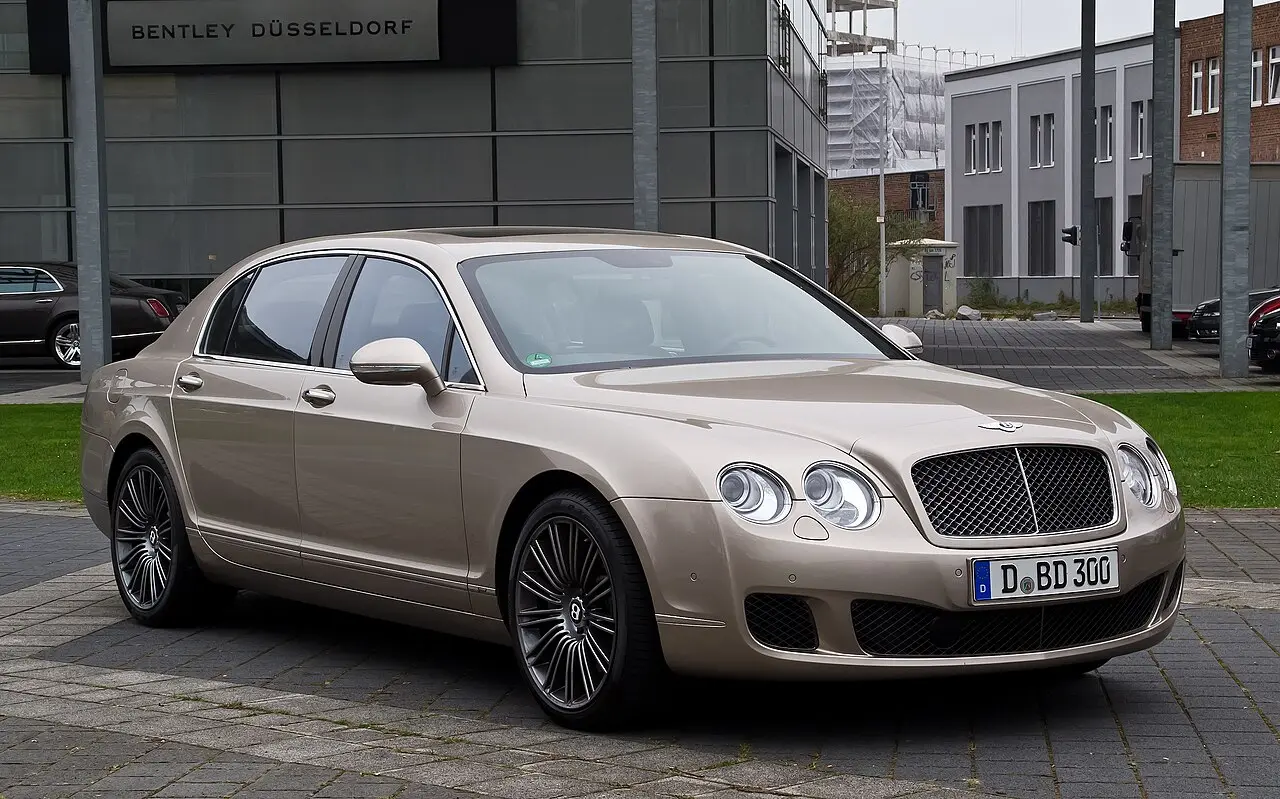
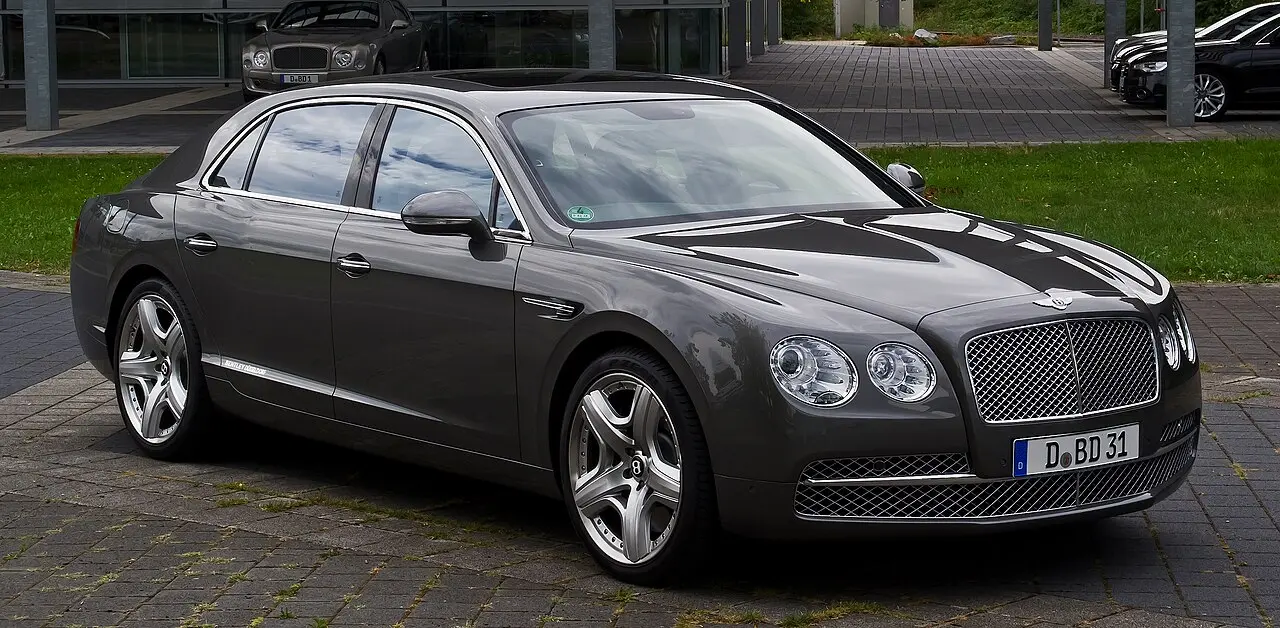
The official data lists 76 versions of the Bentley Flying Spur (2013–2026), in the European Union, the United Kingdom, France, the United States, and Canada. Each market publishes its own figures, measured on its own test procedure.
At a glance
Years in the data
2013–2026
Markets
European Union, United Kingdom, France, United States, Canada
Engines
2.9 L to 6.0 L
Power
306 kW (416 PS) to 550 kW (748 PS)
Fuels
Petrol, Plug-in hybrid, Hybrid, Flex fuel (E85)
Lowest consumption (France)
10.9 L/100 km (NEDC)
Lowest consumption (United Kingdom)
10.9 L/100 km (NEDC)
Lowest consumption (European Union)
12.6 L/100 km (WLTP)
Plug-in hybrid, weighted (European Union)
2.2 L/100 km (WLTP)
Plug-in hybrid, weighted (United Kingdom)
10.7 L/100 km (WLTP)
New registrations in the EU
8,071
What is the Bentley Flying Spur?
The Flying Spur is Bentley’s four-door luxury grand touring saloon. It brings the marque’s performance and handcrafted cabin to a body with room for passengers to travel in comfort. Its modern history began as the four-door Continental Flying Spur, a saloon sibling to the Continental coupé.
Bentley later dropped “Continental” from the name, marking the Flying Spur as a model in its own right. It remains the brand’s four-door grand tourer, with a focus on both the driver and rear-seat passengers.
Flying Spur generations
The first generation, from 2006 to 2013, was the modern Continental Flying Spur. The second generation ran from 2014 to 2019, when the model was established as the Flying Spur in its own right. The third generation began in 2020 and continues today. Plug-in hybrid versions joined the range.
Engines, power and official consumption
EU figures cover engines from 2.9 to 6.0 litres, with power from 306 kW (416 PS) to 467 kW (635 PS). UK figures extend to 550 kW (748 PS). Petrol versions are represented across the markets, while plug-in hybrid versions appear in EU, UK, US and Canadian figures. US figures also include E85 flex-fuel.
The lowest listed non-plug-in figure in the EU is 12.6 L/100 km on WLTP. The lowest plug-in hybrid result is 2.2 L/100 km on WLTP; this weighted figure assumes some driving is electric. The lowest listed non-plug-in figures are 13.8 L/100 km in the US under EPA testing and 13.6 L/100 km in Canada under the 5-cycle procedure. WLTP, EPA and Canada’s 5-cycle tests use different procedures.
Where was the Flying Spur sold?
Official figures are available for the EU, UK, France, US and Canada. EU registrations total 8,071 from 2013 to 2025. UK figures span 2013 to 2026, US figures span 2014 to 2026, and Canadian figures span 2014 to 2026. France’s figures cover 2015.
Questions and answers
How many generations of Flying Spur are listed?
Three: the first generation ran from 2006 to 2013, the second from 2014 to 2019, and the third began in 2020.
Does the Flying Spur have a plug-in hybrid version?
Yes. Plug-in hybrid versions appear in EU, UK, US and Canadian figures.
What is the lowest EU plug-in hybrid consumption figure?
It is 2.2 L/100 km on WLTP, a weighted result that assumes some driving is electric.
New cars registered in the EU (plus Norway and Iceland), from the European Environment Agency. Figures on the NEDC procedure until 2020 and on WLTP from 2021; versions are grouped by engine and power, with their number of registrations.
Years and version
Engine
Power
Fuel
Consumption (combined)
CO₂
Electric range
EU registrations
2025
4.0 L
441 kW (600 PS)
Plug-in hybrid
2.2 L/100 km WLTP25.5 kWh/100 km WLTP
55 g/km
85 km
126
2024–2025
2.9 L
306 kW (416 PS)
Plug-in hybrid
3.3 L/100 km WLTP24.4 kWh/100 km WLTP
75 g/km
41 km
49
2025
4.0 L
382 kW (519 PS)
Plug-in hybrid
3.0 L/100 km WLTP23.6 kWh/100 km WLTP
67 g/km
80 km
25
2025
4.0 L
382 kW (519 PS)
Hybrid
10.7 L/100 km WLTP
237 g/km
–
20
2023–2024
4.0 L
404 kW (549 PS)
Petrol
12.7 L/100 km WLTP
288 g/km
–
245
2024
6.0 L
467 kW (635 PS)
Petrol
15.0 L/100 km WLTP
340 g/km
–
50
2024
4.0 L
441 kW (600 PS)
Plug-in hybrid
1.4 L/100 km WLTP27.9 kWh/100 km WLTP
33 g/km
81 km
26
2023
2.9 L
306 kW (416 PS)
Plug-in hybrid
3.3 L/100 km WLTP24.5 kWh/100 km WLTP
75 g/km
42 km
92
2023
6.0 L
467 kW (635 PS)
Petrol
14.9 L/100 km WLTP
340 g/km
–
85
2022
4.0 L
404 kW (549 PS)
Petrol
12.6 L/100 km WLTP
288 g/km
–
212
2022
2.9 L
306 kW (416 PS)
Plug-in hybrid
3.3 L/100 km WLTP24.5 kWh/100 km WLTP
76 g/km
45 km
120
2022
6.0 L
467 kW (635 PS)
Petrol
14.8 L/100 km WLTP
339 g/km
–
81
2021
4.0 L
404 kW (549 PS)
Petrol
12.6 L/100 km WLTP
288 g/km
–
550
2021
6.0 L
467 kW (635 PS)
Petrol
14.7 L/100 km WLTP
338 g/km
–
138
2021
4.0 L
135 kW (184 PS)
Petrol
12.7 L/100 km WLTP
288 g/km
–
16
2020
6.0 L
467 kW (635 PS)
Petrol
–
305 g/km
–
529
2020
4.0 L
404 kW (549 PS)
Petrol
–
276 g/km
–
64
United Kingdom 9 versions
New cars on sale in the UK, from the Vehicle Certification Agency. NEDC figures until 2018 and WLTP figures after; years are the editions a version appeared in.
Model years sold in the USA, from the EPA and the Department of Energy (fueleconomy.gov). MPG on the EPA test; litres per 100 km = 235.215 ÷ MPG.
Years and version
Engine
Fuel
Gearbox
Drive
Consumption (combined)
CO₂
2025–2026SIDI; PHEV
4.0 L
Plug-in hybrid
8-speed automated manual
All-wheel drive
19 MPG (12.4 L/100 km) EPA
100 g/km
2022–2024SIDI; PHEV
2.9 L
Plug-in hybrid
8-speed automated manual
All-wheel drive
19 MPG (12.4 L/100 km) EPA
156 g/km
2024SIDI
4.0 L
Petrol
8-speed automated manual
All-wheel drive
17 MPG (13.8 L/100 km) EPA
332 g/km
2024SIDI & PFI
6.0 L
Petrol
8-speed automated manual
All-wheel drive
15 MPG (15.7 L/100 km) EPA
378 g/km
2023SIDI
4.0 L
Petrol
8-speed automated manual
All-wheel drive
17 MPG (13.8 L/100 km) EPA
319 g/km
2020–2023SIDI & PFI
6.0 L
Petrol
8-speed automated manual
All-wheel drive
15 MPG (15.7 L/100 km) EPA
373 g/km
2021–2022SIDI
4.0 L
Petrol
8-speed automated manual
All-wheel drive
17 MPG (13.8 L/100 km) EPA
323 g/km
Canada 7 versions
Model years sold in Canada, from Natural Resources Canada fuel consumption ratings (5-cycle test).
Years and version
Engine
Fuel
Gearbox
Consumption (combined)
CO₂
Electric range
2025–2026Mid-size
4.0 L
Plug-in hybrid
8-speed automated manual
12.3 L/100 km 5-cycle
100 g/km
48 km
2022–2024Mid-size
2.9 L
Plug-in hybrid
8-speed automated manual
12.3 L/100 km 5-cycle
156 g/km
34 km
2024Mid-size
4.0 L
Petrol
8-speed automated manual
14.2 L/100 km 5-cycle
333 g/km
–
2024Mid-size
6.0 L
Petrol
8-speed automated manual
16.2 L/100 km 5-cycle
378 g/km
–
2023Mid-size
4.0 L
Petrol
8-speed automated manual
13.6 L/100 km 5-cycle
319 g/km
–
2020–2023Mid-size
6.0 L
Petrol
8-speed automated manual
16.0 L/100 km 5-cycle
373 g/km
–
2021–2022Mid-size
4.0 L
Petrol
8-speed automated manual
13.7 L/100 km 5-cycle
323 g/km
–
Official figures are measured on standard test procedures and differ between markets. Your consumption depends on how, where and in what conditions you drive.