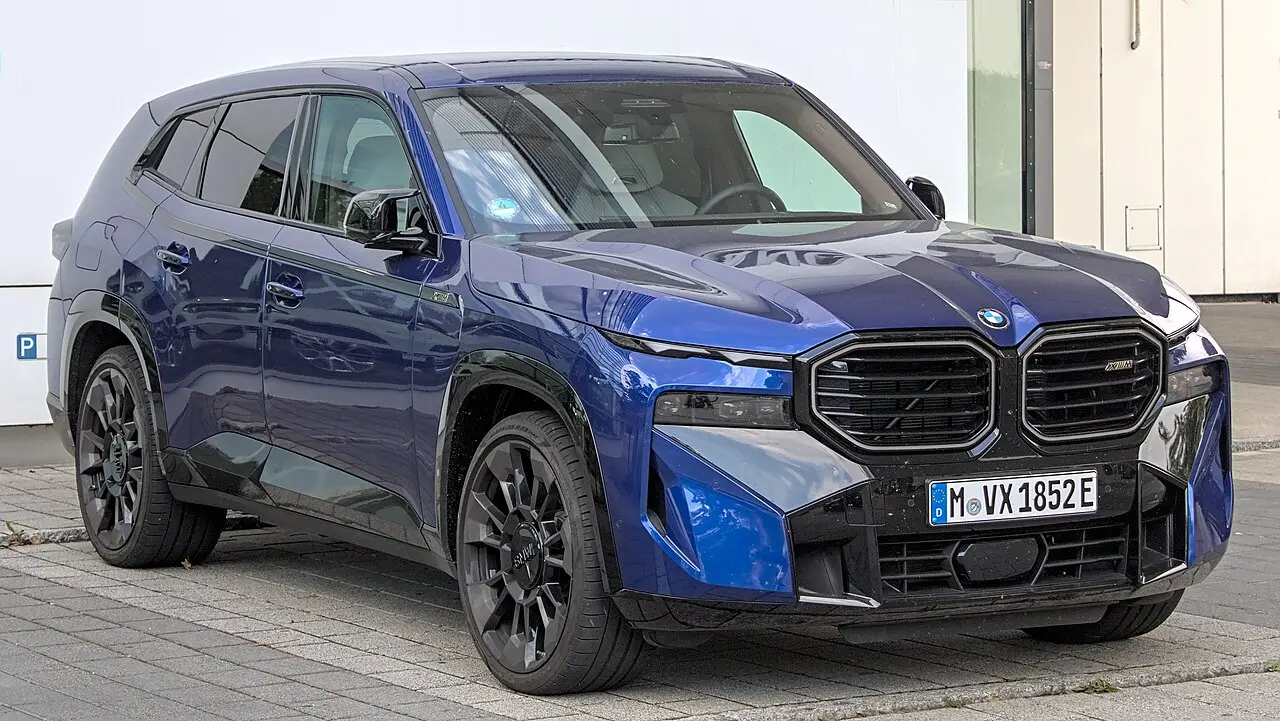
The official data lists 32 versions of the BMW XM (2022–2026), in the European Union, the United Kingdom, the United States, and Canada. Each market publishes its own figures, measured on its own test procedure.
At a glance
Years in the data
2022–2026
Markets
European Union, United Kingdom, United States, Canada
Engines
3.0 L to 4.4 L
Power
230 kW (313 PS) to 550 kW (748 PS)
Fuels
Plug-in hybrid, Hybrid, Petrol
Lowest consumption (European Union)
6.5 L/100 km (WLTP)
Plug-in hybrid, weighted (European Union)
1.6 L/100 km (WLTP)
Plug-in hybrid, weighted (United States)
16.8 L/100 km (EPA)
New registrations in the EU
8,774
What is the BMW XM?
The BMW XM is a large, high-performance SUV developed by BMW M as a standalone model. It combines an upright body and spacious cabin with a plug-in hybrid powertrain. BMW describes its SUVs as Sports Activity Vehicles.
The first-generation XM, code G09, began in 2023. Its bold front end features illuminated grille details, while the cabin brings together digital displays and upscale finishes. BMW M developed it independently rather than as a performance version of another BMW SUV.
Engines and power
EU figures include plug-in hybrid, hybrid and petrol entries, with engine sizes from 3.0 to 4.4 litres and power from 230 kW (313 PS) to 430 kW (585 PS). The 4.4-litre plug-in hybrid is listed at 360 kW (489 PS), while a 3.0-litre plug-in hybrid is listed at 230 kW (313 PS). UK figures cover plug-in hybrids from 350 kW (476 PS) to 550 kW (748 PS). US and Canadian entries are 4.4-litre plug-in hybrids.
How economical is the BMW XM?
The lowest listed EU consumption for a non-plug-in-hybrid entry is 6.5 L/100 km on WLTP. The lowest plug-in hybrid figure is 1.6 L/100 km, a weighted WLTP figure that assumes some driving is electric. The lowest listed plug-in hybrid figures are 16.8 L/100 km on the US EPA test and 17 L/100 km on Canada’s 5-cycle test. WLTP, EPA and the Canadian 5-cycle procedure differ, so these market results are not directly comparable.
Where was the XM sold?
EU registration figures cover 2022–2025, UK VCA figures cover 2025–2026, US EPA figures cover 2023–2026 and Canadian NRCan figures cover 2023–2026. The 4.4-litre plug-in hybrid rated at 360 kW (489 PS) led the listed EU registrations in 2023 and 2024. In 2025, the leading listed version was the 3.0-litre plug-in hybrid rated at 230 kW (313 PS).
Questions and answers
Is the BMW XM a plug-in hybrid?
Plug-in hybrid versions are listed in the EU, UK, US and Canada.
What is the BMW XM’s power output?
EU figures span 230 kW (313 PS) to 430 kW (585 PS); the listed UK range reaches 550 kW (748 PS).
What does the XM’s 1.6 L/100 km figure mean?
It is the lowest listed EU plug-in hybrid WLTP weighted figure, which assumes part of the driving is electric.
Which generation is the BMW XM?
The XM is the first generation, code G09, beginning in 2023.
New cars registered in the EU (plus Norway and Iceland), from the European Environment Agency. Figures on the NEDC procedure until 2020 and on WLTP from 2021; versions are grouped by engine and power, with their number of registrations.
Years and version
Engine
Power
Fuel
Consumption (combined)
CO₂
Electric range
EU registrations
2025
3.0 L
230 kW (313 PS)
Plug-in hybrid
1.6 L/100 km WLTP31.9 kWh/100 km WLTP
36 g/km
81 km
1,763
2025
4.4 L
360 kW (489 PS)
Plug-in hybrid
1.8 L/100 km WLTP33.2 kWh/100 km WLTP
41 g/km
78 km
386
2025
4.4 L
430 kW (585 PS)
Plug-in hybrid
2.1 L/100 km WLTP33.4 kWh/100 km WLTP
62 g/km
77 km
312
2025
3.0 L
230 kW (313 PS)
Hybrid
–
257 g/km
–
61
2025
4.4 L
–
Hybrid
5.8 L/100 km WLTP
280 g/km
–
14
2024
4.4 L
360 kW (489 PS)
Plug-in hybrid
3.0 L/100 km WLTP32.8 kWh/100 km WLTP
41 g/km
78 km
1,434
2024
3.0 L
230 kW (313 PS)
Plug-in hybrid
2.1 L/100 km WLTP32.0 kWh/100 km WLTP
35 g/km
80 km
1,205
2024
4.4 L
430 kW (585 PS)
Plug-in hybrid
2.6 L/100 km WLTP33.3 kWh/100 km WLTP
43 g/km
78 km
643
2024
3.0 L
230 kW (313 PS)
Hybrid
6.5 L/100 km WLTP
246 g/km
–
61
2024
4.4 L
360 kW (489 PS)
Petrol
6.5 L/100 km WLTP
149 g/km
–
38
2024
4.4 L
360 kW (489 PS)
Hybrid
6.5 L/100 km WLTP
277 g/km
–
14
2024
4.4 L
430 kW (585 PS)
Hybrid
6.9 L/100 km WLTP
276 g/km
–
14
2023
4.4 L
360 kW (489 PS)
Plug-in hybrid
1.6 L/100 km WLTP30.3 kWh/100 km WLTP
37 g/km
82 km
2,432
2023
4.4 L
430 kW (585 PS)
Plug-in hybrid
1.9 L/100 km WLTP33.3 kWh/100 km WLTP
42 g/km
78 km
191
2023
4.4 L
360 kW (489 PS)
Hybrid
–
112 g/km
–
126
2023
3.0 L
230 kW (313 PS)
Plug-in hybrid
–
–
75 km
15
2023
4.4 L
67 kW (91 PS)
Plug-in hybrid
30.7 kWh/100 km WLTP
37 g/km
82 km
12
2023
4.4 L
430 kW (585 PS)
Hybrid
–
112 g/km
–
10
United Kingdom 6 versions
New cars on sale in the UK, from the Vehicle Certification Agency. NEDC figures until 2018 and WLTP figures after; years are the editions a version appeared in.
Years and version
Engine
Power
Fuel
Gearbox
Consumption (combined)
CO₂
Electric range
2025–2026XM 50e
3.0 L
350 kW (476 PS)
Plug-in hybrid
8-speed automatic
31.3 kWh/100 km WLTP
–
85 km
2026XM 50e
3.0 L
350 kW (476 PS)
Plug-in hybrid
8-speed automatic
24.9 kWh/100 km WLTP
100 g/km
83 km
2025–2026XM Label
4.4 L
550 kW (748 PS)
Plug-in hybrid
8-speed automatic
32.6 kWh/100 km WLTP
–
82 km
2026XM Label
4.4 L
550 kW (748 PS)
Plug-in hybrid
8-speed automatic
25.1 kWh/100 km WLTP
115 g/km
79 km
2025XM 50e
3.0 L
350 kW (476 PS)
Plug-in hybrid
8-speed automatic
32.0 kWh/100 km WLTP
–
80 km
2025XM Label
4.4 L
550 kW (748 PS)
Plug-in hybrid
8-speed automatic
33.7 kWh/100 km WLTP
–
76 km
United States 3 versions
Model years sold in the USA, from the EPA and the Department of Energy (fueleconomy.gov). MPG on the EPA test; litres per 100 km = 235.215 ÷ MPG.
Years and version
Engine
Fuel
Gearbox
Drive
Consumption (combined)
CO₂
2026SIDI; PHEV
4.4 L
Plug-in hybrid
8-speed automatic
All-wheel drive
14 MPG (16.8 L/100 km) EPA
163 g/km
2023–2025SIDI; PHEV
4.4 L
Plug-in hybrid
8-speed automatic
All-wheel drive
14 MPG (16.8 L/100 km) EPA
152 g/km
2025SIDI; PHEV
4.4 L
Plug-in hybrid
8-speed automatic
All-wheel drive
14 MPG (16.8 L/100 km) EPA
158 g/km
Canada 3 versions
Model years sold in Canada, from Natural Resources Canada fuel consumption ratings (5-cycle test).
Years and version
Engine
Fuel
Gearbox
Consumption (combined)
CO₂
Electric range
2026Sport utility vehicle: Standard
4.4 L
Plug-in hybrid
8-speed automatic
17.0 L/100 km 5-cycle
163 g/km
48 km
2023–2025Sport utility vehicle: Standard
4.4 L
Plug-in hybrid
8-speed automatic
17.2 L/100 km 5-cycle
152 g/km
50 km
2024–2025Sport utility vehicle: Standard
4.4 L
Plug-in hybrid
8-speed automatic
17.1 L/100 km 5-cycle
159 g/km
50 km
Versions outside these generations
European Union 2 versions
New cars registered in the EU (plus Norway and Iceland), from the European Environment Agency. Figures on the NEDC procedure until 2020 and on WLTP from 2021; versions are grouped by engine and power, with their number of registrations.
Years and version
Engine
Power
Fuel
EU registrations
2022
3.0 L
230 kW (313 PS)
Plug-in hybrid
29
2022
4.4 L
430 kW (585 PS)
Plug-in hybrid
14
Official figures are measured on standard test procedures and differ between markets. Your consumption depends on how, where and in what conditions you drive.