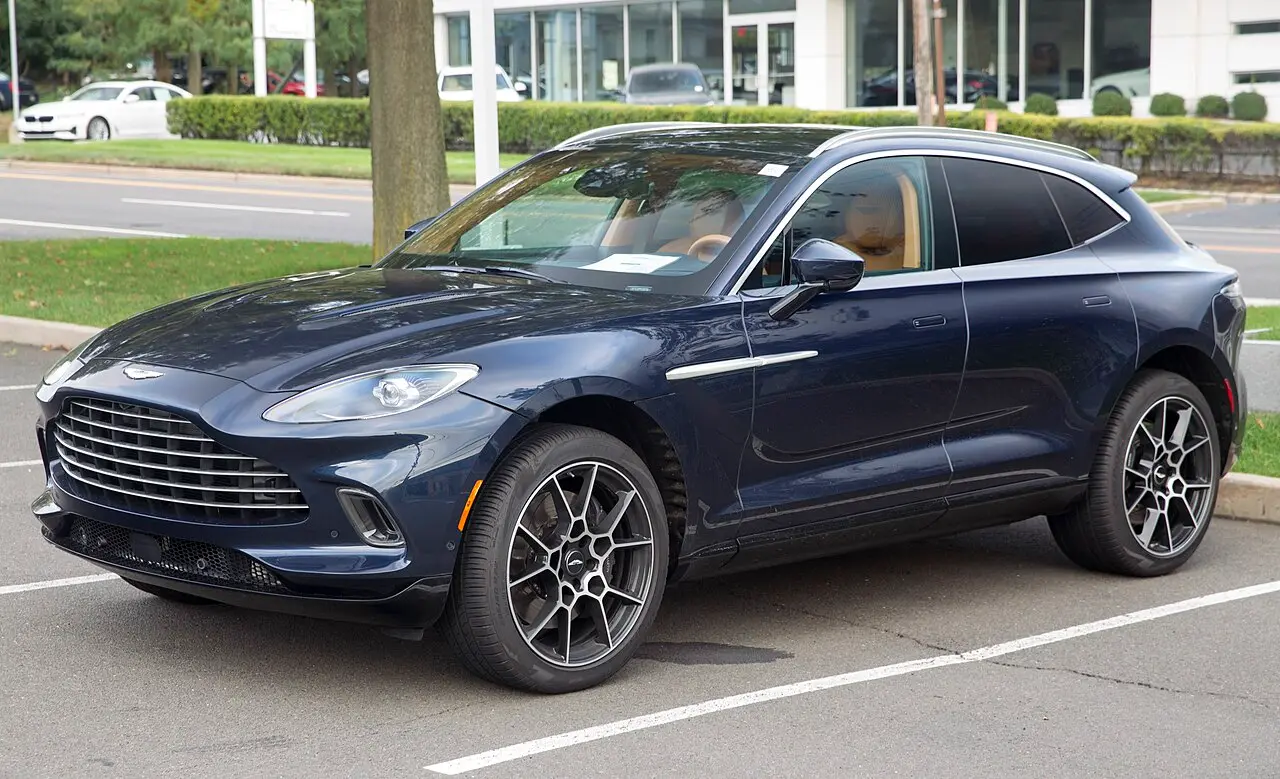
The official data lists 26 versions of the Aston Martin DBX (2020–2026), in the European Union, the United Kingdom, the United States, and Canada. Each market publishes its own figures, measured on its own test procedure.
At a glance
Years in the data
2020–2026
Markets
European Union, United Kingdom, United States, Canada
Engines
4.0 L to 4.0 L
Power
405 kW (551 PS) to 707 kW (961 PS)
Fuels
Petrol
Lowest consumption (European Union)
13.5 L/100 km (WLTP)
Lowest consumption (United States)
13.8 L/100 km (EPA)
Lowest consumption (Canada)
14.0 L/100 km (5-cycle)
New registrations in the EU
2,703
What is the Aston Martin DBX?
The DBX is Aston Martin’s first SUV, bringing the marque’s design and driving focus to a taller body with room for passengers and luggage. It sits alongside the brand’s sports cars and grand tourers, adding a more versatile shape to the range.
The DBX generation began in 2020. Its familiar Aston Martin styling cues are adapted to an SUV, with a cabin and layout suited to everyday use.
Engines and power
The DBX is listed with a 4.0 L petrol engine. EU figures show power from 405 kW (551 PS) to 520 kW (707 PS). UK figures include versions from 405 kW (551 PS) up to 707 kW (961 PS).
How economical is the Aston Martin DBX?
Official consumption figures vary by market because European tests use WLTP, the USA uses EPA procedures and Canada uses its 5-cycle test. The lowest listed EU figure is 13.5 L/100 km on WLTP. The UK’s lowest is 14.2 L/100 km on WLTP; the USA lists 13.8 L/100 km, or 17 MPG combined, on EPA; and Canada lists 14 L/100 km on its 5-cycle test.
EU registrations cover 2020–2025 and total 2,703. The largest annual counts shown are 565 for the 405 kW (551 PS) petrol version in 2021, 549 for that version in 2020, and 420 for the 520 kW (707 PS) version in 2023.
Where was the DBX sold?
Official figures list the DBX in the European Union, the United Kingdom, the United States and Canada. The recorded year spans are 2020–2025 in EU registrations, 2020–2026 in UK figures, and 2021–2026 in both the US and Canadian listings. All listed versions use petrol.
Questions and answers
When did the Aston Martin DBX generation begin?
The DBX generation began in 2020.
What engine and power does the DBX have?
The listed engine is a 4.0 L petrol unit. EU power ranges from 405 kW (551 PS) to 520 kW (707 PS), while UK figures also include a 707 kW (961 PS) version.
What is the DBX’s lowest official fuel consumption?
The lowest listed figure is 13.5 L/100 km on the EU WLTP test. Results vary by market and test procedure.
Which markets have DBX figures?
Figures are listed for the European Union, the UK, the USA and Canada.
New cars registered in the EU (plus Norway and Iceland), from the European Environment Agency. Figures on the NEDC procedure until 2020 and on WLTP from 2021; versions are grouped by engine and power, with their number of registrations.
Years and version
Engine
Power
Fuel
Consumption (combined)
CO₂
EU registrations
2025
4.0 L
520 kW (707 PS)
Petrol
14.2 L/100 km WLTP
323 g/km
330
2025
4.0 L
535 kW (727 PS)
Petrol
14.3 L/100 km WLTP
321 g/km
17
2025
4.0 L
405 kW (551 PS)
Petrol
14.3 L/100 km WLTP
323 g/km
11
2024
4.0 L
520 kW (707 PS)
Petrol
13.7 L/100 km WLTP
323 g/km
344
2024
4.0 L
405 kW (551 PS)
Petrol
13.5 L/100 km WLTP
323 g/km
63
2023
4.0 L
520 kW (707 PS)
Petrol
14.2 L/100 km WLTP
323 g/km
420
2023
4.0 L
405 kW (551 PS)
Petrol
14.3 L/100 km WLTP
323 g/km
81
2022
4.0 L
405 kW (551 PS)
Petrol
14.0 L/100 km WLTP
322 g/km
171
2022
4.0 L
520 kW (707 PS)
Petrol
14.2 L/100 km WLTP
323 g/km
152
2021
4.0 L
405 kW (551 PS)
Petrol
13.7 L/100 km WLTP
323 g/km
565
2020
4.0 L
405 kW (551 PS)
Petrol
–
269 g/km
549
United Kingdom 6 versions
New cars on sale in the UK, from the Vehicle Certification Agency. NEDC figures until 2018 and WLTP figures after; years are the editions a version appeared in.
Years and version
Engine
Power
Fuel
Gearbox
Consumption (combined)
CO₂
2025–2026Hatchback
4.0 L
405 kW (551 PS)
Petrol
9-speed automatic
14.3 L/100 km WLTP
323 g/km
2025–202625MY · DBX707 GPF Hatchback
4.0 L
520 kW (707 PS)
Petrol
9-speed automatic
14.2 L/100 km WLTP
323 g/km
2024Hatchback
4.0 L
550 kW (748 PS)
Petrol
9-speed automatic
14.3 L/100 km WLTP
323 g/km
2024DBX707 GPF Hatchback · 25MY
4.0 L
707 kW (961 PS)
Petrol
9-speed automatic
14.2 L/100 km WLTP
323 g/km
2020–2023Hatchback
4.0 L
405 kW (551 PS)
Petrol
9-speed automatic
14.3 L/100 km WLTP
323 g/km
2022–2023DBX707 GPF Hatchback
4.0 L
520 kW (707 PS)
Petrol
9-speed automatic
14.2 L/100 km WLTP
323 g/km
United States 5 versions
Model years sold in the USA, from the EPA and the Department of Energy (fueleconomy.gov). MPG on the EPA test; litres per 100 km = 235.215 ÷ MPG.
Years and version
Engine
Fuel
Gearbox
Drive
Consumption (combined)
CO₂
2025–2026SIDI
4.0 L
Petrol
9-speed automatic
Four-wheel drive
17 MPG (13.8 L/100 km) EPA
334 g/km
2026SIDI
4.0 L
Petrol
9-speed automatic
Four-wheel drive
16 MPG (14.7 L/100 km) EPA
339 g/km
2022–2024SIDI
4.0 L
Petrol
9-speed automatic
Four-wheel drive
16 MPG (14.7 L/100 km) EPA
345 g/km
2023–2024SIDI
4.0 L
Petrol
9-speed automatic
Four-wheel drive
17 MPG (13.8 L/100 km) EPA
333 g/km
2021
4.0 L
Petrol
9-speed automatic
Four-wheel drive
15 MPG (15.7 L/100 km) EPA
355 g/km
Canada 4 versions
Model years sold in Canada, from Natural Resources Canada fuel consumption ratings (5-cycle test).
Years and version
Engine
Fuel
Gearbox
Consumption (combined)
CO₂
2023–2026Sport utility vehicle: Standard
4.0 L
Petrol
9-speed automatic
14.0 L/100 km 5-cycle
329 g/km
2026Sport utility vehicle: Standard
4.0 L
Petrol
9-speed automatic
14.5 L/100 km 5-cycle
340 g/km
2022–2024Sport utility vehicle: Standard
4.0 L
Petrol
9-speed automatic
14.6 L/100 km 5-cycle
343 g/km
2021Sport utility vehicle: Standard
4.0 L
Petrol
9-speed automatic
15.2 L/100 km 5-cycle
357 g/km
Official figures are measured on standard test procedures and differ between markets. Your consumption depends on how, where and in what conditions you drive.