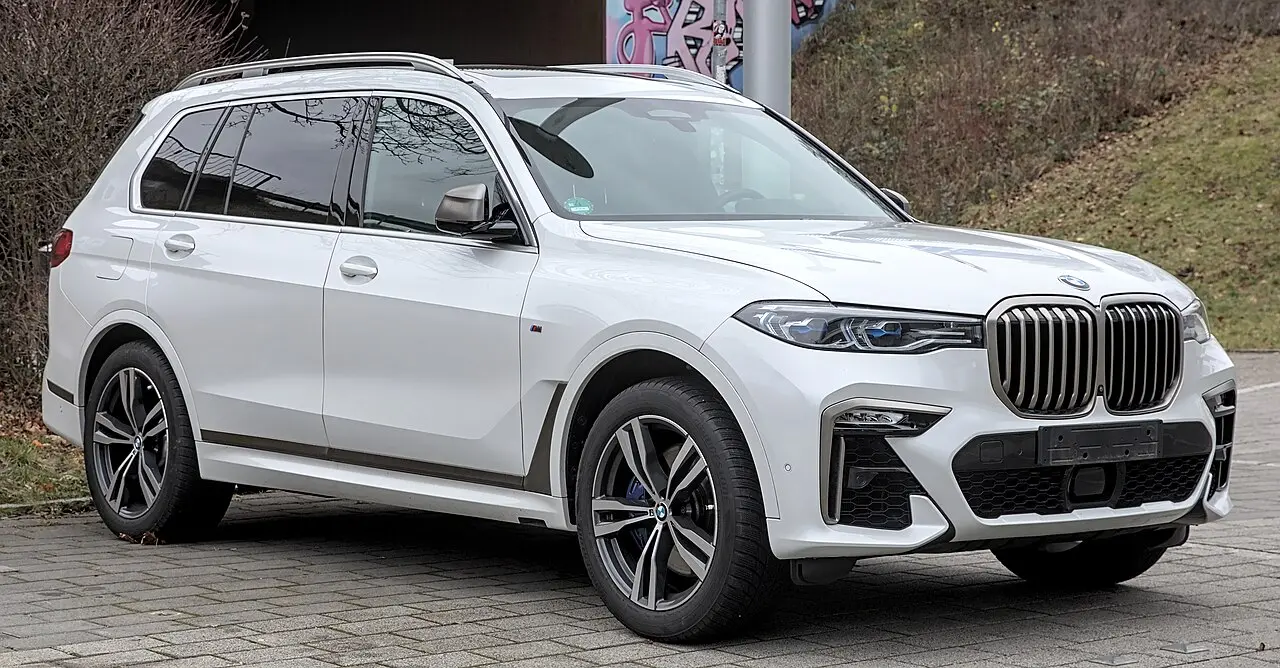
The official data lists 99 versions of the BMW X7 (2016–2027), in the European Union, the United Kingdom, the United States, and Canada. Each market publishes its own figures, measured on its own test procedure.
At a glance
Years in the data
2016–2027
Markets
European Union, United Kingdom, United States, Canada
Engines
3.0 L to 4.4 L
Power
195 kW (265 PS) to 390 kW (530 PS)
Fuels
Hybrid, Diesel, Petrol, Plug-in hybrid
Lowest consumption (European Union)
7.6 L/100 km (WLTP)
Lowest consumption (United Kingdom)
8.0 L/100 km (WLTP)
Lowest consumption (United States)
10.2 L/100 km (EPA)
Plug-in hybrid, weighted (European Union)
8.2 L/100 km (WLTP)
New registrations in the EU
51,204
What is the BMW X7?
The X7 is BMW’s largest sport utility vehicle, which the company calls a Sports Activity Vehicle, or SAV. It sits at the top of the X family, with a spacious cabin and up to three rows of seats. Its large body and comfort-focused character make it suited to family travel and long journeys.
BMW introduced the X7 as a luxury SAV, adding a large, high-riding model to a range that already included smaller X models. It is built at BMW’s Spartanburg plant in the United States.
Generations and engines
The X7 has one generation, the G07, introduced in 2019. Updates have refreshed the model while it has kept its place as the largest X model.
EU versions span 3.0 to 4.4 litres and include diesel, petrol, hybrid and plug-in hybrid powertrains. Official power figures run from 155 kW (211 PS) to 390 kW (530 PS). UK figures cover hybrid models from 259 kW (352 PS) to 390 kW (530 PS). US listings include petrol and hybrid versions, while Canadian listings are petrol; both markets list engines from 3.0 to 4.4 litres.
How economical is the BMW X7?
The lowest listed EU consumption for petrol, diesel and hybrid versions is 7.6 L/100 km on the WLTP test. For plug-in hybrids, the lowest official weighted figure is 8.2 L/100 km WLTP; it assumes part of the driving is electric. In the UK, the lowest listed figure is 8 L/100 km WLTP.
The lowest listed US figure is 10.2 L/100 km under EPA testing, with a best combined rating of 23 MPG. Canada’s lowest listed figure is 10.4 L/100 km on the NRCan 5-cycle test. WLTP, EPA and NRCan 5-cycle procedures differ, so the results are not directly comparable. EU registrations total 51,204 for 2016–2025. Among the most registered listed versions were 3.0-litre hybrids with 250 kW (340 PS), including 5,002 registrations in 2024.
Where is the BMW X7 listed?
Official figures cover the European Union, the UK, the United States and Canada. The EU registration period is 2016–2025; the UK figures cover 2025–2026, the US 2019–2027 and Canada 2019–2026.
Questions and answers
How many generations of BMW X7 are there?
One: the G07, introduced in 2019.
What engines does the BMW X7 have?
EU versions use 3.0 to 4.4-litre diesel, petrol, hybrid or plug-in hybrid powertrains, with official output from 155 kW (211 PS) to 390 kW (530 PS).
What is the BMW X7’s lowest official fuel consumption?
The lowest listed EU figure for petrol, diesel and hybrid versions is 7.6 L/100 km WLTP. Plug-in hybrids have a lowest weighted figure of 8.2 L/100 km WLTP, assuming part of the driving is electric.
Which markets have official BMW X7 figures?
The European Union, the UK, the US and Canada. Test procedures differ by market: WLTP in Europe, EPA in the US and NRCan 5-cycle in Canada.
New cars registered in the EU (plus Norway and Iceland), from the European Environment Agency. Figures on the NEDC procedure until 2020 and on WLTP from 2021; versions are grouped by engine and power, with their number of registrations.
Years and version
Engine
Power
Fuel
Consumption (combined)
CO₂
EU registrations
2025
3.0 L
250 kW (340 PS)
Hybrid
8.2 L/100 km WLTP
216 g/km
4,397
2025
4.4 L
390 kW (530 PS)
Hybrid
12.4 L/100 km WLTP
282 g/km
705
2025
3.0 L
280 kW (381 PS)
Hybrid
9.9 L/100 km WLTP
225 g/km
671
2025
3.0 L
250 kW (340 PS)
Diesel
8.5 L/100 km WLTP
222 g/km
360
2025
4.4 L
390 kW (530 PS)
Petrol
–
229 g/km
88
2025
3.0 L
280 kW (381 PS)
Petrol
–
282 g/km
85
2025
3.0 L
250 kW (340 PS)
Plug-in hybrid
8.2 L/100 km WLTP
213 g/km
69
2025
3.0 L
280 kW (381 PS)
Plug-in hybrid
9.9 L/100 km WLTP
225 g/km
29
2025
4.4 L
390 kW (530 PS)
Plug-in hybrid
12.4 L/100 km WLTP
279 g/km
26
2025
3.0 L
250 kW (340 PS)
Hybrid
8.0 L/100 km WLTP
155 g/km
10
2024
3.0 L
250 kW (340 PS)
Hybrid
8.1 L/100 km WLTP
211 g/km
5,002
2024
4.4 L
390 kW (530 PS)
Hybrid
12.3 L/100 km WLTP
282 g/km
1,178
2024
3.0 L
280 kW (381 PS)
Hybrid
9.8 L/100 km WLTP
224 g/km
955
2024
3.0 L
250 kW (340 PS)
Diesel
8.0 L/100 km WLTP
212 g/km
21
2024
4.4 L
390 kW (530 PS)
Petrol
12.5 L/100 km WLTP
282 g/km
21
2024
3.0 L
230 kW (313 PS)
Hybrid
8.0 L/100 km WLTP
211 g/km
10
2024
3.0 L
250 kW (340 PS)
Hybrid
–
–
10
2023
3.0 L
250 kW (340 PS)
Hybrid
8.1 L/100 km WLTP
210 g/km
3,962
2023
4.4 L
390 kW (530 PS)
Hybrid
12.6 L/100 km WLTP
282 g/km
1,052
2023
3.0 L
280 kW (381 PS)
Hybrid
10.0 L/100 km WLTP
225 g/km
936
2023
3.0 L
250 kW (340 PS)
Diesel
8.3 L/100 km WLTP
194 g/km
291
2023
4.4 L
390 kW (530 PS)
Petrol
12.3 L/100 km WLTP
257 g/km
79
2023
3.0 L
67 kW (91 PS)
Plug-in hybrid
–
209 g/km
34
2023
3.0 L
280 kW (381 PS)
Petrol
–
210 g/km
31
2023
3.0 L
67 kW (91 PS)
Plug-in hybrid
–
225 g/km
13
2023
3.0 L
155 kW (211 PS)
Hybrid
8.0 L/100 km WLTP
209 g/km
11
2023
3.0 L
110 kW (150 PS)
Plug-in hybrid
–
212 g/km
10
2022
3.0 L
250 kW (340 PS)
Hybrid
7.7 L/100 km WLTP
208 g/km
2,669
2022
4.4 L
390 kW (530 PS)
Petrol
12.2 L/100 km WLTP
285 g/km
470
2022
3.0 L
245 kW (333 PS)
Hybrid
9.9 L/100 km WLTP
236 g/km
447
2022
3.0 L
280 kW (381 PS)
Hybrid
9.9 L/100 km WLTP
224 g/km
200
2022
4.4 L
390 kW (530 PS)
Hybrid
12.5 L/100 km WLTP
283 g/km
178
2021–2022
3.0 L
250 kW (340 PS)
Hybrid
–
–
53
2021
3.0 L
250 kW (340 PS)
Hybrid
7.7 L/100 km WLTP
208 g/km
4,927
2021
4.4 L
390 kW (530 PS)
Petrol
12.3 L/100 km WLTP
286 g/km
1,161
2021
3.0 L
245 kW (333 PS)
Hybrid
10.2 L/100 km WLTP
236 g/km
754
2021
3.0 L
250 kW (340 PS)
Diesel
7.6 L/100 km WLTP
207 g/km
464
2021
3.0 L
294 kW (400 PS)
Diesel
8.8 L/100 km WLTP
235 g/km
424
2021
3.0 L
195 kW (265 PS)
Diesel
8.0 L/100 km WLTP
222 g/km
226
2021
3.0 L
250 kW (340 PS)
Petrol
10.7 L/100 km WLTP
256 g/km
160
2021
3.0 L
245 kW (333 PS)
Petrol
9.1 L/100 km WLTP
236 g/km
127
2021
3.0 L
280 kW (381 PS)
Hybrid
–
–
48
2021
2.7 L
250 kW (340 PS)
Diesel
–
306 g/km
24
2021
3.0 L
280 kW (381 PS)
Petrol
–
–
22
2021
3.0 L
155 kW (211 PS)
Hybrid
7.2 L/100 km WLTP
209 g/km
18
2020
3.0 L
294 kW (400 PS)
Diesel
–
188 g/km
3,639
2020
3.0 L
195 kW (265 PS)
Diesel
–
172 g/km
2,813
2020
3.0 L
250 kW (340 PS)
Petrol
–
200 g/km
1,506
2020
4.4 L
390 kW (530 PS)
Petrol
–
247 g/km
1,008
2020
3.0 L
250 kW (340 PS)
Hybrid
–
168 g/km
933
2020
3.0 L
250 kW (340 PS)
Diesel
–
169 g/km
71
2019–2020
3.0 L
155 kW (211 PS)
Diesel
–
171 g/km
62
2020
3.0 L
250 kW (340 PS)
Plug-in hybrid
–
268 g/km
60
2020
3.0 L
280 kW (381 PS)
Plug-in hybrid
–
268 g/km
52
2020
2.0 L
190 kW (258 PS)
Petrol
–
252 g/km
22
2019
3.0 L
195 kW (265 PS)
Diesel
–
172 g/km
3,562
2019
3.0 L
294 kW (400 PS)
Diesel
–
186 g/km
2,632
2019
3.0 L
250 kW (340 PS)
Petrol
–
199 g/km
2,032
2019
4.4 L
390 kW (530 PS)
Petrol
–
249 g/km
318
United Kingdom 14 versions
New cars on sale in the UK, from the Vehicle Certification Agency. NEDC figures until 2018 and WLTP figures after; years are the editions a version appeared in.
Years and version
Engine
Power
Fuel
Gearbox
Consumption (combined)
CO₂
2025–2026X7 xDrive40d Excellence
3.0 L
259 kW (352 PS)
Hybrid
8-speed automatic
8.1 L/100 km WLTP
232 g/km
2025–2026X7 xDrive40d M Sport
3.0 L
259 kW (352 PS)
Hybrid
8-speed automatic
8.0 L/100 km WLTP
231 g/km
2026X7 xDrive40d Excellence
3.0 L
259 kW (352 PS)
Hybrid
8-speed automatic
8.1 L/100 km WLTP
212 g/km
2026X7 xDrive40d M Sport
3.0 L
259 kW (352 PS)
Hybrid
8-speed automatic
8.0 L/100 km WLTP
211 g/km
2025–2026X7 xDrive40i Excellence · X7 xDrive40i M Sport
3.0 L
280 kW (381 PS)
Hybrid
8-speed automatic
9.6 L/100 km WLTP
239 g/km
2026X7 xDrive40i Excellence
3.0 L
280 kW (381 PS)
Hybrid
8-speed automatic
9.6 L/100 km WLTP
217 g/km
2026X7 xDrive40i M Sport
3.0 L
280 kW (381 PS)
Hybrid
8-speed automatic
9.7 L/100 km WLTP
218 g/km
2025–2026X7 M60i xDrive
4.4 L
390 kW (530 PS)
Hybrid
8-speed automatic
12.9 L/100 km WLTP
274 g/km
2025–2026X7 M60i xDrive
4.4 L
390 kW (530 PS)
Hybrid
8-speed automatic
12.1 L/100 km WLTP
292 g/km
2026X7 xDrive M60i xDrive
4.4 L
390 kW (530 PS)
Hybrid
8-speed automatic
12.1 L/100 km WLTP
276 g/km
2025X7 xDrive40d Excellence
3.0 L
259 kW (352 PS)
Hybrid
8-speed automatic
8.8 L/100 km WLTP
212 g/km
2025X7 xDrive40d M Sport
3.0 L
259 kW (352 PS)
Hybrid
8-speed automatic
8.8 L/100 km WLTP
211 g/km
2025X7 xDrive40i Excellence
3.0 L
280 kW (381 PS)
Hybrid
8-speed automatic
10.6 L/100 km WLTP
217 g/km
2025X7 xDrive40i M Sport
3.0 L
280 kW (381 PS)
Hybrid
8-speed automatic
10.6 L/100 km WLTP
218 g/km
United States 13 versions
Model years sold in the USA, from the EPA and the Department of Energy (fueleconomy.gov). MPG on the EPA test; litres per 100 km = 235.215 ÷ MPG.
Years and version
Engine
Fuel
Gearbox
Drive
Consumption (combined)
CO₂
2027SIDI & PFI; Mild Hybrid
3.0 L
Hybrid
8-speed automatic
All-wheel drive
22 MPG (10.7 L/100 km) EPA
241 g/km
2027SIDI; Mild Hybrid
4.4 L
Hybrid
8-speed automatic
All-wheel drive
19 MPG (12.4 L/100 km) EPA
296 g/km
2026SIDI & PFI; Mild Hybrid
3.0 L
Hybrid
8-speed automatic
All-wheel drive
23 MPG (10.2 L/100 km) EPA
240 g/km
2025–2026SIDI; Mild Hybrid
4.4 L
Hybrid
8-speed automatic
All-wheel drive
18 MPG (13.1 L/100 km) EPA
309 g/km
2025SIDI & PFI; Mild Hybrid
3.0 L
Hybrid
8-speed automatic
All-wheel drive
22 MPG (10.7 L/100 km) EPA
247 g/km
2023–2024SIDI & PFI; Mild Hybrid
3.0 L
Hybrid
8-speed automatic
All-wheel drive
22 MPG (10.7 L/100 km) EPA
244 g/km
2023–2024SIDI; Mild Hybrid
4.4 L
Hybrid
8-speed automatic
All-wheel drive
18 MPG (13.1 L/100 km) EPA
299 g/km
2021–2022SIDI; Mild Hybrid
3.0 L
Hybrid
8-speed automatic
All-wheel drive
21 MPG (11.2 L/100 km) EPA
256 g/km
2022SIDI
4.4 L
Petrol
8-speed automatic
All-wheel drive
17 MPG (13.8 L/100 km) EPA
321 g/km
2021SIDI
4.4 L
Petrol
8-speed automatic
All-wheel drive
17 MPG (13.8 L/100 km) EPA
319 g/km
2019–2020SIDI
3.0 L
Petrol
8-speed automatic
All-wheel drive
22 MPG (10.7 L/100 km) EPA
254 g/km
2020SIDI
4.4 L
Petrol
8-speed automatic
All-wheel drive
17 MPG (13.8 L/100 km) EPA
318 g/km
2019SIDI
4.4 L
Petrol
8-speed automatic
All-wheel drive
17 MPG (13.8 L/100 km) EPA
314 g/km
Canada 10 versions
Model years sold in Canada, from Natural Resources Canada fuel consumption ratings (5-cycle test).
Years and version
Engine
Fuel
Gearbox
Consumption (combined)
CO₂
2026Sport utility vehicle: Standard
3.0 L
Petrol
8-speed automatic
10.4 L/100 km 5-cycle
240 g/km
2025–2026Sport utility vehicle: Standard
4.4 L
Petrol
8-speed automatic
13.3 L/100 km 5-cycle
310 g/km
2025Sport utility vehicle: Standard
3.0 L
Petrol
8-speed automatic
10.7 L/100 km 5-cycle
247 g/km
2023–2024Sport utility vehicle: Standard
3.0 L
Petrol
8-speed automatic
10.5 L/100 km 5-cycle
243 g/km
2023–2024Sport utility vehicle: Standard
4.4 L
Petrol
8-speed automatic
12.9 L/100 km 5-cycle
299 g/km
2021–2022Sport utility vehicle: Standard
3.0 L
Petrol
8-speed automatic
11.1 L/100 km 5-cycle
256 g/km
2021–2022Sport utility vehicle: Standard
4.4 L
Petrol
8-speed automatic
13.8 L/100 km 5-cycle
321 g/km
2019–2020Sport utility vehicle: Standard
3.0 L
Petrol
8-speed automatic
10.8 L/100 km 5-cycle
254 g/km
2020Sport utility vehicle: Standard
4.4 L
Petrol
8-speed automatic
13.6 L/100 km 5-cycle
318 g/km
2019Sport utility vehicle: Standard
4.4 L
Petrol
8-speed automatic
12.6 L/100 km 5-cycle
294 g/km
Versions outside these generations
European Union 3 versions
New cars registered in the EU (plus Norway and Iceland), from the European Environment Agency. Figures on the NEDC procedure until 2020 and on WLTP from 2021; versions are grouped by engine and power, with their number of registrations.
Years and version
Engine
Power
Fuel
CO₂
EU registrations
2016
3.0 L
195 kW (265 PS)
Diesel
156 g/km
24
2016
3.0 L
250 kW (340 PS)
Petrol
197 g/km
22
2016
4.4 L
360 kW (489 PS)
Petrol
224 g/km
20
Official figures are measured on standard test procedures and differ between markets. Your consumption depends on how, where and in what conditions you drive.