

Peugeot 5008 III
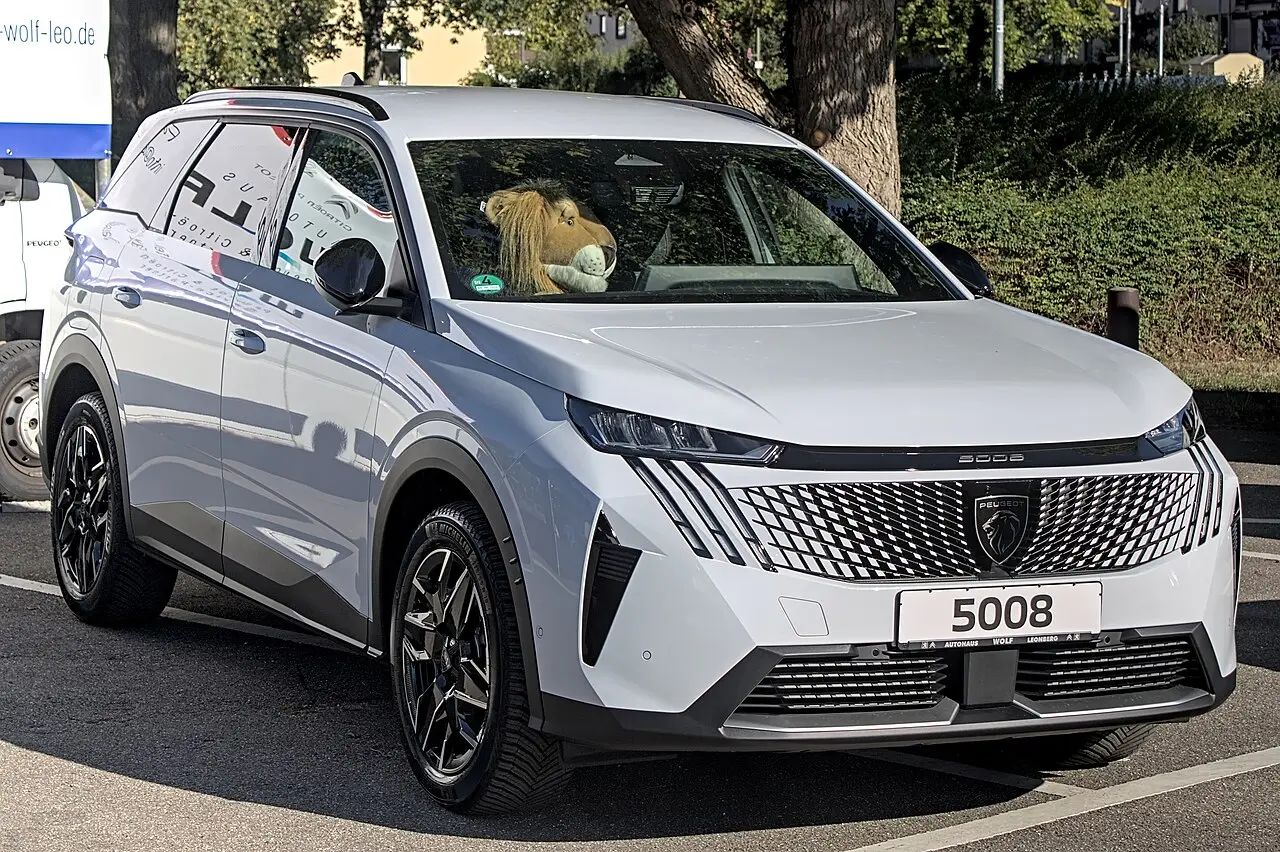
The Peugeot 5008 III (since 2024): dimensions, weights, reliability and the official figures of its 37 versions in the European Union and the United Kingdom.
Model codes: P67 · Sold in: European Union and United Kingdom
Dimensions, weights and capacity
| Specification | Europe | Wikipedia |
|---|---|---|
| Dimensions | ||
| Length | 4,790 mm RDW | 4,791 mm |
| Width | 1,900 mm RDW | 1,895 mm |
| Height | 1,740 mm RDW | 1,694 mm |
| Wheelbase | 2,900–2,910 mm RDW | 2,901 mm |
| Front track | 1,615–1,630 mm ASTRA | – |
| Rear track | 1,620–1,635 mm ASTRA | – |
| Weights and towing | ||
| Kerb weight | 1,600–2,216 kg RDW | 1,440–1,627 kg |
| Mass in running order | 1,700–2,316 kg RDW | – |
| Gross vehicle weight | 2,330–2,940 kg RDW | – |
| Towing, braked trailer | 750–1,300 kg RDW | – |
| Towing, unbraked trailer | 750 kg RDW | – |
| Seats and space | ||
| Seats | 7 RDW | – |
| Doors | 4 RDW | – |
| Boot space | 348 L EV DB | – |
| Performance | ||
| Top speed | 170–220 km/h RDW | 188–207 km/h |
| 0–100 km/h | 6.5–9.8 s EV DB | – |
| Torque | 230–343 Nm ASTRA | – |
| Electric | ||
| Battery capacity (usable) | 70.0–96.9 kWh EV DB | – |
| Battery capacity (gross) | 73.0–101.0 kWh EV DB | – |
| Range (WLTP) | 467–668 km EV DB | – |
| Energy use | 145–149 Wh/km EV DB | – |
| AC charging power | 11 kW EV DB | – |
| DC fast charging power | 160 kW EV DB | – |
Tyre sizes (most common first): 235/50R20, 235/55R19, 225/55R19, 225/60R18
Ranges cover the generation’s versions and body styles; European and North American versions can differ. Sources: RDW type approvals (Netherlands), Wikipedia (en, de), ASTRA type approvals (Switzerland), open EV databases (EV Compare, Open EV Data, Gaia EVDB), Traficom type approvals (Finland). Wikipedia figures are used under CC BY-SA 4.0.
All 37 versions of the Peugeot 5008 III
Show all 37 versions
European Union 15 versions
New cars registered in the EU (plus Norway and Iceland), from the European Environment Agency. Figures on the NEDC procedure until 2020 and on WLTP from 2021; versions are grouped by engine and power, with their number of registrations.
| Years and version | Engine | Power | Fuel | Consumption (combined) | CO₂ | Electric range | EU registrations |
|---|---|---|---|---|---|---|---|
| 2024–2025 | 1.2 L | 100 kW (136 PS) | Hybrid | 5.7–5.8 L/100 km WLTP | 130–131 g/km | – | 38,821 |
| 2024–2025 | Electric motor | 157 kW (213 PS) | Electric | 18.1–21.9 kWh/100 km WLTP | 0 g/km | 455–494 km | 9,445 |
| 2025 | 1.6 L | 110 kW (150 PS) | Plug-in hybrid | 1.2 L/100 km WLTP20.8 kWh/100 km WLTP | 29 g/km | 77 km | 2,539 |
| 2025 | Electric motor | 240 kW (326 PS) | Electric | 18.8 kWh/100 km WLTP | 0 g/km | 465 km | 662 |
| 2024–2025 | Electric motor | 104 kW (141 PS) | Electric | 18.1 kWh/100 km WLTP | 0 g/km | 492–494 km | 636 |
| 2024–2025 | 1.5 L | 96 kW (131 PS) | Diesel | 5.6 L/100 km WLTP | 146–147 g/km | – | 11,839 |
| 2024–2025 | 1.2 L | 100 kW (136 PS) | Petrol | 5.7 L/100 km WLTP | 129 g/km | – | 11,944 |
| 2024–2025 | Electric motor | 170 kW (231 PS) | Electric | 18.9–19.0 kWh/100 km WLTP | 0 g/km | 642–644 km | 287 |
| 2024–2025 | 1.2 L | 96 kW (131 PS) | Petrol | 6.5 L/100 km WLTP | 146–147 g/km | – | 7,298 |
| 2025 | 1.2 L | 100 kW (136 PS) | Plug-in hybrid | 5.8 L/100 km WLTP | 131 g/km | – | 63 |
| 2025 | Electric motor | 105 kW (143 PS) | Electric | 19.0 kWh/100 km WLTP | 0 g/km | 640 km | 62 |
| 2025 | 1.6 L | – | Hybrid | 5.8 L/100 km WLTP | 123 g/km | – | 30 |
| 2025 | 1.6 L | – | Petrol | 5.8 L/100 km WLTP | 64 g/km | – | 17 |
| 2025 | Electric motor | 137 kW (186 PS) | Electric | 18.8 kWh/100 km WLTP | 0 g/km | 466 km | 15 |
| 2024 | Electric motor | 100 kW (136 PS) | Electric | 18.1 kWh/100 km WLTP | 0 g/km | 493 km | 12 |
United Kingdom 22 versions
New cars on sale in the UK, from the Vehicle Certification Agency. NEDC figures until 2018 and WLTP figures after; years are the editions a version appeared in.
| Years and version | Engine | Power | Fuel | Gearbox | Consumption (combined) | CO₂ | Electric range |
|---|---|---|---|---|---|---|---|
| 2025–2026Electric 73 kWh KCZKZX-H0E040 · Electric 73 kWh KCZKZX-H0E000 | Electric motor | 157 kW (213 PS) | Electric | Automatic | 16.0–21.3 kWh/100 km WLTP | 0 g/km | 415–545 km |
| 2026Electric 73 kWh 210 (VH) | Electric motor | 157 kW (213 PS) | Electric | Automatic | 19.6 kWh/100 km WLTP | 0 g/km | 451 km |
| 2026Electric 73 kWh 210 (VL) | Electric motor | 157 kW (213 PS) | Electric | Automatic | 16.2 kWh/100 km WLTP | 0 g/km | 548 km |
| 2026Electric 97 kWh 230 (VH) | Electric motor | 170 kW (231 PS) | Electric | Automatic | 22.1 kWh/100 km WLTP | 0 g/km | 538 km |
| 2026Electric 97 kWh 230 (VL) | Electric motor | 170 kW (231 PS) | Electric | Automatic | 16.9 kWh/100 km WLTP | 0 g/km | 708 km |
| 2026Electric 73 kWh 325 Dual Motor (VH) | Electric motor | 240 kW (326 PS) | Electric | Automatic | 21.5 kWh/100 km WLTP | 0 g/km | 399 km |
| 2026Electric 73 kWh 325 Dual Motor (VL) | Electric motor | 240 kW (326 PS) | Electric | Automatic | 16.8 kWh/100 km WLTP | 0 g/km | 513 km |
| 2025–2026HYBRID 136 KAHPY1-H1AN40 · HYBRID 136 KAHPY1-H1AM00 · HYBRID 136 KAHPY1-H1AN00 and 2 more trims | 1.2 L | 100 kW (136 PS) | Hybrid | 6-speed automatic | 5.4 L/100 km WLTP | 122 g/km | – |
| 2025–2026HYBRID 136 KAHPY1-H1AN40 · HYBRID 136 KAHPY1-H1AM00 · HYBRID 136 KAHPY1-H1AN00 and 2 more trims | 1.2 L | 100 kW (136 PS) | Hybrid | 6-speed automatic | 6.3 L/100 km WLTP | 143 g/km | – |
| 2026HYBRID 145 (VH) | 1.2 L | 107 kW (145 PS) | Hybrid | 6-speed automatic | 6.2 L/100 km WLTP | 141 g/km | – |
| 2026HYBRID 145 (VL) | 1.2 L | 107 kW (145 PS) | Hybrid | 6-speed automatic | 5.3 L/100 km WLTP | 120 g/km | – |
| 2025–2026PLUG-IN HYBRID 195 KBDGK4-H1B000 · PLUG-IN HYBRID 195 KBDGK4-H1B040 | 1.6 L | 100 kW (136 PS) | Plug-in hybrid | 7-speed automatic | 4.6 L/100 km WLTP24.0 kWh/100 km WLTP | 173 g/km | 63 km |
| 2025–2026PLUG-IN HYBRID 195 KBDGK4-H1B000 · PLUG-IN HYBRID 195 KBDGK4-H1B040 | 1.6 L | 110 kW (150 PS) | Plug-in hybrid | 7-speed automatic | 6.8 L/100 km WLTP20.1 kWh/100 km WLTP | 153 g/km | 89 km |
| 2025–2026PLUG-IN HYBRID 195 | 1.6 L | 110 kW (150 PS) | Plug-in hybrid | 7-speed automatic | 5.9–7.2 L/100 km WLTP14.1–15.6 kWh/100 km WLTP | 134–164 g/km | 70–83 km |
| 2026PLUG-IN HYBRID 225 (VH) | 1.6 L | 166 kW (226 PS) | Plug-in hybrid | 7-speed automatic | 7.2 L/100 km WLTP15.6 kWh/100 km WLTP | 164 g/km | 70 km |
| 2026PLUG-IN HYBRID 225 (VL) | 1.6 L | 166 kW (226 PS) | Plug-in hybrid | 7-speed automatic | 5.9 L/100 km WLTP14.1 kWh/100 km WLTP | 134 g/km | 83 km |
| 2024Electric 73 kWh (VH) KCZKZX-H0E040 · Electric 73 kWh (VH) KCZKZX-H0E000 | Electric motor | 210 kW (286 PS) | Electric | Automatic | 21.3 kWh/100 km WLTP | 0 g/km | 415 km |
| 2024Electric 73 kWh (VL) KCZKZX-H0E040 · Electric 73 kWh (VL) KCZKZX-H0E000 | Electric motor | 210 kW (286 PS) | Electric | Automatic | 16.0 kWh/100 km WLTP | 0 g/km | 545 km |
| 2024HYBRID 136 (VL) KAHPY1-H1AN40 · HYBRID 136 (VL) KAHPY1-H1AM00 · HYBRID 136 (VL) KAHPY1-H1AN00 and 1 more trim | 1.2 L | 136 kW (185 PS) | Hybrid | 6-speed automatic | 5.4 L/100 km WLTP | 122 g/km | – |
| 2024HYBRID 136 (VH) KAHPY1-H1AN40 · HYBRID 136 (VH) KAHPY1-H1AM00 · HYBRID 136 (VH) KAHPY1-H1AN00 and 1 more trim | 1.2 L | 136 kW (185 PS) | Hybrid | 6-speed automatic | 6.3 L/100 km WLTP | 143 g/km | – |
| 2024PLUG-IN HYBRID 195 (VH) KBDGK4-H1B000 · PLUG-IN HYBRID 195 (VH) KBDGK4-H1B040 | 1.6 L | 150 kW (204 PS) | Plug-in hybrid | 7-speed automatic | 4.6 L/100 km WLTP24.0 kWh/100 km WLTP | 173 g/km | 63 km |
| 2024PLUG-IN HYBRID 195 (VL) KBDGK4-H1B000 · PLUG-IN HYBRID 195 (VL) KBDGK4-H1B040 | 1.6 L | 150 kW (204 PS) | Plug-in hybrid | 7-speed automatic | 6.8 L/100 km WLTP20.1 kWh/100 km WLTP | 153 g/km | 89 km |
Similar models from other brands



Official figures are measured on standard test procedures and differ between markets. Your consumption depends on how, where and in what conditions you drive.